Mandir Tiles Design: Traditional to Modern Inspirations
May 20, 2026 47
Explore pooja room tiles design ideas from traditional marble looks to modern 3D styles. Compare ceramic, GVT, and PGVT tiles with Vastu colours and practical tips.

In most Indian homes, the mandir gets the most emotional attention of any room and the least planning time. Families spend months choosing kitchen cabinets and bathroom fittings, then decide the pooja room tiles design in a single afternoon visit to a showroom.
That mismatch shows up quickly. A tile that looks striking under showroom LEDs can feel cold and clinical in the morning light of an actual prayer space. A deeply textured surface that photographs beautifully becomes difficult to clean after daily agarbatti ash and diya oil accumulate in its grooves.
This guide covers mandir tile design from the traditional roots of Indian prayer spaces to the modern interpretations now appearing in 2BHK flats and dedicated pooja rooms in larger homes, with practical guidance on materials, finishes, colours, and what to check before buying. If you also want detailed help with Vastu directions, tile selection, maintenance, and pooja room planning, read our complete pooja room tiles design and Vastu guide.
What Separates Mandir Tile Choices from Every Other Room
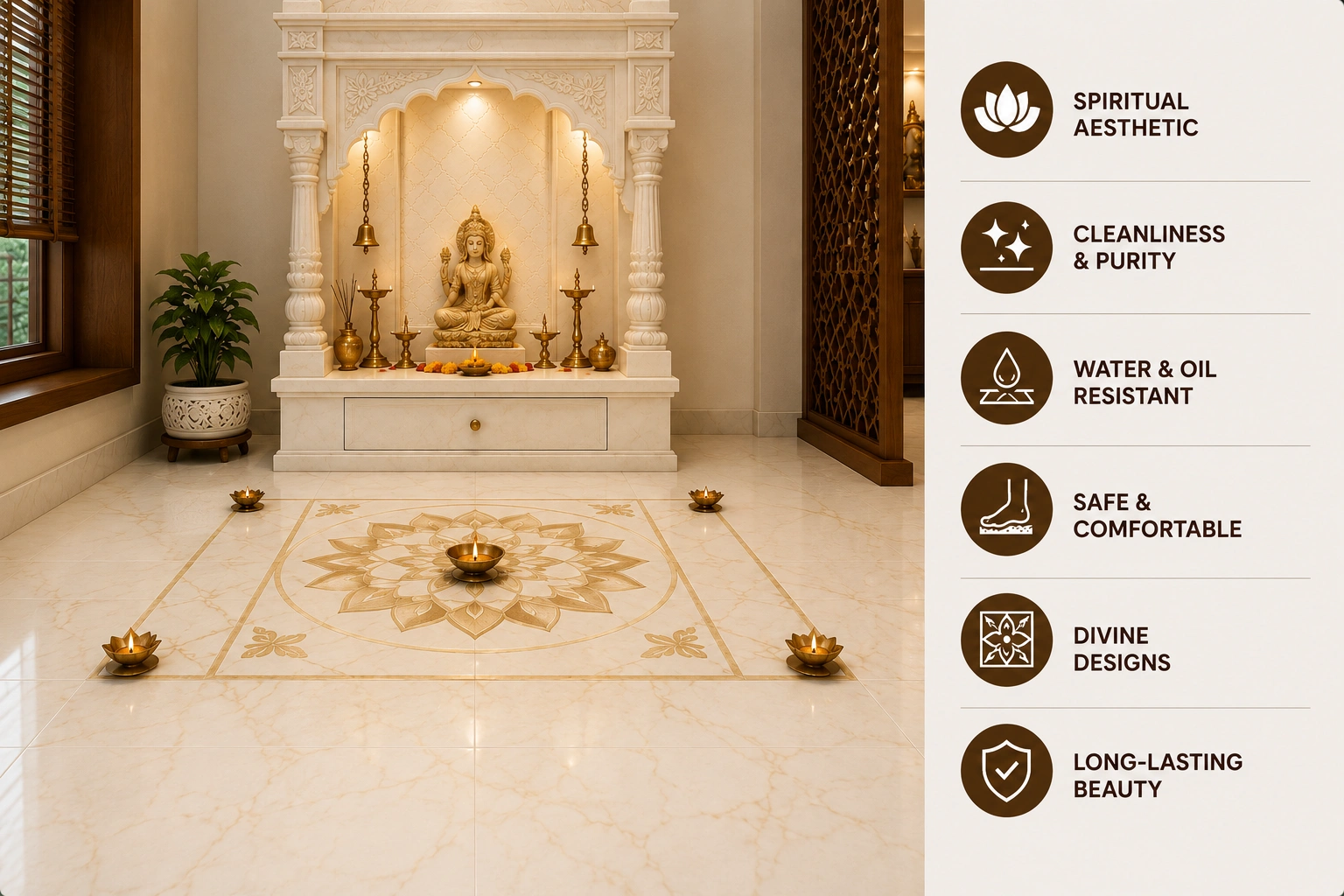
Most rooms in an Indian home have clear functional requirements that drive tile decisions. Kitchen tiles need to resist oil and handle mopping. Bathroom tiles need moisture resistance and anti-skid surfaces. The requirements for god room tiles are different in character. The space is not high-traffic in the physical sense, but it is high-frequency in the emotional sense.
Daily rituals in a pooja room involve agarbatti smoke that coats walls over time, diya oil that drips and stains, kumkum and haldi powder that settles on floors and wall ledges, and water from abhishek or flower offerings that splashes the immediate floor area. None of these stresses is extreme in isolation. Together, they create a surface condition that no other room in the house replicates.
The tiles also carry a visual weight beyond their practical function. The material, texture, and colour of the mandir wall set the tone for prayer. A well-chosen surface feels calm and intentional. A poorly chosen one, however technically sound, can feel generic in a space that is meant to feel sacred.
Vastu Colours for Pooja Room Tiles
Vastu guidance for pooja rooms centres on colours that promote calm, clarity, and positive energy. These are not rules that require strict compliance in every home, but they offer a useful framework when choosing tile colours for a space where atmosphere matters.
| Tile Colour | Vastu Significance | Works Best In | What to Pair With |
| White | Purity, clarity, peace. Reflects morning light well. | Small pooja niches, apartment mandirs, north-facing rooms | Gold or brass fixtures, cream or beige accents |
| Cream or off-white | Warmth, groundedness. Softer than white, less harsh under artificial light. | Traditional homes, wooden mandir surrounds, compact spaces | Light wood tones, ivory, warm yellow accent tiles |
| Beige or sandstone | Stability, calm. Reads as warm and earthy without being heavy. | Contemporary flats, open pooja alcoves, modern mandirs | White or off-white walls, minimal decor |
| Light yellow | Joy, optimism, spiritual brightness. Connects to solar energy in Vastu. | North-facing rooms with limited natural light | White or cream tiles, brass diya stands |
| Marble tones (white-grey) | Sacred, timeless. Associated with temple aesthetics across Indian traditions. | Dedicated pooja rooms feature walls behind the deity platform | Gold border tiles, plain white field tiles |
| Avoid: dark grey, black, deep red | Heavy, absorbs light, creates a closed feeling. Not aligned with Vastu for prayer spaces. | Not recommended for primary mandir surfaces | Can be used sparingly as grout or a thin border only |
If the pooja room faces northeast or east and receives natural morning light, almost any light-toned tile works well. Rooms that face north or west with limited daylight benefit most from white or cream tiles that reflect whatever light the room receives.
From Traditional to Modern: How Mandir Tiles Design Has Changed
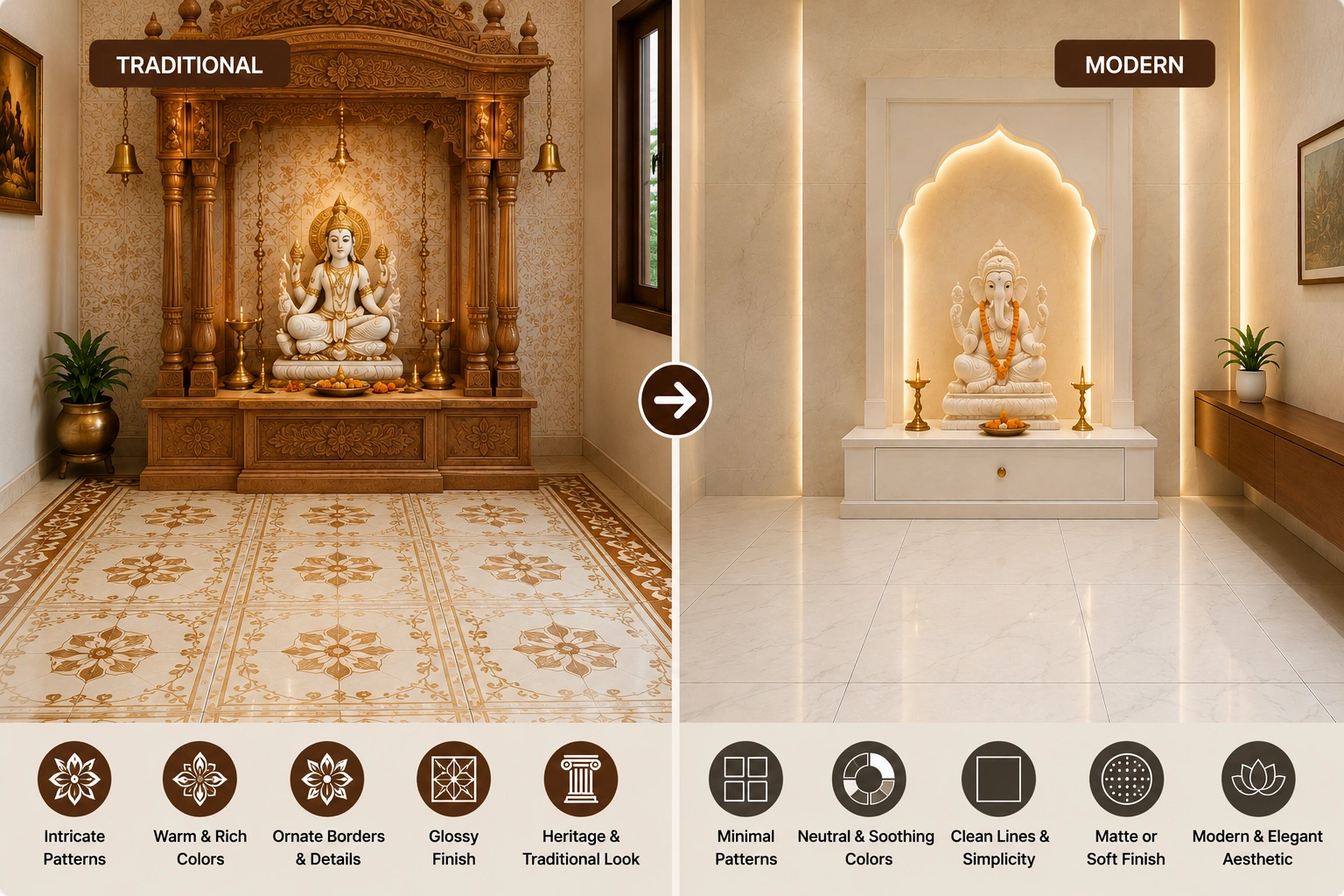
The mandir tiles design choices available in 2026 span a wider range than at any earlier point. Understanding how this design vocabulary has evolved helps in choosing what fits the home and the family's sensibility.
Traditional Mandir Tile Design
Traditional Indian mandir design drew from temple architecture: white marble slabs, stone-carved lattice panels, raised deity platforms in carved stone or teak, and painted walls with religious motifs. Tiles as a category barely featured in these spaces. The material was stone, and the craftsmanship was in the carving.
When tiles did appear, they were usually small-format white or ivory ceramic squares (1x1 or 12x18) on the walls, or simple Shahabad stone on the floor. The tile was a practical background, not a design statement. All the visual interest came from the wooden mandir structure, the idols, and the decorative elements placed on and around it.
Transitional Mandir Style (2010 to 2020)
As modular homes and apartment living expanded across Indian cities through the 2010s, the dedicated pooja room began to shrink or disappear in favour of a pooja corner or an alcove within the living room. This shift changed the tile design approach significantly. The mandir could no longer rely on a full room of carved stone and wood to create atmosphere. The tile itself had to carry more of the visual work.
Marble-look vitrified tiles entered this space as a practical substitute for real marble slabs. They delivered the same white-grey veined look without the weight, cost, or maintenance of natural stone. Ceramic tiles with Om motifs, lotus prints, and temple arch patterns became popular for the back wall of the deity niche. The transition era was characterised by tiles doing more decorative work while the overall space got physically smaller.
Modern Mandir Tile Design (2020 to 2026)
The current design direction for mandirs in Indian homes covers two distinct aesthetics running in parallel. One direction moves toward the minimal: a clean white or cream GVT or PGVT feature wall, a simple wooden shelf for the idols, and no decorative tile pattern at all. The tile is calm and neutral. The deity and the diya carry the visual weight.
The other direction goes the opposite way: large-format marble-look GVT slabs in 2x4 or 32x96 formats covering the full mandir back wall with continuous bold veining, gold border tiles as accents, and 3D textured ceramic panels as a frame around the deity shelf. Both directions are coherent and widely implemented in 2026. The choice depends on whether the family wants the tile to recede or to contribute to the visual statement.
Tile Materials Worth Considering for a Pooja Room
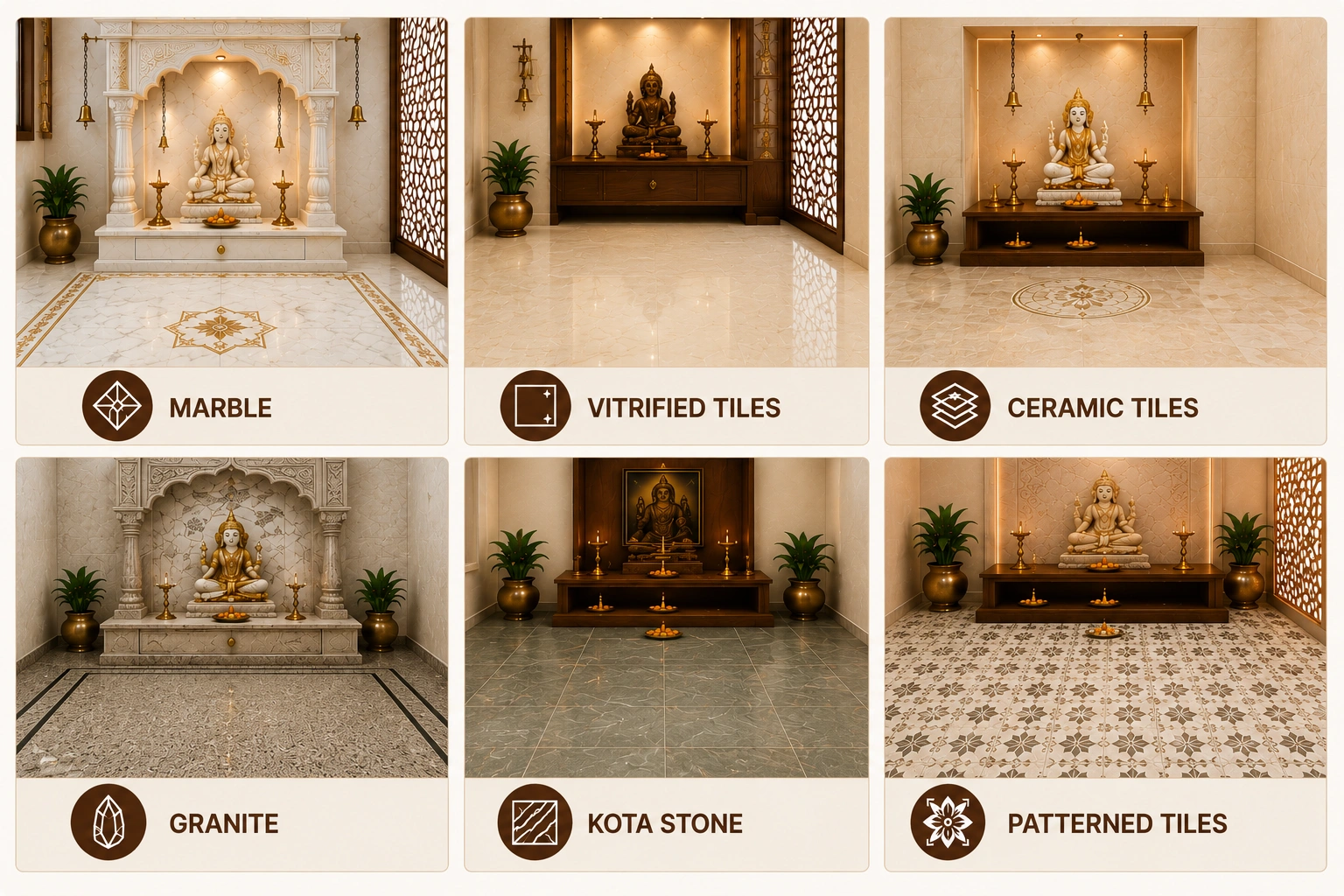
The material determines how the tile is manufactured, how it performs over time, and where it can be used. In a pooja room, three tile materials cover most residential needs.
Ceramic
Ceramic is the most widely used material for mandir walls in Indian homes. It has 12 to 16% water absorption, which makes it wall-only. On mandir floors where water splashes during abhishek and daily cleaning, ceramic tiles absorb moisture over time and eventually de-bond. On walls, though, ceramic is a practical choice with the widest design variety and the most accessible price range, from approximately ₹30 to ₹80 per sq. ft.
Ceramic is the only material that comes in 12x18 and 12x24 sizes, both wall-only formats that fit standard mandir niches without heavy cutting. The design range includes plain whites and creams, Om and lotus motifs, temple arch prints, and decorative relief patterns through Third Fired finishes.
GVT (Glazed Vitrified)
GVT absorbs less than 0.05% water and works on both walls and floors, which makes it the most versatile material for a dedicated pooja room. On the wall in 2x2 or 2x4 sizes, it gives a large-format seamless surface. On the floor in a matte or GHR finish, the same material handles water and diya oil without staining.
GVT carries a wide range of surface designs, from plain solid colours to stone-look, marble-look, wood-look, and textured finishes. The material itself stays the same; the surface print and finish change. Price range: approximately ₹60 to ₹130 per sq. ft.
PGVT (Polished Glazed Vitrified)
PGVT has the same vitrified body as GVT but with a polished, high-shine surface applied during manufacturing. This finish reflects diya and lamp light in a way that matte or satin tiles cannot, which makes it the most visually suitable material for a mandir feature wall in a dedicated pooja room.
PGVT is wall-only in a pooja room context. Its polished surface becomes slippery when wet, making it unsafe on floors where Abhishek water and flower offerings are regular. Use it on the deity back wall and keep a matte GVT on the floor. Price range: approximately ₹70 to ₹160 per sq. ft.
Tile Looks and Surfaces That Work in a Pooja Room
A tile look is the surface design printed or applied onto the tile body. The same marble look can come on a ceramic, a GVT, or a PGVT material. The look is a design choice; the material is a performance choice. They are selected together but for different reasons.
Marble-Look
Marble pooja room tiles texture is the most searched look in mandir design in India. The white-grey veined marble pattern connects to the visual language of traditional Indian temples and classical home mandirs. On a PGVT or GVT material body, this look handles kumkum, haldi, and diya oil stains far better than real marble, needs no sealing, and costs a fraction of natural stone.
Marble-look tiles are available in cream-ivory veining (Botticino style), white with bold grey veining (Statuario style), and white with gold veining (Calacatta Gold style). The bold vein patterns read well on the deity feature wall. Softer veining works better on side walls or floors where a continuous strong pattern can become visually tiring.
Plain and Solid Colour
Plain white, cream, beige, or light grey tiles are the foundation of both traditional and modern mandir design. In a compact pooja alcove, a plain surface on the walls keeps the focus on the deity and the offerings rather than on the tile. In a larger dedicated room, plain tiles on the surrounding walls frame the feature wall without competing with it.
Solid colour tiles on GVT or ceramic material in a glossy finish reflect lamp light cleanly. The same colour in a matte finish absorbs light and creates a calmer, more meditative atmosphere. Both are valid choices depending on whether the mandir is meant to feel luminous or serene.
Textured and 3D Surfaces
Pooja room tiles texture, and 3D look tiles for pooja room applications have expanded significantly. Third Fired decorative tiles with raised geometric or floral motifs, temple arch relief panels, and carved-look 3D surfaces bring a hand-crafted quality to a mandir wall that flat printed tiles cannot replicate.
These look best as a single feature panel directly behind the deity shelf or as narrow column tiles framing the mandir opening. Using textured surfaces across the full wall in a small space creates visual weight that competes with the deity rather than supporting it. One textured panel against plain surrounding tiles is almost always the better arrangement.
The practical note: shallow-relief textured tiles (Texture punch, 0.3 to 1mm depth) are manageable to clean with a damp cloth. Very deep grooves, such as high-depth punch tiles, collect agarbatti ash and diya soot in their grooves and are difficult to clean in daily use. Keep the depth shallow for a mandir wall.
Pooja Room Wall Tiles: Design Ideas That Work
Pooja room wall tiles design decisions come down to two choices made in sequence: what goes on the feature wall directly behind the deity, and what goes on the surrounding walls.
The feature wall should carry the most visual intention. A large-format marble-look GVT in 2x4 with bold grey veining, a PGVT panel in soft cream with a gold border strip, or a Third Fired decorative tile with a temple arch motif all work as feature wall treatments. The surrounding walls should recede: plain white or cream ceramic in 12x24, a matte GVT in the same tone as the feature wall, or simply painted plaster if the room has dedicated plaster walls.
Pooja Room Floor Tiles: What to Use and What to Skip
Pooja room floor tiles design must account for two conditions that do not apply to most living room floors: regular water contact from abhishek and flower offerings, and barefoot use by all family members, including elderly residents.
GVT in a matte or GHR finish in a 2x2 or 1x1 size handles both requirements. The low water absorption manages the splashing from daily rituals. The matte surface prevents slipping on wet stone, which matters when bare feet are stepping in water. White, cream, or light grey in this format also coordinates naturally with the wall tiles.
What to skip on the pooja room floor: glossy tiles or polished vitrified tiles, including PGVT and polished GVT finishes. These become slippery when wet. A diya knocked over, or water from abhishek on a glossy floor, creates a slip hazard, particularly for older family members. The visual gain of a polished floor finish is not worth the safety trade-off in this space.
Marble-look GVT in a matte or posh finish is the best-of-both option: the visual of marble on the floor without the polished surface that creates a slip risk. Pair it with the marble-look wall tile in the same design family for a coordinated floor-to-wall look.
| Floor Tile Choice | Suitable for Pooja Room? | Reason |
| GVT matte or GHR finish (2x2, 1x1) | Yes. Best choice. | Low water absorption, anti-skid surface, handles diya oil and water splash well. |
| Marble-look GVT in matte or posh finish | Yes. | Looks like marble without the maintenance. Matte finish keeps grip when wet. |
| Ceramic 1x1 (300x300 mm) | Yes, acceptable. | Wall tile is used on the floor as an exception to this small size. Works in compact niches. |
| PGVT Polished or Polished GVT | No. | Slippery when wet. Pooja floors regularly have water from rituals. Safety risk. |
| Glossy or High Glossy GVT | No. | Same slip issue as PGVT when wet. Avoid any wet-adjacent floor. |
| Real marble slab | Use with caution. | Stains from kumkum and haldi, unless sealed. Slippery when wet unless honed finish. |
Practical Tips Before Buying Mandir Tiles
Test the tile under the room's actual lighting before buying. Pooja room lighting in Indian homes tends to be warm: LED diyas, warm-white recessed lights, or a single yellow lamp. A tile that looks fresh white under cool showroom LEDs can appear yellowish or beige under warm interior lighting. Bring a sample home and check it under the actual light source.
Choose grout that will not show agarbatti ash. White grout in a pooja room collects incense ash and diya soot in the grout lines over time. A cream or light grey grout closely matched to the tile colour hides this accumulation and reduces the visual maintenance burden without affecting the overall look.
In a small mandir niche or alcove, use one feature tile and one plain tile, not two different decorative tiles. Mixing two patterned or textured tiles in a compact space creates visual noise that competes with the deity rather than framing it. One decision tile on the feature wall, one calm background tile everywhere else.
Buy 10 to 15% more tiles than the measured area. Mandir walls often have niches, arches, and angled cuts around the deity shelf that generate more cutting wastage than a plain flat wall. Keep the extra tiles stored in case of future repairs. Production lot colour variations mean a reordered tile may not match exactly.
Check the tile's heat resistance if the mandir uses an enclosed diya or havan area. Standard vitrified and ceramic tiles handle the indirect heat from diyas placed a short distance from the wall without any issue. If the design includes an enclosed fire pit or a havan kund close to the tile surface, confirm heat resistance ratings with the tile supplier before ordering.
Mistakes That Are Easy to Avoid
Choosing dark tiles because they look rich in the showroom. A deep charcoal or dark brown tile looks impressive as a sample piece. In a compact pooja alcove or small dedicated room, dark tiles absorb the lamp light that the space depends on for atmosphere. The room feels heavier and smaller than it should. Keep dark tones to thin border accents at most.
Use a polished finish on the floor. This comes up in every pooja room renovation where the homeowner sees a PGVT marble-look tile and wants it on both the wall and the floor for a coordinated look. On the wall, it works perfectly. On the floor of a space with regular water contact, it becomes slippery. Use the matte or posh finish version of the same tile design for the floor.
Tiling the mandir before the deity shelf or mandir structure is installed. The shelf mounting, mandir frame, and niche dimensions need to be finalised before tiling begins. Tiles installed before the structure is confirmed often need to be cut or partially broken when the mandir frame is mounted, leaving uneven edges visible around the deity area.
Overloading the space with decorative tiles. Textured panels, gold border strips, Om motif tiles, and 3D relief tiles each make an individual contribution. Using all of them in the same small mandir space creates a surface so busy that it competes with everything placed on the deity shelf. One feature tile and clean surroundings work better than four different decorative elements fighting for attention.
Not testing the grout colour before laying. Grout colour significantly changes the appearance of a tiled wall. White tiles with charcoal grout have a graphic, patterned look. White tiles with cream grout read as one continuous surface. In a mandir, the seamless version is usually better. But this is easy to test with a small sample application before the full wall is laid.
Create a Mandir Space That Feels Peaceful Every Day
The best mandir tiles are not always the most decorative. They are the ones that hold their appearance through years of daily prayer rituals, reflect light in a way that feels right at different times of day, and create a background that lets the deity, the diya, and the family's devotion take the foreground.
Before finalising, write down the room dimensions, the direction it faces, the lighting type you plan to install, and whether you want the tile to carry the visual statement or recede behind the mandir structure. Take samples home and see them at the time of day when morning puja happens.
You can browse pooja room tile options across ceramic, vitrified, marble-look, and 3D decorative categories on TilesFinders to compare designs from Indian manufacturers before visiting a showroom.
FAQs
For most Indian homes, a marble-look GVT or PGVT tile in white or cream with soft grey veining on the deity feature wall, paired with plain white or cream ceramic tiles on the surrounding walls, gives the most balanced result. This combination looks like a temple material, handles agarbatti ash and diya oil well, and does not compete with the idols and offerings placed on the mandir shelf. Third-fired decorative tiles with relief motifs work well as a feature panel or border in homes that prefer a more ornamental traditional look.
In a small pooja alcove or a niche within a living room, keep the tile design simple. One feature tile on the back wall of the deity area, and a plain or very subtly textured tile on the sides and floor. Light colours (white, cream, light grey) are important in compact spaces because they reflect whatever light is present rather than absorbing it. A 12x18 or 12x24 ceramic in a marble or plain finish for the walls, and a 2x2 or 1x1 matte GVT for the floor, is a proportionate choice that does not overwhelm a small area.
Marble-look vitrified tiles are an excellent choice for a pooja room. They deliver the traditional temple visual, handle kumkum, haldi, and diya oil stains far better than natural marble, and need no sealing or special maintenance. Natural marble in a working pooja room stains from turmeric within weeks and requires periodic acid polishing. Marble-look GVT or PGVT in a cream or white-grey veined pattern looks almost identical to real marble and stays clean with a standard damp wipe.
The most widely used and Vastu-aligned colour combination is white or cream tiles on the walls paired with the same tone or a slightly warmer beige on the floor. For a more layered look, white or cream field tiles with a single row of gold or brass-toned accent tiles as a border around the deity area add richness without heaviness. Avoid combining two strong colours in a small mandir space. The general principle is one warm neutral across most surfaces, with one accent colour used sparingly.
Glossy or polished finishes work well on mandir walls because they reflect diya and lamp light, which adds warmth and depth to the space. On mandir floors, matte or GHR finish is the safer choice because mandir floors are regularly wet from abhishek water and flower offerings, and a polished or glossy floor becomes slippery in those conditions. A practical approach: polished or high-gloss vitrified on the feature wall, matte GVT in the same design family on the floor.
Agarbatti smoke deposits a fine layer of carbon residue on nearby tiles over time. A weekly wipe with a damp cloth and a mild neutral cleaner keeps glossy and matte vitrified tiles clean without damaging the surface. For grout lines that have darkened from smoke deposits, a paste of baking soda and water applied and left for ten minutes before scrubbing removes most of the staining. Avoid abrasive scrubbers on glossy tiles. For diya oil drips on the floor, clean while still fresh; dried oil bonds to grout faster than it does to the tile surface itself.
For small dedicated pooja rooms (below 40 sq. ft.), a 600x600 mm (2x2) tile on the floor and 300x450 mm (12x18) or 300x600 mm (12x24) on the walls gives proportionate coverage without making the space feel cut-up by too many grout lines. For very compact niches or alcoves, a 1x1 (300x300 mm) GVT on the floor and 12x18 ceramic on the walls keeps the tile scale appropriate to the space. Avoid large-format 2x4 tiles in very small mandirs, as they may need heavy cutting and can overpower the proportions of a compact prayer area.
