

Dining Room Tiles in India: Complete Buyer's Guide for 2026
Explore the best dining room tiles in India for 2026. Compare GVT, vitrified, wall and floor tile...


Loading designs...






Dining room tiles take more punishment than most people expect. Chairs scrape across the floor daily. Food and liquid spills happen regularly. Guests walk in wearing outdoor footwear. The right dining area tiles handle this without showing damage or becoming slippery when wet. This page covers which tile types, finishes, and sizes work best for dining spaces in Indian homes, with price ranges in Rs./sq.ft and guidance on what to avoid.
Dining room tile design choices in India range from large-format GVT planks in wood looks to full-body vitrified in stone textures. For walls, ceramic and GVT both work well. For floors, GVT and Double Charge in matte or GHR finishes give the best mix of looks and low-maintenance cleaning. Dining tiles priced between Rs. 55 and Rs. 180 per sq. ft. cover most home budgets. Above Rs. 180, large-format GVT slabs and full-body vitrified tiles give a high-end result that lasts for decades.
Many buyers pick glossy or polished finishes for dining floors because they look impressive in the showroom. In actual use, these finishes show every scratch from chair legs and every footprint smudge. A glossy floor in a dining space needs cleaning two to three times more often to look presentable.
Matte, GHR (Glaze High Resistance), and sugar finish tiles are the three practical choices for dining floor tiles. Matte GVT in sizes like 600x1200 mm (2x4) or 800x1600 mm (32x64) gives a clean look without the maintenance overhead of polished surfaces. GHR finish adds a stone-like texture that hides minor scuff marks well. The sugar finish sits between the two: slightly textured, easy to clean, and better at hiding daily marks.
Chair abrasion is the main reason dining room floor tiles design should prioritise scratch resistance over shine. GVT in matte finish, rated under IS 15622:2006, has a water absorption of 0.05% and holds up well against repeated scraping.
Note: Glossy, High Glossy, Semi High Glossy, Super High Glossy, Satin Matte, and Semi Polished finishes are NOT recommended for dining floors. They scratch easily and show marks quickly.
| Tile Type | Water Absorption | Best Finish for Dining | Sizes Available (mm) | Price Range (Rs./sq.ft) |
| GVT (Glazed Vitrified) | 0.05% | Matte, Sugar, GHR | 600x600, 600x1200, 800x1600, 800x1200 | Rs. 55 to Rs. 180 |
| Double Charge | 0.05% | Polished (dry areas only) | 600x600, 800x800, 600x1200 | Rs. 70 to Rs. 140 |
| Full Body Vitrified | 0.05% | Matte, GHR | 600x600, 600x1200, 800x1600 | Rs. 90 to Rs. 200 |
| Porcelain | 2% to 5% | Matte | 600x600, 600x1200 | Rs. 45 to Rs. 110 |
| Ceramic (floor use) | 12% to 16% | N/A (wall-only) | 300x300 on bathroom floors only | Not for dining floors |
GVT is the most used tile type for dining floors in India. It absorbs 0.05% water, resists chair scratches in matte finish, and comes in sizes from 600x600 mm (2x2) to 800x1600 mm (32x64). Large-format GVT tiles in wood-look or stone-look designs give dining spaces a spacious feel with fewer visible grout lines.
Full-body vitrified tiles work well in homes where the dining and living areas share one continuous floor. Because the colour runs through the full body, any edge chip is invisible. People mostly use these in high-traffic common areas of villas and bungalows at Rs. 90 to Rs. 200 per sq.ft.
Dining room wall tiles serve two functions. The first is practical: a washable, stain-resistant surface behind a dining table is easier to clean than painted walls. The second is visual: a feature wall in the dining space, covered in textured or pattern tiles, gives the room a focal point.
Dining wall tiles in India are mostly ceramic or GVT. Ceramic tiles (300x300, 300x450, 300x600 mm) in matte or glossy finish cover the wall behind a dining table at Rs. 30 to Rs. 70 per sq.ft. GVT in larger formats like 600x1200 mm (2x4) gives a cleaner, grout-line-free result at a higher price point.
Wall tiles for the dining area feature walls that benefit from texture. Glossy carving tiles, stucco tiles, and rain-drop finish GVT add a three-dimensional quality that flat paint cannot match. These are fixed only on one accent wall, not all four walls, to keep the room from feeling heavy.
PGVT in polished finish is widely used on dining walls, particularly in spaces where a marble-like shine is desired on the wall behind the buffet or sideboard. At 0.05% water absorption, PGVT holds up well even in spaces where food smells and humidity are present. Sizes like 800x1600 mm (32x64) reduce the number of joints visible on the wall surface.
Note: PGVT tiles must not be used on floors, including dining floors. PGVT is a wall category only.
| Tile Type | Finish Options | Best Use on Dining Walls | Size Range | Price (Rs./sq.ft) |
| Ceramic | Glossy, Matte | Full wall cover, budget projects | 300x300, 300x450, 300x600 | Rs. 30 to Rs. 70 |
| GVT | Matte, Sugar, Glossy Carving, Stucco | Feature walls, large format coverage | 600x600, 600x1200, 800x1600 | Rs. 55 to Rs. 180 |
| PGVT | Polished Glossy, Polished High Glossy | Accent walls, buffet walls | 600x1200, 800x1600, 800x1200 | Rs. 90 to Rs. 220 |
| Full Body | Matte, GHR | High-use walls with edge visibility | 600x600, 600x1200 | Rs. 90 to Rs. 200 |
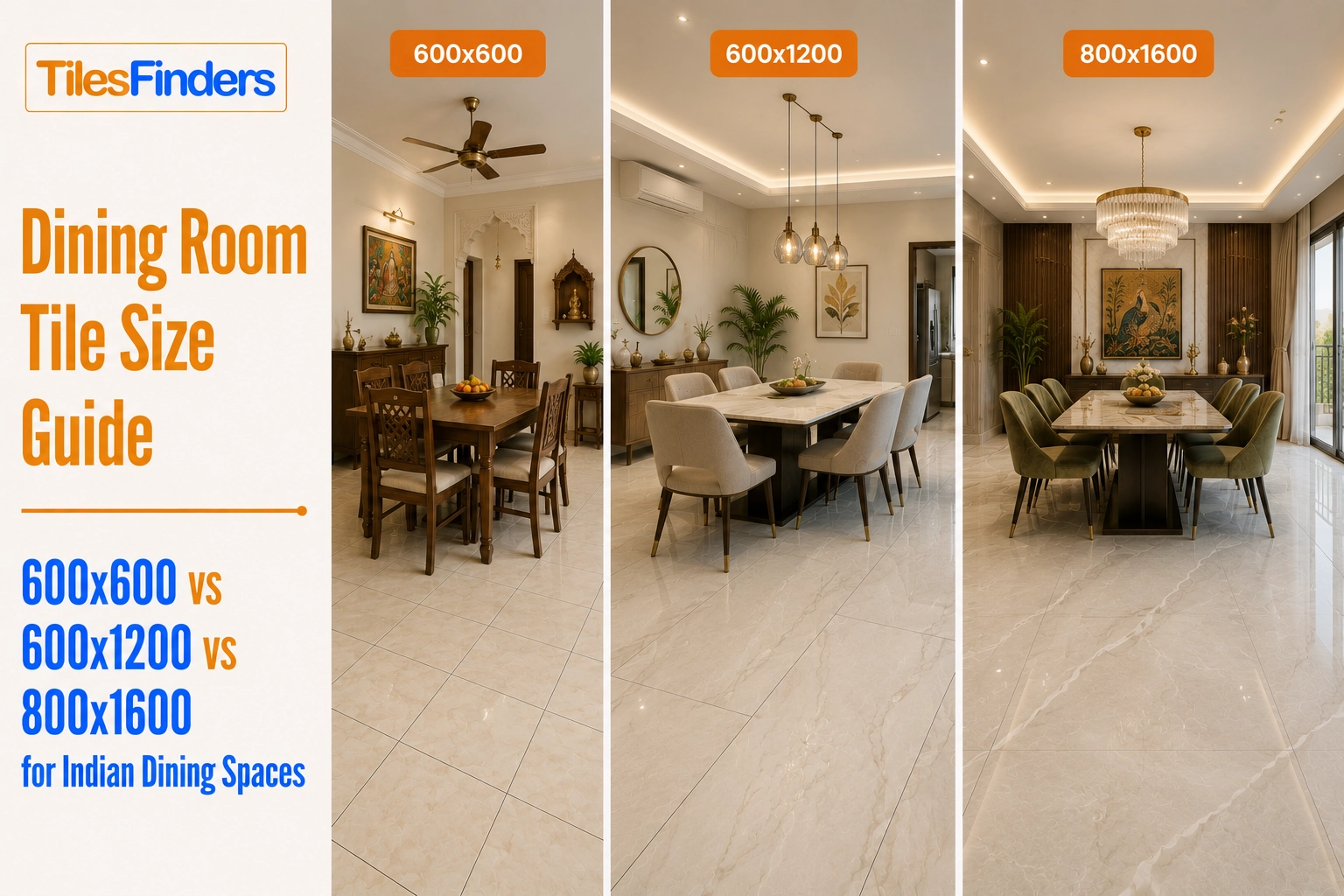
Size choice changes how large a dining space feels. Small tiles in a 10x12 ft dining room make the floor look busy. Large-format tiles reduce the number of grout lines and make the same room feel open.
600x1200 mm (2x4) is the most popular size for dining room floor tiles design in India right now. It is large enough to give a spacious look, fits through standard door widths during delivery, and is easy to cut without waste. GVT in 2x4 in matte or GHR finish is the standard choice at Rs. 65 to Rs. 150 per sq.ft.
800x1600 mm (32x64) gives a more high-end result in open-plan dining and living areas. These large-format GVT tiles are laid with 2 mm joints and minimal grout lines. Full Body vitrified tiles in 32x64 covers 1.28 sq.mt per tile and is well suited for spaces where furniture legs would otherwise cross multiple small tiles.
For dining hall tiles designed in commercial spaces, restaurants, and banquet halls, 600x600 mm (2x2) in GHR finish is the most practical size. It is resistant to heavy chair traffic, and replacing a damaged tile in a 2x2 grid is easier than sourcing a large slab to match.
On walls, 300x600 mm (12x24) ceramic tiles are standard for budget projects. GVT in 600x1200 mm (2x4) covers more area per piece and looks cleaner on feature walls. For modern dining room wall tiles design, 800x1600 mm (32x64) PGVT in a marble or travertine pattern gives the most impactful result.
| Size | Alias | Wall / Floor | Best Dining Use | Category Options |
| 300x300 mm | 1x1 | Both | Budget dining floors, bathroom-adjacent dining | Ceramic, GVT |
| 300x600 mm | 12x24 | Wall only | Full wall cover, budget dining rooms | Ceramic |
| 600x600 mm | 2x2 | Both | Dining halls, commercial spaces | GVT, Double Charge, Full Body |
| 600x1200 mm | 2x4 | Both | Dining floors and feature walls | GVT, PGVT (walls), Full Body |
| 800x1600 mm | 32x64 | Both | Large dining areas, open plan | GVT, Full Body |
| 800x1200 mm | 32x48 | Both | Mid-size dining floors and walls | GVT, PGVT (walls) |
Note: 300x600 mm (12x24) and 300x450 mm (12x18) sizes are wall-only. Never specify these on dining floors.
Finish is the most important decision after size and tile type. The wrong finish in a dining space means daily frustration: visible scratches, slippery wet patches when a drink spills, or a floor that looks dirty an hour after mopping.
Matte finish GVT is the most practical pick for dining floors. It hides minor scratches, shows fewer footprints, and gives a non-slip surface even when wet. The matte finish on GVT is factory-applied to the glaze layer and does not fade with cleaning. Prices run from Rs. 55 to Rs. 120 per sq.ft in standard matte GVT.
GHR (Glaze High Resistance) finish is the best pick for high-traffic dining areas and dining halls. The textured stone-like surface resists scratching from chair legs better than plain matte. It is used in restaurants, hotels, and large family dining rooms where furniture moves frequently. GHR GVT in 2x4 size runs Rs. 80 to Rs. 160 per sq.ft.
Sugar finish works in mid-range dining projects. The textured drops on the tile surface break light reflection and hide marks reasonably well. Sugar finish GVT comes in both floor and wall variants and is priced at Rs. 60 to Rs. 130 per sq.ft.
On dining room walls, glossy ceramic at Rs. 30 to Rs. 70 per sq ft is practical because walls do not face the same abrasion as floors. Polished Glossy PGVT on a feature wall gives a high-shine result at Rs. 90 to Rs. 220 per sq.ft. Stucco and Glossy Carving GVT on accent walls add texture at Rs. 70 to Rs. 150 per sq ft.
Laying large-format tiles in a diagonal pattern across a rectangular dining room makes the space feel wider. This works especially well in narrow dining rooms that open into a corridor. GVT in 600x1200 mm laid at 45 degrees takes about 10% more material due to cutting waste, so account for this in the estimate.
Two-tone dining spaces work well when the floor tile and wall tile share the same colour family but differ in finish. A matte grey GVT floor paired with a Polished High Glossy PGVT feature wall in a lighter grey gives depth without colour clash. This is a common approach in Ahmedabad and Mumbai apartments.
Matching the floor tile in the dining area to the adjacent living room floor gives a flow that makes both spaces feel larger. GVT in 600x1200 mm laid in a single direction across both rooms removes the visual boundary. Epoxy grout in a colour matching the tile body keeps the transition clean and prevents staining at the junction.
For kitchen-adjacent dining areas where oil mist is a concern, tiles with a matte carving or GHR finish are easier to clean than plain matte. The slightly textured surface does not trap grease the way deep texture tiles do, but it hides water marks and light grease spatters between cleaning cycles.
Dining spaces with large windows and good natural light show floor tiles differently at different times of day. Matte tiles look consistent across morning and evening light. Polished or glossy tiles create glare in direct sunlight, which can be uncomfortable. Most designers in Gujarat and Maharashtra prefer matte floors for south-facing dining spaces.
GVT, Full Body, Double Charge, ceramic, and PGVT tiles for dining floors and feature walls are listed on TilesFinders with water absorption percentage, finish type, size alias, and body category on every product card. Use the area filter to browse [dining tiles] and the finish filter to narrow between matte, GHR, sugar, and glossy options across brands and price points from Rs. 45 to Rs. 220 per sq.ft.
GVT (Glazed Vitrified Tiles) in matte or GHR finish are the best choice for dining floors. They absorb 0.05% water, resist chair-leg scratching in matte finish, and come in large formats like 600x1200 mm (2x4) that give a spacious look. Prices start at Rs. 55 per sq.ft for standard matte GVT and go up to Rs. 180 for large-format options.
Avoid Glossy, High Glossy, Satin Matte, and Semi Polished finishes on dining floors. These scratch easily from chair movement, show footprints, and can become slippery when liquid is spilled. Matte, GHR, and sugar finishes handle daily dining room use without these problems.
PGVT tiles are only for dining room walls, not floors. PGVT is a wall tile category. On dining walls, PGVT in Polished Glossy or Polished High Glossy finish at Rs. 90 to Rs. 220 per sq.ft gives a marble-like shine. Never specify PGVT on any floor surface.
600x1200 mm (2x4) GVT works well even in dining rooms as small as 9x10 ft. The large format reduces the number of grout lines, which makes the floor look less busy. Avoid sizes smaller than 300x300 mm in dining spaces as they make the room feel fragmented.
Use epoxy grout for dining room floor joints. Epoxy grout does not absorb food or liquid spills, does not stain, and does not crack at tile joints. Standard cement grout absorbs spills and shows permanent staining within a year in a busy dining area. Epoxy grout costs more to apply but saves cleaning time and replacement costs.
Dining room wall tiles in India range from Rs. 30 per sq.ft for basic glossy ceramic in 300x600 mm to Rs. 220 per sq.ft for large-format PGVT in 800x1600 mm. Mid-range GVT wall tiles in 600x1200 mm with matte or stucco finish cost Rs. 65 to Rs. 150 per sq.ft. Prices vary by brand, size, and finish.
Dining hall tiles for commercial spaces need higher scratch resistance and easier replaceability. GHR finish GVT in 600x600 mm (2x2) is standard in restaurants and banquet halls. Home dining tiles allow larger formats like 800x1600 mm and finer finishes like matte carving or sugar, which look better in lower-traffic residential spaces but are harder to replace in sections.