What Tile Finish Is Safest for Children's Rooms: Slip Ratings, Edges, and Maintenance Explained
Learn how to choose the safest tile finish for children's rooms by comparing slip ratings, edge profiles, maintenance needs, and anti-skid options for a secure, easy-to-maintain floor.
-221b7c9a-667f-42d2-b5b3-66ba2d2266c1.webp)
- Slip Ratings Explained: What the Numbers Actually Mean
- How Slip Risk Changes by Age Stage
- Edge Safety: The Overlooked Physical Hazard
- Maintenance as a Safety Factor, Not Just an Aesthetic One
- Finish Decision Summary
- Anti-Skid GVT for Children's Rooms in India: Manufacturing Context
- Browse Anti-Skid Children's Room Tiles on TilesFinders
A safe children's room floor depends on anti-skid performance, rounded tile edges, and proper maintenance, not just choosing a matte finish. Always verify the wet COF, use bullnose trims where needed, and avoid glossy or polished tiles for long-term child safety.
Most guidance on children's room tiles focuses on colour and design, and treats safety as a single line item: avoid glossy tiles. That is correct but incomplete. Genuine floor safety for a children's room involves three separate technical factors that interact with each other: the surface's slip resistance when dry and wet, the physical geometry of any exposed tile edge, and how the finish behaves under the specific kind of daily maintenance a child's room actually receives. This guide explains all three in technical detail.
Slip Ratings Explained: What the Numbers Actually Mean
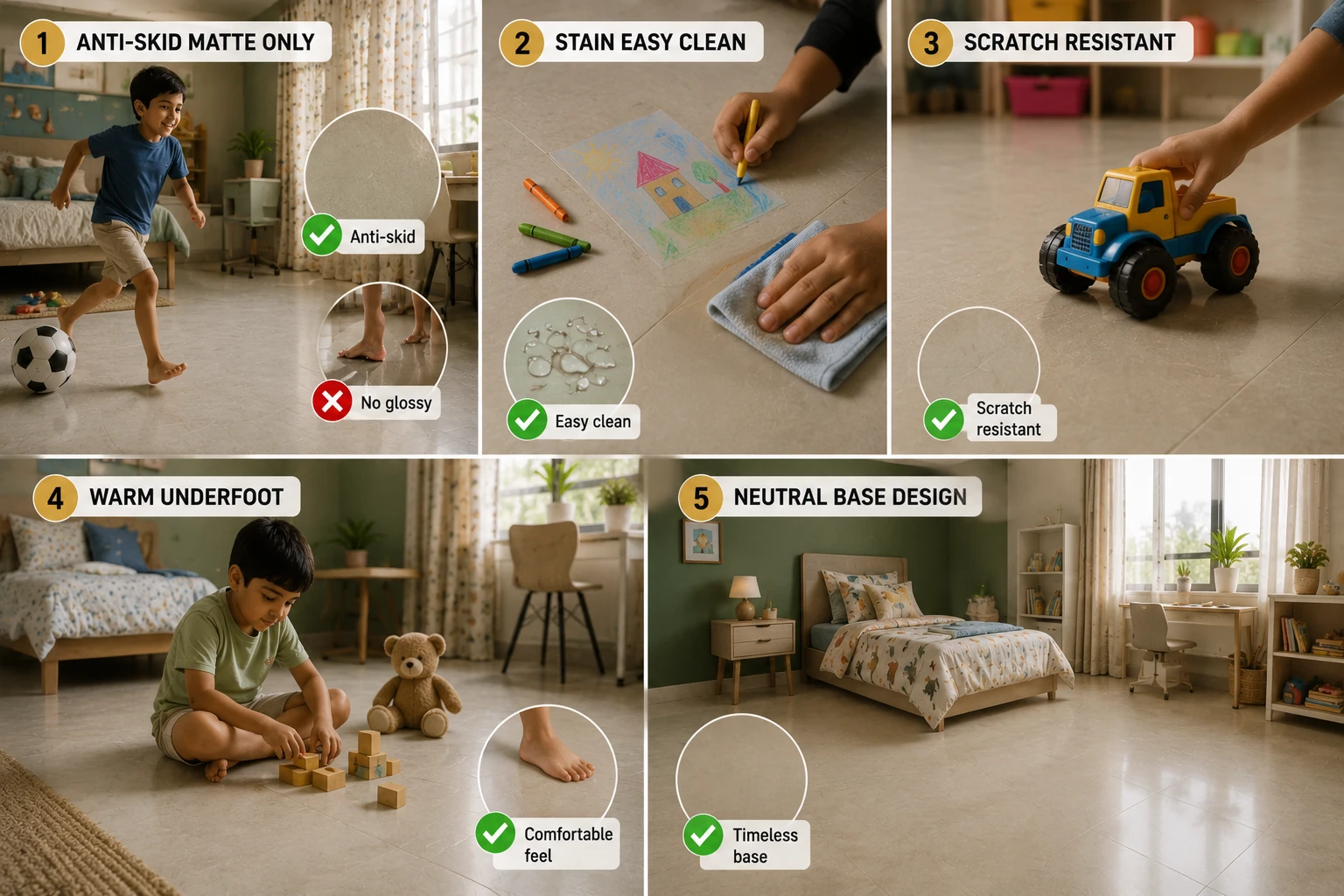
Coefficient of friction, or COF, is the measurable figure that determines how likely a foot is to slip on a given surface. It is tested and rated separately for dry and wet conditions, and a children's room needs to be evaluated on both, since spilled water, juice, or a wet-footed child coming from a bathroom can turn an otherwise dry room into a temporarily wet-floor condition.
| Finish | Dry COF (approximate) | Wet COF (approximate) | Safe for Children's Rooms? |
| Standard matte GVT | 0.55 to 0.65 | 0.35 to 0.45 | Generally safe for a dry-area room. Confirm anti-skid rating if wet contact is a regular occurrence. |
| Anti-skid matte GVT | 0.60 to 0.75 | 0.42 to 0.55 | The safest choice, particularly for a room with an ensuite bathroom, water play, or younger children prone to spills. |
| Sugar finish GVT | 0.55 to 0.65 | 0.35 to 0.45 (not anti-skid rated by default) | Comparable to standard matte when dry. Confirm anti-skid COF separately if the room has a wet-contact risk; do not assume the texture provides this. |
| Satin matte GVT | 0.45 to 0.55 | 0.25 to 0.35 | Not recommended. Lower wet COF than standard matte despite its refined appearance. |
| Semi-polished or polished GVT | 0.40 to 0.50 | 0.20 to 0.30 | Not safe. Should never be specified for a children's room floor under any circumstances. |
Critical point: A finish's visual appearance does not reliably indicate its slip safety. Sugar finish looks textured and can seem inherently grippier than it actually is, while satin matte looks understated and can seem safer than a glossy tile despite having a lower wet COF than standard matte. Always request the specific wet COF figure from the tile's technical data sheet rather than judging safety by how a surface looks or feels when dry in a showroom.
How Slip Risk Changes by Age Stage
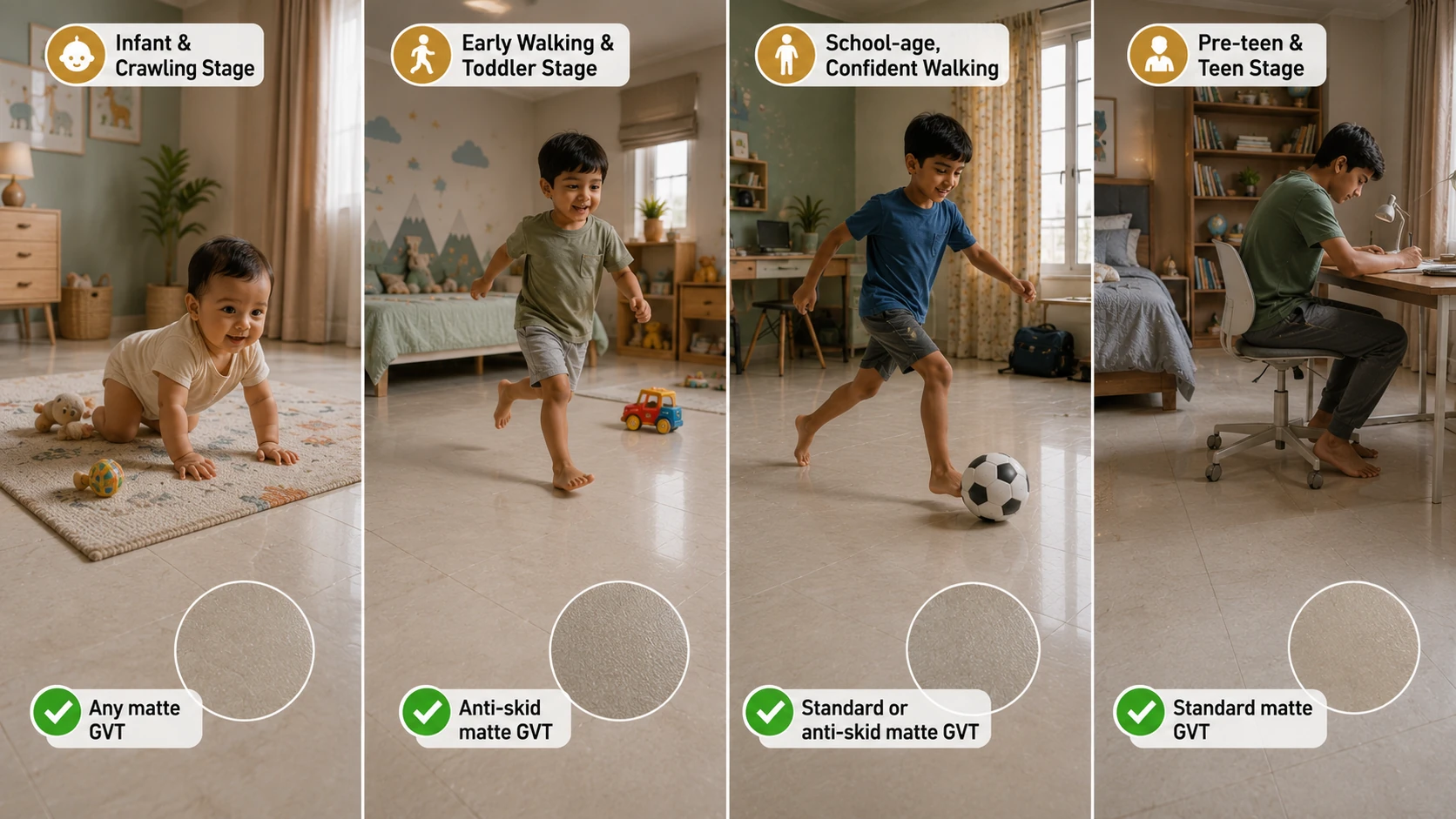
| Age Stage | Primary Floor Risk | Specific Recommendation |
| Infant and crawling stage | Direct, prolonged floor contact. Slip risk is minimal since the child is not yet walking, but surface hardness and cleanliness matter most. | Any matte GVT is appropriate. Prioritise a warm, layered rug for comfort and easy spot-cleaning of the rug rather than the tile itself. |
| Early walking and toddler stage | Highest slip risk stage. Unsteady gait, frequent falls as a normal part of learning to walk, and a strong tendency to run before being fully stable. | Anti-skid matte GVT is the strongest recommendation at this stage, even in a room with no bathroom nearby, since falls during normal development are frequent regardless of moisture. |
| School-age, confident walking | Lower baseline slip risk from gait alone, but higher risk from fast, distracted movement, running, and jumping during play. | Standard matte or anti-skid matte GVT both work well. Anti-skid remains the safer default if the room has any water-contact source. |
| Pre-teen and teen | Similar to an adult risk profile, primarily wet-contact related rather than gait-related. | Standard matte GVT is generally sufficient. Confirm anti-skid specifically for any ensuite bathroom transition zone. |
Edge Safety: The Overlooked Physical Hazard
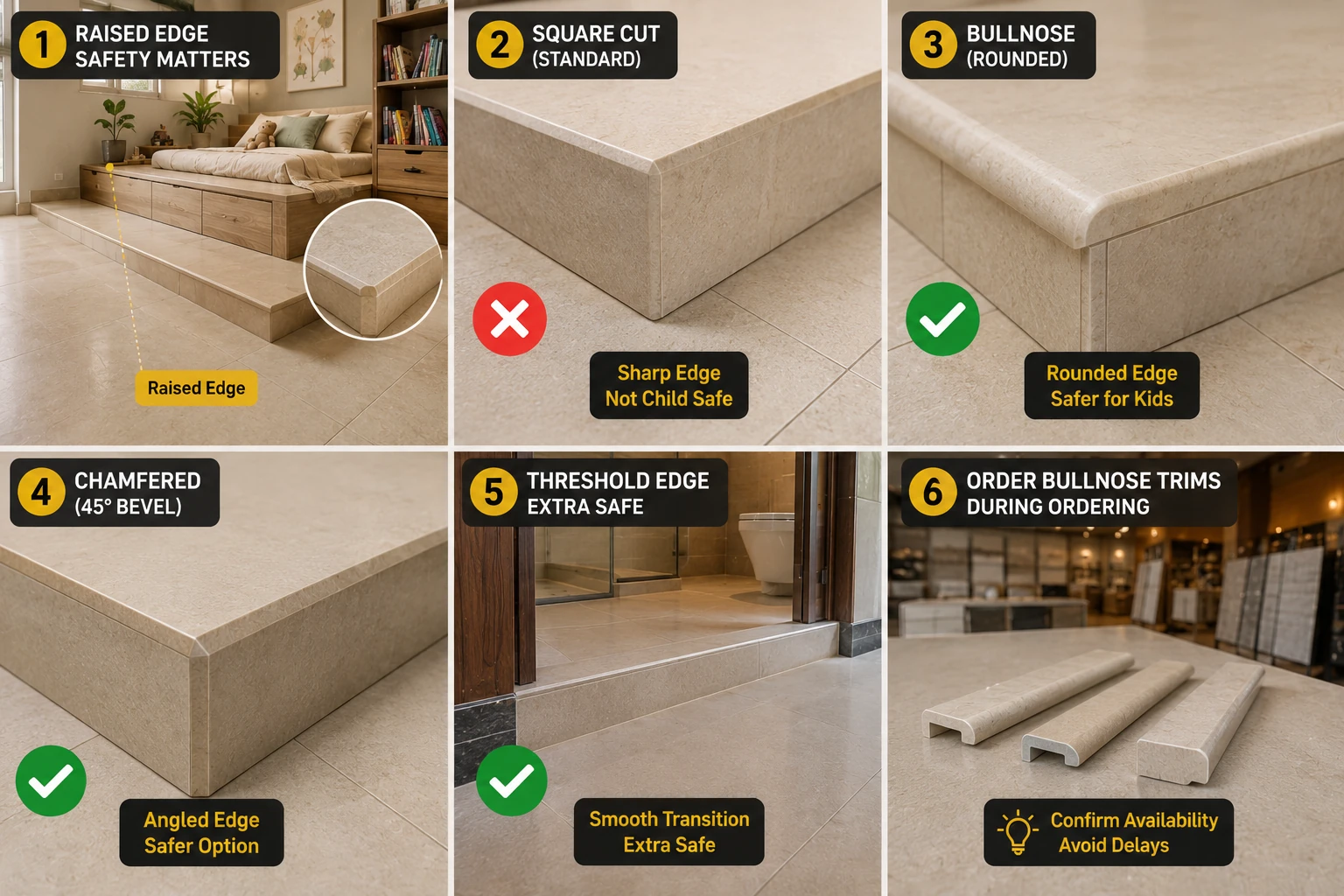
Slip resistance addresses the floor surface itself, but a child's room often includes raised or edged tile applications, a step up to a platform bed, a built-in window seat, a raised threshold at a bathroom transition, where the physical shape of the tile's exposed edge matters as much as the surface finish.
| Edge Profile | Description | Where to Use | Where to Avoid |
| Square cut (standard) | A sharp 90-degree edge is the default cut for most tiles unless specified otherwise. | Flat floor areas with no raised edge or step. | Any exposed vertical edge at a height a child could fall against, such as a platform bed base or window seat step. |
| Bullnose | A rounded, convex edge profile that eliminates the sharp corner. | Any raised step, platform edge, built-in seating base, or threshold in a children's room. | Not applicable; this is the recommended profile for exposed edges. |
| Chamfered | A flat, angled bevel cut at 45 degrees rather than a full round. | An acceptable alternative to bullnose, where a rounder profile is not available, is still softer than a square cut. | Less protective than a true bullnose; use bullnose where available. |
Pro tip: Ask specifically for bullnose or rounded-edge trim tiles when ordering, rather than assuming the installer will source them automatically. Bullnose trims are typically a modest additional cost per linear metre and are not always stocked by default at every tile supplier, so confirming availability during the ordering stage, not after installation has begun, avoids delays or a fallback to a standard square-cut edge.
Maintenance as a Safety Factor, Not Just an Aesthetic One
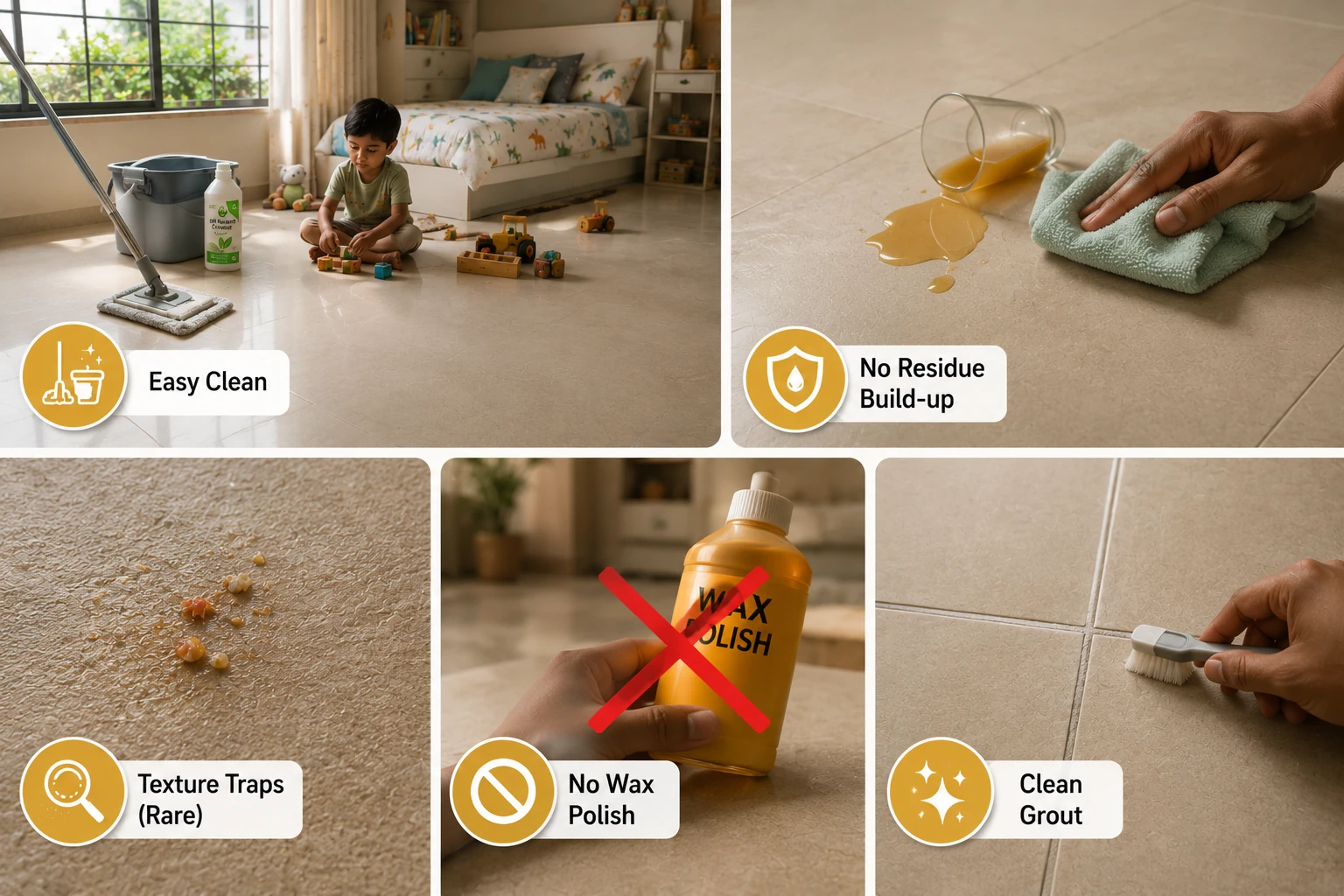
How a finish behaves under real daily maintenance affects its safety over time, not just its appearance. A finish that is difficult to keep genuinely clean can accumulate residues that change its slip characteristics even if the base tile was correctly specified.
- Matte and anti-skid matte GVT clean with a simple damp mop and pH-neutral cleaner, and residue from spills does not typically build up on the surface in a way that changes slip characteristics over time, provided routine cleaning continues.
- Textured anti-skid surfaces can, in rare cases, trap fine residue such as dried juice or food particles within the micro-texture if not cleaned promptly, which is worth being aware of but is generally addressed by routine weekly mopping.
- Avoid wax-based or oil-based floor polish products on any children's room floor. These products, sometimes used on natural stone or older ceramic floors, can significantly reduce surface friction and are not necessary or appropriate for GVT, which does not require polishing or sealing.
- Grout maintenance matters for hygiene, not just appearance. A mid-tone grout that hides staining is a cosmetic choice, but keeping grout lines genuinely clean, regardless of colour, prevents residue buildup that could affect hygiene in a room where young children have frequent direct floor contact.
Finish Decision Summary
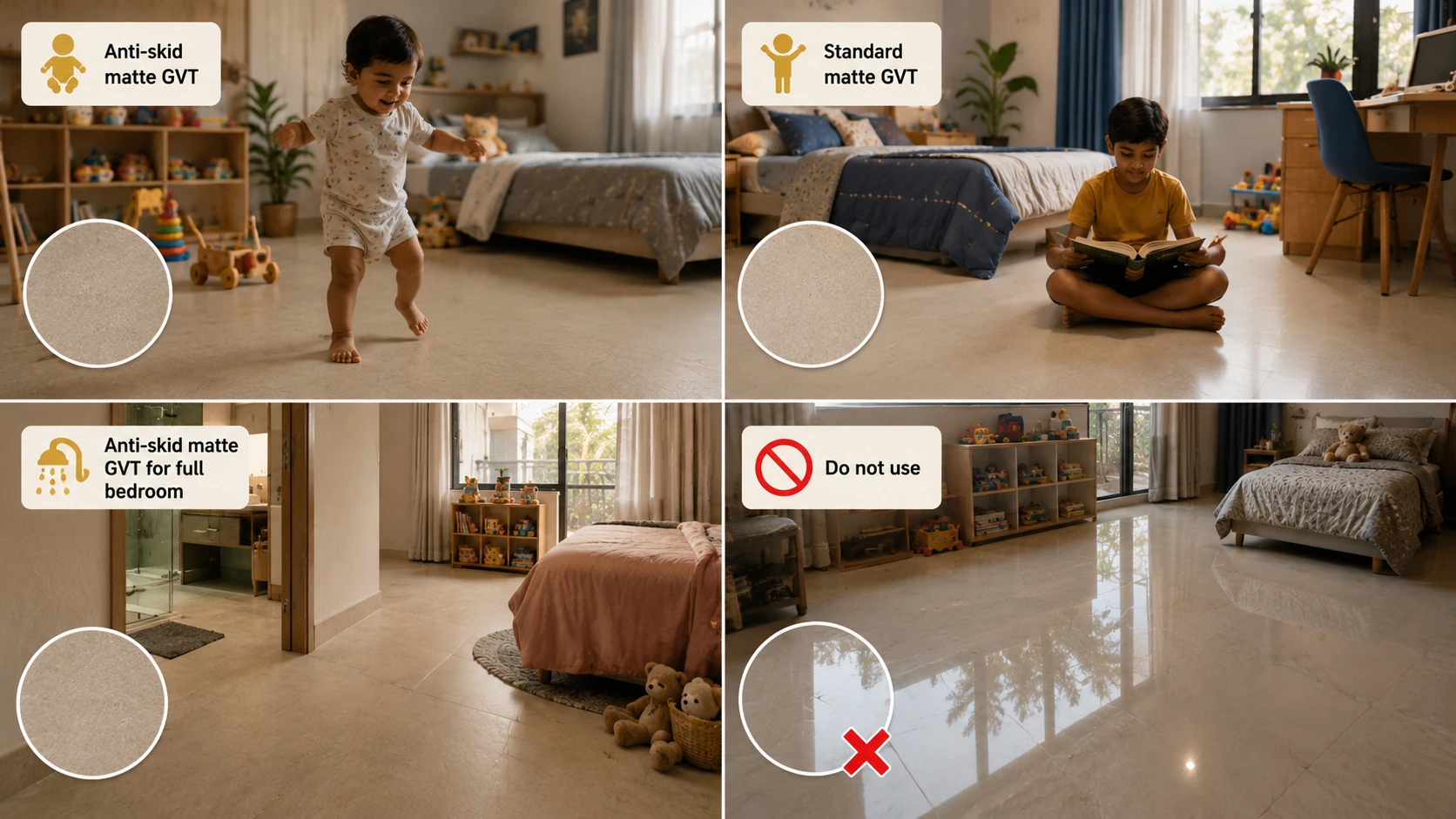
| Scenario | Recommended Finish | Why |
| Toddler or early walker, any room | Anti-skid matte GVT | Highest slip risk stage regardless of moisture; anti-skid provides the strongest safety margin. |
| School-age child, dry-area room only | Standard matte GVT | Adequate slip resistance for confident walkers with no regular wet-contact risk. |
| Any age, room with an ensuite bathroom | Anti-skid matte GVT for the full bedroom | Wet-footed transition risk applies at any age; anti-skid should extend beyond the bathroom itself. |
| Any age, any room, glossy or polished, considered | Do not use | Wet COF below the safety threshold regardless of age or room type. |
Choosing the safest tile finish is only one part of planning a child's bedroom. Our Children's Room Tile Guide covers tile sizes, colours, durability, safety features, and practical buying tips to help you create a room that's comfortable, long-lasting, and child-friendly.
Anti-Skid GVT for Children's Rooms in India: Manufacturing Context
Anti-skid matte GVT tiles suitable for children's rooms are manufactured in Morbi, Gujarat, under IS 15622:2006 at water absorption 0.05% or below, with COF wet ratings confirmed through the manufacturer's TDS documentation. Bullnose and rounded-edge trim tiles are produced as a standard accessory item by most major Morbi manufacturers alongside their main tile ranges, though availability in every specific colour and design should be confirmed with the supplier before finalising an order that includes raised or stepped tile edges.
In coastal Indian cities with monsoon humidity of 85 to 95%, anti-skid matte GVT at 0.05% water absorption maintains its slip-resistant surface texture without degradation across all seasons, unlike some natural stone anti-slip treatments, which can wear down over the years and require periodic reapplication.
Once you've selected the right safety specifications, explore our Kids Room Tile Design Ideas for creative layouts, timeless colour palettes, and playful flooring inspirations that remain stylish as children grow.
Browse Anti-Skid Children's Room Tiles on TilesFinders
Anti-skid matte GVT tiles with confirmed wet COF ratings, along with bullnose edge trim options, are available on TilesFinders from verified Morbi manufacturers. Request the wet COF figure in writing before ordering any children's room floor.
FAQs
A wet coefficient of friction of 0.4 minimum is the recommended threshold for a children's room floor, particularly for toddlers, early walkers, or any room with an ensuite bathroom. Confirm this figure specifically from the tile's technical data sheet rather than assuming a matte or textured finish meets this threshold automatically.
Sugar finish has a wet COF comparable to standard matte, but its textured appearance can create a false impression of extra grip that is not automatically confirmed. If the room has any wet-contact risk, request the specific wet COF figure and confirm anti-skid rating separately, rather than assuming the texture provides it.
Bullnose edge trim, a rounded convex profile, is the safest choice for any exposed tile edge at a height a child could fall against. It eliminates the sharp corner of a standard square-cut tile edge. A chamfered, angled edge is an acceptable alternative where bullnose is not available.
The early walking and toddler stage carries the highest slip risk, due to unsteady gait and frequent falls that are a normal part of learning to walk, combined with a tendency to run before being fully stable. Anti-skid matte GVT is the strongest recommendation at this age stage, even in a room with no bathroom nearby.
Yes. Wax-based or oil-based floor polish products can significantly reduce surface friction and should never be used on a GVT children's room floor. GVT does not require polishing or sealing. Routine damp mopping with a pH-neutral cleaner maintains both appearance and the tile's intended slip characteristics.

See our tile guides first
Set TilesFinders as a preferred source and our buying guides surface ahead of the rest for you.
Add as preferred sourceTakes one tap. Nothing to install.
What Readers Say
I was about to redo my parking area with the wrong tile size until I read this. The layout comparisons saved me from a costly mistake.
We reference TilesFinders guides while briefing clients on material selection. The size and pattern breakdowns are accurate and easy to explain visually.
On site, I get asked about grout spacing all the time. This article gave me a solid reference I now share with my team before every job.
Finally a guide that doesn't just push generic advice. The oil stain removal steps actually worked on our clubhouse driveway tiles.
I run a small construction firm and now send this link to clients directly when they ask about entrance tile sizing. Saves me an hour of explaining.
Good practical detail, though I wish there were more examples for compact apartment entrances specifically, not just villas.
My mother-in-law wanted marble, I wanted vitrified. This blog gave us the neutral comparison we needed to actually decide together.
Detailed without being overwhelming. I appreciated that it covered both cost and maintenance, not just the aesthetics.
Used the algae and hard water removal tips on our terrace tiles after the monsoon. Worked better than what our regular cleaner was doing.
As someone who sources tiles for multiple builder projects, I find these comparisons genuinely useful for vendor conversations, not just consumer content.
Recommended this to a client who kept second-guessing the entrance design. The small vs large layout section settled the debate instantly.
Straightforward and honest, no unnecessary jargon. Would like to see a similar breakdown for outdoor pool-deck tiles next.
We've bookmarked several TilesFinders guides for our design handbook. Reliable source when clients want data, not just opinions.
Two paths, one marketplace.
Get free quotes from verified suppliers.
Share your room, budget, and style. Suppliers in Morbi respond within hours.
Get Free QuotesList your business, reach real buyers.
Put your showroom in front of homeowners searching for tiles right now.
List Your Business