Satin Matte vs Matte vs Polished Sugar: Which Mid-Sheen Finish Performs Best in Indian Spaces
July 14, 2026 45
A practical evaluation of standard matte, satin matte, and polished sugar finishes covering surface feel, lighting response, room recommendations, pricing, and buying considerations.
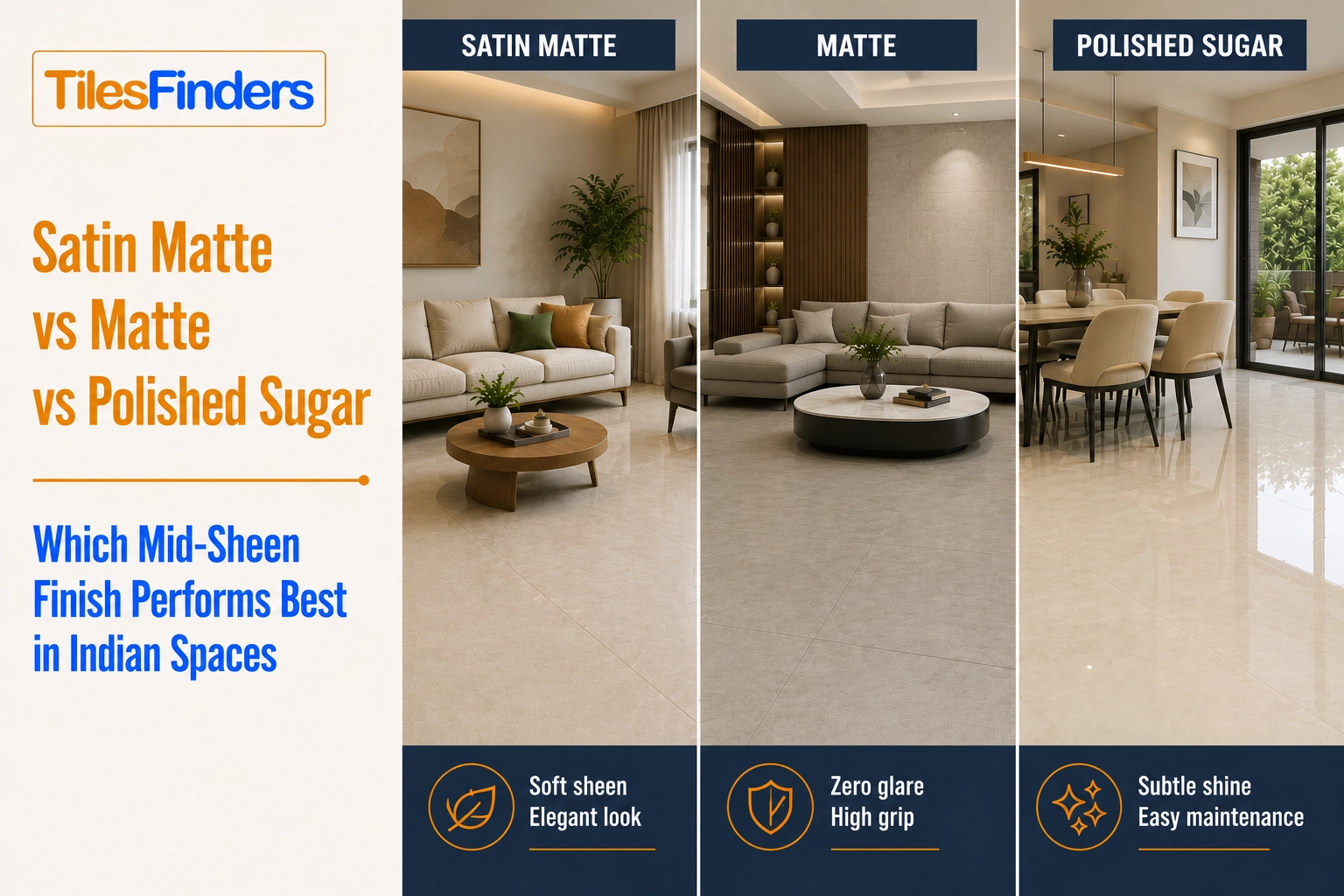
Satin matte offers the most balanced finish among matte and polished sugar, combining a soft, premium sheen with consistent performance across different lighting conditions. It suits most Indian interiors while avoiding the excessive shine or visual complexity of higher-gloss finishes.
Polished sugar is the newest entrant into the Indian tile finish market: a hybrid surface that takes standard sugar finish's micro-granular crystalline texture and passes it through a light mechanical polish, softening the peaks of the texture while leaving the valleys intact. The result sits between sugar finish and satin matte on the sheen spectrum, delivering more reflectivity than sugar finish while retaining a trace of tactile character that pure satin matte lacks.
This guide compares satin matte, standard matte, and polished sugar directly: how each is made, how each performs in Indian light and household conditions, and which one belongs in which room. This is a three-way comparison that goes one step further than the standard matte versus premium finish question, because it isolates the specific trade-off between polished sugar's added shine and satin matte's smoother, quieter character.
What Standard Matte, Satin Matte, and Polished Sugar Actually Are
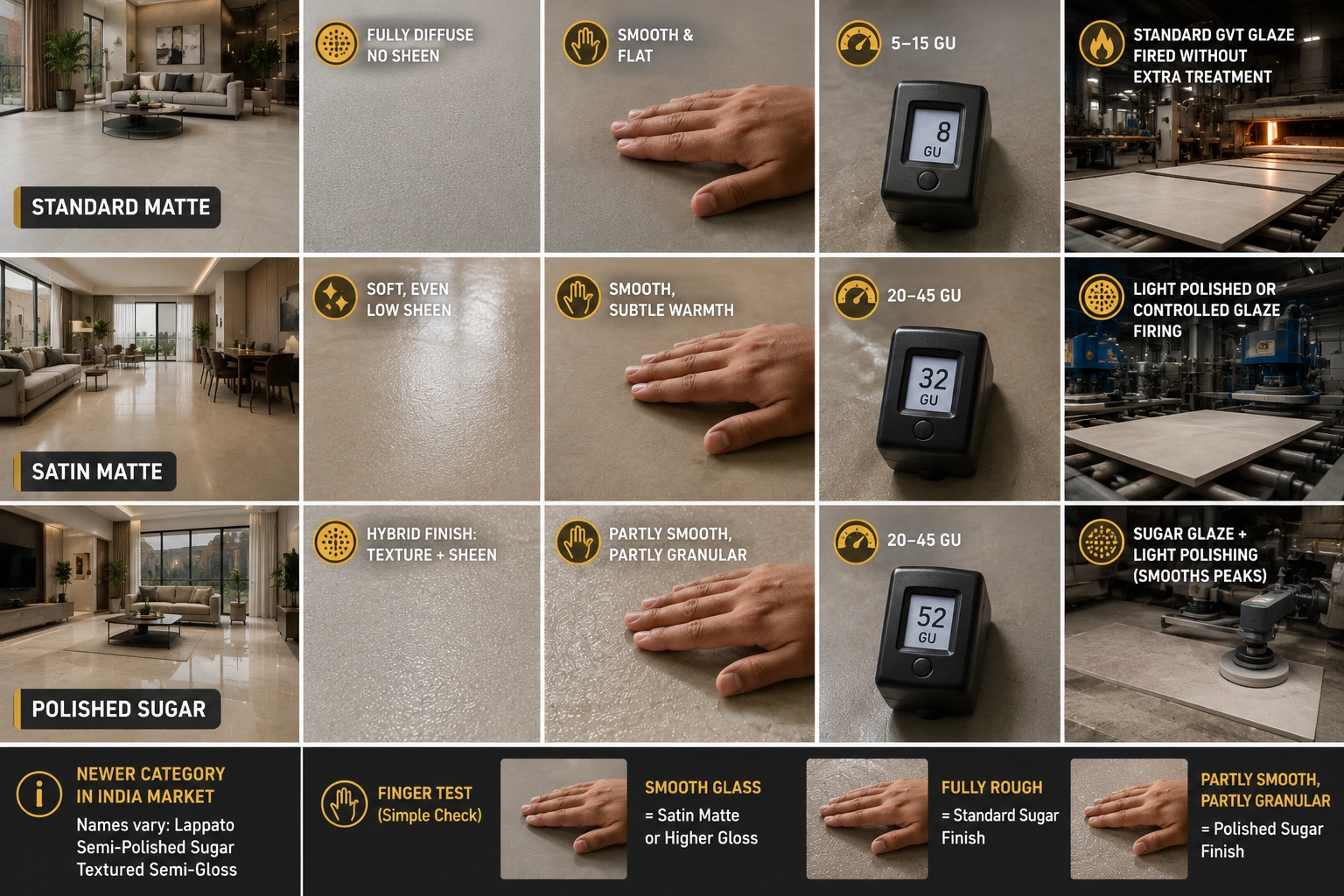
| Finish | Technical Description | Surface to Touch | Gloss Level (GU) | How It Is Made |
| Standard matte | A fully diffuse, non-reflective glaze surface with no sheen and no texture. | Completely smooth and flat. | 5 to 15 GU | Standard GVT glaze fired without any additional surface treatment. |
| Satin matte | A smooth surface with a soft, even, low-level sheen, achieved through light polishing or controlled glaze firing. | Smooth, no granularity, subtle warmth to the touch. | 20 to 45 GU | Glaze is lightly polished or fired to a controlled low-gloss state after standard firing. |
| Polished sugar | A hybrid finish: the crystalline micro-texture of sugar finish is applied during firing, then the surface is passed through a light mechanical polish that smooths the raised peaks of the texture while leaving the recessed valleys intact. | A softened granularity: less rough than standard sugar finish, but with perceptible micro-texture remaining, unlike the fully smooth satin matte. | 40 to 65 GU | Standard sugar finish crystalline glaze applied during firing, followed by a light diamond-pad polishing pass calibrated to smooth only the highest points of the texture. |
Note: Polished sugar is a newer product category in the Indian market, and manufacturer terminology varies. Some Morbi factories call it lappato (an Italian term meaning lightly polished, borrowed into the ceramic tile industry to describe this exact hybrid texture-plus-sheen finish), others call it semi-polished sugar or textured semi-gloss. Regardless of the name used, the defining physical test is the same: run a finger across the surface. If you feel smooth glass, it is satin matte or higher gloss. If you feel a fully rough, even granularity, it is a standard sugar finish. If you feel a partly smooth, partly granular surface where some areas feel polished and others feel textured, it is polished sugar.
Satin matte tiles strike the perfect balance between matte and glossy finishes, offering a soft sheen without excessive reflection. Explore our Satin Matte Tiles Guide to understand their benefits, performance, maintenance, and the best applications for Indian homes.
How the Three Finishes Read in Indian Light Conditions
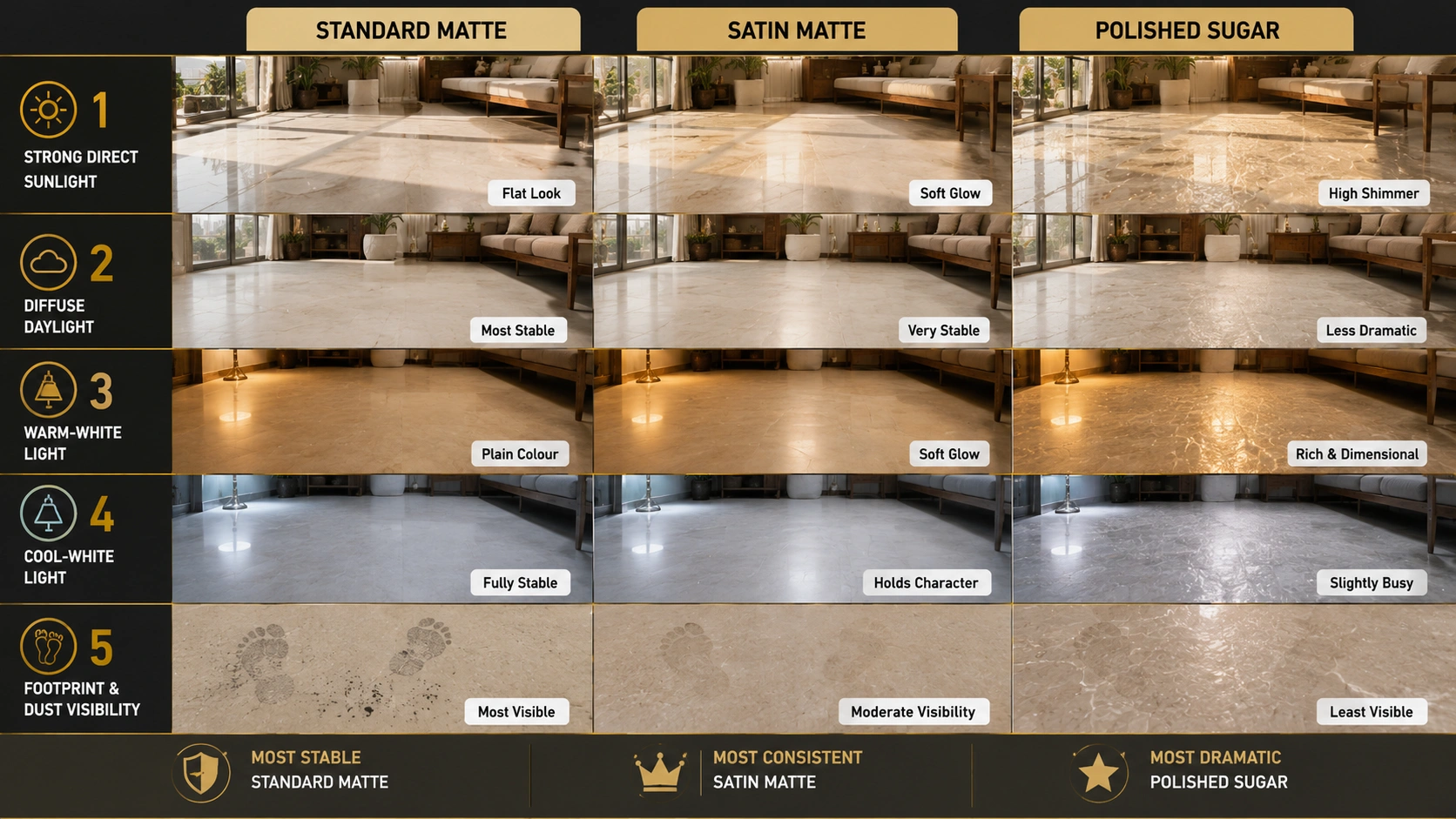
| Light Condition | Standard Matte | Satin Matte | Polished Sugar |
| Strong direct sunlight (south or west facing) | Reads flat and can appear slightly chalky on light colours under the strong Indian sun. | The soft sheen picks up direct sunlight and reads as gently luminous. Very flattering. | The most dramatic under direct sun of the three: the polished high points catch light sharply while the textured valleys stay matte, creating a shimmer-and-shadow effect that neither pure satin matte nor pure sugar finish produces. |
| Diffuse daylight (north facing, overcast) | Most stable. No change in appearance regardless of light condition. | Holds its soft sheen quality well across diffuse light. Very stable. | The shimmer effect is reduced in diffuse light, but the underlying texture still reads as more dimensional than standard matte. More stable than standard sugar finish, less dramatic than under direct sun. |
| Warm-white artificial (2700K to 3000K) | Reads as the tile's plain colour with no enhancement. | Reads at its best. The even sheen becomes a soft glow under this light. | Reads richly. The combination of texture and polish creates the most complex light interaction of the three under warm-white light, appearing warmer and more three-dimensional than either satin matte or standard sugar finish alone. |
| Cool-white artificial (4000K to 5000K) | No change. Fully stable. | Holds its character reasonably well, more stable than sugar finish or polished sugar under this light. | Can show a slightly uneven or busy quality under cool-white light, since the contrast between the polished points and matte valleys becomes more pronounced under harsher, cooler illumination. |
| Footprint and dust visibility | Highest visibility on light colours. Every mark reads clearly. | Lower than standard matte. Marks read as tonal variation rather than sharp smudges. | Lowest of the three. The mixed texture surface is the most effective at disguising footprints and dust because the irregular surface breaks up the visual continuity a footprint would otherwise create. |
Verdict: Standard matte is the most lighting-stable but delivers no visual enhancement. Satin matte is the most consistently premium-reading finish across the widest range of Indian lighting conditions, with no unusual behaviour under any light type. Polished sugar delivers the most dramatic and dimensional light interaction, particularly under direct sun and warm-white artificial light, but is more variable under cool-white light and shows the most complex surface behaviour of the three. Polished sugar also has the best footprint-hiding quality of the three finishes.
Room-by-Room Comparison
-ec8714c1-9efc-4e80-a3bc-c9bef1c5cff5.webp)
| Room | Standard Matte | Satin Matte | Polished Sugar | Recommended |
| Formal living room | Practical and accessible, but delivers no premium visual read. | Best for a quiet, architecturally serious room with consistent light performance across variable Indian conditions. | Best for a room with strong natural light and a design brief that wants visible material character and dimension. | Satin matte for consistency across lighting zones. Polished sugar for a room with strong direct light and a more expressive design brief. |
| Master bedroom | Suitable, no wet-area risk, most affordable. | Very good. Quiet, restful, minimal visual activity suits most bedroom briefs. | Good, but it can read as slightly busy for a restful bedroom brief, given the higher visual complexity of the mixed texture. | Satin matte for most bedrooms. Polished sugar only if the bedroom brief specifically wants tactile, characterful flooring. |
| Formal dining room | Practical, no premium read. | Very good. Reads as soft, glowing stone under a chandelier without distraction. | Excellent. The complex light interaction under a chandelier's direct light is where polished sugar performs at its most impressive. | Polished sugar for maximum drama under chandelier lighting. Satin matte for a calmer, more restrained dining room. |
| Entrance foyer | Practical, minimal design impact. | Good. Even considered glowing under a statement light. | Very good. The texture and polish combination creates visual interest at the compact foyer scale, where the effect is concentrated. | Either satin matte or polished sugar, depending on whether restraint or expressiveness is the design goal. |
| Bathroom floor | Safe only with anti-skid COF confirmation. | Not safe. Lower wet COF than standard matte. | Not safe without specific confirmation. The polished high points reduce wet friction similarly to satin matte, despite the retained texture in the valleys. | None of the three has anti-skid confirmation. Specify anti-skid matte GVT with COF 0.4 wet for bathroom floors. |
| Kitchen floor | Safe only with anti-skid COF confirmation. | Not safe. | Not safe without specific confirmation. | Same as the bathroom. Anti-skid matte GVT required. |
| Bathroom wall | Standard, practical. | Good, adds refinement. | Very good, the textured-polished surface catches vanity light attractively with no slip risk on a vertical surface. | Any of the three, chosen on visual preference. No safety concern for walls. |
Critical safety note: Despite retaining some surface texture, polished sugar has a wet coefficient of friction similar to satin matte, not similar to standard sugar finish. The polished high points of the texture reduce wet grip significantly compared to an unpolished sugar finish. Do not assume polished sugar is safer than satin matte for wet-area floors simply because it retains some visible texture. Neither satin matte nor polished sugar should be specified for bathroom, kitchen, outdoor, or staircase floors without a written anti-skid COF confirmation of 0.4 wet minimum from the manufacturer's TDS.
Need inspiration before choosing your flooring? Browse our Satin Matte Design Ideas to discover elegant living rooms, bedrooms, kitchens, and dining spaces that showcase this understated luxury finish in modern Indian interiors.
Full Comparison Scorecard
| Criteria | Standard Matte | Satin Matte | Polished Sugar |
| Lighting stability | Highest. No change across any condition. | High. Consistent across most Indian light types. | Medium. Most dramatic under direct sun and warm light, more variable under cool-white. |
| Footprint and dust hiding | Lowest on light colours. | Medium. Better than standard matte. | Highest of the three. The mixed texture is most effective at disguising marks. |
| Visual complexity and character | None. Plain colour reading only. | Low to medium. A soft, even glow. | Highest. Combines texture and shine for the most dimensional surface of the three. |
| Best design brief | Budget-first, no premium requirement. | Quiet, architecturally serious, understated luxury. | Expressive, textural, tactile luxury with visible material character. |
| Tactile experience | Flat, smooth. | Smooth with subtle warmth. | Partly smooth, partly granular. The most tactilely complex of the three. |
| Availability from Morbi | Highest. Universal. | Limited. Not all manufacturers produce it. | Most limited. A newer, more specialised product with the fewest producing factories. |
| Price range (per sq.ft, 600x1200 mm) | Rs. 85 to Rs. 140/sq.ft | Rs. 95 to Rs. 155/sq.ft | Rs. 110 to Rs. 175/sq.ft |
| Wet floor safety | Safe with anti-skid COF confirmation. | Not safe without specific confirmation. | Not safe without specific confirmation, despite retained texture. |
How to Choose: Three Questions
Question 1: Does the room have strong, direct natural light?
A south or west-facing room with strong afternoon sun is where polished sugar performs at its most impressive: the shimmer-and-shadow effect from the mixed texture is most visible under direct sunlight. A north-facing room with primarily diffuse or artificial light favours satin matte, which holds its consistent quality without the light-dependent drama of polished sugar.
Question 2: Is the design brief quiet and restrained, or expressive and tactile?
If the brief calls for a floor that recedes and supports the room without drawing attention to itself: satin matte. If the brief specifically wants a floor with visible material character, dimension, and a sense of crafted texture: polished sugar. These are two different design philosophies, not two tiers of the same quality, and choosing between them should be based on the room's intended character rather than budget alone.
Question 3: How much footprint and dust visibility can the household tolerate?
For a household with children, pets, or limited daily cleaning capacity, polished sugar's superior footprint-hiding quality makes it the more practical choice among premium finishes for a light-coloured floor. Satin matte is the second most forgiving. Standard matte on light colours is the least forgiving of the three.
Pro tip: Because polished sugar is a newer and less widely available product, request the manufacturer's specific process description before ordering: some Morbi factories achieve a more convincing hybrid texture than others, and the ratio of polished to unpolished surface area varies between producers. Ask to see and touch a physical sample larger than a standard swatch, ideally a full tile, to properly evaluate the texture-and-shine balance before committing to a bulk order.
Mid-Sheen Tile Finishes in India: Manufacturing Context 2026
Standard matte GVT is produced across the widest range of Morbi, Gujarat manufacturers and represents the largest volume category by far. Satin matte is produced by a smaller subset of Morbi factories with the capability for controlled low-gloss firing or light post-firing polish, most commonly available in ivory, white, and grey marble-look and stone-look designs in 600x600 mm through 800x1600 mm formats. Polished sugar (lappato) is the newest and most specialised of the three, produced by a still smaller number of Morbi manufacturers with the specific diamond-pad calibration required to selectively polish sugar finishes' crystalline texture without removing it entirely.
All three finishes are available on GVT bodies meeting IS 15622:2006 at water absorption 0.05% or below and PEI 4 for floor use. Lead times increase with specialisation: standard matte ships in 7 to 10 days for stock designs, satin matte in 10 to 21 days, and polished sugar in 14 to 28 days, given its narrower production base and the additional processing step involved. For any project specifying polished sugar, confirming production availability and lead time early in the design process is essential, given the limited number of manufacturers currently producing this finish.
Compare Mid-Sheen Tile Finishes on TilesFinders
Standard matte, satin matte, and polished sugar (lappato) GVT tiles from Morbi, Gujarat manufacturers are available on TilesFinders. Request physical samples of all three finishes in the same tile design before ordering, and confirm production availability and lead time for polished sugar, given its more limited manufacturing base.
FAQs
Polished sugar is a hybrid tile finish that takes the crystalline micro-texture of standard sugar finish and passes it through a light mechanical polish, smoothing the raised peaks of the texture while leaving the recessed valleys intact. This creates a surface that is partly smooth and partly textured, with a gloss level of 40 to 65 GU, higher than standard sugar finish but with more retained texture than satin matte. It is also sometimes called lappato finish.
Satin matte is fully smooth with no tactile texture and a soft, even sheen throughout. Polished sugar has a partly smooth, partly granular surface where the polished high points create shine while unpolished valleys retain the crystalline texture of standard sugar finish. Polished sugar has a higher gloss level and more visual complexity, particularly under direct sunlight, but is less consistent under variable artificial lighting than satin matte.
Polished sugar hides footprints and dust best of the three. Its mixed texture surface breaks up the visual continuity that a footprint creates on a smoother surface, making marks less visible than on satin matte or standard matte. Satin matte is the second most forgiving. Standard matte on light colours shows footprints most clearly of the three.
Not without specific anti-skid COF confirmation. Despite retaining some surface texture, the polished high points of the sugar reduce wet friction significantly compared to the unpolished standard sugar finish, giving it a wet slip profile closer to satin matte than to anti-skid matte. Never assume polished sugar is safer than satin matte for wet floors simply because it looks textured. Specify anti-skid matte GVT with a COF 0.4 wet minimum for bathroom and kitchen floors.
Polished sugar performs most impressively in a formal dining room under a chandelier, where the combination of texture and polish creates the most complex and dramatic light interaction of the three finishes. Satin matte is the better choice for a calmer, more restrained dining room where the floor should not draw attention away from the table setting.
Polished sugar (lappato) GVT at 600x1200 mm ranges from Rs. 110 to Rs. 175 per sq.ft from Morbi manufacturers, higher than the same design in satin matte (Rs. 95 to Rs. 155 per sq.ft) or standard matte (Rs. 85 to Rs. 140 per sq.ft), reflecting the additional processing step and the more limited production base for this newer finish category.
No, it is the most limited of the three finishes in this comparison. Polished sugar is a newer product category produced by a smaller number of Morbi factories with the specific diamond-pad calibration capability required. Confirm production availability and lead time (typically 14 to 28 days) before committing to a project timeline that includes this finish.
Satin matte performs most consistently in a room with mixed lighting conditions, such as an open-plan living and dining space with different lighting zones. Polished sugar's visual character changes more noticeably between direct sunlight, diffuse daylight, and different artificial light temperatures, which can read as inconsistent in a space that moves between multiple lighting conditions throughout the day.
