Marble Tile vs Marble-Look Vitrified Tile: Honest Comparison for Indian Homes
June 13, 2026 5
Compare real marble and marble-look vitrified tiles for Indian homes. Explore differences in cost, maintenance, durability, climate performance, and room-wise suitability.
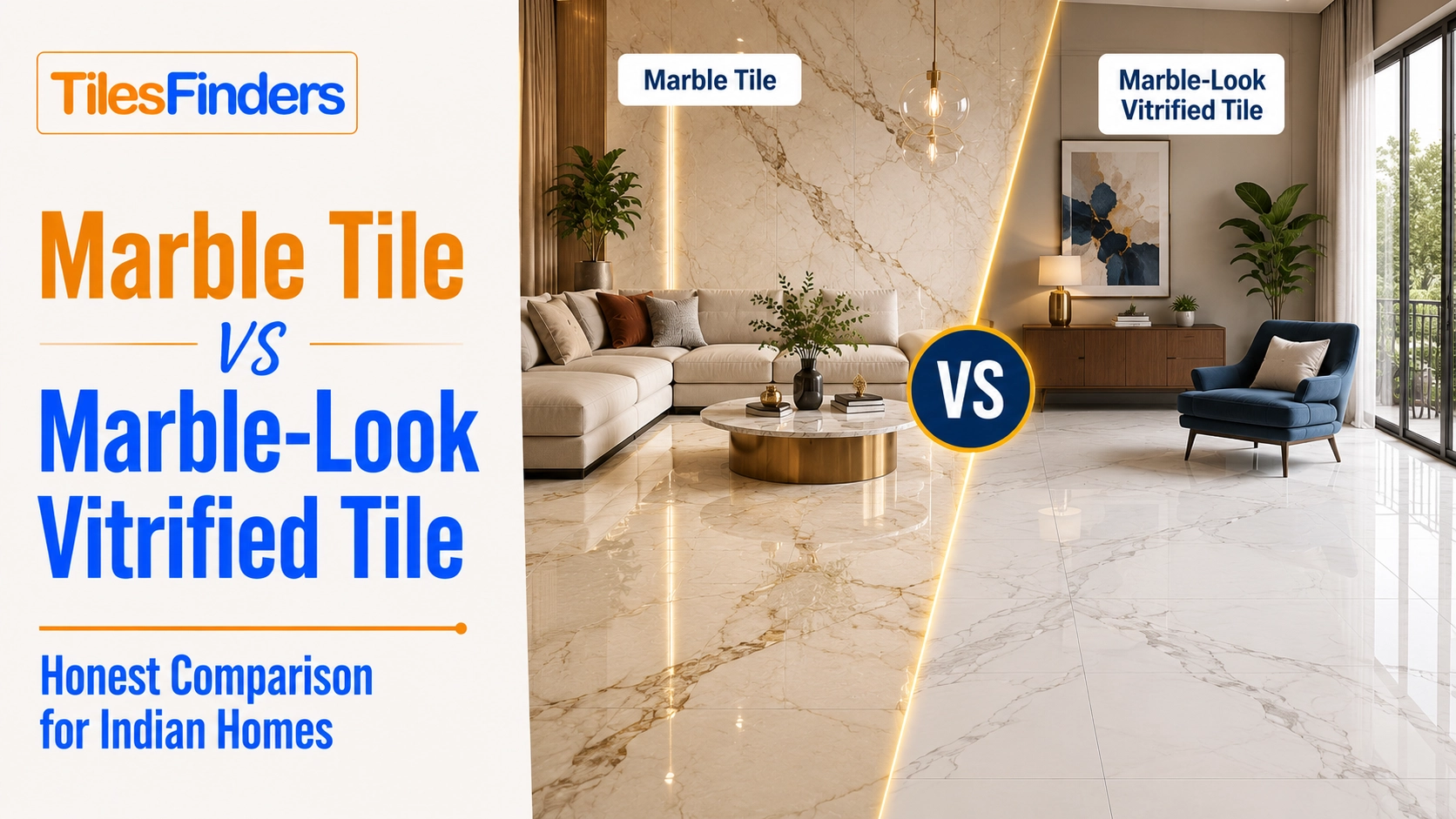
Real marble offers unmatched natural beauty, prestige, and resale value but requires sealing, polishing, and regular maintenance. Marble-look GVT and PGVT tiles deliver a similar visual appeal at a lower cost with better stain, scratch, and moisture resistance. For most Indian homes, vitrified tiles are the practical choice for everyday living spaces, while real marble is best reserved for premium statement areas where its unique character can be appreciated.
Marble has been the prestigious flooring material in Indian homes for generations. From the marble courtyards of Rajput havelis to the Italian marble floors of Mumbai sea-facing apartments, the association between marble and quality runs deep in how Indian buyers think about their homes.
Then came marble-look vitrified tiles. The same white body, the same grey veining, the same polished surface, at a fraction of the cost and with none of the maintenance burden. For many Indian homeowners today, the choice is no longer obvious.
This comparison covers both options honestly. Cost, appearance, durability, maintenance, Indian climate performance, and room-by-room suitability. By the end, you will know exactly when real marble justifies its premium and when marble-look vitrified tiles are the smarter choice for an Indian home.
What We Mean by Marble Tile and Marble-Look Vitrified Tile
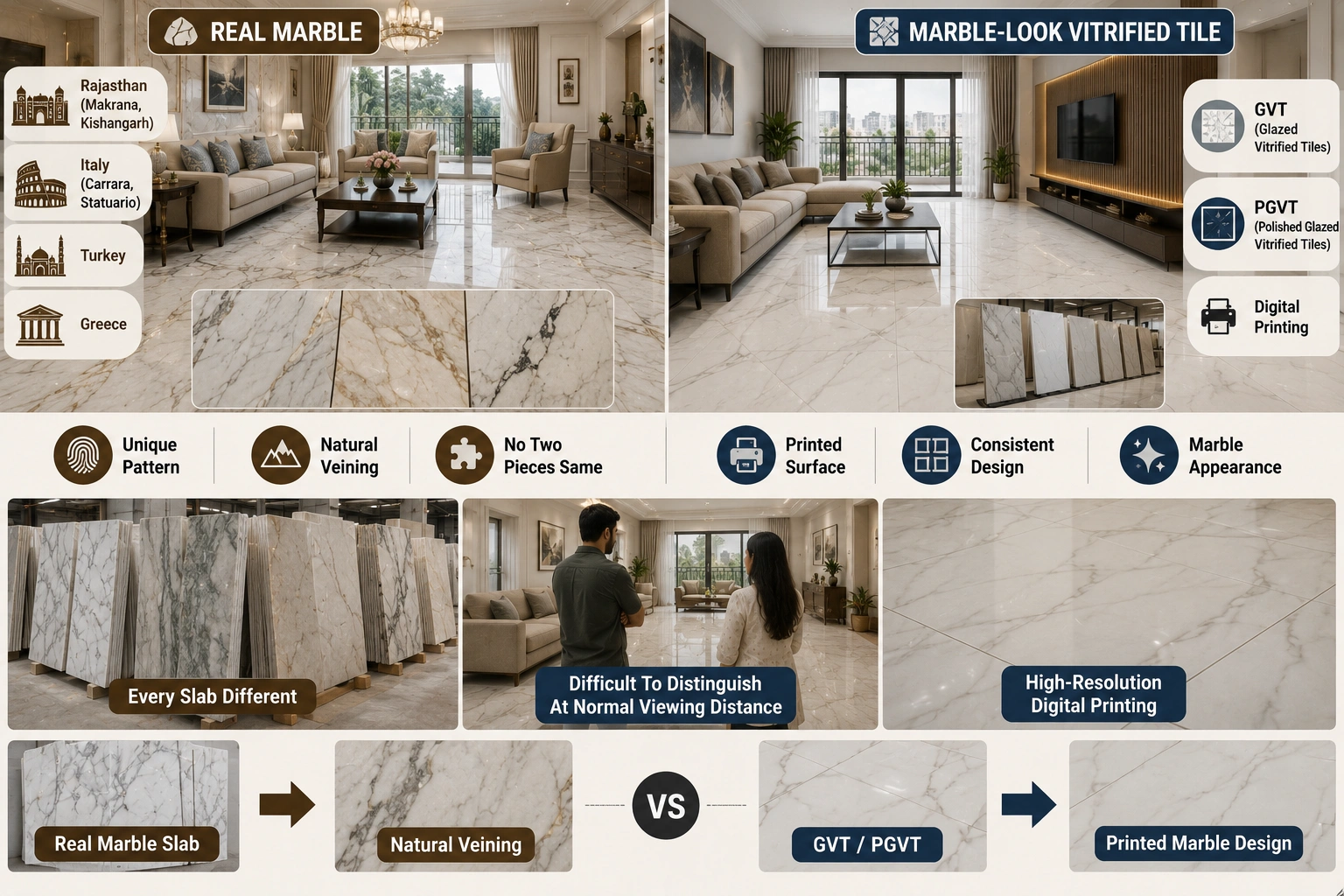
Real marble tile is cut from natural marble stone, quarried primarily in Rajasthan (Makrana, Kishangarh), Italy (Carrara, Statuario), Turkey, and Greece. Each slab is unique. The veining, colour variation, and surface character are natural and cannot be exactly replicated. Indian marble, like Makrana White,e has been used in historic monuments including the Taj Mahal.
Marble-look vitrified tile is a manufactured tile with a printed surface designed to replicate marble. The two main categories in India are GVT (Glazed Vitrified Tiles) and PGVT (Polished Glazed Vitrified Tiles). Both have a water absorption rate of 0.0 per cent or less, making them far less porous than natural marble. The printing process uses high-resolution digital technology that has improved dramatically since 2018. Today's best GVT and PGVT marble-look designs are genuinely difficult to distinguish from real marble at normal viewing distances.
The two are fundamentally different materials with different properties, different maintenance needs, and different performance profiles in Indian conditions. Knowing those differences is more useful than a simple better-or-worse verdict.
Cost Comparison: Purchase Price and Lifetime Cost
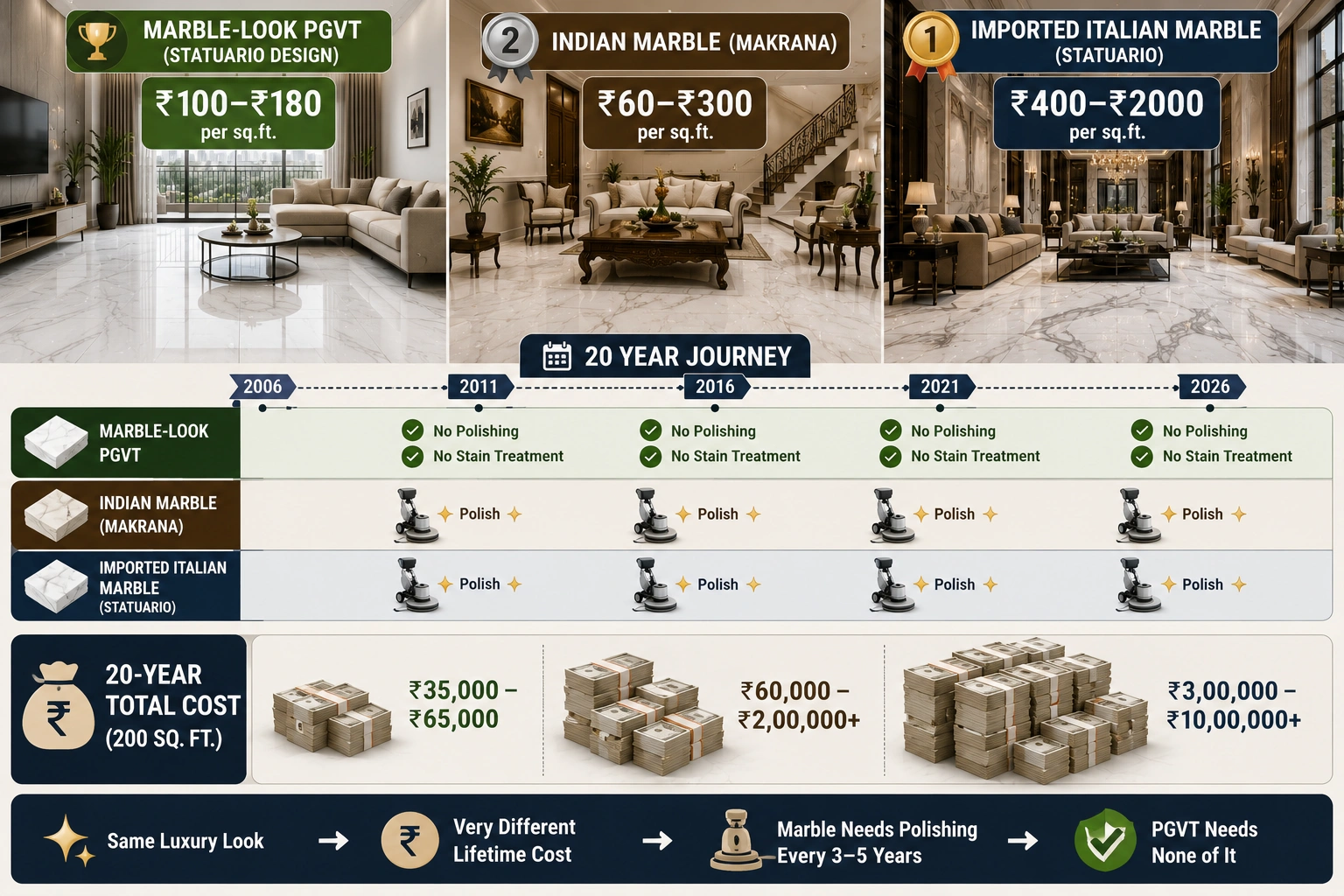
Indian Makrana White marble costs approximately Rs. 60 to Rs. 150 per sq. ft. for standard grade material. Premium Makrana with consistent white body and fine veining runs Rs. 150 to Rs. 300 per sq. ft. Imported Italian Statuario marble runs Rs. 400 to Rs. 2000 per sq. ft., depending on grade and slab size. These are material costs only, before cutting, polishing, and installation.
Marble-look PGVT in a Statuario design runs Rs. 100 to Rs. 180 per sq. ft. for a quality Indian manufactured tile. GVT matte marble-look runs Rs. 80 to Rs. 150 per sq. ft. Installation cost for both real marble and marble-look vitrified is roughly comparable at Rs. 25 to Rs. 50 per sq. ft. for standard residential work. Where real marble diverges significantly is in lifecycle cost.
Real marble requires professional polishing every 3 to 5 years in a busy Indian household. A standard living room polishing job (200 sq. ft.) costs Rs. 8000 to Rs. 20000, depending on the city and the condition of the marble. Over 20 years, polishing alone adds Rs. 50000 to Rs. 100000 to the cost of a marble floor that initially seemed affordable.
Marble-look vitrified tiles require no polishing, ever. The surface is factory-set and does not dull with age the way natural marble does. For a deeper look at what the different marble polishing finishes mean and what Indian homeowners should know before specifying them, the marble tile polishing guide covers Lippato, Honed, and Brushed finishes in detail.
| Cost Component | Indian Marble (Makrana) | Imported Marble (Italian) | Marble-Look PGVT |
| Material per sq. ft. | Rs. 60 to Rs. 300 | Rs. 400 to Rs. 2000 | Rs. 100 to Rs. 180 |
| Installation per sq. ft. | Rs. 25 to Rs. 50 | Rs. 40 to Rs. 80 | Rs. 25 to Rs. 45 |
| Polishing every 3-5 years | Rs. 40 to Rs. 100 per sq. ft. | Rs. 40 to Rs. 100 per sq. ft. | Not required |
| Stain treatment (occasional) | Rs. 20 to Rs. 60 per sq. ft. | Rs. 20 to Rs. 60 per sq. ft. | Not required |
| 20-year total cost (200 sq. ft.) | Rs. 60,000 to Rs. 2,00,000+ | Rs. 3,00,000 to Rs. 10,00,000+ | Rs. 35,000 to Rs. 65,000 |
Appearance: How Close Does Vitrified Actually Look?
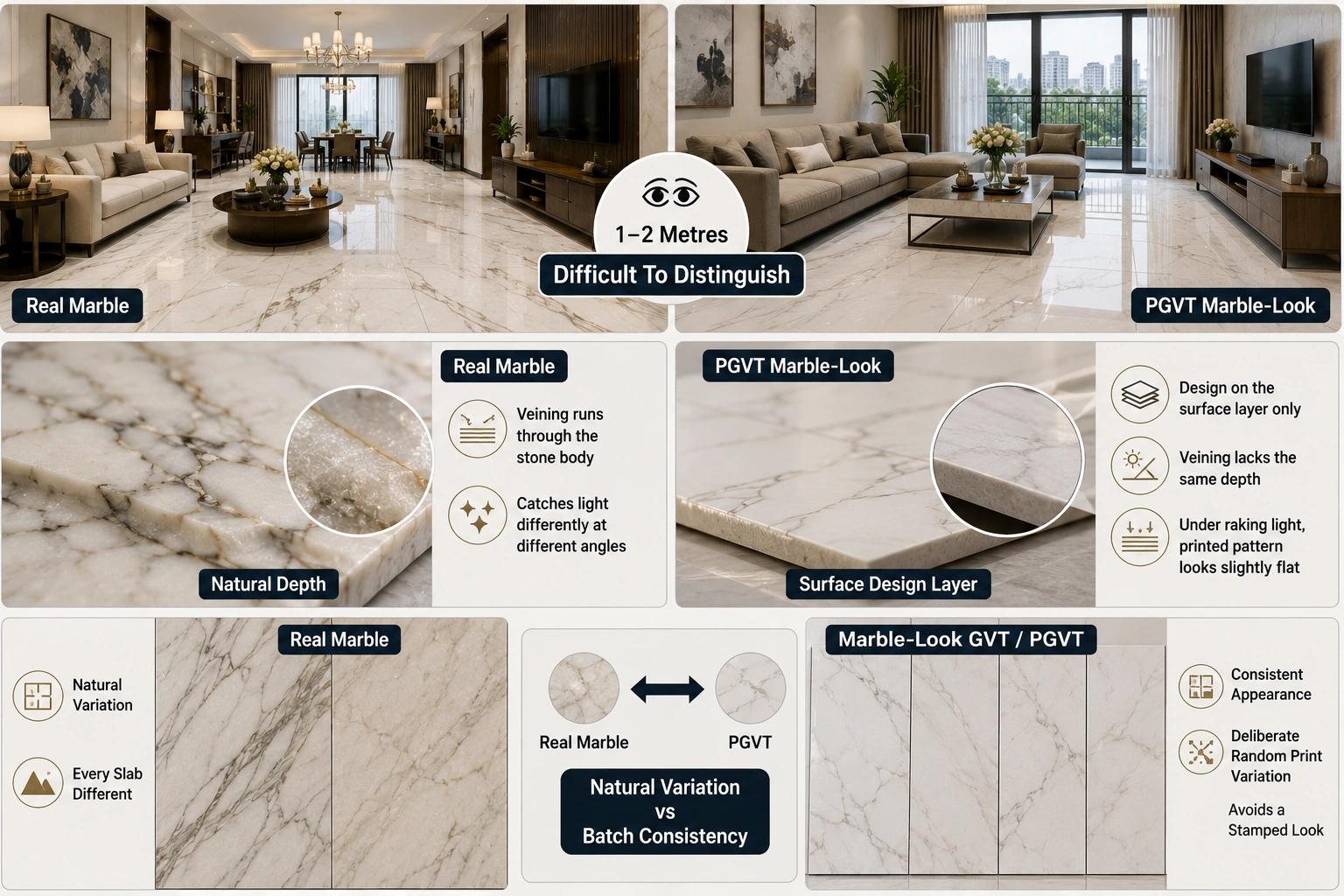
At a showroom viewing distance of 1 to 2 metres, today's best marble-look PGVT tiles are genuinely difficult to distinguish from real marble. The digital printing technology produces veining that mimics the random, natural movement of stone. In high-quality tiles, the pattern is non-repetitive across a batch, which is the key visual test.
Up close, at 30 cm or less, the differences become visible to a trained eye. Real marble has depth to its surface. The veining runs through the stone body and catches light differently at different angles. Marble-look vitrified has its design on the surface layer only. The veining does not have the same physical depth, and under raking light (light hitting the surface at a sharp angle), the printed pattern looks slightly flat.
Real marble also has natural variation between slabs that no tile batch can replicate. Two adjoining slabs of Italian Statuario will never match perfectly. This is considered a mark of authenticity by buyers who value natural stone. For some Indian homeowners, this uniqueness is precisely what they are paying for. Marble-look vitrified tiles aim for consistency: each tile in a batch is similar.
The best GVT and PGVT manufacturers introduce deliberate random printing variation to avoid a stamped look. To understand how to identify genuine Statuario marble versus a high-quality replica in the Indian market, see the guide on identifying real versus replica Statuario marble in India.
Durability and Hardness in Indian Conditions
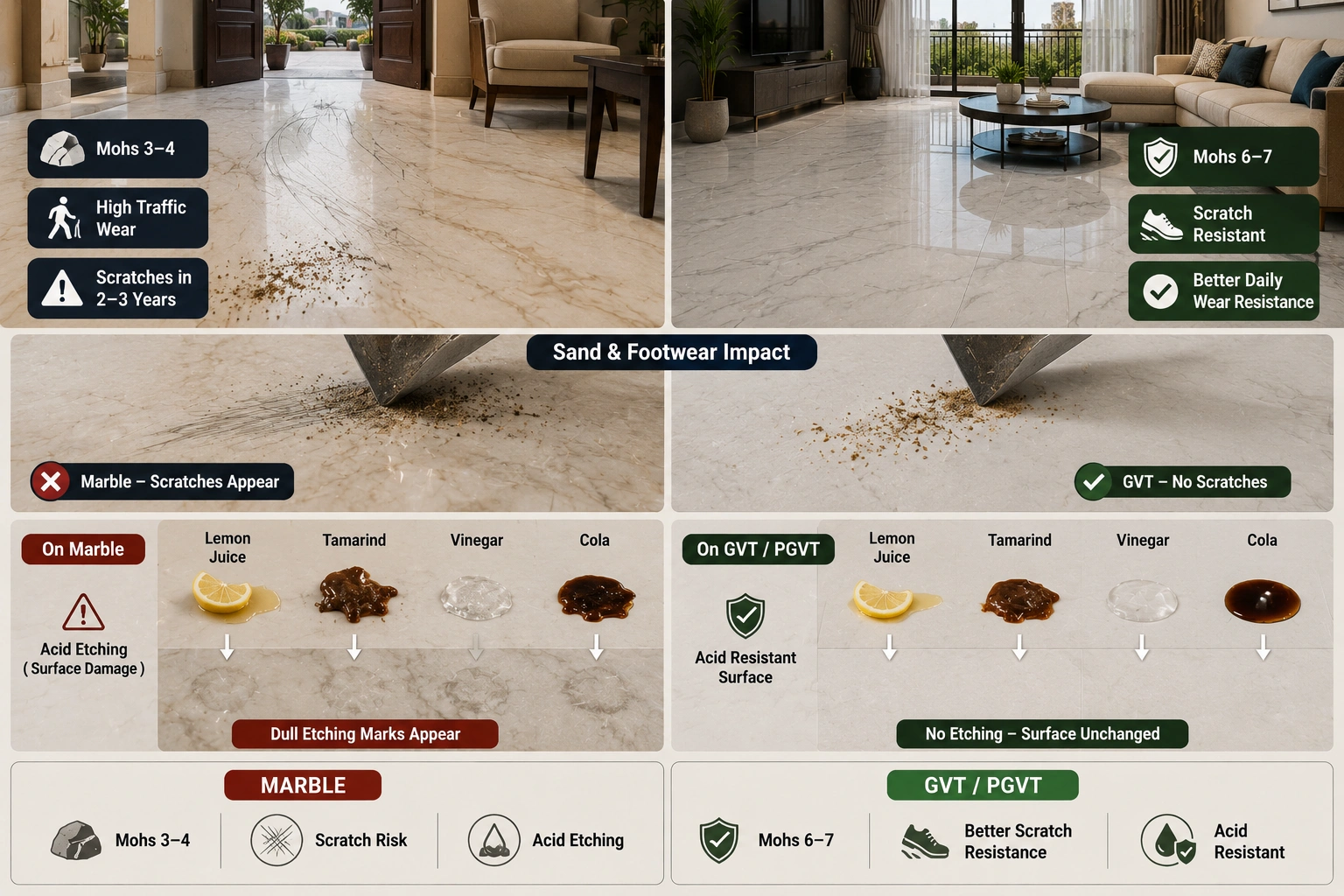
Marble is a metamorphic rock with a Mohs hardness of 3 to 4. This is softer than most vitrified tile surfaces. Indian conditions are hard on natural marble. Sand particles tracked in from streets and construction sites act as abrasives on marble floors. In homes near busy roads in Delhi, Mumbai, or Chennai, marble floors in high-traffic areas (entryways, living rooms) show wear and scratches within 2 to 3 years without regular maintenance.
Marble-look GVT has a surface hardness of 6 to 7 on the Mohs scale. It resists everyday scratching from sand, footwear, and furniture movement far better than natural marble. PGVT polished surfaces are slightly softer than GVT matte because the polishing process removes some of the harder glaze layer, but still outperform natural marble on scratch resistance.
Marble is also susceptible to acid etching. Common Indian kitchen and bathroom substances, including lemon juice, tamarind, vinegar, cola, and most cleaning products with a pH below 7, leave dull etching marks on polished marble surfaces. These are not stains but surface damage to the calcium carbonate structure of the stone. Vitrified tiles are completely acid-resistant. No everyday household substance will etch a GVT or PGVT surface.
Maintenance: Daily Cleaning and Long-Term Care
Real Marble Maintenance
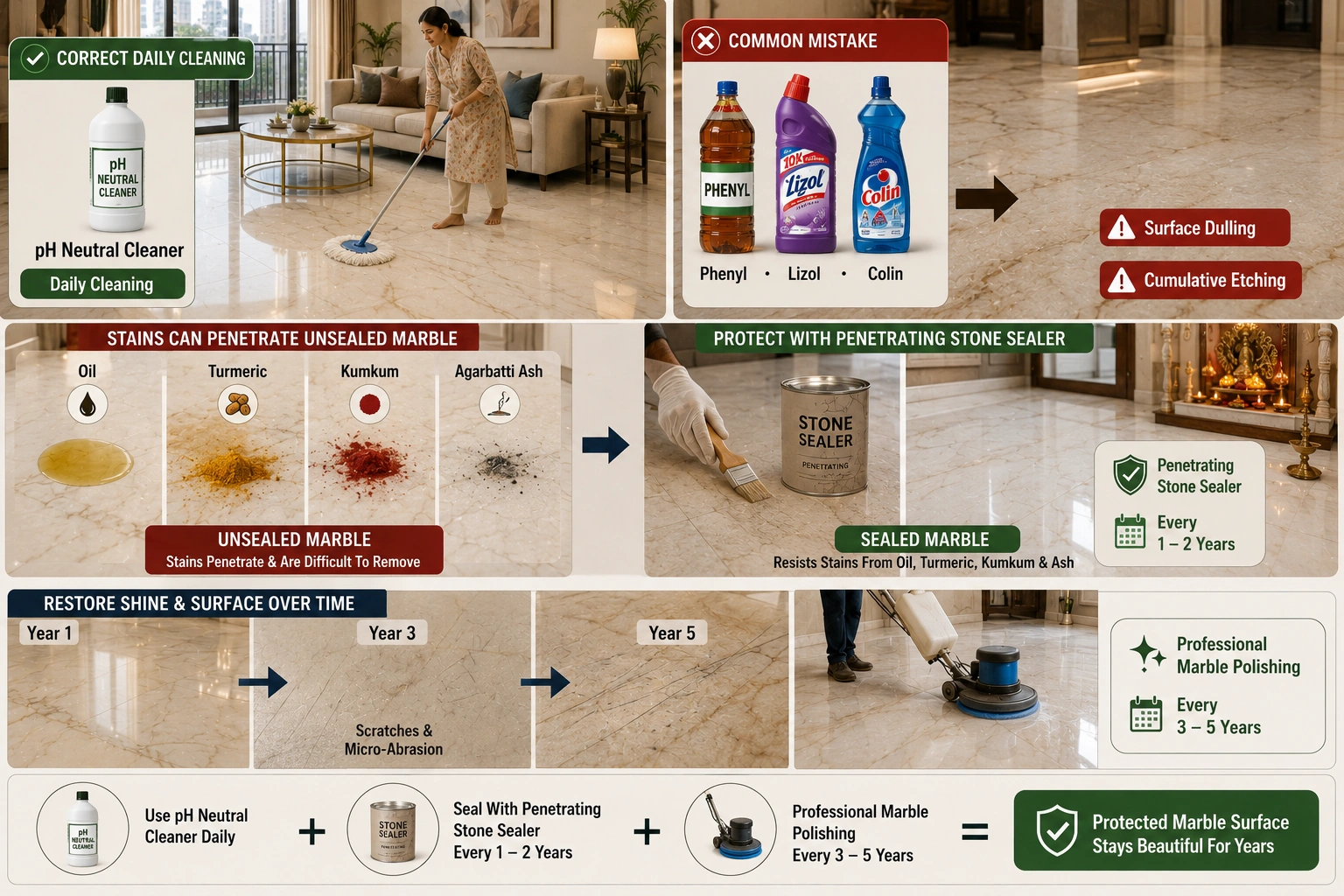
Daily cleaning of real marble requires a pH-neutral cleaner. Standard Indian floor cleaners (Phenyl, Lizol, Colin) are acidic and damage marble surfaces over time. Indian households that use these products on marble floors inadvertently cause cumulative etching thatdullsl the surface within 2 to 3 years. Many homeowners then blame the marble quality rather than the cleaning product.
Real marble floors need sealing with a penetrating stone sealer every 1 to 2 years to reduce porosity and limit staining. Unsealed marble in Indian kitchens and pooja rooms stains from oil, turmeric, kumkum, and agarbatti ash. These stains can be very difficult to remove once they penetrate the stone. Professional marble polishing every 3 to 5 years restores the surface shine after scratching and micro-abrasion. Yellowing in Indian marble, a common complaint in older homes, is covered in the guide on marble tile yellowing and staining causes and prevention in the Indian climate.
Marble-Look Vitrified Maintenance
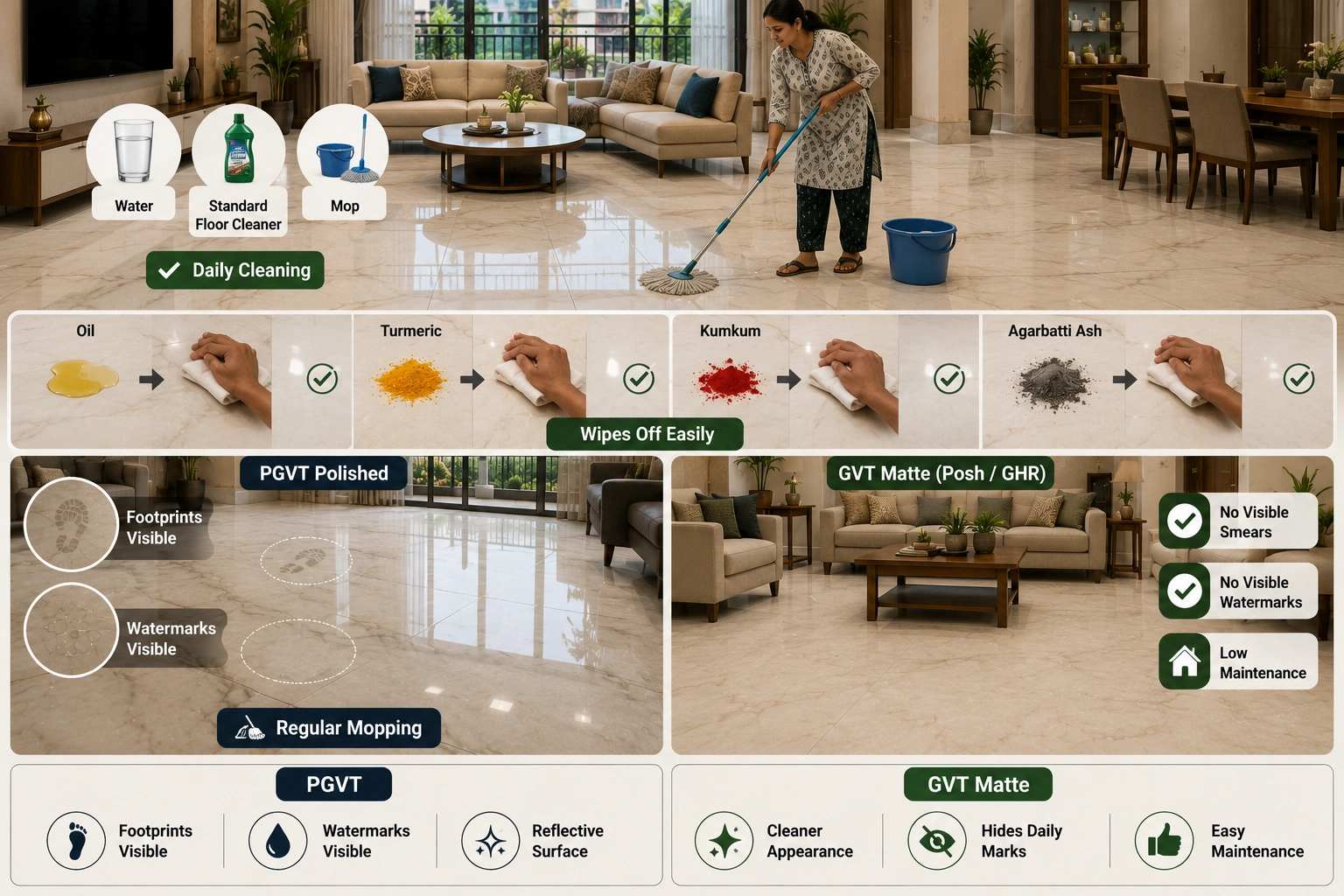
Marble-look vitrified tiles need no special cleaning products. Standard floor cleaners, water, and a mop handle are used daily with no damage. The glazed surface does not absorb stains from oil, turmeric, kumkum, or agarbatti ash. Most stains wipe off with a damp cloth within seconds of contact.
PGVT polished tiles show water marks and footprints more than GVT matte because the reflective polished surface makes smears visible. In Indian homes with daily mopping (which is the standard practice in most households), this is manageable. GVT matte marble-look tiles in a Posh or GHR finish are the lowest-maintenance option because they do not show smears or watermarks under normal conditions.
Indian Climate Performance: Monsoon, Heat, and Hard Water
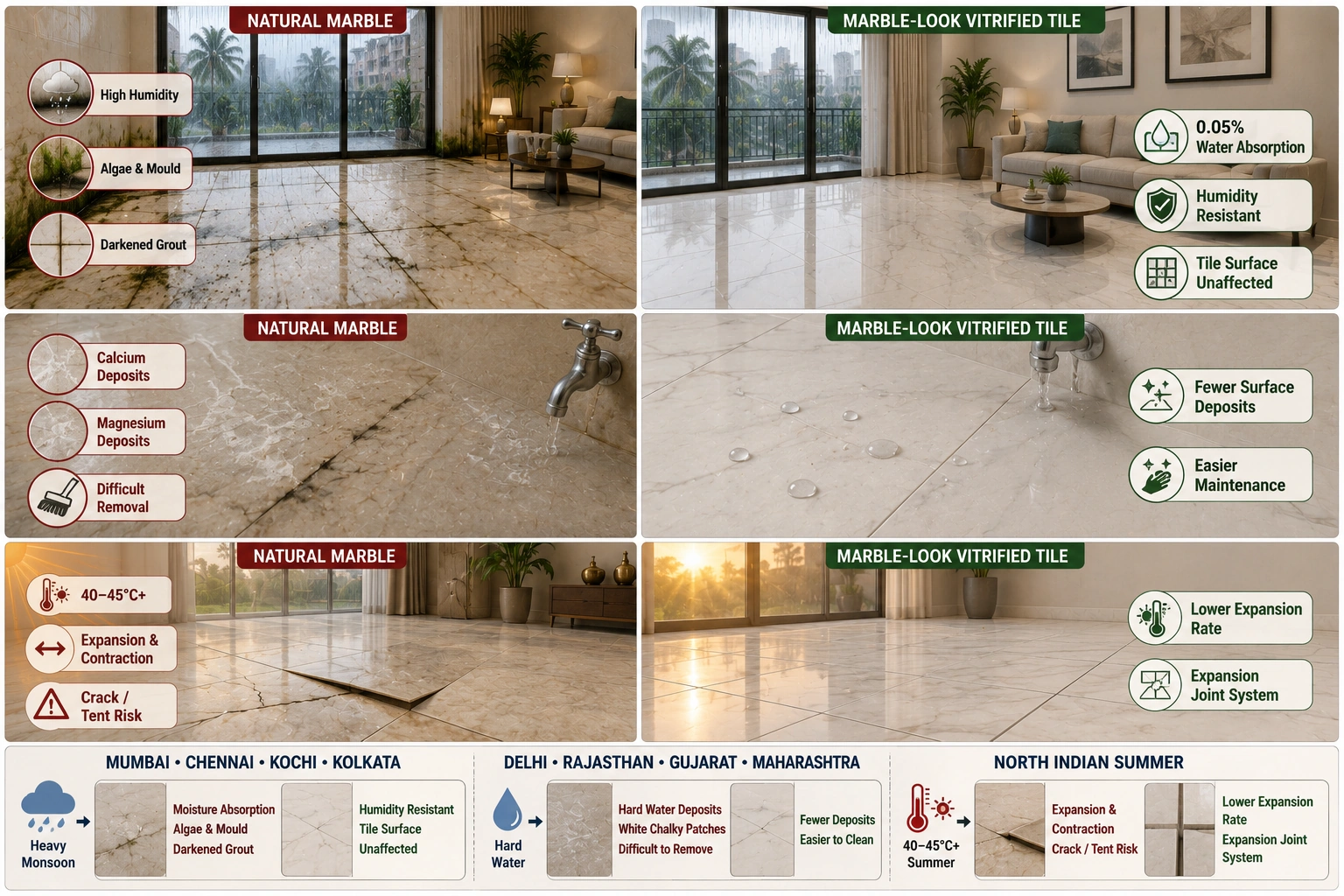
Monsoon humidity is a genuine challenge for natural marble in coastal and humid cities like Mumbai, Chennai, Kochi, and Kolkata. High ambient moisture over 4 to 5 months accelerates the growth of biological stains (algae, mould) in unpolished or freshly polished marble floors. Grout lines in marble installations absorb moisture and darken over time in humid conditions without regular treatment.
Marble-look vitrified tiles with their 0.05 per cent water absorption are essentially impervious to humidity. Grout lines can still darken in wet areas, but the tiles themselves are unaffected by monsoon conditions. This is one of the most significant practical advantages of vitrified over natural marble for Indian coastal homeowners.
Hard water is a major issue in most Indian cities. Delhi, Rajasthan, Gujarat, and parts of Maharashtra have particularly hard municipal and borewell water. The calcium and magnesium deposits in hard water leave white chalky patches on polished marble that are difficult to remove without acidic cleaners, which themselves damage the marble. Vitrified tiles handle hard water deposits better because the glazed surface has fewer microscopic pores for deposits to grip.
Thermal expansion is relevant for large marble floor installations in Indian climates where summer temperatures exceed 40 to 45 degrees Celsius in many northern cities. Marble expands and contracts with temperature. Without adequate expansion joints, large marble floors can crack or tent (lift) in extreme summer conditions. Vitrified tiles also expand, but at a lower rate, and installation standards for vitrified tiles include expansion joint guidelines that most Indian tile contractors are familiar with.
Room-by-Room Recommendation for Indian Homes
Living Room and Hall
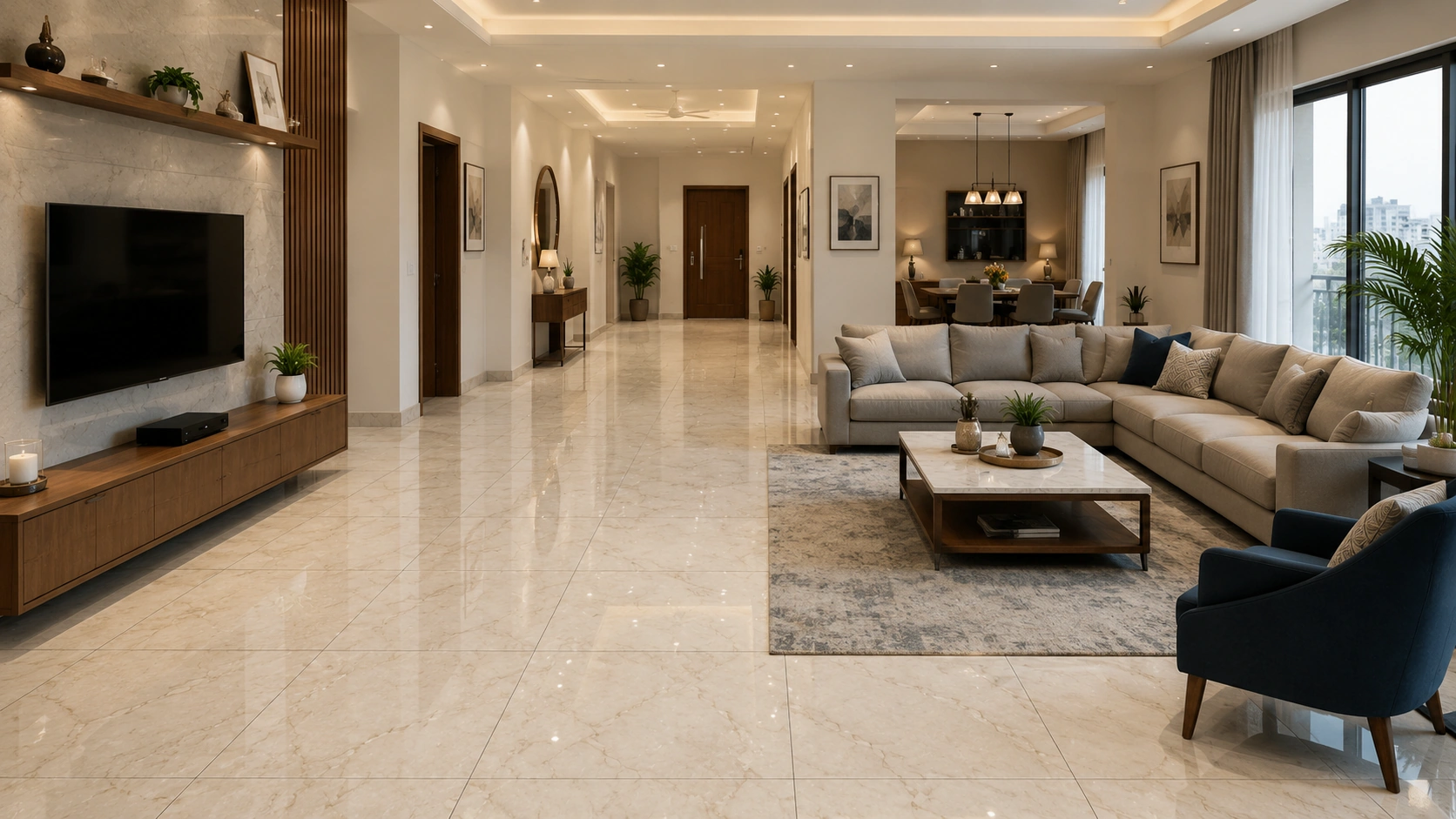
For large living rooms above 200 sq. ft. with good natural light, real Makrana White or imported Italian marble creates a floor that vitrified genuinely cannot match in depth and character. If the household has no children, minimal sand ingress, a reliable maintenance routine, and a budget for polishing cycles, real marble in the living room is a premium choice that holds its visual quality for decades with proper care.
For most Indian families with children, pets, or heavy daily use, marble-look PGVT in a Statuario or Calacatta design gives 85 to 90 per cent of the visual effect at 30 to 40 per cent of the total lifetime cost. In 2BHK and 3BHK apartments with a living room area below 200 sq. ft., the difference in visual outcome between real marble and a high-quality PGVT is small enough that most visitors cannot tell.
Master Bedroom
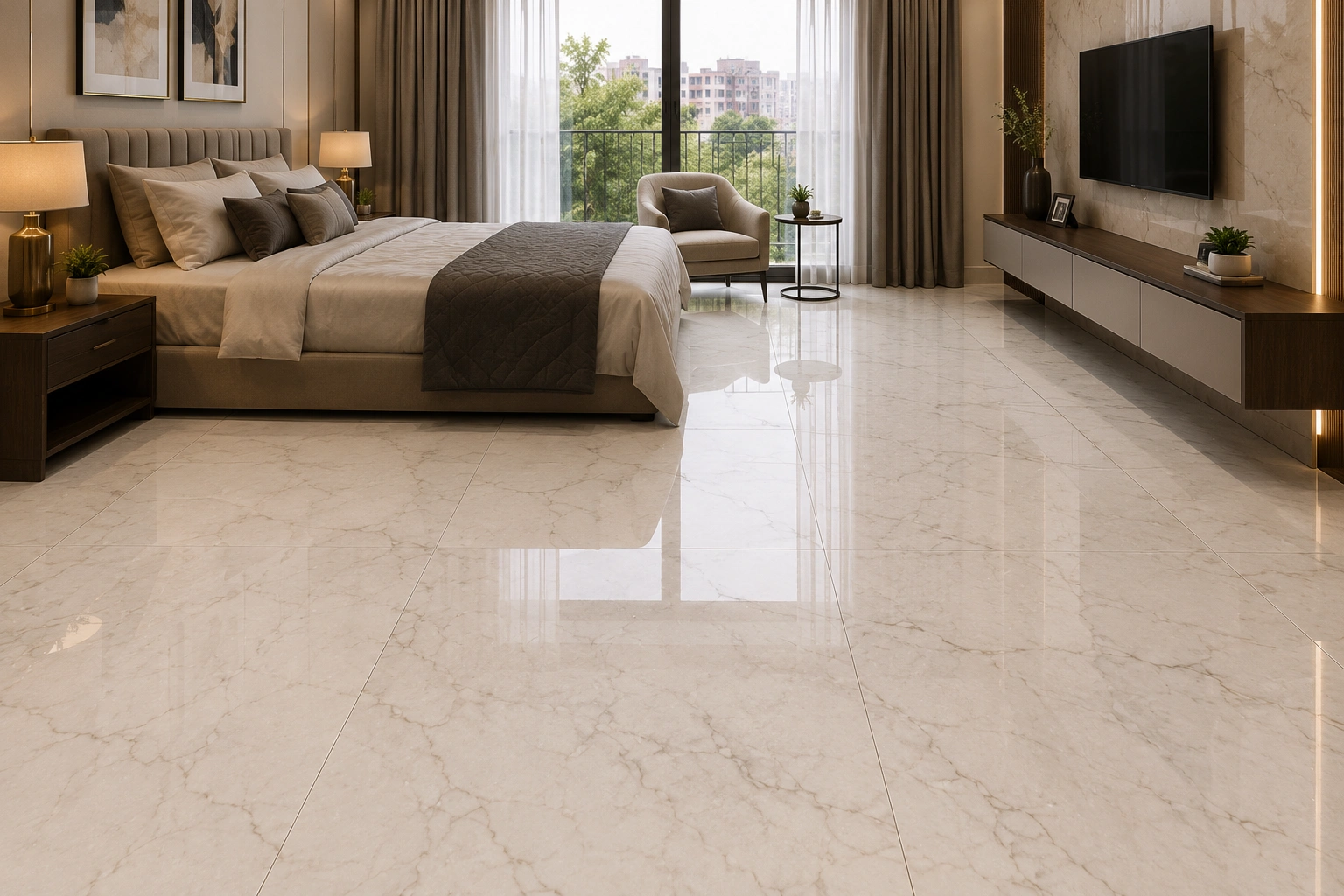
Bedrooms are lower-traffic areas than living rooms and see less sand ingress. This makes them more forgiving of real marble. Indian bedrooms also rarely use acidic cleaning products on the floor because mopping with plain water is the standard practice. For these reasons, real Makrana White marble holds up reasonably well in bedrooms with basic maintenance.
That said, marble-look GVT in a Posh finish is an excellent choice for Indian master bedrooms. It gives a quieter, more comfortable underfoot feel in matte finish, handles bare-foot daily use without slipperiness concerns, and requires no special cleaning or polishing.
Bathroom and Wet Areas
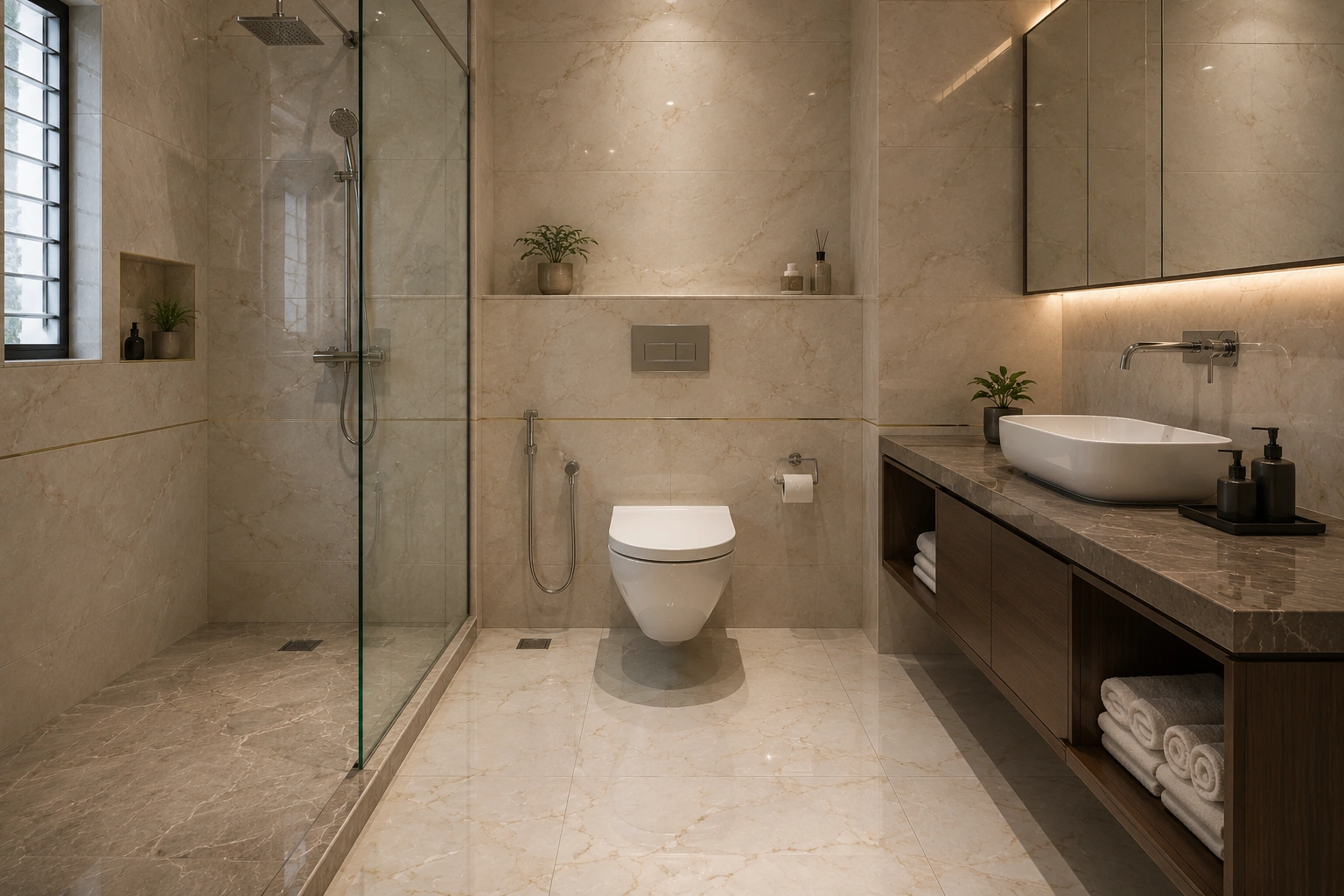
Real marble in Indian bathrooms is a high-maintenance choice. Daily water contact, soap residue, hard water deposits, and the acidic pH of most Indian bathroom cleaners all work against marble surfaces. Polished marble floors become slippery when wet. Honed or brushed marble finishes are safer in wet areas but still require careful maintenance.
For Indian bathroom floors, marble-look GVT with a matte or Rain Drops anti-skid finish is the practical choice. For bathroom walls, marble-look PGVT in large 2x4 (600x1200 mm) or 32x64 (800x1600 mm) format gives a clean, high-end look that requires nothing more than a weekly wipe-down. Real marble on bathroom walls works beautifully if the sealing and maintenance schedule is maintained consistently.
Kitchen
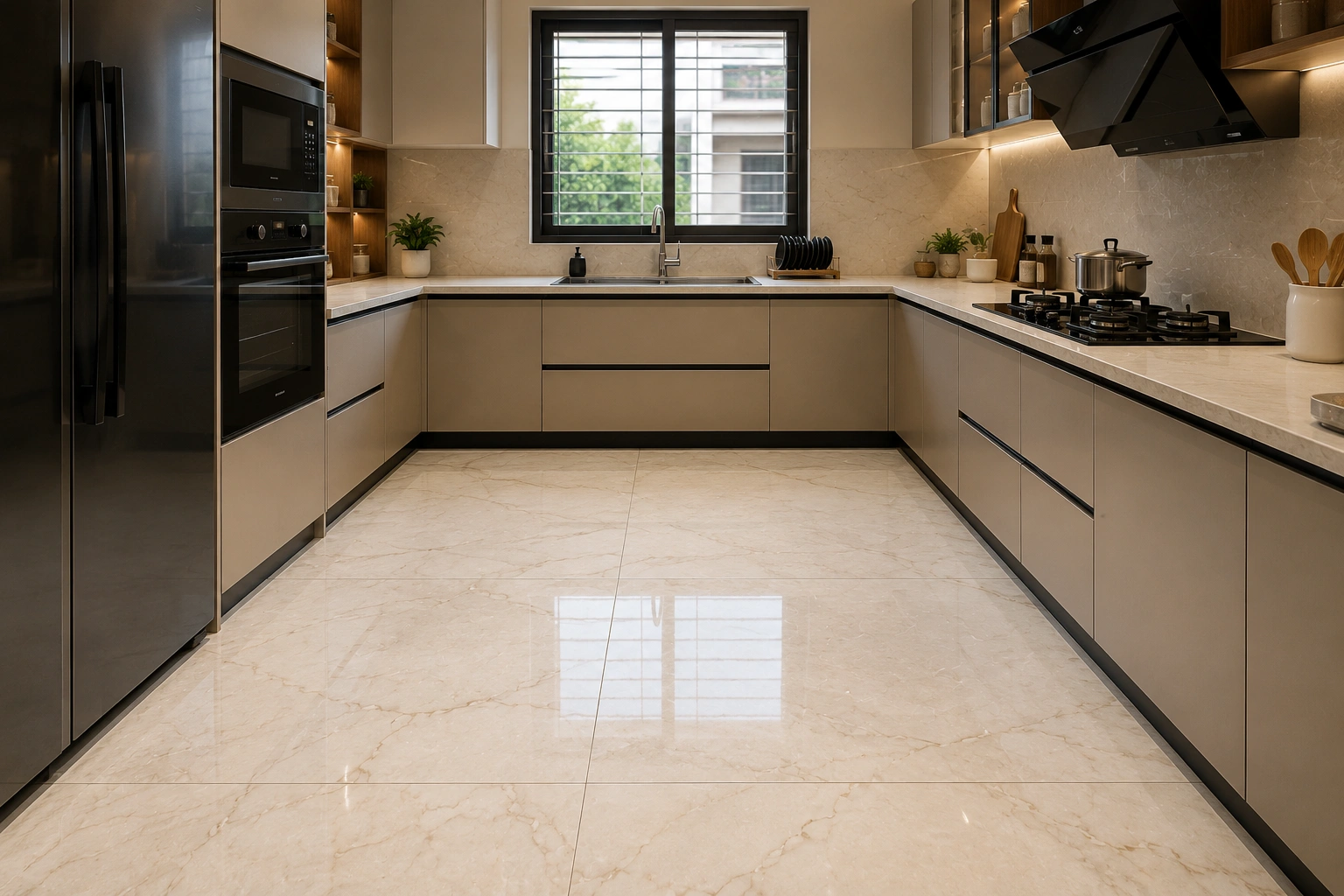
Real marble on Indian kitchen floors is generally not recommended. The combination of oil splatter, turmeric, masala stains, lemon juice, and the acidic cleaners used to degrease Indian kitchen floors will damage marble surfaces within months of use. Kitchen platforms in marble can work with very diligent care and immediate cleaning of any acidic contact. However, for everyday Indian cooking habits, marble-look GVT with a matte or GHR finish is the far more practical kitchen floor choice.
Pooja Room
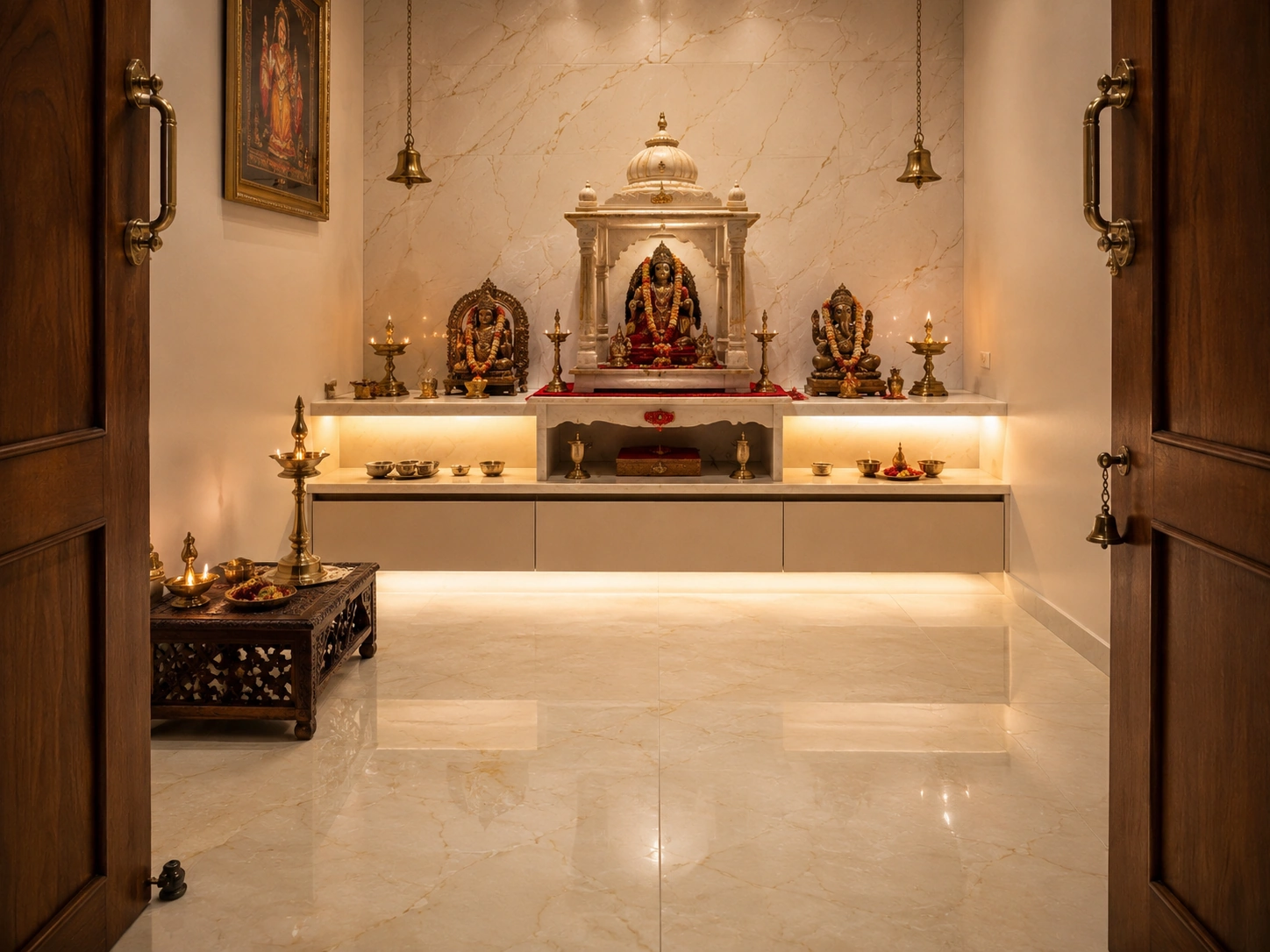
Pooja rooms present a specific challenge. Real marble has deep cultural and spiritual significance in Indian homes, and many families specifically want natural stone in their prayer space. The challenge is that agarbatti ash, diya oil, kumkum, and haldi are all staining agents on marble. With daily puja practice, real marble in a pooja room needs careful and consistent maintenance.
White marble-look PGVT or GVT tiles in a pooja room give the visual sanctity of marble with practical resistance to daily puja stains. For homeowners who feel strongly about natural materials in the prayer space, using a small amount of genuine Makrana marble as a platform or altar surface, while tiling the floor and walls with marble-look vitrified, is a common and sensible approach.
Resale Value: Which Adds More to Your Home's Worth
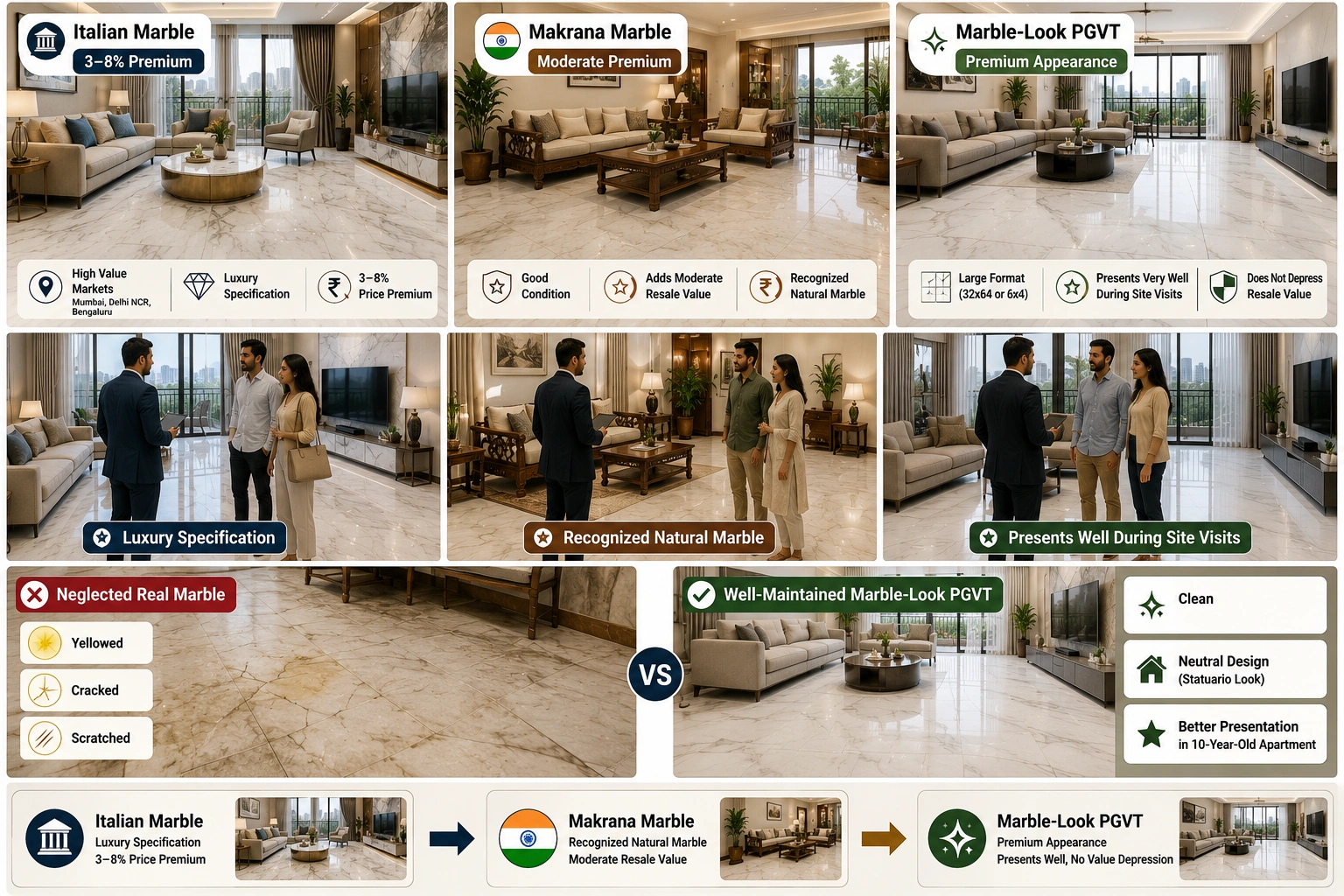
Real Italian marble (Statuario, Calacatta) in good condition adds a measurable premium to a property's resale value in the Indian market, particularly in Mumbai, Delhi NCR, and Bengaluru. Premium apartment buyers and property valuers still associate Italian marble with luxury specification. A living room floor in genuine Statuario marble is noted in property listings and can support a 3 to 8 per cent price premium in high-value markets.
Indian Makrana marble in good condition adds moderate resale value. Marble-look vitrified tiles do not carry the same resale premium because buyers and valuers recognise the difference. However, a well-maintained marble-look PGVT floor in a premium large format (32x64 or 6x4) presents very well during site visits and does not depress resale value the way worn, scratched, or yellowed real marble can.
A key point most homeowners overlook: poorly maintained real marble hurts resale value more than marble-look vitrified. Yellowed, cracked, or heavily scratched marble in an old apartment is one of the first renovation items a new buyer flags for replacement. A clean, well-laid marble-look PGVT floor in a neutral Statuario design will present better in a 10-year-old apartment than neglected real marble.
Vastu Shastra and Marble: What Indian Buyers Ask
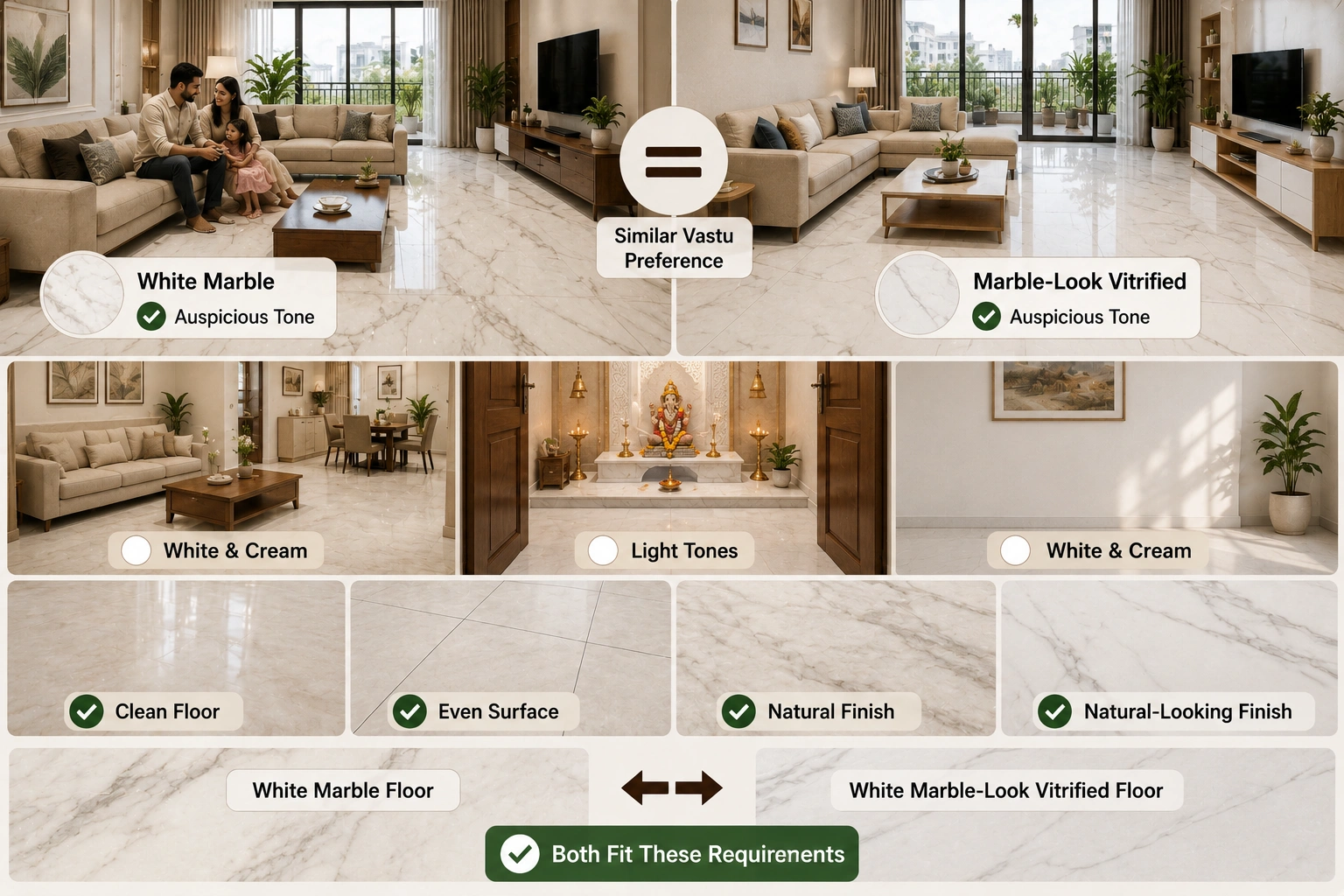
Many Indian homeowners ask whether Vastu Shastra has a preference between real marble and marble-look vitrified. Traditional Vastu texts reference natural stone as an auspicious material for homes, particularly white and light-toned stone for living spaces and prayer areas. However, contemporary Vastu practitioners generally focus more on colour and direction than on whether a material is natural or manufactured.
White and cream tones are considered auspicious in Vastu for living rooms, pooja rooms, and north-facing walls, regardless of whether the material is real marble or vitrified. The most common Vastu guidance around flooring focuses on avoiding dark colours in the pooja room, maintaining clean and even floor surfaces, and using natural or natural-looking finishes in prayer spaces. Both real marble and marble-look vitrified tiles can satisfy these requirements.
Verdict: When to Choose Real Marble and When to Choose Vitrified
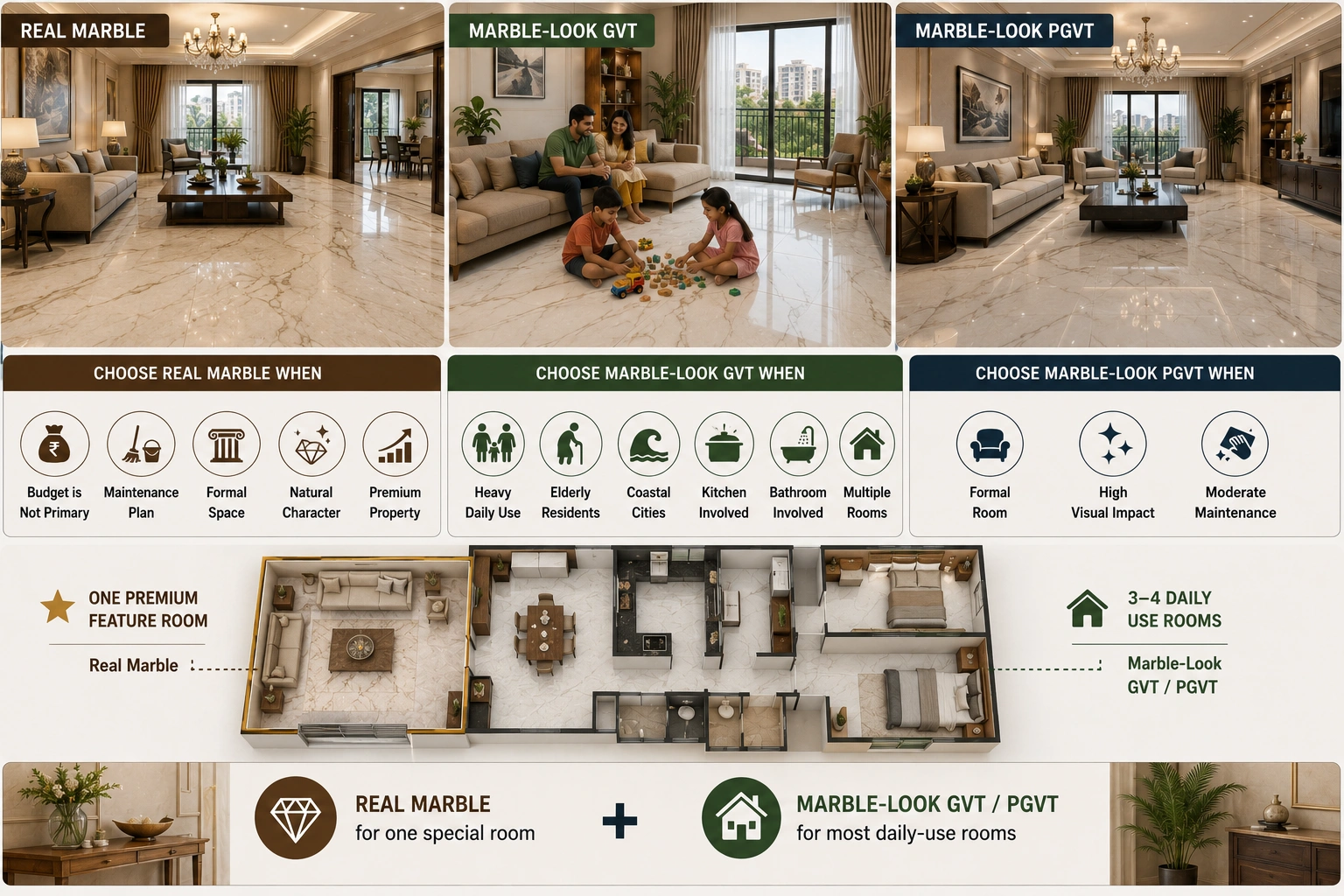
Choose real marble when: budget is not the primary constraint, you have a reliable and consistent maintenance plan, the room is a formal space with lower daily foot traffic, natural stone's unique character is important to you, and the project is a premium property where Italian marble contributes to resale value.
Choose marble-look vitrified tiles when: the room sees heavy daily use, there are children or elderly family members in the household, the home is in a coastal or high-humidity city, the kitchen or bathroom is involved, the total budget needs to be managed across multiple rooms, or ongoing polishing and maintenance are not practical.
For most Indian homeowners in 2026, marble-look GVT or PGVT in a large format is the practical choice for 3 to 4 rooms out of 5. Real marble, if chosen, is best reserved for the one room where its unique character and visual depth will be most appreciated and where the maintenance commitment is genuinely sustainable.
For a full breakdown of how marble compares to granite and quartz as flooring choices in Indian homes, the comparison of marble versus granite versus quartz tiles covers cost, durability, and maintenance across all three options.
| Factor | Real Marble | Marble-Look GVT | Marble-Look PGVT |
| Purchase price | Rs. 60 to Rs. 2000+ per sq. ft. | Rs. 80 to Rs. 150 per sq. ft. | Rs. 100 to Rs. 180 per sq. ft. |
| 20-year lifecycle cost | High (polishing + sealing) | Low (no maintenance) | Low (no maintenance) |
| Scratch resistance | Low (Mohs 3 to 4) | High (Mohs 6 to 7) | Moderate (Mohs 5 to 6) |
| Acid resistance | None (etches easily) | Full resistance | Full resistance |
| Monsoon/humidity performance | Needs careful maintenance | Excellent | Excellent |
| Hard water resistance | Poor (deposits stick) | Good | Moderate (shows marks) |
| Wet area suitability | Not recommended (slippery) | Yes (with anti-skid finish) | No (slippery when wet) |
| Maintenance effort | High | Low | Moderate (shows smears) |
| Resale value contribution | High (premium properties) | Moderate | Moderate |
| Vastu acceptance | Traditional preference | Acceptable | Acceptable |
Compare Marble and Marble-Look Tiles Before You Buy
Choosing between real marble and marble-look vitrified tiles depends on more than appearance alone. Factors such as budget, maintenance requirements, room usage, climate conditions, and long-term ownership costs all play a role in determining which material is the better fit for your home. While natural marble offers unique character and prestige, marble-look vitrified tiles deliver a similar visual appeal with greater stain resistance, lower maintenance, and predictable performance.
To make the comparison easier, TilesFinders allows homeowners to explore marble-look GVT and PGVT collections from verified Indian dealers, compare sizes, finishes, designs, and price ranges, and shortlist suitable options before visiting a showroom. Reviewing specifications in advance helps narrow down choices and ensures you select a flooring solution that matches both your design goals and practical requirements.
FAQs
Neither is universally better. Real marble has unique visual depth, cultural significance, and adds resale value in premium properties. But it requires regular polishing, sealing, and pH-neutral cleaners, and performs poorly in Indian kitchens, bathrooms, and humid coastal cities. Marble-look vitrified tiles (GVT or PGVT) resist scratching, acid etching, and moisture far better, need no polishing, and cost 60 to 80 per cent less over 20 years. For most Indian households, marble-look vitrified is the practical choice for high-use rooms.
Indian Makrana White marble costs Rs. 60 to Rs. 300 per sq. ft. for material. Imported Italian Statuario runs Rs. 400 to Rs. 2000 per sq. ft. Marble-look PGVT in Statuario design costs Rs. 100 to Rs. 180 per sq. ft. from Indian manufacturers. But the real cost difference appears over time: real marble needs polishing every 3 to 5 years at Rs. 40 to Rs. 100 per sq. ft. and stain treatment periodically. Marble-look vitrified needs none of this. Over 20 years on a 200 sq. ft. floor, the total cost difference is often Rs. 1 lakh or more.
Marble-look vitrified tiles are significantly easier to maintain. They clean with any standard floor cleaner, resist acid etching from kitchen and bathroom products, do not need sealing or polishing, and handle monsoon humidity without any special treatment. Real marble requires pH-neutral cleaners only, annual or biannual sealing, professional polishing every 3 to 5 years, and immediate treatment of any acidic spill. For Indian households with daily cooking and active children, the maintenance difference is substantial.
Technically, yes, but it is not recommended for daily use in Indian bathrooms. Polished marble is slippery when wet. Soap, hard water, and most Indian bathroom cleaners etch and dull the marble surface over time. If you want marble in the bathroom, use honed (matte) finish on the floor for grip, and reserve polished marble for the walls above the splash zone. Marble-look GVT with an anti-skid matte finish is the safer and more practical choice for Indian bathroom floors.
Traditional Vastu texts favour natural stone, but contemporary Vastu practitioners generally focus on colour and direction rather than distinguishing real stone from manufactured tiles. White and cream tones are considered auspicious for living rooms and pooja rooms, regardless of material. Both real marble and white marble-look vitrified tiles satisfy typical Vastu colour guidance. If Vastu compliance is important to you, focus on the tile colour and the room direction rather than the material category.
- High-quality PGVT in Statuario White or Calacatta Gold designs from established Indian manufacturers (primarily from Morbi, Gujarat) are the closest to real marble at normal viewing distance. The key quality indicator is non-repetitive random printing: each tile in a good batch should look slightly different, just as real marble slabs vary naturally. Ask your dealer to lay out 6 to 8 tiles side by side before purchasing. If all tiles look identical, the design will look obviously printed once laid.
