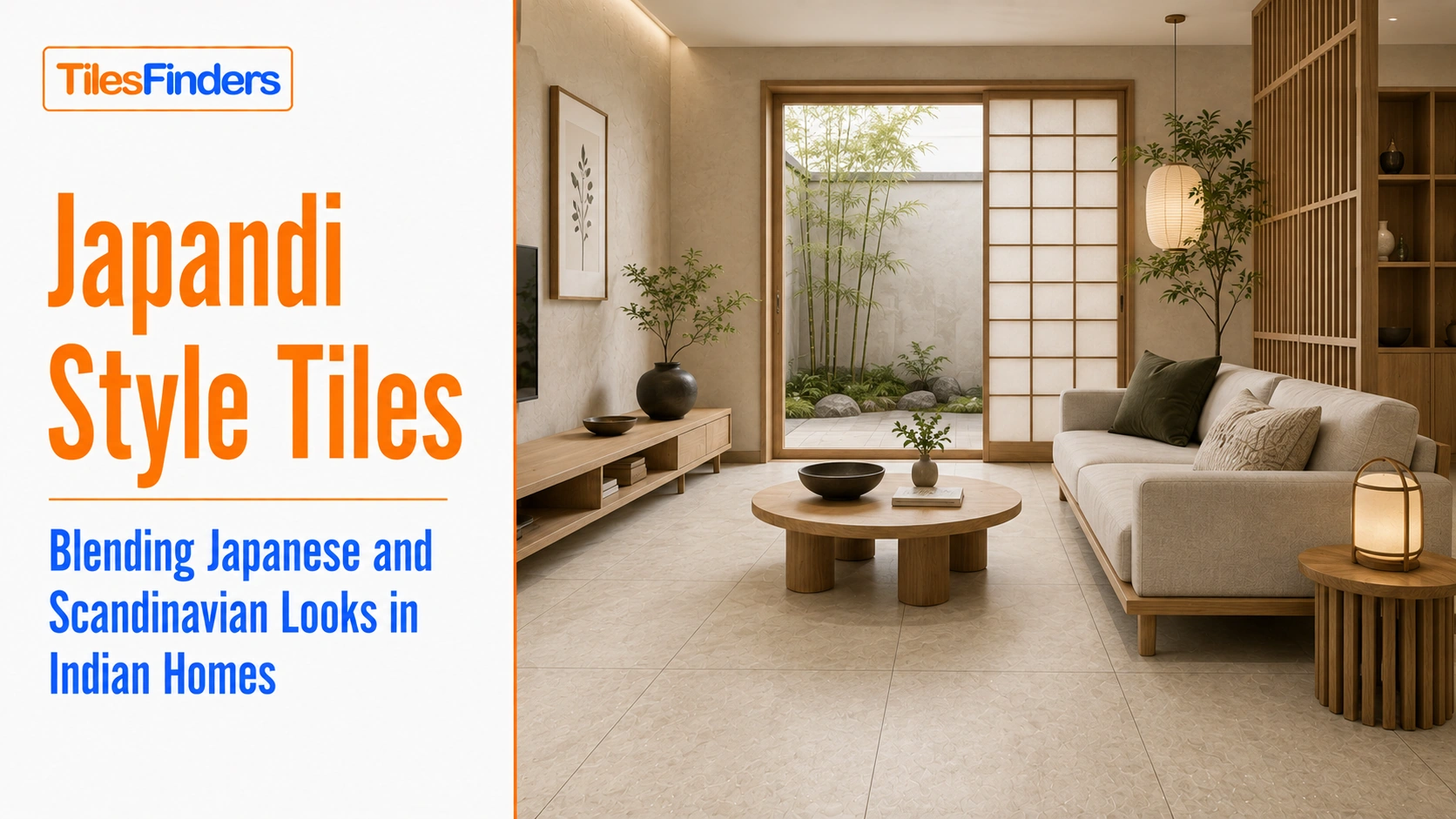
Japandi Style Tiles: Blending Japanese and Scandinavian Looks in Indian Homes
Japandi palettes were built for Nordic daylight, so Indian sun turns them yellow. This guide covers the shade correction, honest-material rules, and grout details for a calm floor.
- What Japandi Asks of a Surface
- The Daylight Correction Nobody Makes
- The Honesty Problem With Wood-Look Tile
- The Palette as Tile Shades, Not Paint Chips
- Room by Room in Japandi Terms
- Three Technical Details That Decide Whether It Reads Calm
- Where Japandi and Indian Homes Genuinely Conflict
- Six Mistakes in Japandi Tile Selection
- Settling on a Restrained Shortlist
Japandi palettes were built for Nordic daylight. Indian daylight is warmer and harder, so a shade that reads calm in a reference photo reads yellow here. This covers the correction, the honest-material problem with wood-look tile, and the grout and face-count details that decide whether a minimal floor looks quiet.
Japandi advice comes in paint chips. Warm off-white walls, sage accents, light oak furniture, matte black hardware. Useful if you are painting a wall in Copenhagen.
A floor is a different commitment. You cannot repaint it three days later when the shade turns out wrong against your furniture, and in India it turns out wrong for a reason nobody writing about Japandi has addressed.
So this translates the style into a specification. What the philosophy actually asks of a surface, the correction Indian daylight forces on the palette, and the technical details that decide whether a minimal floor reads as calm or as flat.
What Japandi Asks of a Surface
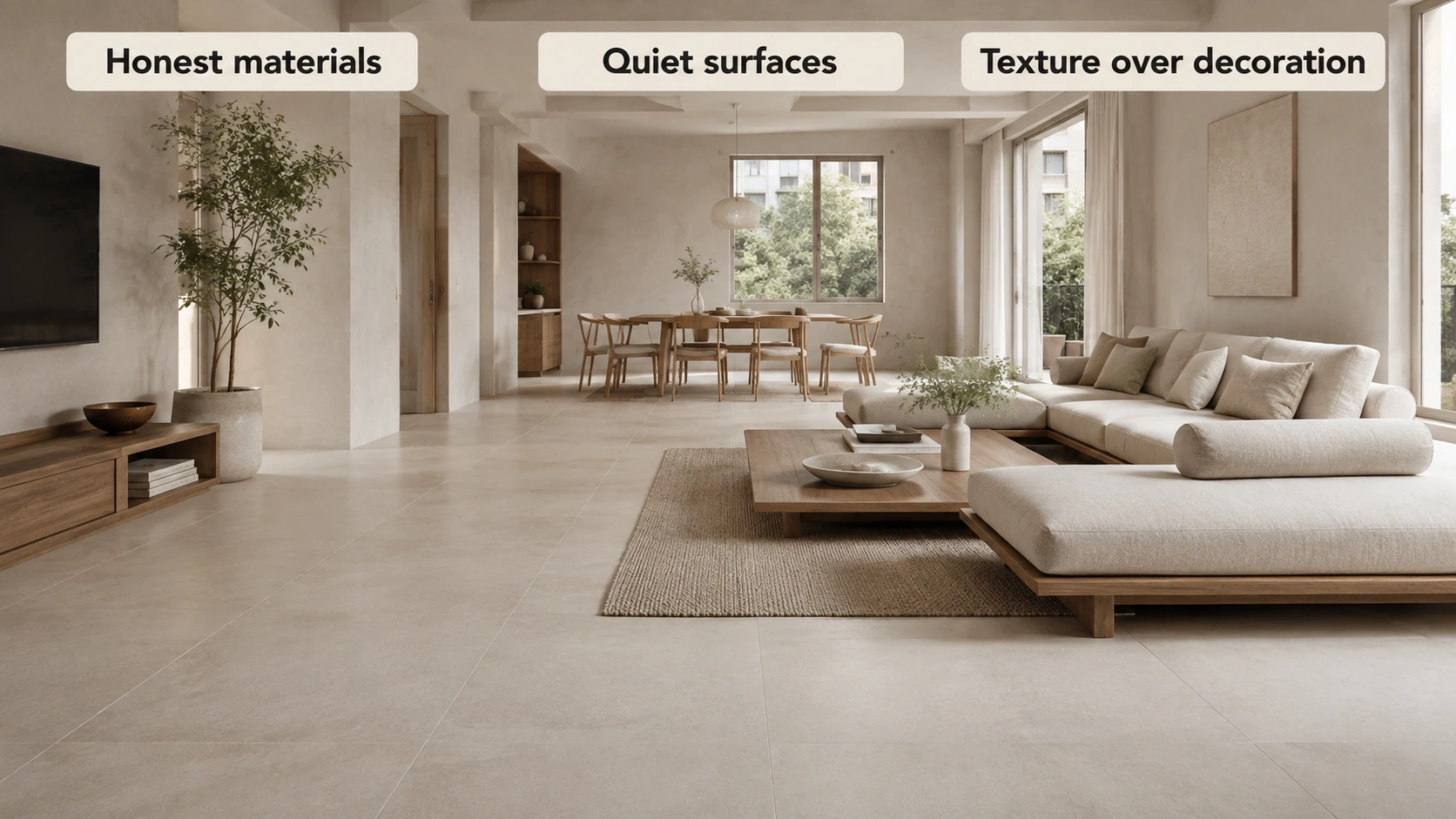
Strip away the mood boards and the style makes three demands that a tile can actually be judged against.
Honest materials. Surfaces should look like what they are. This comes from the Japanese side and it is the demand that causes the most trouble in a tile showroom, for reasons the next section takes up.
Quiet surfaces. Nothing on a wall or floor should ask for attention. Pattern is allowed only as the natural variation a material would have anyway, never as a printed motif.
Texture instead of decoration. Where a maximalist room adds interest through colour and pattern, Japandi adds it through how a surface catches light. Matte against slight sheen, rough against smooth.
Those three are the test. A tile that satisfies all three is a Japandi tile regardless of what the catalogue calls the range.
The Daylight Correction Nobody Makes
Japandi palettes were developed under Nordic and Japanese daylight, and Indian daylight is a different light entirely, which is why so many carefully chosen matte tiles land on site looking nothing like the reference image that sold them.
Northern European daylight is diffuse, low-angle and comparatively cool, and there is not much of it for half the year. Palettes built for it lean warm deliberately, to put back the warmth the light does not supply. That is why every Japandi guide tells you to avoid cool grey and stark white.
Indian daylight supplies that warmth already, in quantity. High sun angle, intense, and distinctly golden through the afternoon across most of the country. Take a warm greige chosen to compensate for Copenhagen, put it on a floor in Ahmedabad or Chennai, and by two in the afternoon it is reading yellow-brown.
The practical correction is straightforward. Choose your tile shade one step cooler and one step lighter than the Japandi reference photograph suggests. What looks slightly too neutral on a sample board will look correct once your own daylight has added its warmth to it.
This is not permission to buy cool grey. Cool grey is still wrong, because Japandi is warm-grounded rather than clinical. It means aiming for the neutral centre of the palette and letting the room push it warm, rather than buying warm and watching it go further.
Test it properly. Take a full tile home, put it on the floor of the actual room, and look at it at eleven in the morning, at three in the afternoon and at nine at night under the bulbs you will really use. Warm 2700K lighting pushes an already warm tile further still, and that combination is where most Japandi floors go wrong in India.
From The Marketplace
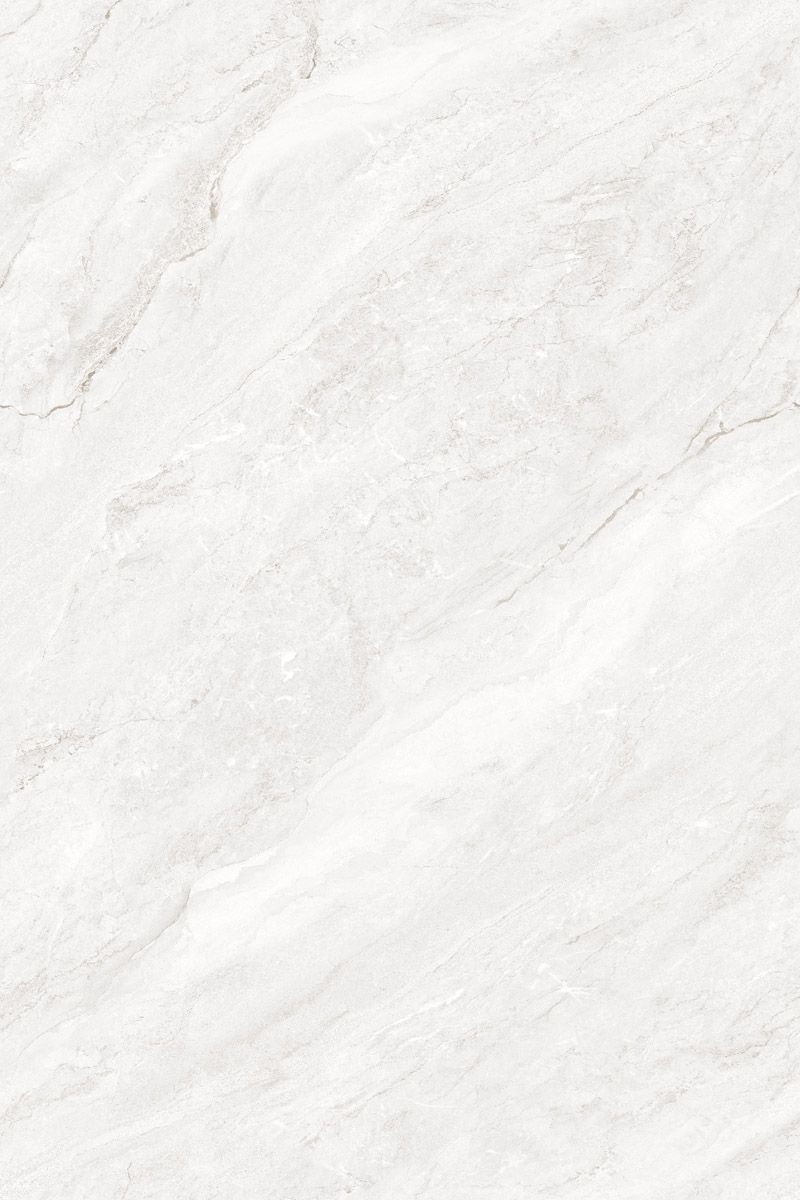
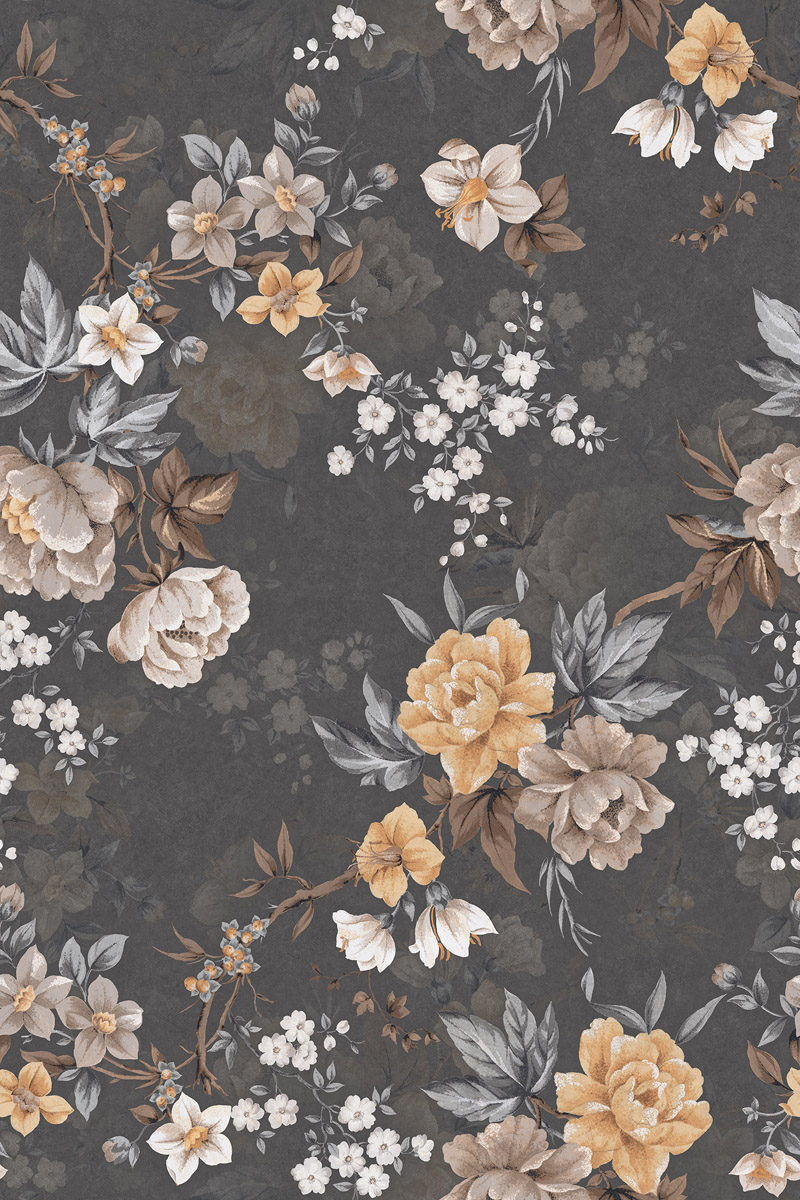
Popular tiles right now

The Honesty Problem With Wood-Look Tile
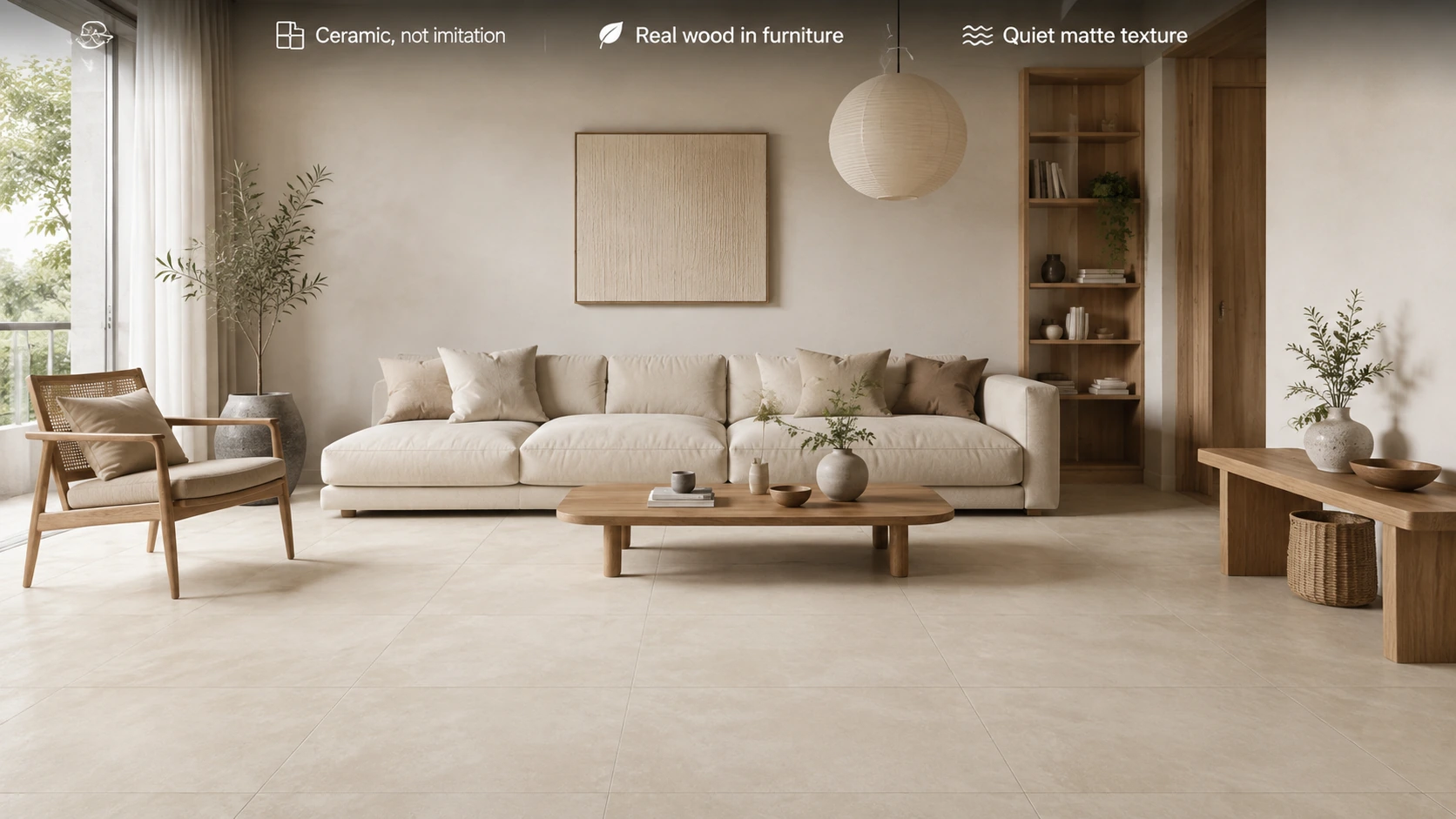
Every Japandi shopping list includes light oak flooring, so the obvious move is a plank tile, and this is where the style argues with itself. Wooden tiles are a printed image of one material on the surface of another, which is precisely what the honest-materials rule exists to rule out.
The strict answer is to avoid imitation entirely. The useful answer is more interesting.
Ceramic and stone are themselves Japandi materials, named in every account of the style alongside wood, linen and clay. A tile that reads as fired clay, as plaster, as unpolished limestone or as concrete is not imitating anything. It is being what it is.
So the move is to stop shopping for a tile that pretends to be timber and start shopping for one that behaves like ceramic. Put the wood into the room as actual wood, in the furniture, the shelving and a low bed frame, where Japandi wants it and where it is affordable in small quantities.
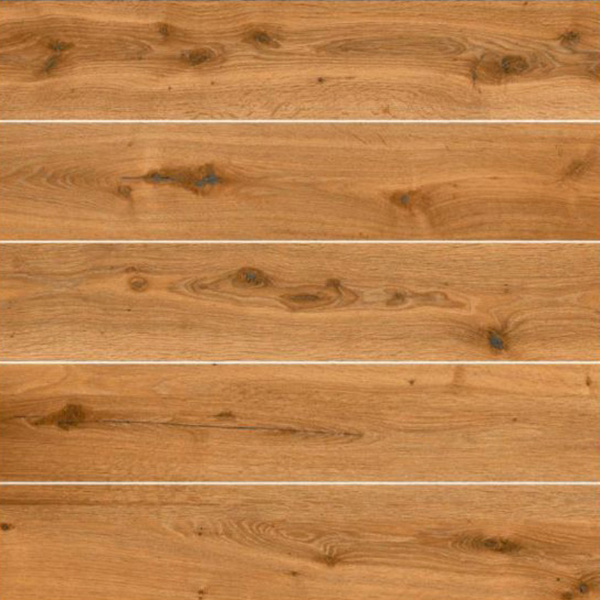
If you do want plank tiles, choose a range with restrained grain rather than a dramatic one. The failure mode is a tile with strong knots and heavy figure repeating across a floor, which announces itself as printed the moment you notice the same knot twice.
The Palette as Tile Shades, Not Paint Chips
Translated into surfaces you can actually buy, and adjusted for Indian light, the palette narrows usefully. Most of it lives among stone look tiles and plain textured ranges rather than in anything described as a design.
| Role | Shade direction | Where it goes |
|---|---|---|
| Base, about 60% | Warm off-white, oat, pale sand, soft limestone | Floors and main walls |
| Ground, about 30% | Greige, warm taupe, unpolished travertine tones | Feature walls, bathroom floors |
| Anchor, about 10% | Muted sage, dusty charcoal, raw umber, soft clay | One wall, a niche, a splashback |
| Avoid | Cool grey, stark white, pink-toned beige | Anywhere in the scheme |
| Avoid | High gloss, mirror finishes, metallics | Anywhere in the scheme |
The anchor is the part people skip, and skipping it is what produces the beige room that reads as empty rather than as calm. One deeper tone, used once, does the work of a great deal of styling.
On finish, this style is unusually easy to specify in India, because it wants matte and unpolished throughout and that happens to be the correct answer for Indian floors anyway. No polished, no lappato, no high gloss, and no satin matte on anything wet.
Room by Room in Japandi Terms
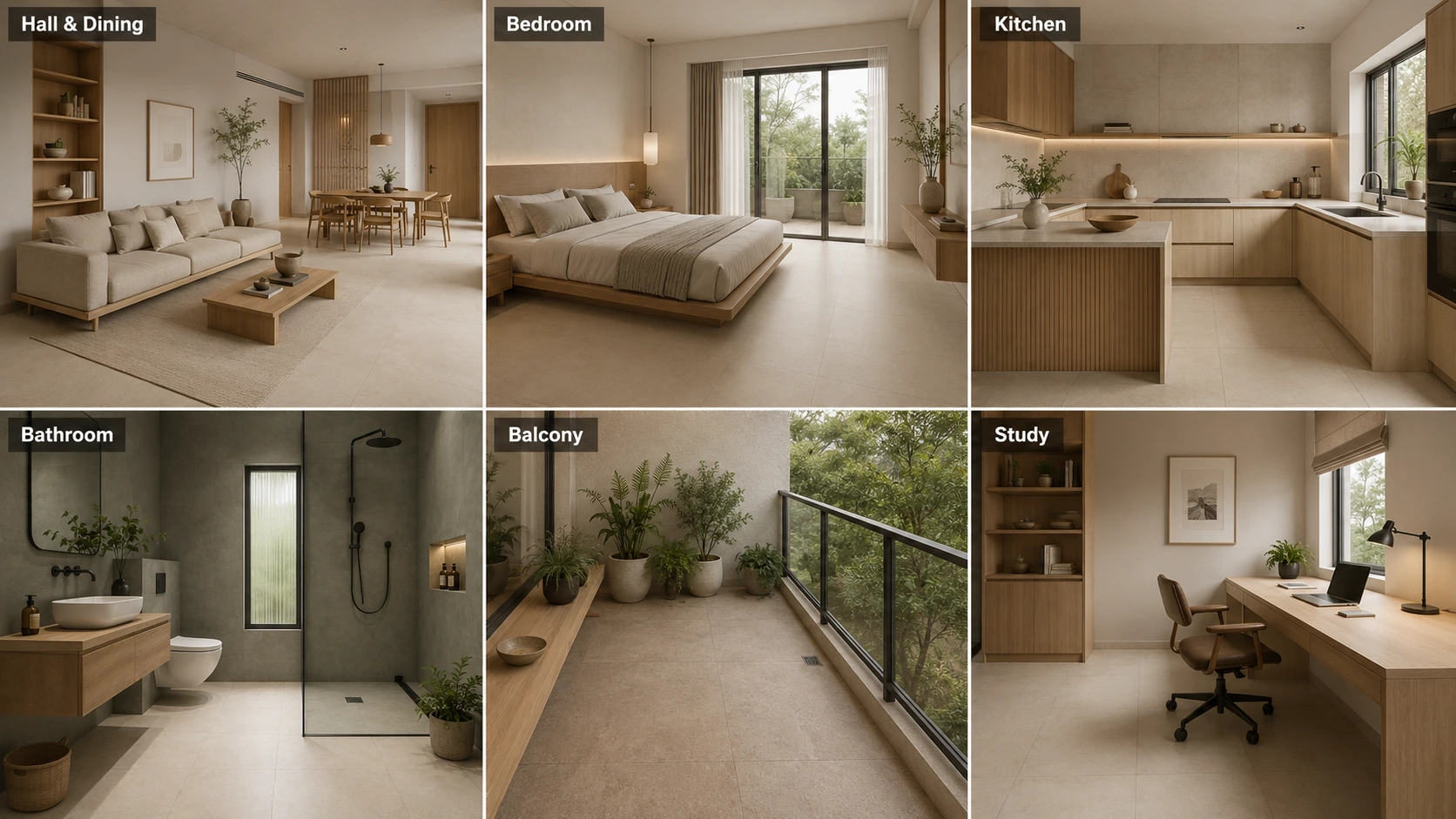
The style asks for continuity rather than a different look in every room, so the same base shade running through the living room tiles and the bedrooms is closer to the intent than four coordinated but different floors would be.
- Hall and dining. One warm off-white or oat field in 600x1200mm matte, laid straight, no border, no inset. The restraint is the design.
- Bedroom. The same field carried through, or one step warmer. Keep the module quiet and skip any tile with strong movement.
- Kitchen. Matte or textured floor, and a plain limestone-tone splashback rather than a patterned one. Handle-free cabinetry does the visual work.
- Bathroom. This is where the anchor tone earns its place. A muted sage or dusty charcoal wall against an off-white floor, with matte black fittings, in 300x600mm on the wall and 300x300mm on the floor.
- Balcony. Textured or GHR in a warm stone tone, with the outdoor rules holding regardless of style. Nothing polished, nothing glossy, and a fall away from the room.
- Study. Warm neutral matte, chosen for the same reason as everywhere else, and helped by the fact that matte is what a screen wants nearby anyway.
Three Technical Details That Decide Whether It Reads Calm
Face count and shade variation
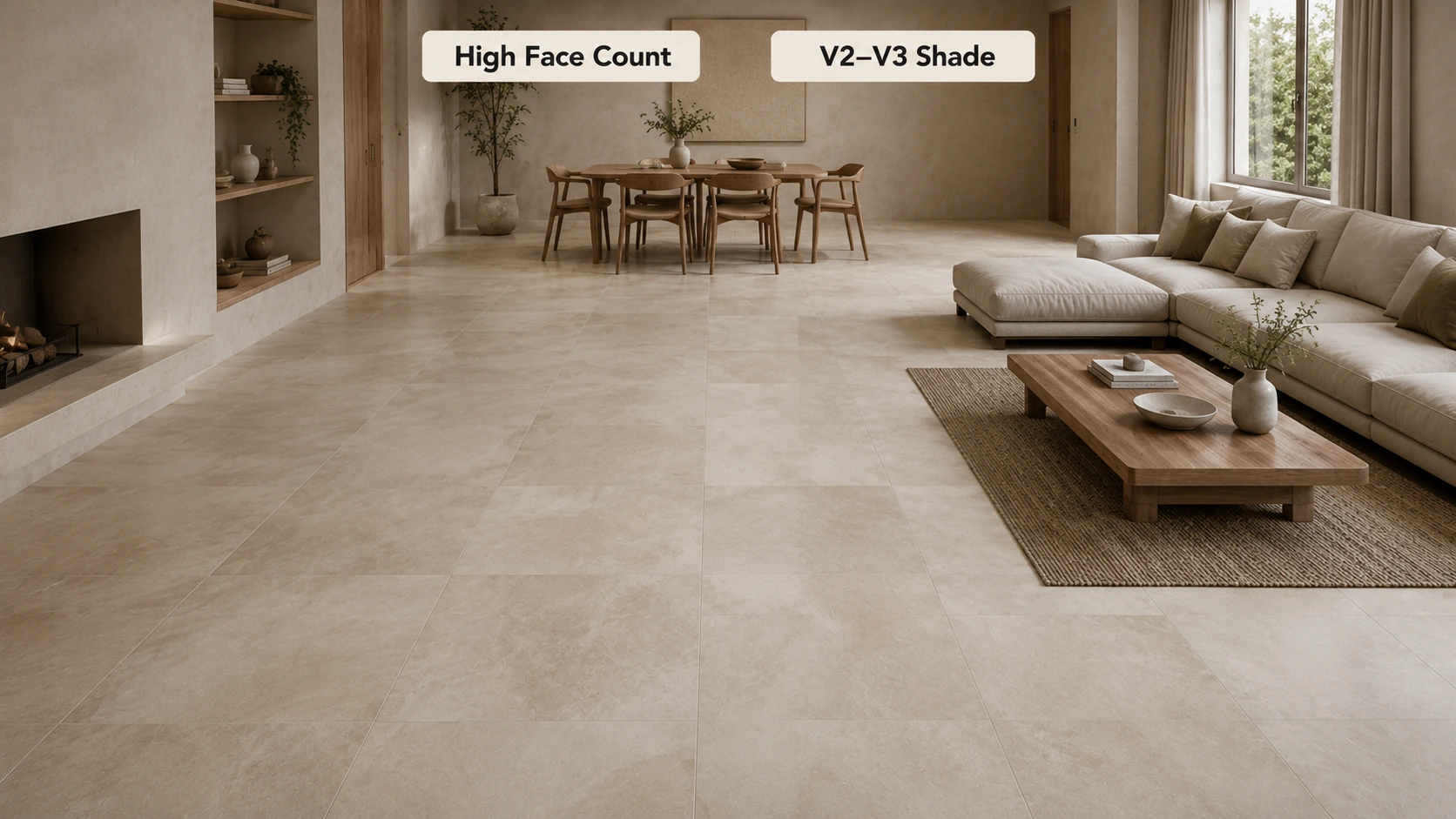
A digitally printed tile carries a limited number of unique printed faces, sometimes as few as four or six across an entire range. On a busy patterned floor, nobody notices. On a quiet, minimal floor, the eye finds the repeat, and a repeating surface is the opposite of calm.
Ask two questions before buying. How many faces does the design have, where more is better, and anything above twenty is comfortable. And what is the shade variation grade, where V2 to V3 gives the natural movement Japandi wants, and V1 gives a flatness that reads as vinyl.
The grout line is the design
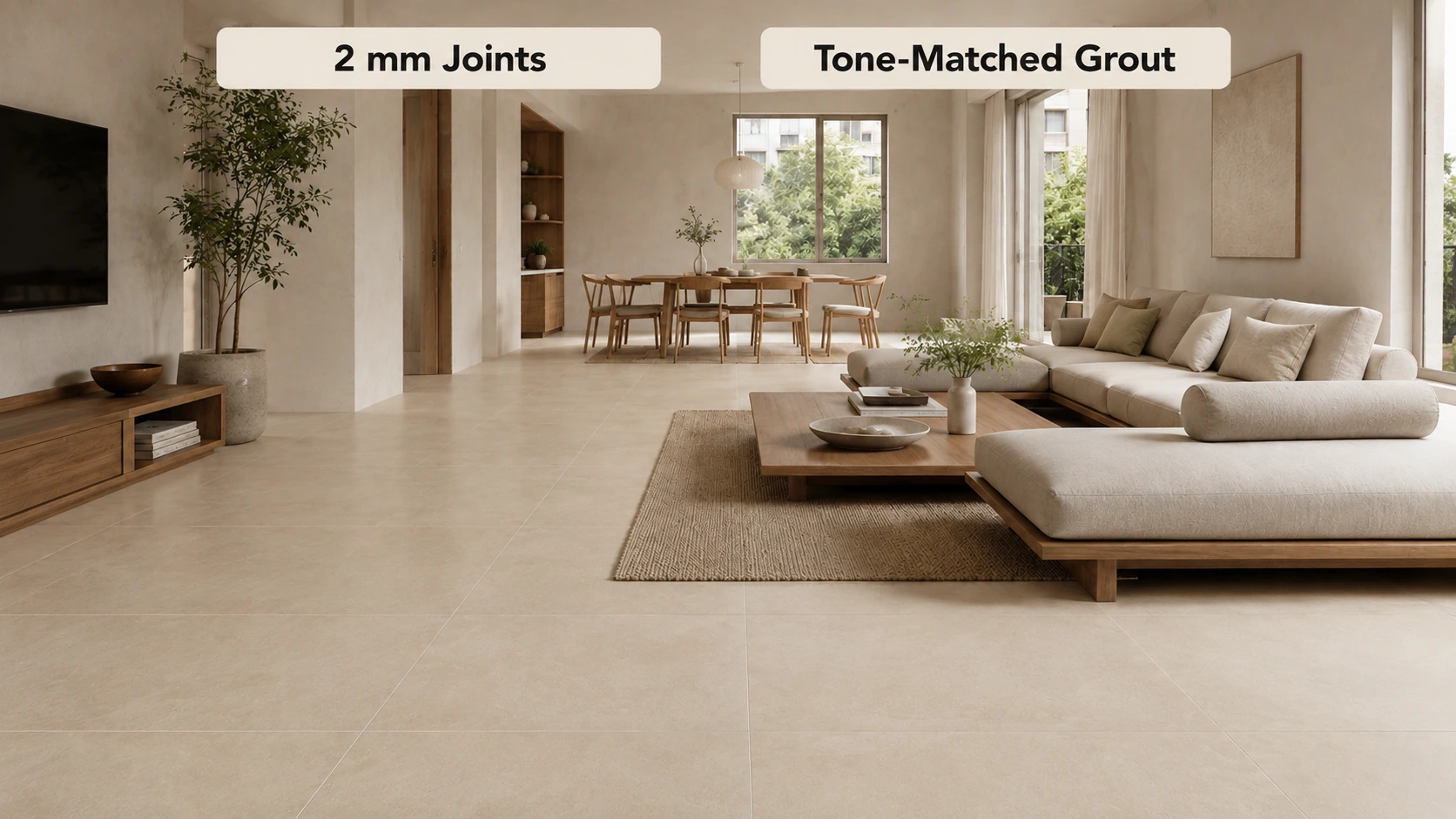
In a room with pattern and colour, grout disappears. In a minimal room with nothing else happening, the grout joint becomes the strongest visual line on the floor, and most people specify it as an afterthought.
Match the grout to the tile as closely as the range allows, go slightly darker rather than lighter, and use rectified tiles so the joint can run at 2mm instead of 3mm. A white grout under an oat floor draws a grid across the room that you will notice every day.
Wabi-sabi is not the same as poor workmanship
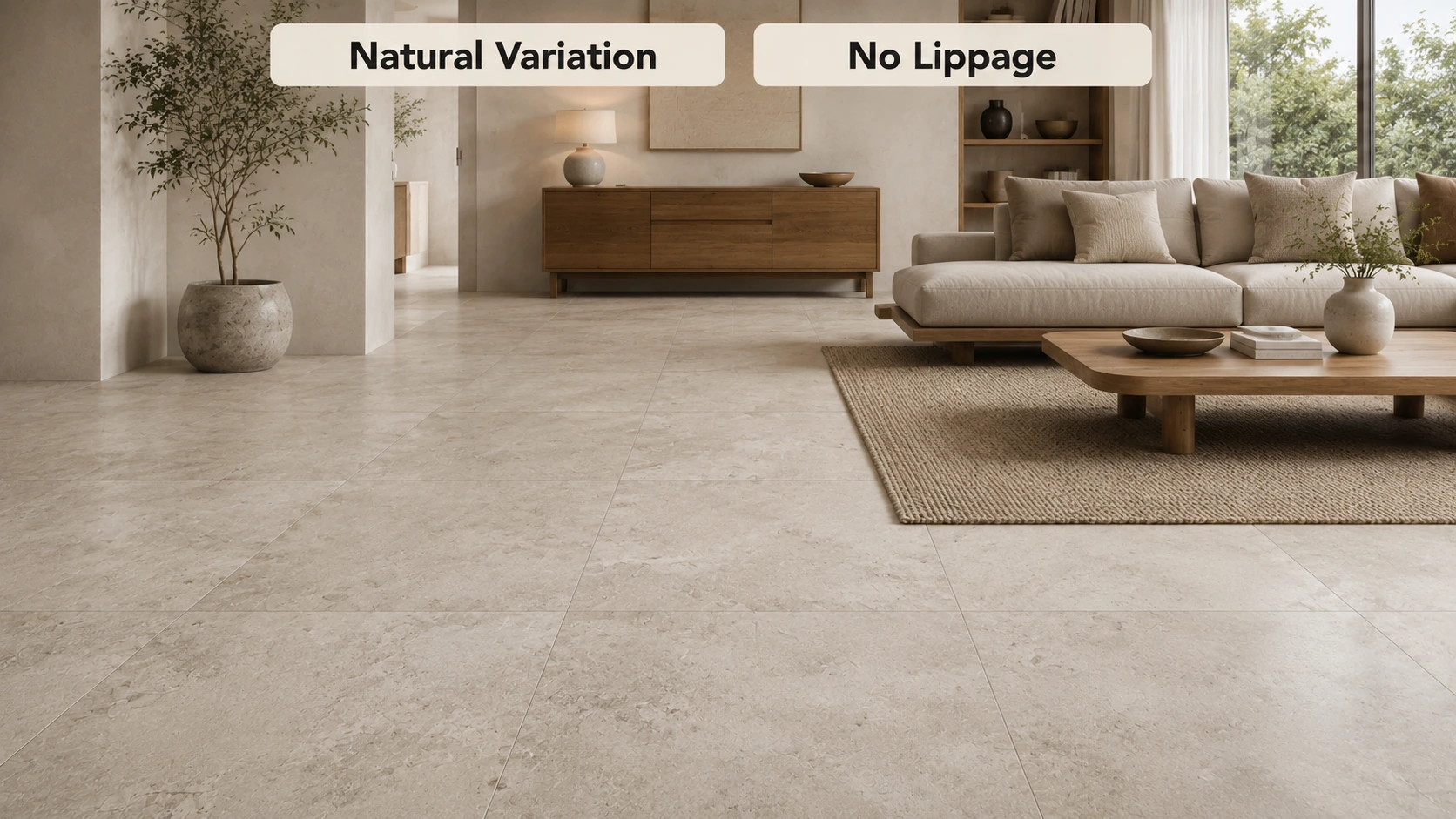
Japandi borrows the wabi-sabi appreciation of imperfection, and this gets used on site to excuse things it does not cover.
Intentional variation is wabi-sabi. A V3 stone-look range where no two tiles match, a handmade-feeling glaze, a surface that shows its material. Execution error is not. Lippage between tiles, uneven joints, a cut row wandering along a wall, and a floor that is not level are simply a bad job, and no philosophy makes them read as charm.
Worth saying to the tiler at the start, because the distinction gets blurred quickly once work begins.
Where Japandi and Indian Homes Genuinely Conflict
Three tensions are real and worth resolving deliberately rather than discovering later.
Light floors and Indian dust. The style wants pale surfaces, and Indian interiors accumulate a fine film faster than most. A flat pale floor shows it within a day. The resolution is tonal texture rather than flat pallor, a surface with subtle movement in it that carries dust without displaying it, which is also more honest as a material.
Minimal joints and the epoxy question. Japandi rejects visible synthetic materials, and Indian wet areas need epoxy grout, which is a synthetic resin. This one resolves easily on inspection: colour-matched epoxy in a narrow joint is close to invisible, and a cementitious joint that has gone brown and mouldy is far more visually intrusive than the resin ever was.
Barefoot living, which is not a conflict at all. Japanese homes remove footwear at the genkan and Indian homes do the same at the door, so the style assumes a barefoot floor and so do you. Matte, warm-toned and comfortable underfoot is the specification both traditions arrive at independently, and it is one of the reasons this particular style transplants to India more naturally than most imported looks do.
Six Mistakes in Japandi Tile Selection
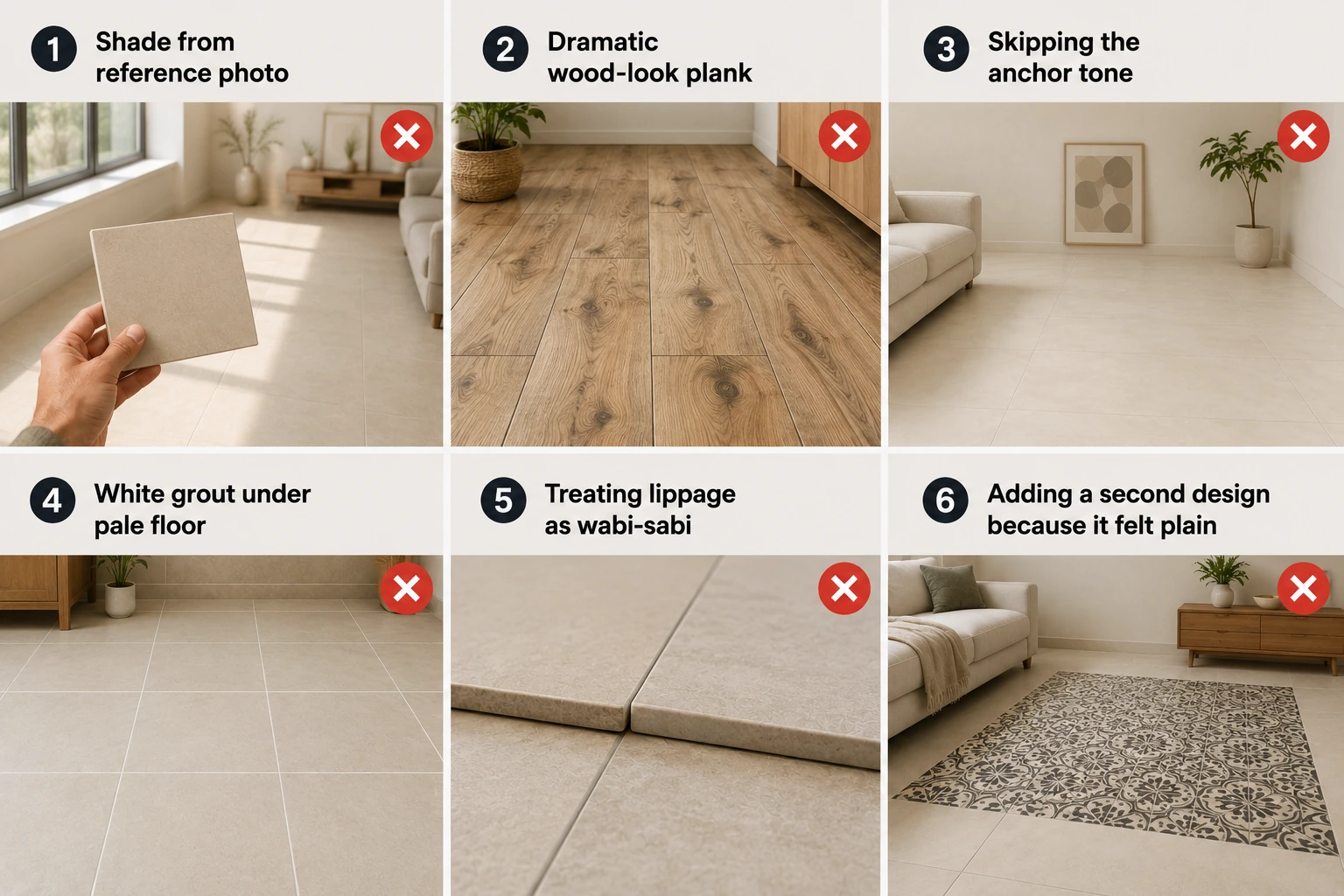
- Buying the shade from a reference photograph. Those images were lit by a different sun. Aim one step cooler and lighter than the picture suggests, then test the sample in your own room at three in the afternoon.
- Choosing a dramatic wood-look plank. Strong knots and heavy figure repeat visibly across a floor and announce the print, which breaks the one rule the style cares most about.
- Skipping the anchor tone. All base and no anchor produces a room that reads as unfinished rather than as restrained.
- Specifying white grout under a pale floor. It draws a grid across the quietest surface in the house.
- Treating lippage as wabi-sabi. Material variation is the philosophy. Uneven tiles are a bad job.
- Adding a second design because the room felt plain. The plainness is the point, and the correct fix is texture and one anchor tone, not a pattern.
Settling on a Restrained Shortlist
Four shades, one finish family and a matched grout is the whole specification, which makes this an unusually short shopping list once the daylight correction is applied, and matte, textured and stone-look ranges across 300x300mm, 300x600mm, 600x600mm and 600x1200mm are listed on TilesFinders with finish type, size alias and water absorption stated on every product. Use the finish filter to keep polished and glossy options out from the start, and the textured surfaces when a floor needs movement in it without a printed design.
FAQs
Matte or lightly textured tiles in warm off-white, oat, sand or greige, with subtle natural movement rather than a printed design. Stone-look, limestone-look, plaster-look and plain textured ranges all fit. Avoid anything polished, glossy, metallic or heavily patterned, and keep the whole house to a small number of shades.
Warm grey and greige, yes. Cool grey, no. The distinction matters more in India than elsewhere, because intense golden daylight pushes every shade warmer through the afternoon. Aim for the neutral centre of the palette and let your own light supply the warmth, rather than buying a warm shade that then goes further.
You can, though the style would rather you did not, since a printed image of timber on a ceramic body is what the honest-materials rule exists to exclude. If you do, pick a restrained grain over a dramatic one and check the face count. A better route is a ceramic or stone-look floor with real wood in the furniture.
The closest match to the tile, or a shade darker. Never lighter. In a minimal room, the grout joint is the strongest line on the floor, so a contrasting joint turns a quiet surface into a grid. Rectified tiles let you run a 2mm joint instead of 3mm, which helps further.
It works better in a small flat than most styles do, because it reduces visual noise rather than adding decoration. Carry one floor shade through the hall and bedrooms without borders or insets, keep the module large and the joints narrow, and let a single anchor tone appear once. Continuity is what makes a compact plan feel larger.
Scandinavian palettes run cooler and brighter, built around pale blonde timber and near-white surfaces. Japandi runs warmer and more grounded, accepting medium and darker wood tones and earthy anchors. In tile terms, a Scandi floor is a pale cool neutral and a Japandi floor is a warm neutral with visible texture and one deeper tone somewhere in the room.


See our tile guides first
Set TilesFinders as a preferred source and our buying guides surface ahead of the rest for you.
Add as preferred sourceTakes one tap. Nothing to install.
What Readers Say
I was about to redo my parking area with the wrong tile size until I read this. The layout comparisons saved me from a costly mistake.
We reference TilesFinders guides while briefing clients on material selection. The size and pattern breakdowns are accurate and easy to explain visually.
On site, I get asked about grout spacing all the time. This article gave me a solid reference I now share with my team before every job.
Finally a guide that doesn't just push generic advice. The oil stain removal steps actually worked on our clubhouse driveway tiles.
I run a small construction firm and now send this link to clients directly when they ask about entrance tile sizing. Saves me an hour of explaining.
Good practical detail, though I wish there were more examples for compact apartment entrances specifically, not just villas.
My mother-in-law wanted marble, I wanted vitrified. This blog gave us the neutral comparison we needed to actually decide together.
Detailed without being overwhelming. I appreciated that it covered both cost and maintenance, not just the aesthetics.
Used the algae and hard water removal tips on our terrace tiles after the monsoon. Worked better than what our regular cleaner was doing.
As someone who sources tiles for multiple builder projects, I find these comparisons genuinely useful for vendor conversations, not just consumer content.
Recommended this to a client who kept second-guessing the entrance design. The small vs large layout section settled the debate instantly.
Straightforward and honest, no unnecessary jargon. Would like to see a similar breakdown for outdoor pool-deck tiles next.
We've bookmarked several TilesFinders guides for our design handbook. Reliable source when clients want data, not just opinions.
Two paths, one marketplace.
Get free quotes from verified suppliers.
Share your room, budget, and style. Suppliers in Morbi respond within hours.
Get Free QuotesList your business, reach real buyers.
Put your showroom in front of homeowners searching for tiles right now.
List Your BusinessMore Blogs
See all-b5e2414e-da74-41d7-a6e5-752c260e2201.webp)
Aqua Green vs Turquoise vs Teal Tiles: Which Cool Blue-Green Tone Works for Indian Humid Spaces
Compare aqua green, turquoise, and teal tiles for humid Indian spaces, with guidance on saturatio...
Read More
Tile Design Trends Indian Homes Are Following in 2026
A buyer's filter on 2026 Indian tile trends: large format, warm neutrals and matte finishes to ac...
Read More
Best Tiles for Hotels & Resorts in India: Material, Design & Durability Guide
A practical guide to sourcing tiles in Bhopal, covering top brand showrooms, major wholesale clus...
Read More