High Glossy vs Super High Glossy vs Polished Glossy: The Complete Sheen Comparison
July 10, 2026 10
Compare high glossy, super high glossy, and polished glossy finishes by reflectivity, durability, repair options, slip resistance, and ideal applications to select the right surface with confidence.
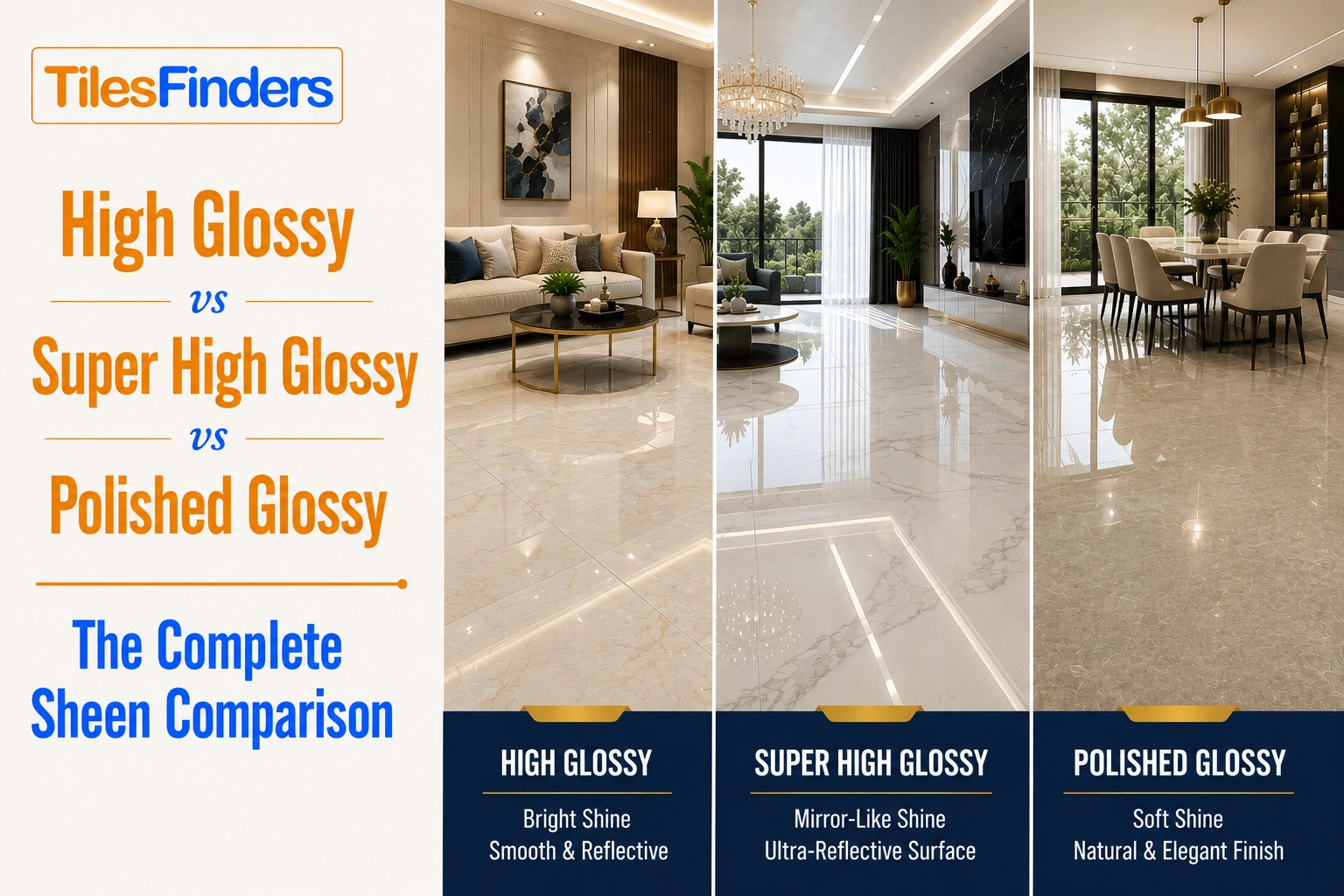
Polished glossy (PGVT/DC) is the only gloss level that can be re-polished if scratched; high and super high glossy are glaze-based and non-repairable.
Not all reflective tiles are made the same way, and the differences matter more than most Indian tile buyers realise. High glossy, super high glossy, and polished glossy are three distinct surface categories that achieve their reflective quality through completely different manufacturing processes, and this manufacturing difference determines durability, repair options, price, and long-term appearance in ways that are invisible in a showroom but very visible after five years of use.
This guide explains the technical differences among the three gloss levels, compares their performance under Indian conditions, and provides a clear specification guide for which one belongs in which application.
How the Three Gloss Levels Are Actually Made
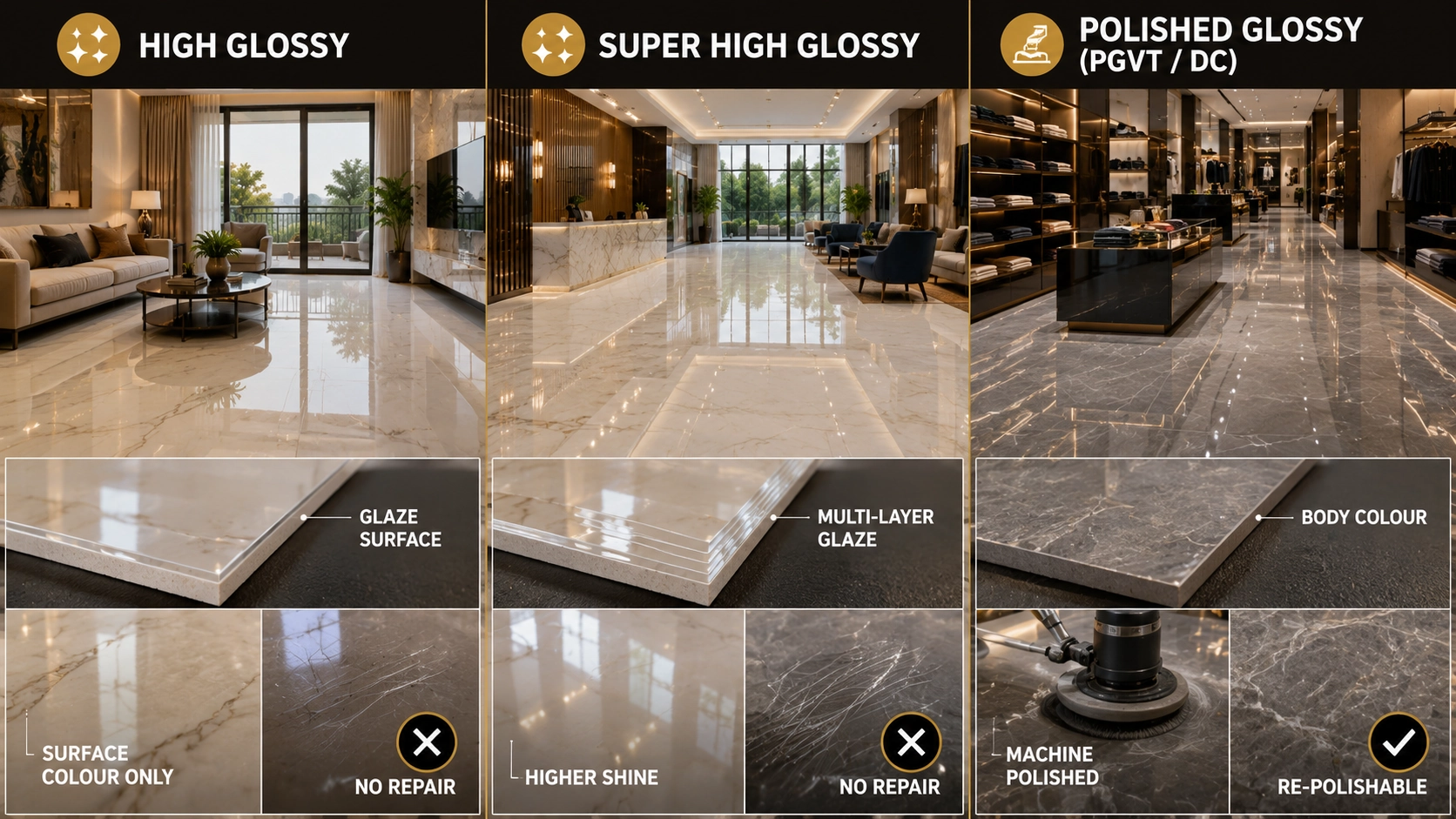
The single most important fact in this comparison: high-gloss and super high-glossy are glaze-based finishes achieved during firing. Polished glossy is a mechanical surface treatment applied after firing. This is not a subtle distinction. It changes everything about how the tile behaves over its lifetime.
| Finish | How the Gloss Is Created | Gloss Level (GU) | Colour Location | Repairability |
| High glossy | A reflective glaze layer is applied to the tile surface and fired in the kiln. The gloss is part of the glaze chemistry, not a mechanical treatment. | 60 to 90 GU | Colour is in the glaze layer only. The body underneath is typically a different, unglazed colour (usually white or buff for ceramic, or the base vitrified colour for GVT). | Cannot be re-polished if scratched. A scratch in the glaze is permanent. The only remedy is tile replacement. |
| Super high glossy | A thicker, higher-quality reflective glaze is applied in multiple layers and fired at a more precisely controlled kiln temperature to achieve maximum light return. Sometimes includes a final nano-coating for extra reflectivity. | 90 to 120 GU | Colour is in the glaze layer, same as high gloss, but the glaze itself is of higher optical quality and clarity. | Cannot be re-polished. Same limitation as high gloss: a scratch is permanent and requires replacement. |
| Polished glossy (PGVT / DC) | A vitrified tile body (colour already present in the body via digital print or full-body pigmentation) is mechanically ground and polished after firing using progressively finer diamond abrasive pads, the same process used on natural stone. | 80 to 130 GU | Colour is in the vitrified body itself (deeper in DC tiles, shallower in PGVT), not just a surface glaze. | Can be re-polished on-site by a professional stone polishing contractor to restore gloss after scratching, using the same diamond pad process used for the original finish. This is the single biggest practical advantage of polished glossy over high glossy or super high glossy. |
Design principle: This manufacturing distinction explains a fact that confuses many Indian buyers: a hotel lobby floor from 2010 that still looks flawless in 2026 is almost certainly polished GVT or double charge tile that has been professionally re-polished at some point in its life, not a glazed high-gloss ceramic that has miraculously avoided scratching for 15 years. Glazed high gloss tiles, whether standard or super high, cannot be restored once scratched. This single fact should drive the specification decision for any floor that needs to look good for decades rather than years.
Performance Comparison: High Glossy vs Super High Glossy vs Polished Glossy
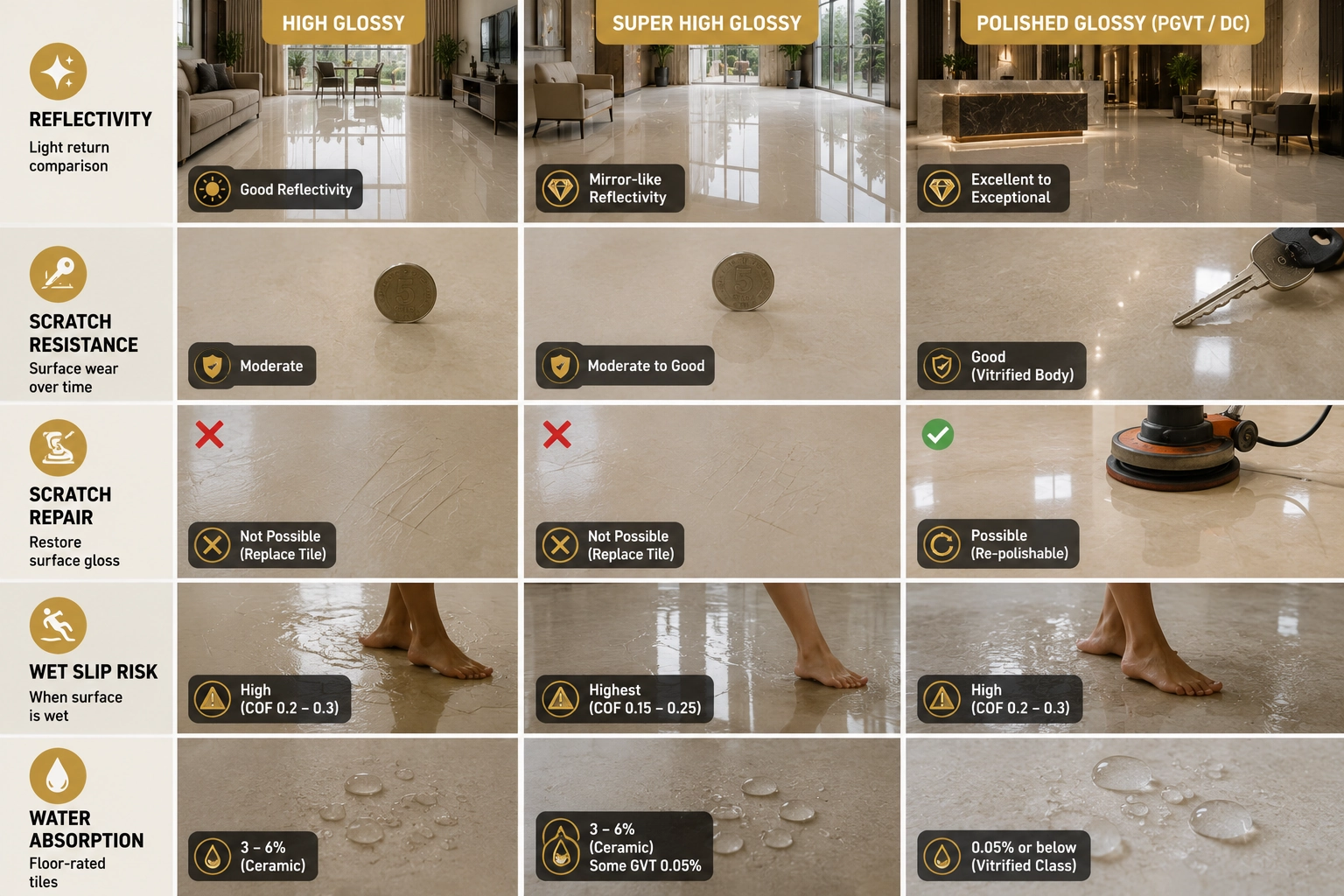
| Factor | High Glossy | Super High Glossy | Polished Glossy (PGVT/DC) |
| Reflectivity | Good. Reads as glossy and light-amplifying, but with a visible difference from a true mirror. | Excellent. The closest to a true mirror surface among glaze-based finishes. Very high light return. | Excellent to exceptional. DC and high-grade PGVT can match or exceed super high glossy ceramic reflectivity. |
| Scratch resistance | Moderate. Standard glaze hardness. Scratches from grit and furniture movement accumulate over the years. | Moderate to good. The thicker, higher-quality glaze in super high glossy resists scratching slightly better than standard high glossy, but is still a glaze surface. | Good for the vitrified body. Micro-scratches on the polished surface are normal wear but do not compromise the tile body, which is the same hardness as matte GVT. |
| Scratch repair | Not possible. A scratched high-gloss tile must be replaced. | Not possible. Same limitation. | Possible. Professional re-polishing with diamond abrasive pads restores the surface gloss, extending the tile's usable life significantly. |
| Wet slip risk | High. Standard glossy wet COF of 0.2 to 0.3. | Highest. Super high glossy has the lowest wet COF of the three, typically 0.15 to 0.25. | High. PGVT and DC wet COF is 0.2 to 0.3, similar to standard glossy. |
| Water absorption (floor-rated) | 3 to 6% for ceramic. Not a vitrified class. | 3 to 6% for ceramic super high glossy. Some GVT-body super high glossy variants achieve 0.05%. | 0.05% or below (IS 15622:2006). Vitrified class. |
| Typical application | Bathroom and kitchen walls. Occasional decorative floor use in dry areas with ceramic floor-rated variants. | Feature walls, decorative accent panels, luxury bathroom, and living room walls where maximum reflectivity is the brief. | Living room and bedroom dry-area floors, commercial lobbies, hotel floors, and any application where floor durability over decades matters. |
| Price range (per sq.ft) | Rs. 40 to Rs. 120/sq.ft | Rs. 90 to Rs. 250/sq.ft | Rs. 100 to Rs. 280/sq.ft |
Where to Use Each Gloss Level in Indian Homes
High Glossy
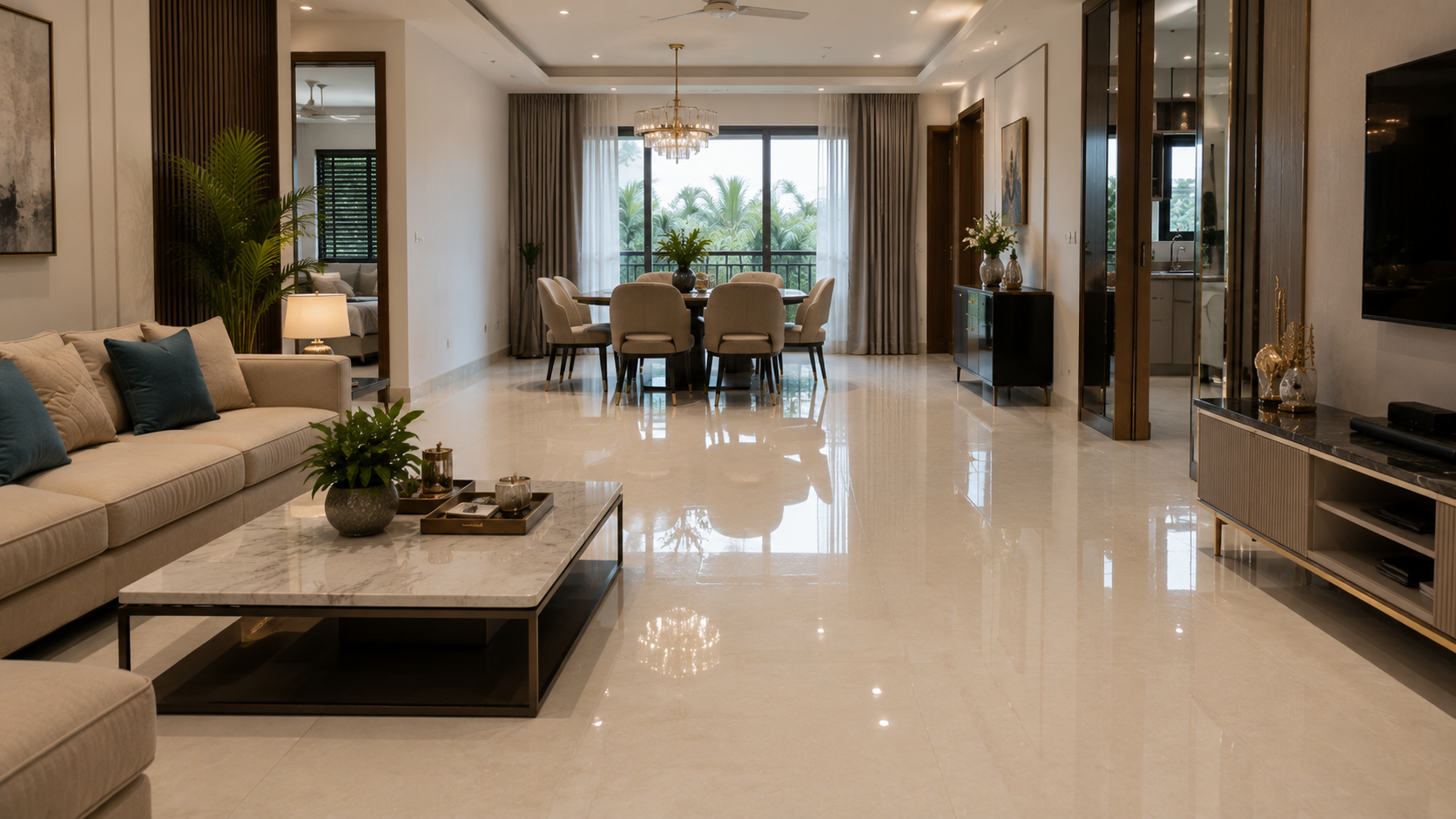
The most cost-accessible and widely available of the three. High glossy ceramic is the correct choice for standard Indian bathroom and kitchen walls where the brief is a clean, reflective, easy-to-clean surface at an accessible budget. It is appropriate for backsplash, full bathroom walls, and any vertical surface where the gloss level does not need to be maximum. High gloss is not the correct choice for any floor without a confirmed anti-skid COF, and it is not repairable if scratched, which matters most for high-traffic wall zones like a kitchen backsplash behind a stove, where pans and utensils occasionally contact the wall.
If you're considering this finish, read our High Glossy Guide for room-by-room recommendations, safety considerations, maintenance requirements, and applications to avoid before making your final selection.
Super High Glossy
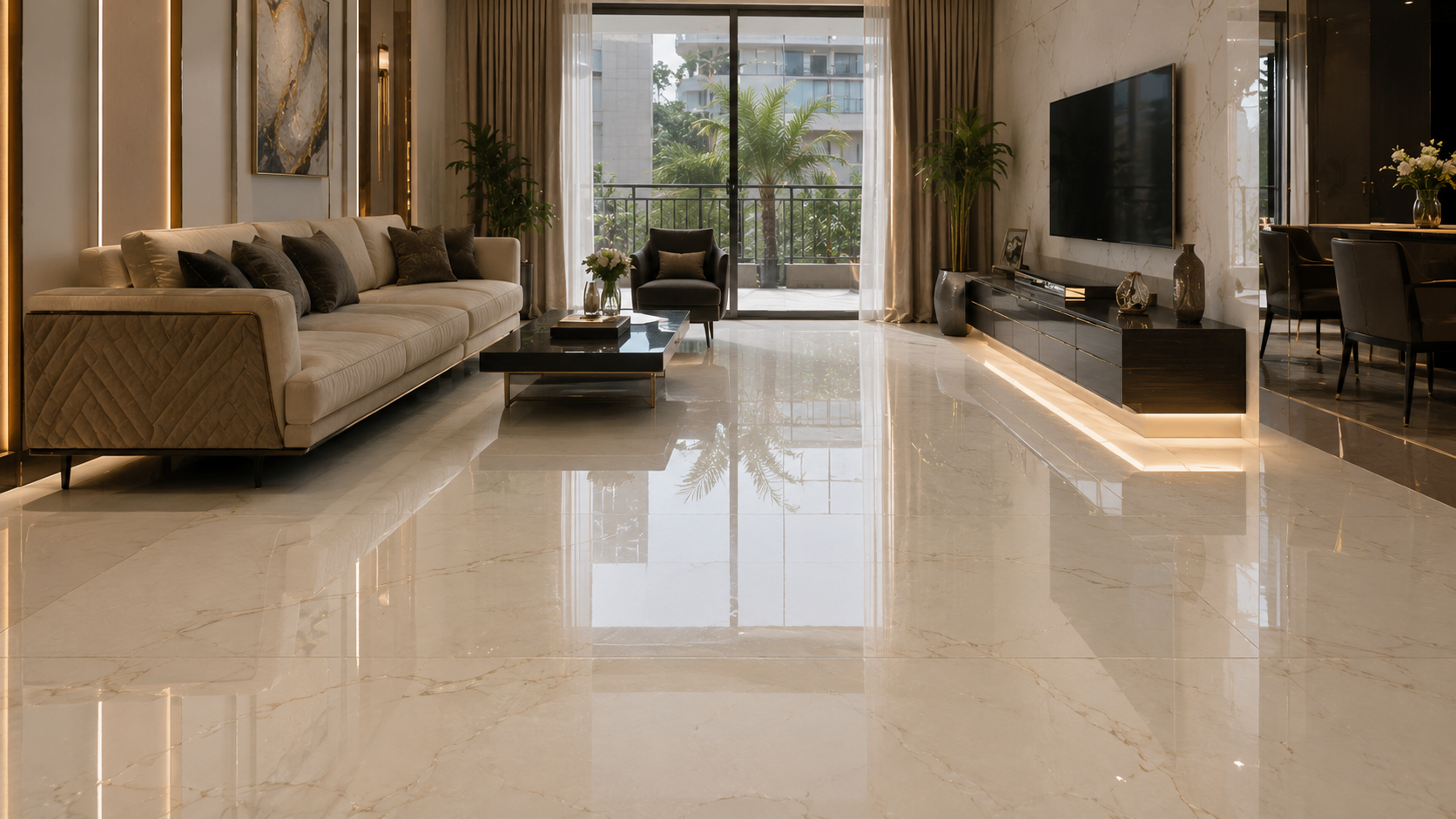
Reserved for feature applications where the maximum mirror-like quality is the specific design brief: a statement bathroom wall behind a freestanding tub, a living room accent wall intended to read as a genuine mirror surface, or a luxury retail display wall. Super high glossy is not a general-purpose finish. It is a specialist choice for a specific dramatic effect and carries a price premium that only makes sense when that effect is the priority. It should never be specified for floors of any kind: the wet COF is the lowest of the three gloss levels, making it the most dangerous when wet.
Polished Glossy (PGVT / Double Charge)
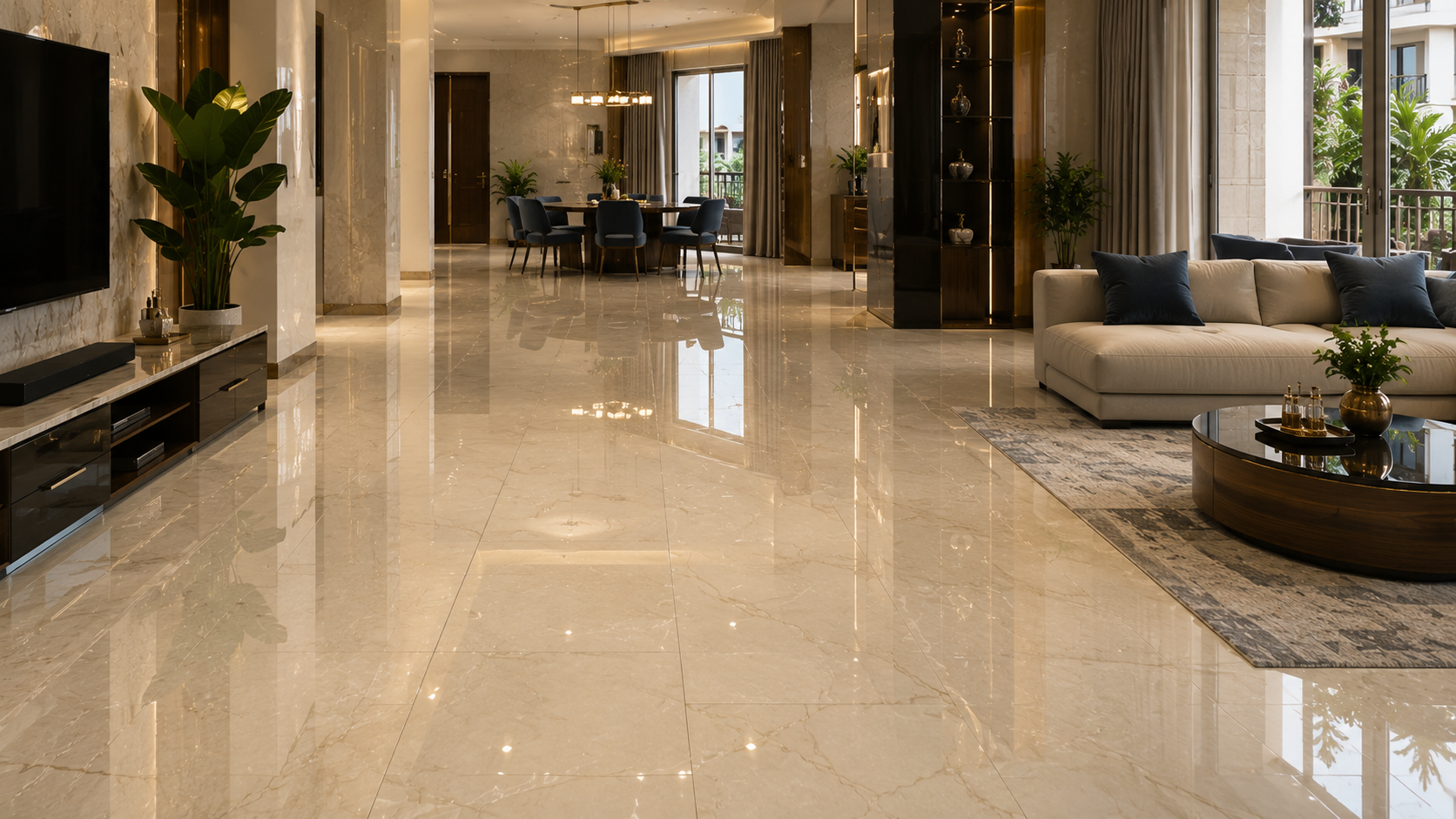
The correct choice for any glossy floor application in an Indian home or commercial space, and the only one of the three gloss levels that should ever be considered for a floor. Polished glossy delivers the mirror-effect quality on a vitrified, durable body that can be professionally re-polished if scratched, extending its usable life well beyond either glaze-based finish. For dry-area living rooms, hotel lobbies, and commercial floors where the floor needs to remain looking correct for 10 to 20 years, polished GVT and double charge are the only technically sound glossy floor specifications available.
Critical distinction: None of the three gloss levels, high glossy, super high glossy, or polished glossy, is safe for bathroom floors, kitchen floors, outdoor floors, or staircase treads without a specific anti-skid COF confirmation from the TDS. Super high glossy has the lowest wet COF of the three and is the most dangerous of the three if mistakenly specified for a wet-area floor. This applies regardless of how the finish is described in a showroom or catalog.
Long-Term Maintenance and Repair: The Deciding Factor
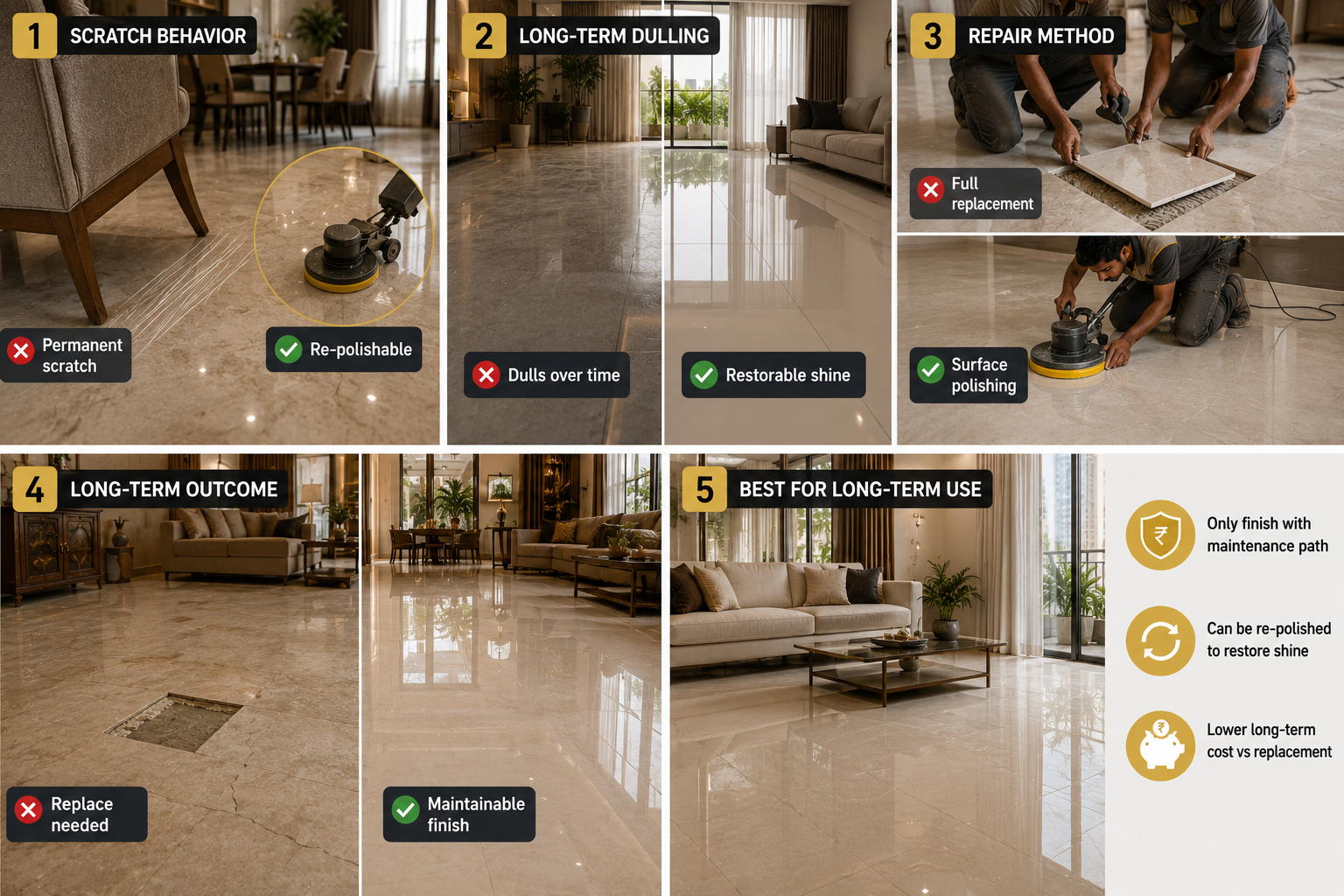
Over a 10 to 15 year ownership period, the repairability difference between glaze-based gloss and polished vitrified gloss becomes the most financially significant distinction between the three finishes.
| Scenario | High Glossy | Super High Glossy | Polished Glossy (PGVT/DC) |
| Furniture dragged a scratch on the floor or wall | Permanent scratch. The tile must be replaced if in a visible location. | Permanent scratch. Same as high gloss. | Can be professionally re-polished to remove or significantly reduce the scratch's visibility. |
| Overall dulling from 10 years of use. | The glaze surface gradually loses reflectivity with cumulative micro-scratching. Cannot be restored. Replacement is the only option to restore the original appearance. | Same limitation. The higher initial gloss means the dulling is more noticeable over time by comparison. | Can be professionally re-polished across the full floor area to restore near-original gloss level, typically at a fraction of the cost of full replacement. |
| Repair cost for a damaged area. | Full tile replacement, including matching the discontinued batch or design if the original product is no longer manufactured. Colour matching risk is high. | Same as high-glossy. Colour matching risk is high given the specialised nature of super high-glossy products. | Localised re-polishing (for minor scratches) or full tile replacement (for chips or cracks) at costs significantly below full-floor replacement. |
| 10-year total cost of ownership (200 sq ft floor, moderate wear) | If used on a floor (ceramic floor-rated only): Rs. 0 in restoration if undamaged, full replacement cost (Rs. 8,000 to Rs. 20,000 material plus labour) if damaged. | Not applicable for floors: should not be specified for any floor use. | Rs. 3,000 to Rs. 8,000 for professional re-polishing in years 7 to 10, restoring near-original appearance without replacement. |
Verdict: For any application where the tile is expected to look good for 10 or more years without replacement, polished glossy (PGVT or double charge) is the only gloss-level finish with a viable long-term maintenance path. High-gloss and super high-gloss are permanent-condition finishes: what you install is what you have until it needs replacing. This is an acceptable trade-off for a wall application at a lower cost point, but it is a significant long-term cost risk for any glossy floor specification.
How to Choose: Three Questions
Question 1: Is this a wall or a floor application?
Wall: all three gloss levels are viable, chosen on budget and desired reflectivity. Floor: only polished glossy (PGVT or double charge) should be considered, and only for dry-area floors with anti-skid confirmation for any wet-area alternative use. High glossy and super high glossy should never be specified for any floor without specific anti-skid COF confirmation, and even then, their lack of repairability makes them a poor floor choice compared to polished glossy.
Question 2: Does the surface need to be repairable over its lifetime?
If the tile is in a high-traffic or high-risk-of-damage location (a floor, a wall behind a kitchen workspace, a commercial space with heavy use) and long-term appearance matters, polished glossy is the only finish with a repair path. If the tile is in a low-risk location (a bathroom wall above the vanity, a decorative accent panel) where damage is unlikely and replacement is straightforward if it does occur, high-gloss or super-high-gloss is an acceptable and more affordable choice.
Question 3: What is the specific reflectivity brief?
If the brief is 'clean and light-reflecting' for a standard bathroom or kitchen wall, high gloss is sufficient and the most cost-effective. If the brief is 'maximum mirror effect' for a specific dramatic feature wall, super high glossy delivers the highest reflectivity of the three, at a price premium justified only by that specific design intent. If the brief is 'glossy floor that stays looking good for a decade or more': polished glossy, specifically double charge for the best long-term performance, is the only appropriate choice.
Looking for inspiration? Explore our High Glossy Design Ideas to see mirror-effect living rooms, kitchens, feature walls, and luxury interior combinations before choosing a finish.
Pro tip: When in doubt about which gloss level a specific tile is, ask the supplier directly: is the colour in the glaze or in the tile body? If the answer is glaze, it is high-glossy or super high-glossy, both non-repairable. If the answer is the body itself (visible if you look at a cut edge or a chip), it is polished glossy of the PGVT or DC type, which can be professionally re-polished. This single question resolves the categorisation faster than any visual inspection.
Gloss-Level Tile Production in India: 2026 Context
High-gloss ceramic tiles are manufactured across the widest range of Indian production centres, including Morbi and Wankaner in Gujarat, and additional centres in Rajasthan, Andhra Pradesh, and Tamil Nadu, under IS 13712:2006 for ceramic tile classification. Super high glossy is a more specialised product manufactured by a smaller number of Morbi factories with the multi-layer glaze and precision firing capability required, and it commands a premium, reflecting this narrower production base. Polished GVT and double charge tiles are manufactured in Morbi, Gujarat, under IS 15622:2006 at water absorption 0.05% or below, with the mechanical polishing step typically performed at the same Morbi facility using diamond abrasive polishing lines.
In the Indian market in 2026, polished GVT and double charge tiles are increasingly specified for commercial and hospitality projects where the repairability advantage justifies the higher upfront cost over a 15 to 20 year building lifecycle. Residential specification of polished glossy floors has declined somewhat in favour of sugar finish and matte GVT as Indian homeowners have gained more experience with the maintenance demands of any glossy floor, whether glaze-based or polished. Super high glossy remains a specialist product used primarily for accent walls and feature panels rather than as a general specification category.
Compare Gloss-Level Tiles on TilesFinders
High-gloss ceramic for bathroom and kitchen walls, super high-gloss for feature walls, and polished GVT or double charge for dry-area floors and commercial applications are all available on TilesFinders from verified Indian manufacturers. Request physical samples and confirm the colour location (glaze versus body) before ordering to understand the long-term repairability of your specification.
FAQs
High gloss has a standard reflective glaze fired onto the tile surface, reaching 60 to 90 gloss units (GU). Super high glossy uses a thicker, higher-quality multi-layer glaze fired at a more precisely controlled temperature to achieve 90 to 120 GU, the closest to a true mirror surface among glaze-based finishes. Both are equally non-repairable if scratched: the colour is in the glaze layer in both cases, not the tile body.
Polished glossy (PGVT or double charge) is a vitrified tile that has its colour in the body itself, then is mechanically ground and polished after firing using diamond abrasive pads, the same process used on natural stone. High gloss achieves its shine through a fired-in surface glaze. The key practical difference: polished glossy can be professionally re-polished if scratched or dulled over time. High-gloss and super high-gloss cannot be repaired once scratched and must be replaced.
None of the three. High glossy, super high glossy, and polished glossy all have wet COF below the 0.4 wet minimum required for safe bathroom floors in India. Super high glossy has the lowest wet COF of the three and is the most dangerous if mistakenly used on a floor. For any Indian bathroom floor, specify anti-skid matte GVT with a COF of 0.4 wet and an R10 to R11 rating.
Only polished glossy tiles (PGVT or double charge) can be repaired through professional re-polishing using diamond abrasive pads, which restores the surface gloss. High glossy and super high-gloss tiles have a fired glaze surface that cannot be re-polished. A scratch on these finishes is permanent, and the only remedy is replacing the affected tile, which carries a colour-matching risk if the original batch or product is discontinued.
High glossy ceramic is sufficient and cost-effective for a standard Indian bathroom wall where the brief is a clean, reflective surface. Super high glossy is appropriate only for a feature wall or accent panel where the maximum mirror effect is the specific design brief, typically at a higher price premium. Both are wall-only applications with no slip risk.
High glossy ceramic ranges from Rs. 40 to Rs. 120 per sq.ft. Super high glossy ranges from Rs. 90 to Rs. 250 per sq.ft, reflecting its specialised multi-layer glaze production. Polished glossy (PGVT/DC) ranges from Rs. 100 to Rs. 280 per sq.ft, depending on format and whether it is PGVT or the more durable double charge type.
Hotel lobby floors are typically polished GVT or double charge tile that has been professionally re-polished on a maintenance schedule, often every 3 to 5 years, using diamond abrasive pads. This restores the surface gloss and removes accumulated micro-scratching. Home glossy floors, particularly those using high glossy or super high glossy glaze-based finishes, cannot be re-polished and simply accumulate scratches and dulling over time with no restoration option available.
Double charge (DC) is the better long-term specification. The colour runs through two pressed layers of the tile body rather than being confined to a surface glaze layer as in PGVT. This means surface wear at high-traffic points reveals the same colour rather than a different-coloured layer beneath, and the tile maintains visual consistency over 10 to 15 years better than PGVT. Both can be professionally re-polished, but DC starts with a more durable colour structure.
