Double Charge Tiles: Why They Dominate High-Traffic Areas
May 25, 2026 105
From busy family living rooms to crowded lobbies, learn why double-charge tiles dominate high-traffic zones. Compare finishes, check 2026 prices, and safeguard your home's floors.

Most tiles look fine on day one. The question is what they look like after three years of daily foot traffic in a hallway, a living room, or a hotel lobby. Standard GVT tiles have a 1 to 2mm glazed layer on the surface. When that layer wears through in a high-traffic zone, the design underneath fades and the surface becomes dull in the areas used most. Double-charged vitrified tiles were engineered specifically to solve this problem.
Among all categories of polished floor tiles in India, double charge has the thickest design layer: 2 to 3mm of compressed pigment fused into the top portion of the tile body. That thickness means the design and colour go deep enough that normal wear over years of use does not reach the base body. The tile keeps its appearance longer than any other vitrified category in high-traffic conditions.
How Double Charge Tiles Are Made and Why That Matters
Standard GVT and PGVT tiles are manufactured with a thin glazed layer, typically 1 to 2mm, applied digitally on top of the vitrified body. That glaze carries the design: the marble veining, the stone print, the solid colour. Below that thin glaze, the tile body is plain.
Double charge tiles use a different process. Two separate layers of pigmented material are loaded into the press mould: the base body and a 2 to 3mm design layer on top. Both are compressed under high pressure and fired together at temperatures above 1200 degrees Celsius. The result is a tile where the design layer is physically fused into the top 30 to 50 percent of the tile thickness, not just applied to the surface.
This construction is what makes them the leading scratch-resistant floor tiles for high-traffic zones. A surface scratch on a GVT tile cuts through the thin glaze and exposes the plain body below. The same scratch on a double-charge tile only reaches deeper into the same design material. The colour and pattern remain consistent because the design layer extends far below the surface.
| Feature | GVT | PGVT | Double Charge |
| Design layer depth | 1 to 2mm glaze on surface | 1 to 2mm polished glaze on surface | 2 to 3mm compressed pigment fused into tile body |
| Design visibility after surface scratch | Design fades where scratched | Design fades where scratched | Design remains consistent through the layer depth |
| Scratch resistance | Moderate | Lower (polished surface shows marks easily) | Highest among vitrified categories |
| Water absorption | Less than 0.05% | Less than 0.05% | Less than 0.05% |
| Finish available | Matte, glossy, GHR, sugar, many others | Polished only | Polished glossy and semi-gloss |
| Design variety | Very wide: marble, wood, stone, concrete, abstract | Wide in marble-look and solid colour | Limited: solid colours, simple geometric and abstract patterns |
| Sizes available | 2x2, 2x4, 32x48, 6x4, 8x4, 32x96, 32x120, 8x48 | 2x2, 2x4, 32x48, 6x4, 8x4, 32x96, 32x120 | 2x2, 32x32 (800x800), 2x4 only |
| Wet area floor use | Yes (matte or GHR finish) | No | No |
| Outdoor use | Yes (matte or GHR) | No | Not recommended |
| Wall use | Yes | Yes | Limited; primarily a floor tile |
What the Double Layer Means in Real Use
The performance difference between double-charged tiles and other vitrified tiles becomes visible over time rather than immediately. In the first year, a well-installed GVT and a double charge tile in the same hallway look similar. By years three to five in a genuinely high-traffic zone, the difference shows. The GVT surface begins to show wear patterns in the areas of heaviest use, particularly in front of doors, along walking paths, and at the base of staircases. The double charge floor in the same locations retains its design and finish consistency.
This longevity advantage is why double charge became the default flooring choice for commercial projects in India: shopping malls, hotel lobbies, hospital corridors, airport waiting areas, and office buildings. These spaces cannot afford to retile every few years. The upfront cost of double charge is slightly higher than standard GVT, but the replacement cycle is significantly longer.
For residential use, a double charge makes practical sense in the same reasoning: spaces that see the heaviest daily foot traffic. The main entrance, the living room in a joint family home, the ground floor hallway connecting rooms, and the staircase landing are all areas where the double-layer investment pays off over the life of the home.
Double Charge Tile Design Range
Double charge tiles design options are deliberately narrower than GVT or PGVT. The manufacturing process that gives double charge its durability advantage also limits the design complexity. Because the design layer is a physical pigment compressed into the tile rather than a high-resolution digital print, the patterns available are simpler: solid colours, tone-on-tone abstract patterns, soft geometric designs, and subtle movement in light marble-like or granite-like colour transitions.
The dominant colour palette is cream, ivory, beige, light grey, off-white, and warm white. These tones dominate because double charge was designed for spaces that need to look clean and open: lobbies, corridors, living rooms, and commercial interiors, where a light reflective floor makes a room feel larger.
The finish is polished or semi-gloss. Double charge does not come in matte, GHR, or textured finishes. This is an important limitation: the polished surface means double charge must not be used in wet areas, regardless of how durable the tile body is. The tile's durability advantage applies to dry, high-traffic indoor floors only.
Available sizes are 2x2 (600x600 mm), 32x32 (800x800 mm), and 2x4 (600x1200 mm). The 32x32 size is unique to double charge among standard vitrified categories and is widely used in commercial spaces where a larger format tile reduces grout lines in a high-traffic area.
Where Double Charge Floor Tiles Work Best
Residential High-Traffic Areas
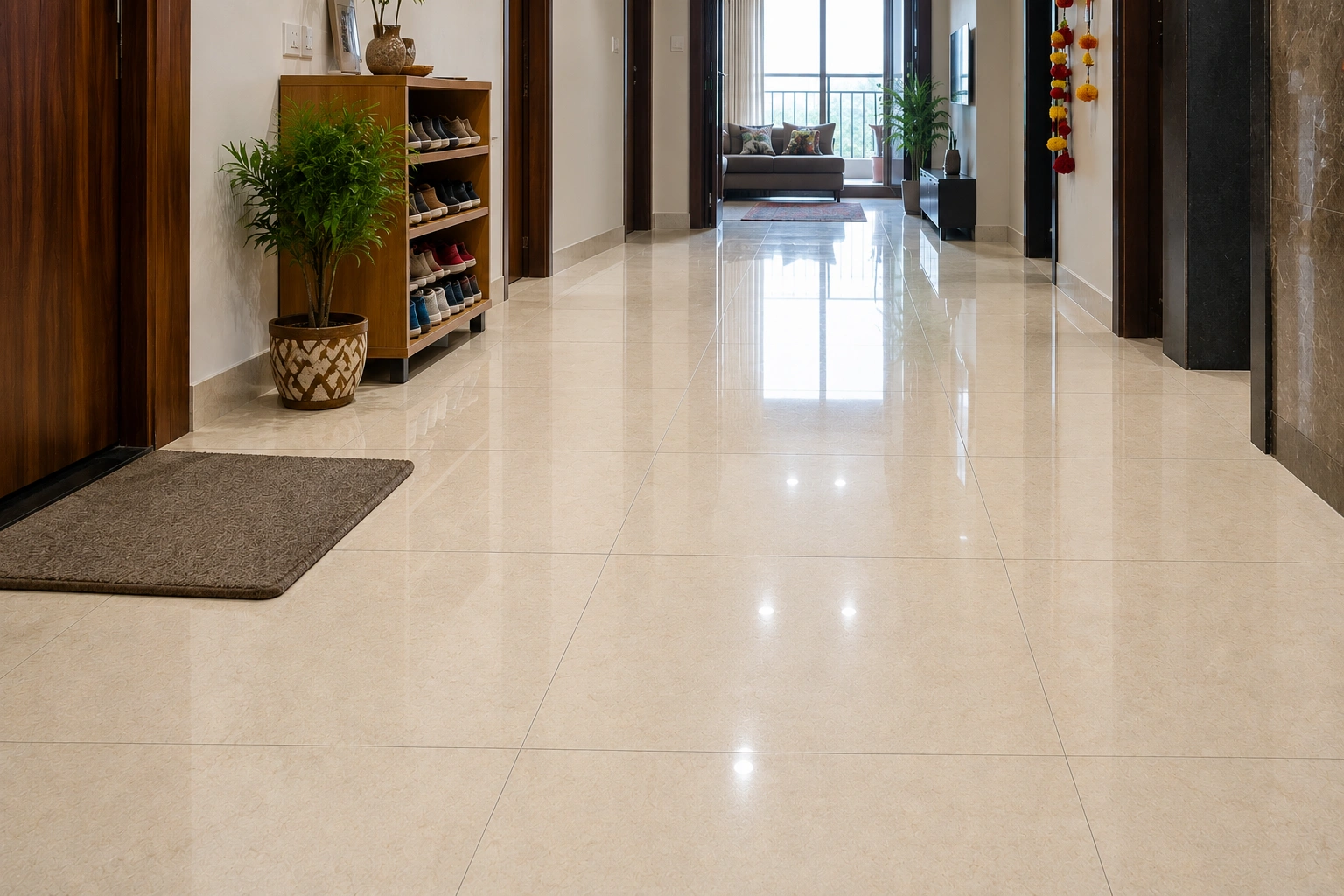
Double charge tiles for living room floors in Indian homes make particular sense in joint family setups, ground-floor homes, and homes in Tier 1 cities where the living room sees near-constant daily use. The polished surface reflects ambient light and keeps the room feeling open. The thick design layer means the floor holds its appearance through years of daily mopping and foot traffic without the surface dulling that GVT tiles develop in the same conditions.
Vitrified tiles for hallway applications are another clear fit. The hallway in an Indian home is the single highest-traffic strip in the residence: every family member crosses it multiple times a day, footwear is worn in and out, and the floor is cleaned daily. A matte GVT holds up well here, too, but double charge in a 2x2 or 2x4 format gives a longer-wearing polished finish in this zone without the design degradation that would appear on GVT over many years.
Staircases, ground-floor common areas in apartments, and main entrances are also appropriate residential applications. Anywhere the floor sees heavy, consistent foot traffic and the homeowner wants a polished finish that lasts beyond five to seven years without visible wear.
Commercial and Institutional Spaces
Double charge tiles for commercial spaces represent the tile's primary market. Shopping malls, hotel lobbies, hospital OPD corridors, airport passenger areas, bank branches, and large restaurant dining areas all use double charge as the default floor tile for one consistent reason: it holds its appearance longer under crowd-level foot traffic than any other vitrified category at a comparable price.
Double charge tiles for office spaces, particularly reception areas, open-plan office floors, and conference room corridors, are a strong match. Office cleaning schedules involve daily mopping with water and cleaning agents. The polished double charge surface handles repeated mopping without the finish degradation that lower-grade tiles develop. The light cream and ivory tones popular in double charge also photograph well and read as professional in client-facing spaces.
| Space Type | Double Charge Suitable? | Recommended Size | Why It Works Here |
| Living room floor (residential) | Yes | 2x2 or 2x4 | Heavy daily use, polished finish lasts longer than GVT surface glaze |
| Hallway and entrance floor | Yes | 2x2 or 2x4 | Highest foot traffic in the home. Double layer withstands concentrated wear. |
| Staircase landing floor | Yes | 2x2 | Consistent concentrated foot contact. Design layer holds under impact. |
| Hotel lobby floor | Yes | 2x4 or 32x32 | Crowd-level traffic. Double charge is the industry standard here. |
| Office reception and corridors | Yes | 2x2 or 32x32 | Daily mopping and high occupant movement. Finish holds well. |
| Shopping mall concourse | Yes | 32x32 or 2x4 | Very high foot traffic. Few tiles other than double charge hold this long. |
| Hospital corridor floor | Yes | 2x2 or 2x4 | Heavy trolley and foot traffic. Easy to clean and maintain. |
| Bedroom floor | Yes, but GVT matte is sufficient | 2x2 | Bedroom traffic is low. Double charge is over-specified but not wrong. |
| Kitchen floor | No | — | Polished finish is slippery when wet. Kitchen floors need matte GVT. |
| Bathroom floor | No | — | Wet area. Polished double charge is a slip hazard. |
| Outdoor or balcony floor | No | — | Not rated for outdoor. GVT matte or GHR is the correct outdoor choice. |
Where Double Charge Tiles Should Not Go
The polished finish on double charge tiles is its most significant limitation in terms of application range. Despite the tile body's exceptional durability, the polished surface must not be used in wet areas, on wet floors, or outdoors.
Kitchen floors are the most common error in Indian homes. A homeowner selects double charge for the living room because of its durability, then orders the same tile for the kitchen floor for consistency. Kitchen floors receive cooking water, oil, and daily wet mopping. The polished double-charge surface becomes slippery in those conditions. Matte or GHR finish GVT is the right kitchen floor tile, not double-charged.
Bathroom floors carry the same prohibition. No polished vitrified tile belongs on a bathroom floor. Wet feet on a polished surface create a slip hazard that the tile's durability cannot compensate for. Outdoor balconies and terraces are also out: double charge is not rated for exposure to Indian monsoon conditions or direct sun and rain cycling.
Walls are technically possible for double charge, but unusual. The tile is heavy, the design range is limited compared to GVT and PGVT, and there is no reason to use the double charge's high-durability body on a wall that does not bear foot traffic or impact. GVT or PGVT on walls is the correct choice in every scenario where a double charge might be considered for a wall.
If you want a broader understanding of vitrified tile categories, including GVT, PGVT, full body, and double charge, read our complete vitrified tiles buying guide for Indian homes.
Double Charge Tiles vs GVT and Full Body: A Direct Read
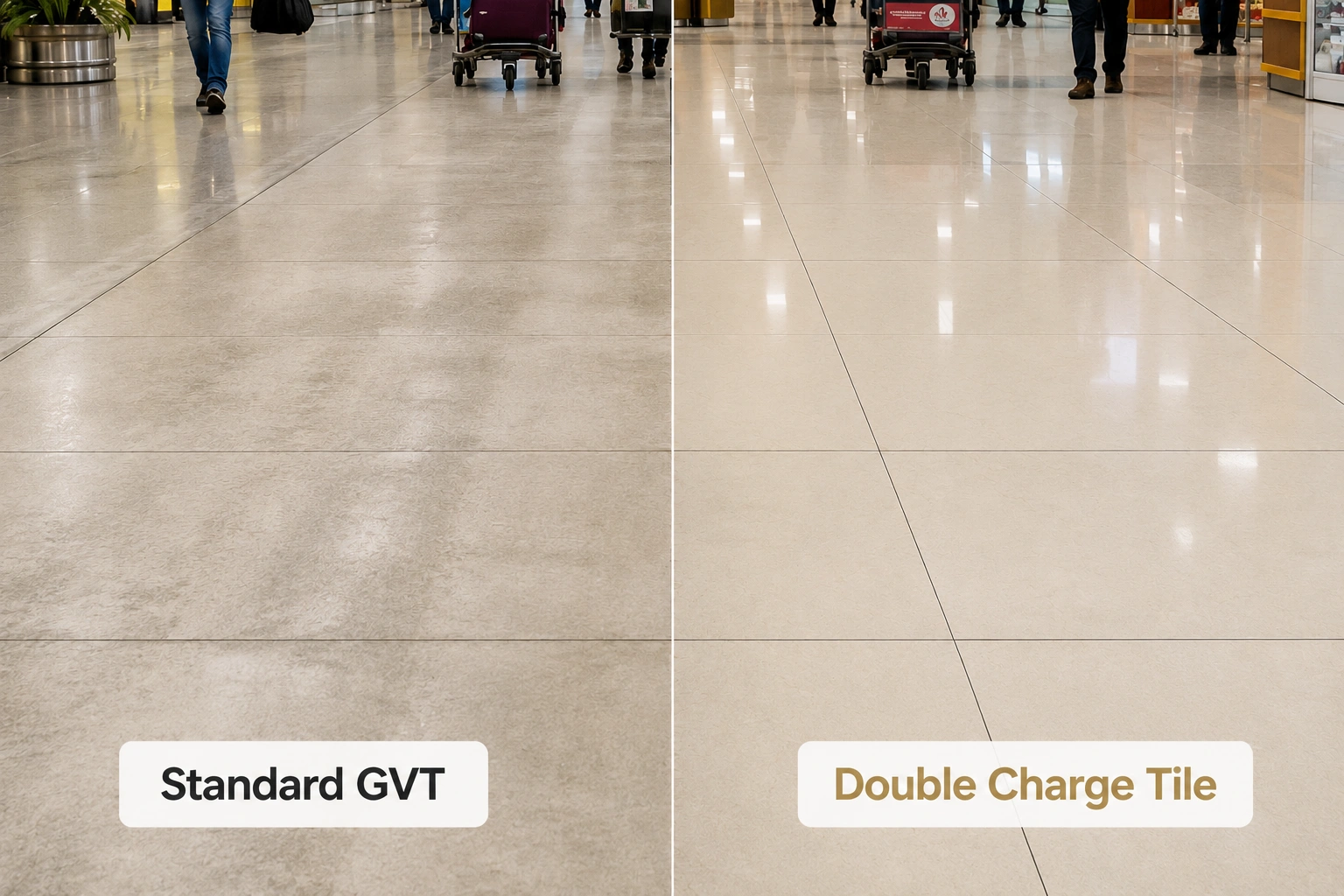
Double charge tiles vs GVT is the most common comparison question from Indian buyers choosing between vitrified categories for a high-traffic floor. The answer is not that one is always better, but that each has a specific advantage in specific conditions.
GVT in a matte or GHR finish wins on: wet area safety (anti-skid), design variety (marble, wood, stone, concrete, fabric, abstract), finish variety (matte, GHR, Rain Drops, Sugar, Texture, Carving), outdoor suitability, and size range (including 8x48 plank). It is the more flexible tile across applications.
Double charge wins on: scratch resistance in high-traffic dry indoor floors, design consistency over years of wear, and long-term appearance retention in commercial-grade usage. For a polished floor in a high-traffic dry zone, double charge outlasts GVT's thin glaze layer.
Full Body vitrified is the closest category to double charge in terms of durability philosophy. Full Body tiles have their colour running through the entire tile body, which means chipping at tile edges also stays consistent in colour. Full Body is the stronger choice where edge visibility matters, such as in large commercial installations where tile edges are exposed. Double charge has a deeper design layer than standard GVT but a thinner, consistent-colour depth than Full Body. For most Indian residential and standard commercial uses, double charge is the more cost-effective choice between the two.
Double Charge Tiles Price in India
Double charge tiles price in India runs from approximately ₹40 to ₹120 per sq. ft. depending on size, design, and brand. The 2x2 size in standard cream and ivory patterns starts at the lower end of this range. The 32x32 size and 2x4 format in more detailed designs reach the upper end.
Against standard GVT, double charge is similarly priced at the entry level and slightly higher in larger formats, because the manufacturing process involves the additional material and press step of the second charge layer. The durability advantage that double charge provides over GVT in high-traffic applications typically justifies this difference when viewed over the full floor life rather than the initial purchase cost.
All prices are approximate and vary by brand, dealer city, and order volume. Commercial projects ordering at bulk volume typically negotiate below the catalogue price, particularly for large-format 32x32 tiles in long-term supply arrangements.
What to Confirm Before Buying
Confirm the tile is being used on a dry indoor floor. Double charge is not appropriate for wet-area floors regardless of their durability. Confirm your installation zone is dry before ordering.
Ask for the design layer depth specification. Genuine double charge tiles have a 2 to 3mm design layer. Some tiles marketed as double-charged have a shallower layer that offers less wear resistance. Ask the supplier for the technical data sheet confirming the layer depth before purchasing, especially for commercial projects.
Check the available sizes against your room dimensions. Double charge is only available in 2x2, 32x32, and 2x4. If your room requires a different format for proportional reasons, GVT or Full Body vitrified in the required size with a polished glossy finish may be the alternative.
Request multiple tiles from the same batch to check colour consistency. Double charge design layer pigments can vary slightly between production batches. For large commercial projects where colour uniformity across the full area matters, check multiple tiles from the planned batch before confirming the order.
Buy 10 to 12% more than the measured area. Cutting wastage and installation breakage are standard for any vitrified tile project. For large-format 32x32 tiles, the per-cut waste is higher, so budget closer to 12%.
Common Misunderstandings About Double Charge Tiles
Double charge means the tile has two complete layers. This is a common misreading of the name. Double charge refers to the double loading of pigment in the press during manufacturing, not two separate tile bodies bonded together. The result is one unified tile with a thick design layer at the top of the body.
Double charge is suitable anywhere because it is so durable. Durability applies to wear resistance and scratch resistance. It does not override the slip hazard of the polished finish in wet conditions. A double-charge tile on a wet bathroom floor is just as slippery as a PGVT tile on the same floor. The tile's strength does not make it safe in wet applications.
Double charge is always the best tile for any floor. In low-traffic rooms like bedrooms, the durability advantage of double charge over GVT is not meaningful in daily use. GVT in a matte finish in a bedroom does not wear through in a normal residential lifecycle. Double charge is the right specification for genuinely high-traffic floors. In lower-traffic spaces, the extra cost and the limited design range of double charge do not add value over standard matte GVT.
Double charge and double loading are the same as Full Body. They are different categories. Full Body vitrified has colour evenly distributed through the entire tile body. Double charge has a thick design layer at the top but a different-coloured base body below it. The practical difference shows only if the tile chips at a corner or edge and the edge is visible: Full Body keeps consistent colour at the edge, double charge shows the base body colour at the chipped edge. For most interior floor applications where edges are not visible, this distinction is not practically relevant.
Conclusion
Double charge tiles earn their dominance in high-traffic areas through construction rather than marketing. The 2 to 3mm design layer is a physical property that GVT's thin glaze cannot replicate, and in a floor that sees heavy use every day for fifteen or twenty years, that physical difference shows.
Before ordering, confirm the installation zone is dry, check the layer depth specification with the supplier, and match the tile size to your room dimensions. For large commercial projects, request multiple batch samples to verify colour consistency across the full area.
You can browse double-charged vitrified tiles by size, design, and colour on TilesFinders to compare options from Morbi manufacturers and shortlist before visiting a showroom.
FAQs
A double charge vitrified tile is a type of vitrified tile manufactured by loading two separate layers of pigmented material into the press mould before firing. The base body forms the structural layer, and a 2 to 3mm pigmented design layer is compressed on top of it. Both layers are fired together at high temperatures, fusing the design deep into the top portion of the tile body. This thick design layer gives double charge tiles their primary advantage: the design and colour extend far enough below the surface that normal wear in high-traffic areas does not reach the plain body underneath, keeping the tile's appearance consistent over years of use.
For most high-traffic indoor residential and standard commercial floors, double charge is the more cost-effective choice. Full Body vitrified has colour running through the entire tile body, which means chipped tile edges stay colour-consistent. This makes Full Body better for installations where tile edges are exposed and visible. For standard flooring where edges are covered by skirting or adjoining tiles, double charge delivers comparable durability at a lower price point. If budget is not a constraint and edge consistency matters, Full Body is the stronger specification.
No. Double charge tiles are not rated for outdoor use. The polished finish becomes slippery in rain or wet conditions, and the tile body is not designed for the expansion and contraction cycles of direct sun and monsoon exposure that Indian outdoor surfaces face. For balconies, terraces, car porches, and outdoor pathways, GVT in a matte or GHR finish is the correct choice. These finishes have anti-skid properties and the GVT body handles outdoor conditions that double charge is not rated for.
For the heaviest residential traffic areas, double charge in 2x2 or 2x4 size from established Indian manufacturers (Kajaria, Somany, Johnson, or Morbi-based exporters) in a cream, ivory, or light grey palette is the standard recommendation. For commercial spaces like malls and hotels, the 32x32 (800x800 mm) size is widely used because it reduces grout lines in large-area installations and looks more continuous under crowd-level use. Confirm the design layer depth is 2 to 3mm before ordering for any heavy-traffic project.
Double charge tiles in India cost approximately ₹40 to ₹120 per sq. ft., depending on size, design, and brand. Standard 2x2 tiles in cream and ivory tones from domestic manufacturers start at the lower end of this range. Larger formats like 32x32 and 2x4 in more detailed patterns sit in the mid to upper range. Prices are approximate, vary by city and dealer, and do not include GST and installation costs. Commercial bulk orders typically negotiate below catalogue pricing for large quantities.
In a high-traffic residential space, double-charged tiles typically maintain their appearance for 15 to 25 years with standard maintenance. In commercial spaces with very high foot traffic such as shopping malls and hospital corridors, the surface finish can begin to show wear after 10 to 15 years, depending on the intensity of use and cleaning regimen. The thick 2 to 3mm design layer is the key factor: it takes significantly longer for normal abrasion to wear through the design material compared to the 1 to 2mm glaze on standard GVT tiles. With periodic machine polishing to restore shine, double-charged floors in commercial settings extend their usable life considerably.
For dry, high-traffic indoor floors where a polished finish is wanted, and the floor will not contact regular water, double charge is the better long-term choice because its thicker design layer resists wear more effectively than GVT's thin glaze. For wet-area floors, kitchen floors, bathroom floors, outdoor areas, or any floor where anti-skid properties are needed, matte or GHR finish GVT is the correct choice, not double-charged. The two categories do not directly compete for the same applications: double charge is for dry, high-traffic polished floors, matte GVT is for wet and outdoor floors.
