Commercial Tiles in India: Durability Standards, Designs and Procurement Guide
Choose the right commercial floor tiles with confidence. Compare PEI ratings, slip resistance, tile constructions, procurement tips, and durability standards for high-traffic projects in India.
- PEI Wear Classification for Commercial Use
- Material Construction for High-Traffic Commercial Floors
- Slip Safety by Commercial Zone
- Commercial Design Categories in Demand for 2026
- Procurement Process for Commercial Tile Orders
- Commercial Tile Manufacturing in India: 2026 Context
- Source Commercial Tiles on TilesFinders
Selecting the right commercial tile means matching PEI rating, slip resistance, and tile construction to the traffic level while ensuring consistent batch quality and verified technical specifications. Always confirm PEI, wet COF, water absorption, batch numbers, and procurement timelines before placing large commercial orders to avoid costly replacements and project delays.
Tile specification differs from residential projects in almost every dimension that matters. From wear class requirements and commercial tile performance standards to batch consistency across large orders, procurement timelines, and construction schedules, every decision has a greater impact. A wrong specification can affect thousands of square feet rather than a single living room. This guide covers the durability standards, design considerations, and procurement process for commercial tile projects in India.
PEI Wear Classification for Commercial Use
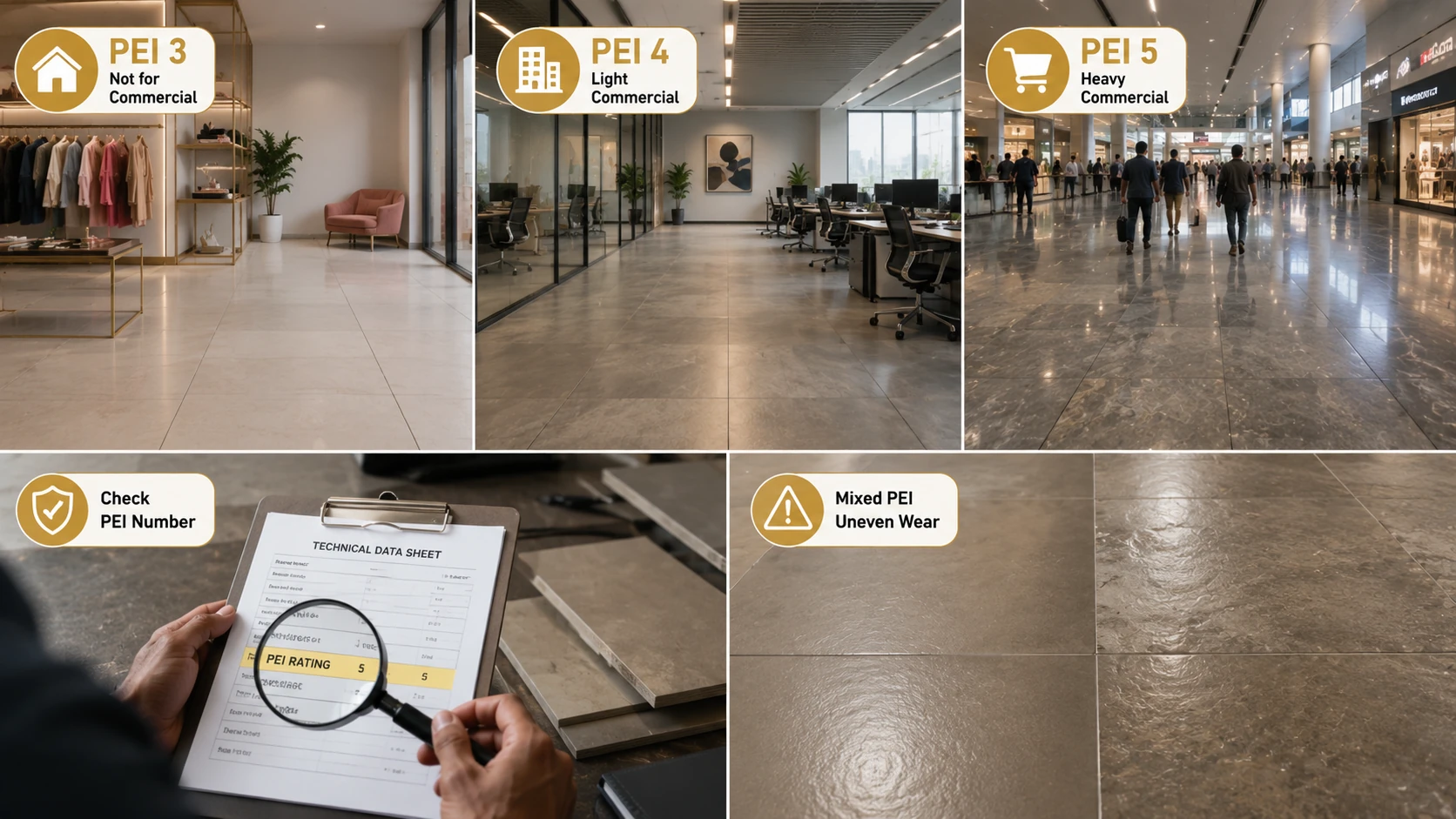
PEI (Porcelain Enamel Institute) rating measures a glazed tile's resistance to surface abrasion from foot traffic. It is the single most important specification figure for any commercial floor, and using a residential-grade PEI rating in a commercial space is the most common and most expensive procurement mistake in Indian commercial tile projects.
| PEI Class | Traffic Level | Appropriate Commercial Application | Not Suitable For |
| PEI 3 | Light residential traffic | Not appropriate for any commercial application, regardless of budget pressure. | Any commercial floor, including low-footfall offices. |
| PEI 4 | Moderate to heavy residential, light commercial | Boutique retail, small offices, hotel guest rooms, and restaurant dining areas with moderate footfall. | High-footfall retail, hotel lobbies, shopping mall common areas, transit-adjacent spaces. |
| PEI 5 | Heavy commercial and light industrial | Shopping mall corridors, hotel lobbies, airports, hospital corridors, high-footfall retail, restaurant kitchens, and service corridors. | Rarely a limitation; PEI 5 is the top of the standard residential and commercial classification and suits nearly all commercial applications. |
Procurement caution: Do not accept a supplier's verbal assurance that a tile is 'commercial grade.' Request the specific PEI number in the written technical data sheet for every SKU in a commercial order. A single mixed batch containing both PEI 4 and PEI 5 tiles of the same visual design, common when a supplier substitutes stock to meet a delivery deadline, produces uneven wear patterns within a few years that are expensive and disruptive to correct in an occupied commercial space.
Material Construction for High-Traffic Commercial Floors
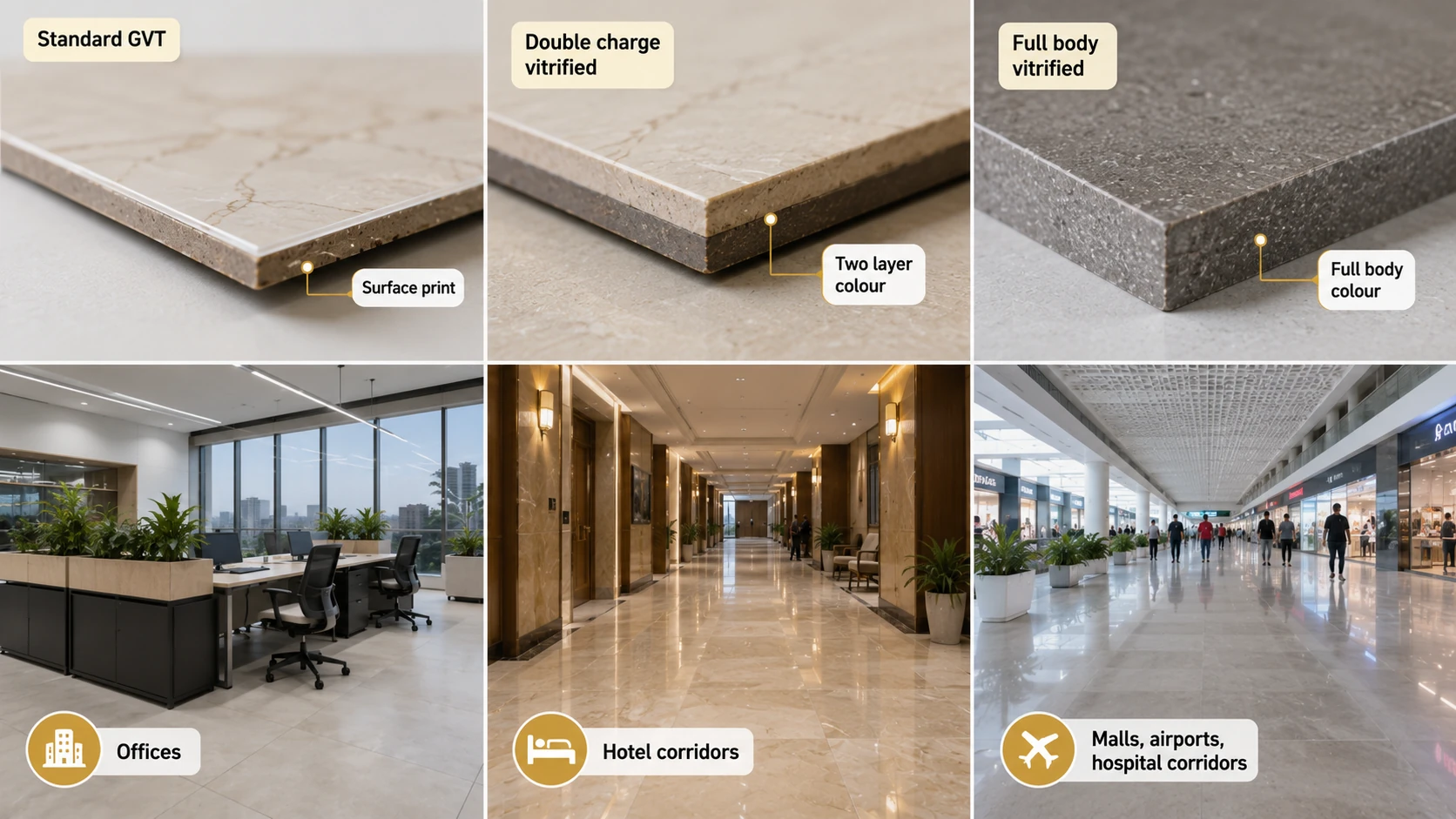
| Material | Colour Depth | Best Commercial Use | Price Range |
| Standard GVT | Surface print or thin glaze layer | Offices, retail below very heavy footfall, hospitality, and guest rooms | Rs. 70 to Rs. 160/sq.ft |
| Double charge vitrified | Colour pressed through two body layers | Hotel corridors, retail floors, moderate-to-heavy commercial traffic | Rs. 90 to Rs. 165/sq.ft |
| Full body vitrified | Colour through the entire tile thickness | Shopping malls, airports, hospital corridors, and the heaviest continuous commercial traffic | Rs. 115 to Rs. 180/sq.ft |
Slip Safety by Commercial Zone
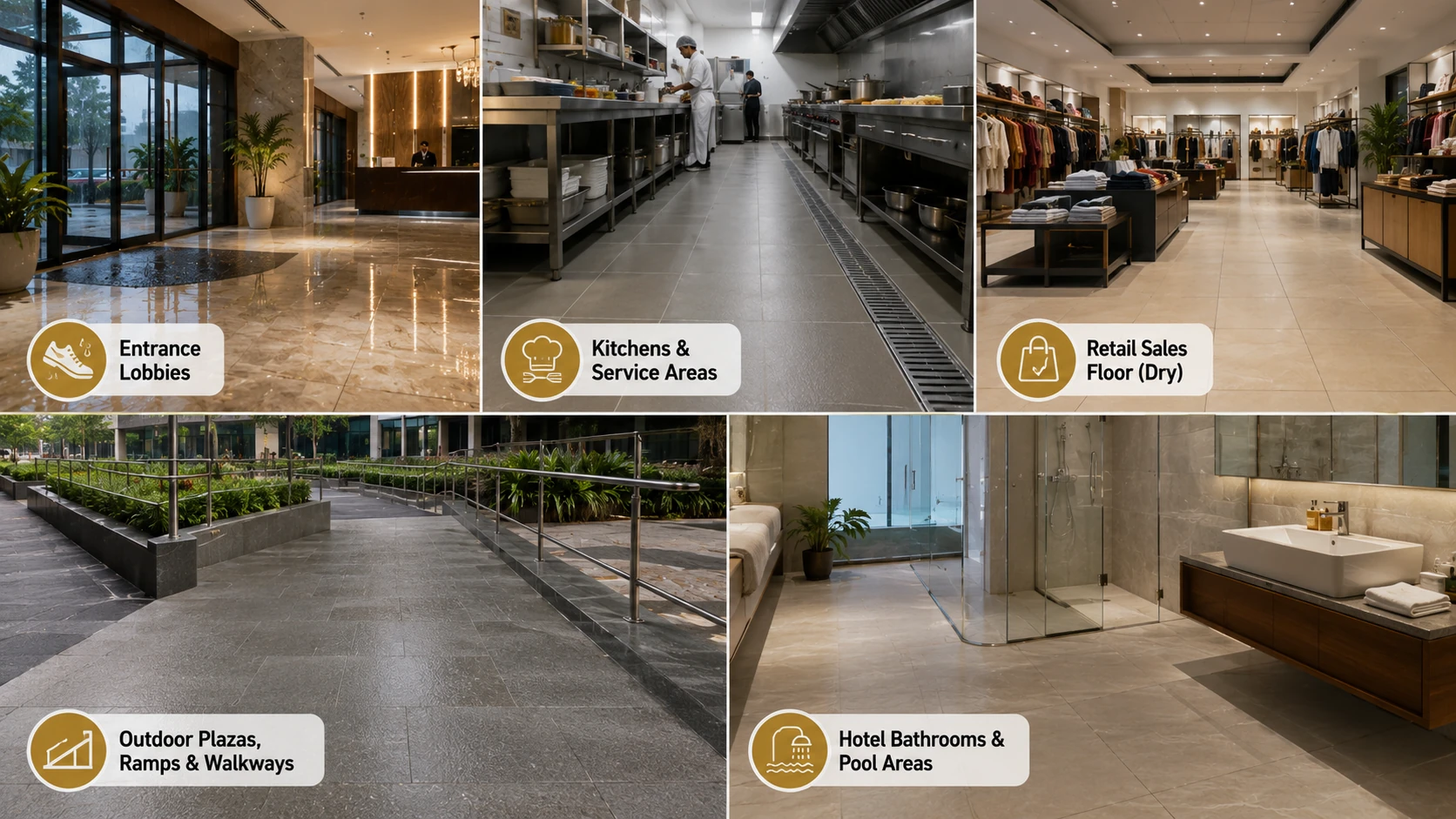
| Zone | Required Wet COF | Correct Specification |
| Entrance lobbies (monsoon wet footwear) | 0.4 wet minimum | Anti-skid matte GVT, R10 to R11 rating |
| Restaurant kitchens and service corridors | 0.4 wet minimum, often higher per local food safety guidance | Anti-skid matte GVT, R11 rating recommended |
| Retail sales floor (dry-area interior) | Standard, confirm per finish | Matte, semi-polished, or polished, acceptable with informed maintenance planning |
| Outdoor plazas, ramps, and covered walkways | 0.5 wet minimum | Anti-skid matte GVT, R11 minimum, R12 for ramps |
| Hotel bathroom and pool-adjacent areas | 0.4 wet minimum | Anti-skid matte GVT, R10 to R11 |
Commercial Design Categories in Demand for 2026
Idea 1: Grey Marble-Look Double Charge Lobby Floor
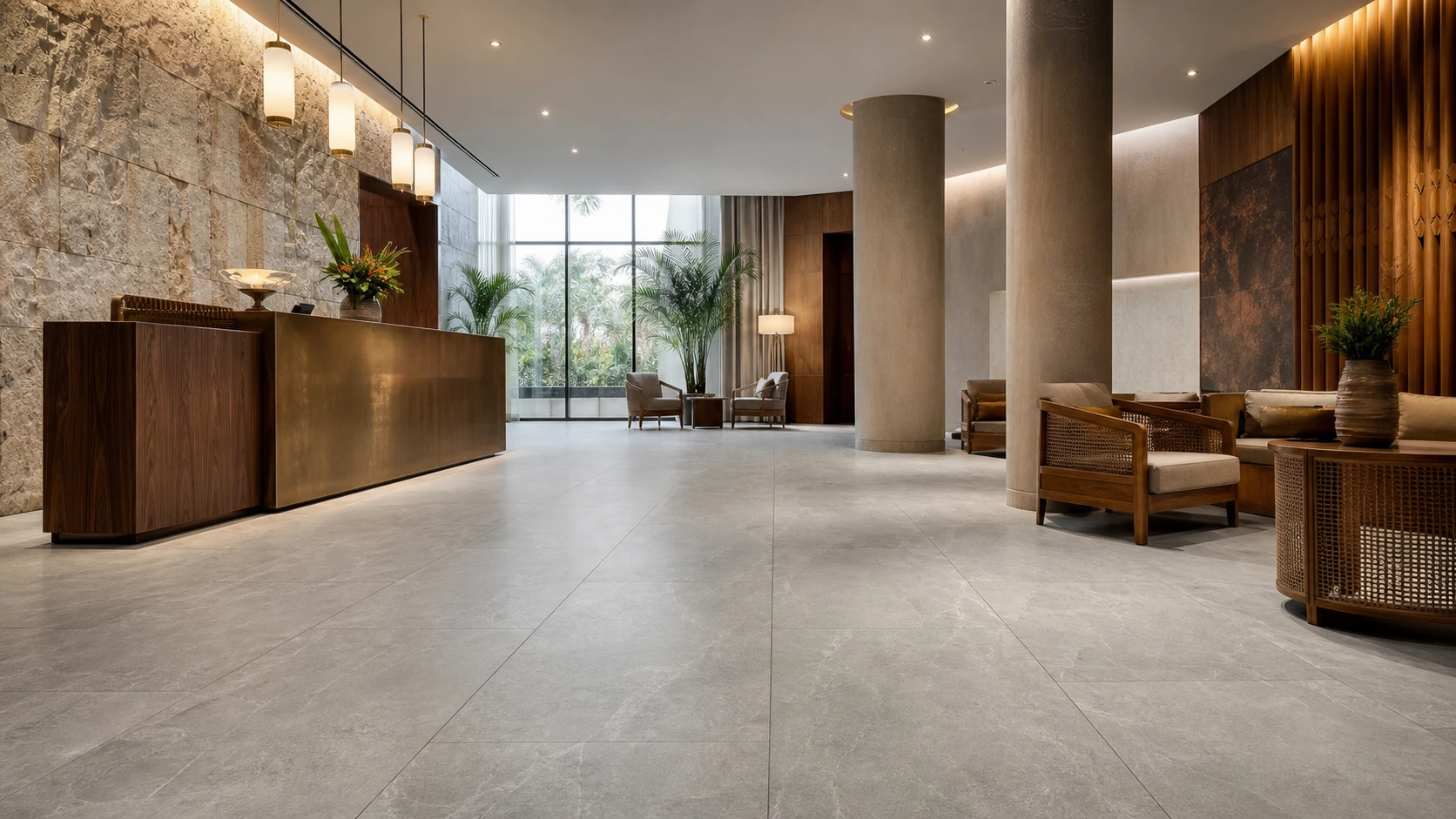
Double charge vitrified | 2x4 (600x1200 mm) | Matte or semi-polished | Rs. 105 to Rs. 165/sq.ft
The standard specification for Indian hotel and corporate lobby floors in 2026, balancing wear durability with a formal, premium visual read. Confirm PEI rating and finish-specific COF before specifying semi-polished or polished variants.
Idea 2: Warm Beige Full Body Retail Floor, PEI 5
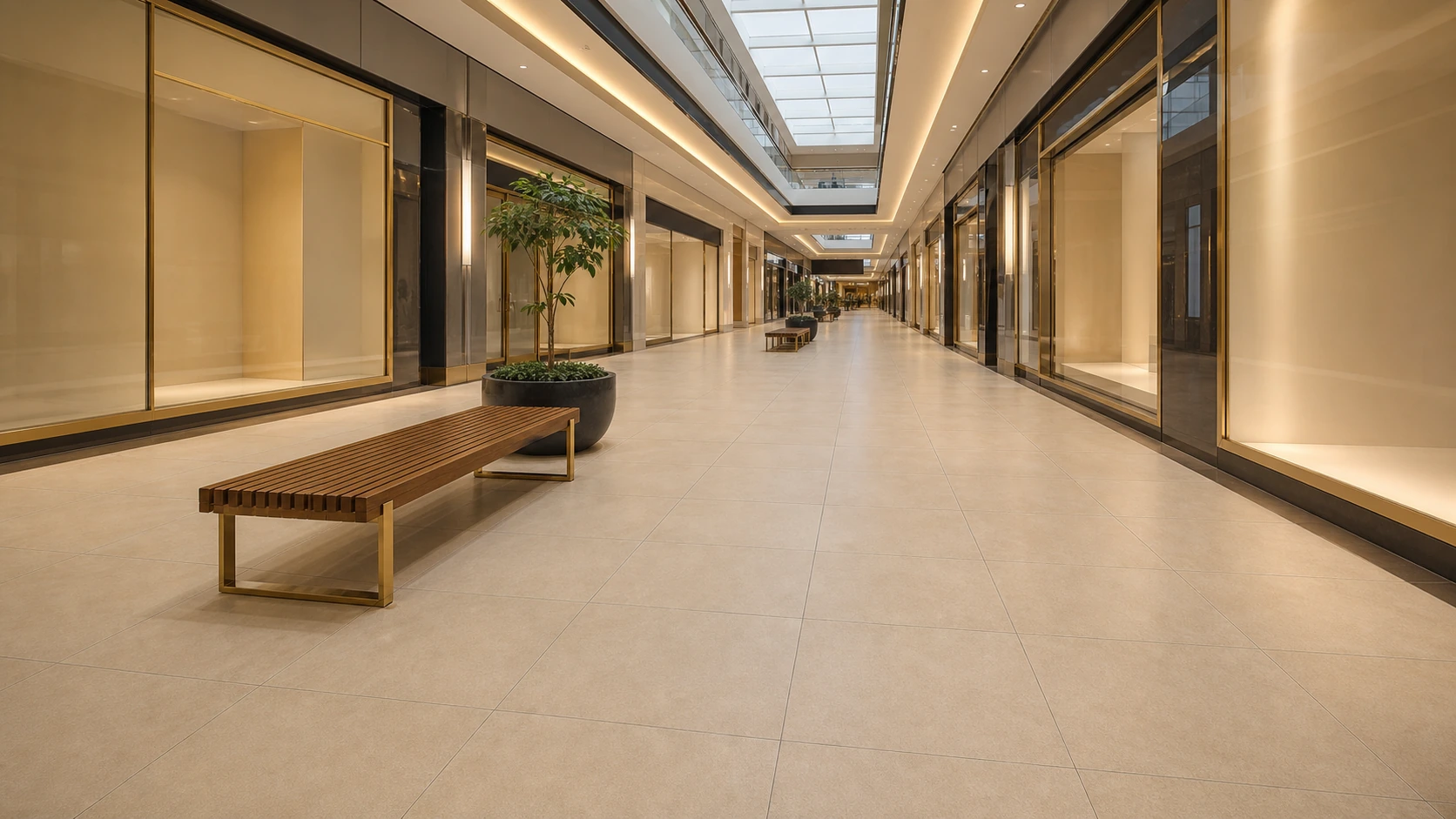
Full body vitrified | 32x32 (800x800 mm) | Matte or anti-skid matte | Rs. 120 to Rs. 175/sq.ft
The correct specification for a shopping mall or high-footfall retail corridor, where continuous daily traffic across the full retail operating day requires the highest available wear class.
Idea 3: Anti-Skid Grey Stone-Look Restaurant Floor
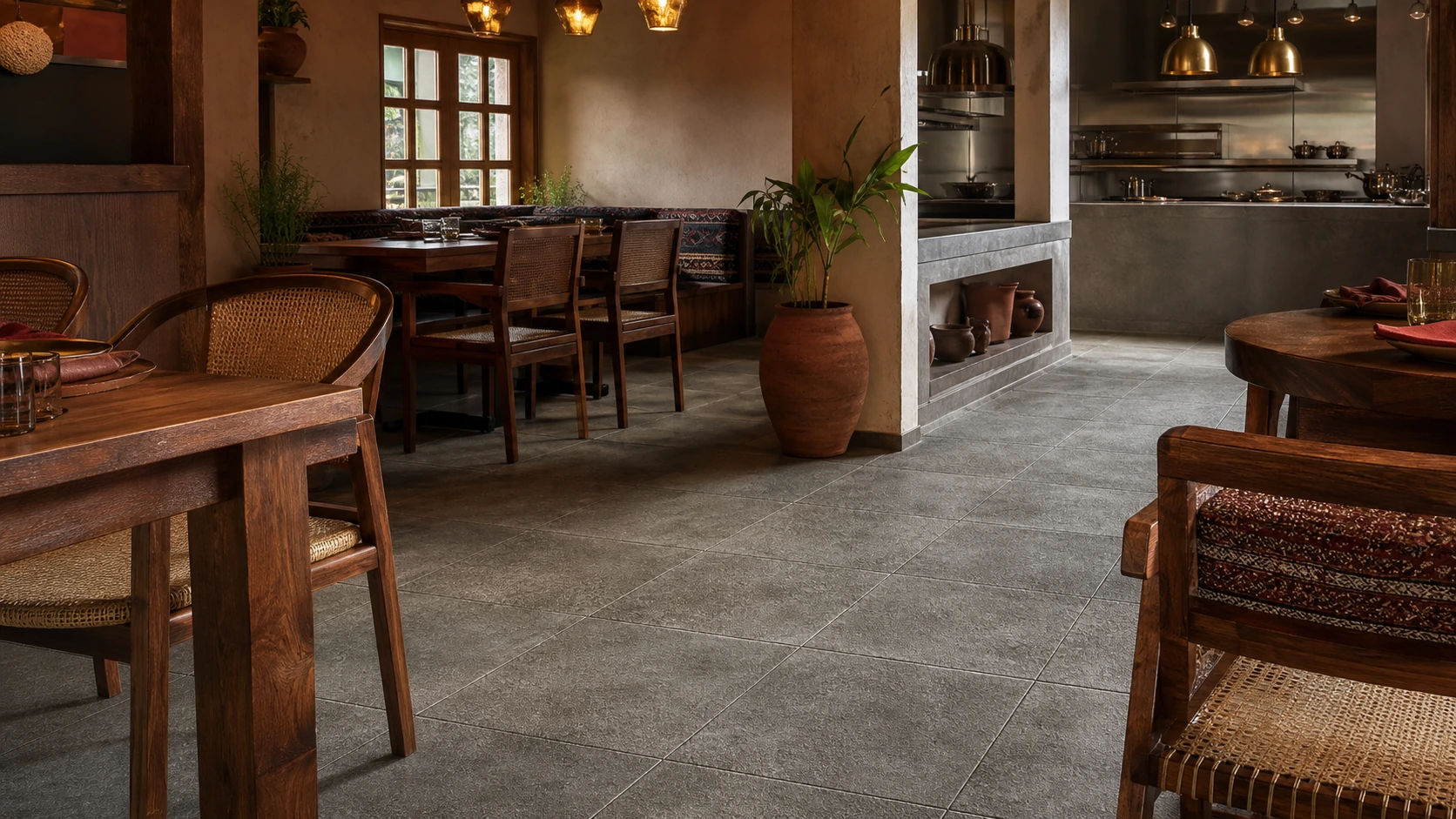
GVT anti-skid | 2x2 or 24x24 (600x600 mm) | Anti-skid matte, R11 | Rs. 80 to Rs. 130/sq.ft
Restaurant dining and kitchen-adjacent floors require anti-skid specification regardless of design ambition. Grey stone-look at R11 handles food and beverage spill risk while reading as considered rather than purely utilitarian.
Procurement Process for Commercial Tile Orders
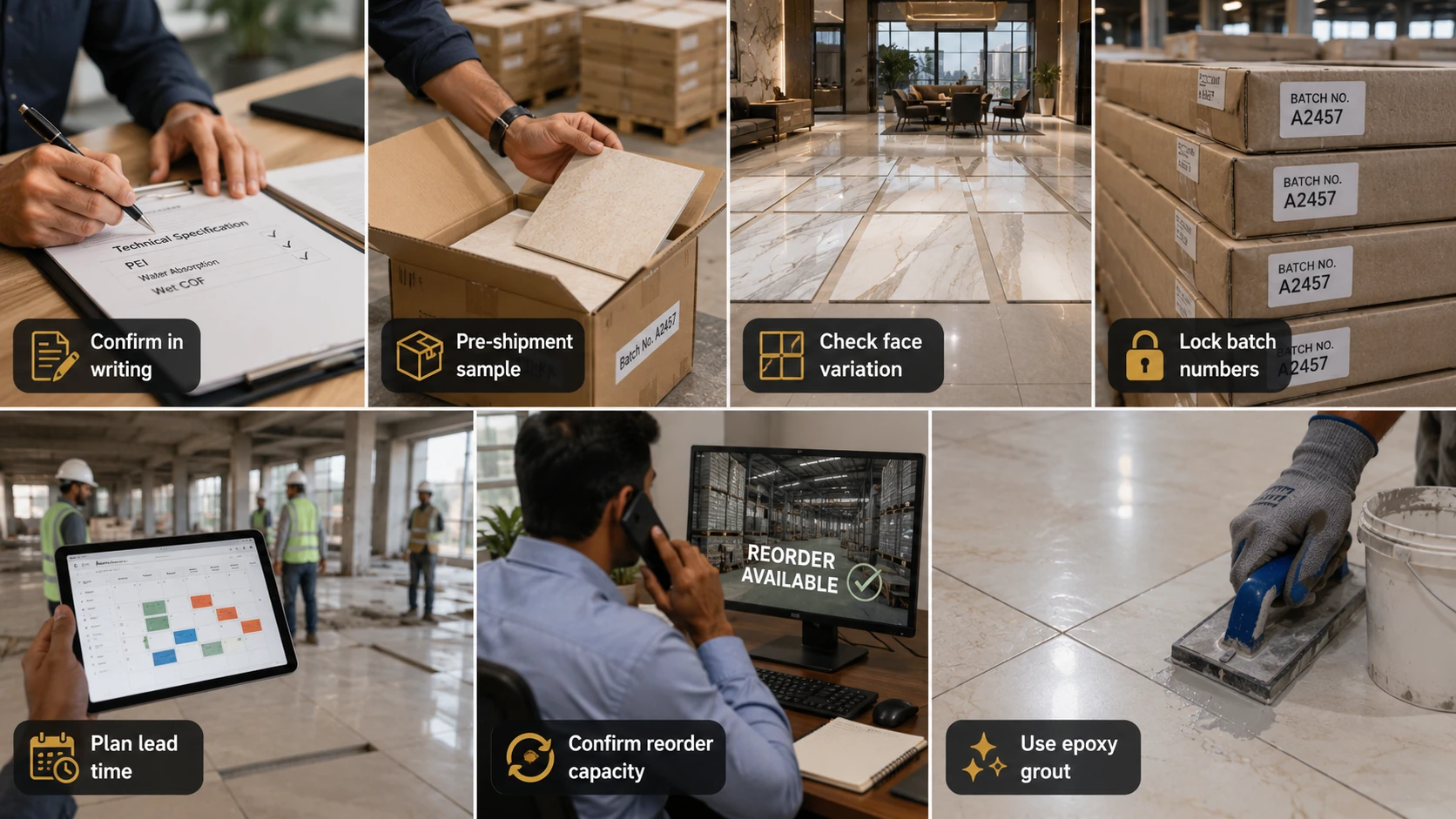
- Confirm PEI, water absorption, and wet COF in writing for every SKU before finalising a purchase order, not after delivery.
- Request a pre-shipment sample from the actual production batch, not a generic catalog sample, for any order above 2,000 sq.ft.
- Confirm face variation count and view a multi-tile layout before approving a design for a large continuous floor area, since pattern repetition is far more visible at a commercial scale than in a residential room.
- Lock batch numbers across the full order quantity. A commercial floor installed from multiple batches shows visible tonal seams that are far more noticeable at scale than in residential use.
- Build lead time into the construction schedule with a margin. Standard commercial formats ship in 2 to 3 weeks; large-format and full-body PEI 5 products can run 4 to 8 weeks, and any delay cascades into trades scheduled after flooring.
- Confirm the manufacturer's capacity for reorder if the project may need additional material after initial installation, since production runs are not held indefinitely, and a discontinued batch creates a permanent colour-matching problem.
- Specify epoxy grout for any polished or semi-polished commercial floor to prevent grout-line staining under heavy daily cleaning cycles.
Commercial Tile Manufacturing in India: 2026 Context
Commercial-grade double charge and full-body vitrified tiles are manufactured predominantly in Morbi, Gujarat, which produces over 70% of India's vitrified tile supply, under IS 15622:2006 at water absorption 0.05% or below. PEI 5 full body vitrified is produced by a smaller subset of specialist manufacturers with the production capability for the highest wear classification, and lead times for this category run longer than standard PEI 4 GVT. Hotel groups, retail chains, and corporate facility developers across India increasingly specify double charge and full body construction for new commercial builds specifically for the long-term wear consistency and reduced retiling frequency these materials deliver over a building's operating life.
In coastal Indian commercial developments with monsoon humidity of 85 to 95%, GVT at 0.05% water absorption performs without staining or sealing requirements across all seasons, a meaningful operating cost advantage over natural stone commercial flooring, which requires periodic resealing under continuous facility use.
Source Commercial Tiles on TilesFinders
Double charge, full body, and standard GVT tiles meeting commercial PEI and anti-skid specifications are available on TilesFinders from verified Morbi manufacturers, with bulk procurement support for large-quantity commercial orders. Request written TDS confirmation and pre-shipment batch samples before finalising any commercial purchase order.
FAQs
PEI 4 is the minimum for light commercial use, such as boutique retail and small offices. PEI 5 is required for heavy-footfall commercial spaces, including shopping malls, hotel lobbies, airports, and hospital corridors. PEI 3 residential-grade tiles should never be used in any commercial application.
Double charge tiles have colour pressed through two layers of the tile body, offering better wear consistency than standard GVT at high-traffic points. Full body vitrified tiles have colour through the entire tile thickness, the most durable option, suited to the heaviest continuous commercial traffic, such as shopping malls and airports.
Entrance lobbies with monsoon wet footwear exposure, restaurant kitchens and service corridors, outdoor plazas and ramps, and hotel bathroom or pool-adjacent areas all require a confirmed anti-skid COF of 0.4 wet minimum, with outdoor and ramp areas requiring 0.5 wet minimum and R11 to R12 rating.
Standard PEI 4 commercial formats ship in 2 to 3 weeks from Morbi manufacturers. Large-format and PEI 5 full-body vitrified products can take 4 to 8 weeks, given more limited specialist production capacity. Build this lead time into the construction schedule with margin, since delays cascade into subsequent trades.
Standard GVT at PEI 4 ranges from Rs. 70 to Rs. 160 per sq.ft. Double charge vitrified ranges from Rs. 90 to Rs. 165 per sq.ft. Full body vitrified at PEI 5 ranges from Rs. 115 to Rs. 180 per sq.ft, reflecting its higher wear classification and more limited manufacturing base.
A commercial floor typically covers a much larger continuous area than a residential room, making tonal variation between production batches far more visible at scale. Locking batch numbers across the full order quantity before installation begins prevents visible seams that are expensive and disruptive to correct once a commercial space is occupied and operating.
Yes, for dry-area interior floors with a professional daily cleaning schedule, such as retail sales floors and hotel lobbies away from entrance wet zones. Both finishes have wet COF well below the safety threshold and must never be used in any area with wet-contact risk, including entrances, restrooms, and outdoor-adjacent zones, regardless of the space being commercial.
Epoxy grout is recommended for any polished or semi-polished commercial floor to prevent staining under heavy daily cleaning cycles. For anti-skid matte commercial floors, a durable cementitious grout matched or tone-close to the tile colour is standard, with epoxy as an upgrade option for the highest-traffic zones.

See our tile guides first
Set TilesFinders as a preferred source and our buying guides surface ahead of the rest for you.
Add as preferred sourceTakes one tap. Nothing to install.
What Readers Say
I was about to redo my parking area with the wrong tile size until I read this. The layout comparisons saved me from a costly mistake.
We reference TilesFinders guides while briefing clients on material selection. The size and pattern breakdowns are accurate and easy to explain visually.
On site, I get asked about grout spacing all the time. This article gave me a solid reference I now share with my team before every job.
Finally a guide that doesn't just push generic advice. The oil stain removal steps actually worked on our clubhouse driveway tiles.
I run a small construction firm and now send this link to clients directly when they ask about entrance tile sizing. Saves me an hour of explaining.
Good practical detail, though I wish there were more examples for compact apartment entrances specifically, not just villas.
My mother-in-law wanted marble, I wanted vitrified. This blog gave us the neutral comparison we needed to actually decide together.
Detailed without being overwhelming. I appreciated that it covered both cost and maintenance, not just the aesthetics.
Used the algae and hard water removal tips on our terrace tiles after the monsoon. Worked better than what our regular cleaner was doing.
As someone who sources tiles for multiple builder projects, I find these comparisons genuinely useful for vendor conversations, not just consumer content.
Recommended this to a client who kept second-guessing the entrance design. The small vs large layout section settled the debate instantly.
Straightforward and honest, no unnecessary jargon. Would like to see a similar breakdown for outdoor pool-deck tiles next.
We've bookmarked several TilesFinders guides for our design handbook. Reliable source when clients want data, not just opinions.
Two paths, one marketplace.
Get free quotes from verified suppliers.
Share your room, budget, and style. Suppliers in Morbi respond within hours.
Get Free QuotesList your business, reach real buyers.
Put your showroom in front of homeowners searching for tiles right now.
List Your Business