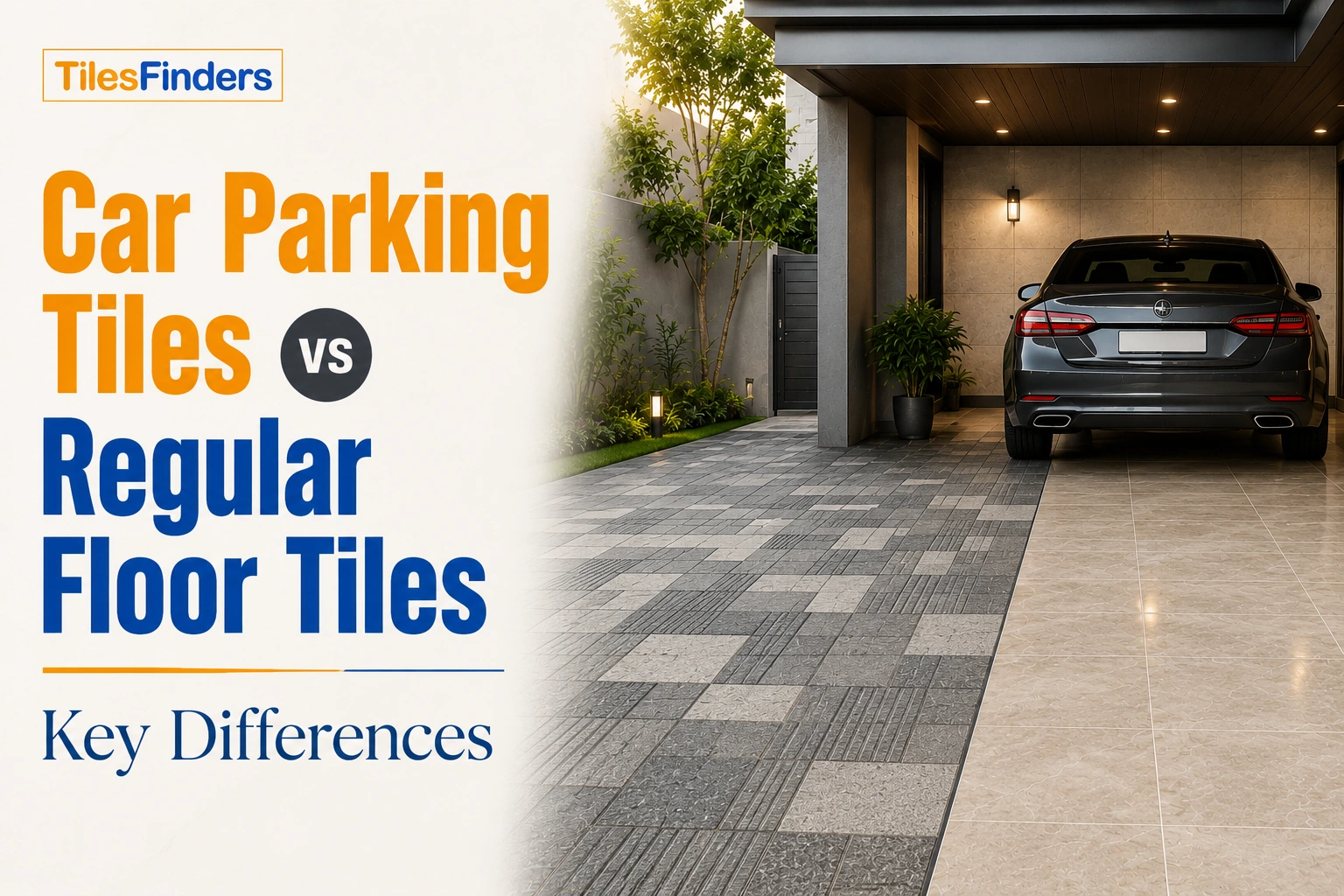
Car Parking Tiles vs Regular Floor Tiles: Key Differences
Don't let your driveway crack! Discover the crucial differences between parking and regular tiles, from 18mm thickness to load-bearing strength.
- What Makes Car Parking Tiles Different from Regular Floor Tiles?
- Key Differences: Car Parking Tiles vs Regular Floor Tiles
- Thickness: Why Parking Tiles Need to Be Thicker
- Body Type: Full Body Vitrified Tiles Are the Right Category for Parking
- Surface Finish: Why Parking Tiles Have a Textured Surface
- Water Absorption: The Factor Most Buyers Ignore
- Load Bearing and Breaking Strength
- Which Tiles Are Best for Car Parking in India?
- Parking Tiles Price in India per Square Feet: What to Expect
- How to Choose Parking Tiles for Your Home Driveway
- Common Mistakes When Choosing Between Parking Tiles and Regular Tiles
- Final Tips Before Choosing Car Parking Tiles
Car Parking Tiles vs Regular Floor Tiles: Key Differences
The tile that looks perfect in your living room will crack under your car in six months. This is the most common and most expensive tiling mistake Indian homeowners make.
Car parking tiles and regular floor tiles look similar in a showroom. Both are flat, both come in similar sizes, and a dealer in a hurry will sometimes sell you the wrong one without a second thought. The technical differences between them are not visible to the eye. The consequences show up only after a few months of daily vehicle movement.
This guide compares car parking tiles and regular floor tiles across every specification that matters: body strength, thickness, surface finish, water absorption, and price. The goal is to make the right choice clear before the installation begins, not after.
What Makes Car Parking Tiles Different from Regular Floor Tiles?
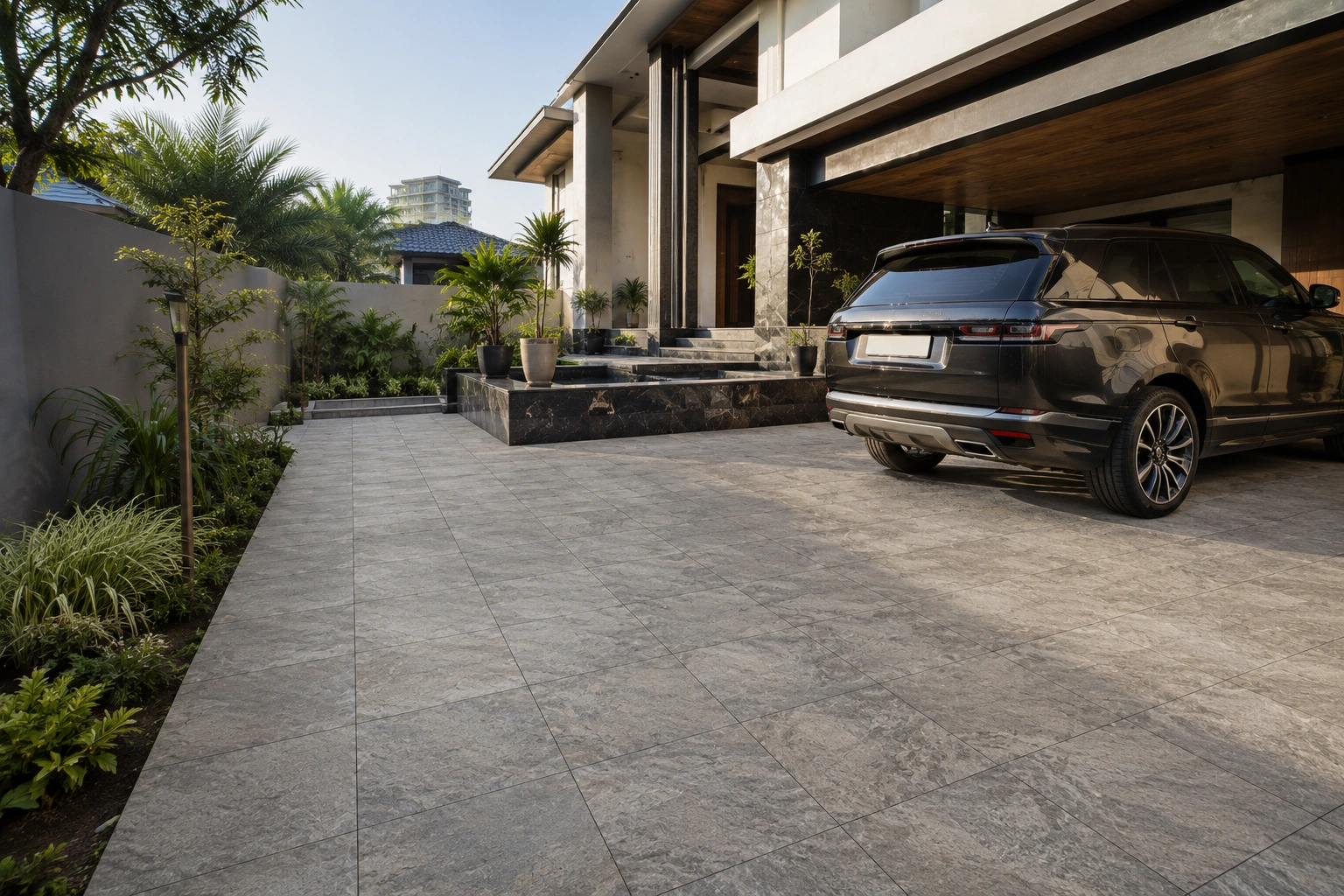
The difference between parking tiles and floor tiles is not cosmetic. It is structural. Car parking tiles are manufactured specifically to carry vehicle load, resist tyre friction, hold up under monsoon conditions, and maintain grip on a surface that is sometimes wet, sometimes dusty, and sometimes covered in oil.
Regular floor tiles are pressed and fired for foot traffic and interior conditions. Their body density, thickness, and surface finish are calibrated for rooms, not driveways. Put a regular floor tile under a car and it transfers the vehicle load to the adhesive and substrate as stress rather than distributing it across the tile body.
Car parking floor tiles are built specifically to prevent this. Regular floor tiles are not. By the second monsoon, water enters through those cracks, the adhesive bond fails, and tiles start lifting.
Parking floor tiles are pressed at higher pressure, fired at higher temperatures, and produced at greater thickness. These three manufacturing differences give them the structural properties to carry vehicle load without fracturing.
Key Differences: Car Parking Tiles vs Regular Floor Tiles
| Specification | Car Parking Tiles | Regular Floor Tiles |
| Body type | Full body vitrified tiles, GVT (outdoor rated), porcelain | GVT, PGVT, ceramic, double charge (indoor) |
| Thickness | 18 to 25 mm for car load | 8 to 12 mm for foot traffic |
| Breaking strength | 3,000 N and above | 1,000 to 2,000 N |
| Surface finish | Matte, GHR (Glaze High Resistance), textured | Glossy, matte, polished, satin matte |
| Water absorption | Below 3% (vitrified 0.05%, porcelain 2 to 5%) | 0.05% to 16% depending on category |
| Outdoor use | Rated for outdoor exposure and vehicle load | Most categories not rated for outdoor use |
| Anti-skid rating | R10 to R12 minimum | R6 to R9 (indoor standard) |
| Price range | Rs. 60 to Rs. 250 per sq. ft. | Rs. 30 to Rs. 220 per sq. ft. |
Thickness: Why Parking Tiles Need to Be Thicker
What thickness parking tiles for home car use? For a single-car home parking area, 18 mm to 20 mm tiles in full body vitrified or outdoor-rated GVT are the minimum. A standard family car weighs between 1,200 kg and 1,800 kg. That load is distributed across four tyre contact patches, each roughly the size of a palm. The tile under each tyre receives concentrated pressure with every parking and unparking movement.
A 10 mm regular floor tile cannot distribute this load. The tile flexes under the point load, stress fractures develop at the tile edges and grout joints, and the tile eventually breaks. Parking tiles thickness at 18 mm to 25 mm spreads the load across more tile bodies and transmits it more evenly to the substrate below.
For two-wheeler parking areas like bike stands in societies, 12 mm to 15 mm tiles can work. For cars, 18 mm is the safe minimum. For heavy vehicles or society parking with constant movement, 25 mm and above is the correct specification.
Body Type: Full Body Vitrified Tiles Are the Right Category for Parking
Are full body vitrified tiles good for parking? Yes. Full body vitrified tiles for parking are the strongest tile category outdoors because the colour and composition run through the entire tile thickness. If a tile gets chipped by a vehicle wheel, the damage is barely visible because the interior looks the same as the surface. This also means the tile body has no weak internal layer that can delaminate under load.
Full body vitrified tiles absorb less than 0.05% water and score 6 to 8 on the Mohs hardness scale. This combination gives them strong tyre pressure resistance under daily car movement and the outdoor tile durability to hold up through monsoon cycles without expanding, cracking, or staining.
GVT (Glazed Vitrified Tiles) in outdoor-rated, anti-skid finishes also work for home car parking when specified correctly. The key word is outdoor-rated. Indoor GVT at standard 8 mm to 10 mm thickness is not a parking tile regardless of the category name.
PGVT (Polished Glazed Vitrified Tiles) should never be used in parking areas. The polished surface has near-zero slip resistance when wet, and the finish degrades quickly under tyre friction. PGVT is built for interior walls and dry indoor floors, not driveways.
Surface Finish: Why Parking Tiles Have a Textured Surface
Why do parking tiles have a textured surface? Because a smooth floor surface under a car becomes a safety hazard the moment it gets wet, dusty, or lightly oiled from engine drips. The textured surface on parking tiles creates friction points that hold tyre and foot grip even in these conditions.
GHR (Glaze High Resistance) finish gives a stone-like rough anti-skid surface with the best performance in the Indian parking tile market. It carries strong tyre pressure resistance and is the top recommendation for open driveways that face rain and direct sun. Textured parking tiles in matte finish are the most widely available option and give reliable slip resistant outdoor flooring performance for home car parking.
Matte finish outdoor tiles in GVT or full body vitrified carry slip ratings of R10 to R11, which is the minimum standard for outdoor vehicle areas in India. The R rating comes from a wet ramp test that measures how much grip the tile holds when wet. R9 is the minimum for interior wet areas like bathrooms. Parking areas need R10 or above.
Regular floor tiles in glossy, high glossy, satin matte, or polished finishes are not rated for outdoor parking under any circumstance. These finishes become slippery on outdoor surfaces within seconds of rain or moisture. Even regular floor tiles sold in matte finish are not always rated for the outdoor durability that driveway tiles need.
Water Absorption: The Factor Most Buyers Ignore
Outdoor parking tiles face a water absorption challenge that indoor floor tiles never encounter. Every monsoon, water sits on the parking surface for hours. Over weeks and months, tiles with high water absorption absorb this moisture, expand slightly, and contract when dry. This cycle breaks the adhesive bond at the tile edges and causes tiles to lift or crack.
Full body vitrified tiles and GVT absorb less than 0.05% water. This makes them the correct choice for weatherproof flooring in Indian outdoor parking conditions. Porcelain tiles absorb 2% to 5%, still acceptable for outdoor use at home. Ceramic tiles absorb 12% to 16% and should not be used outdoors at any price point.
Regular indoor floor tiles in PGVT, double charge, or nano categories are not rated for outdoor water exposure. Double charge tiles are excellent for high-traffic indoor flooring in showrooms and lobbies but should never be used in outdoor parking because they are not built for wet area conditions. The category matters: outdoor floor tiles India needs for parking must be vitrified or porcelain, not indoor categories like double charge or nano.
Load Bearing and Breaking Strength
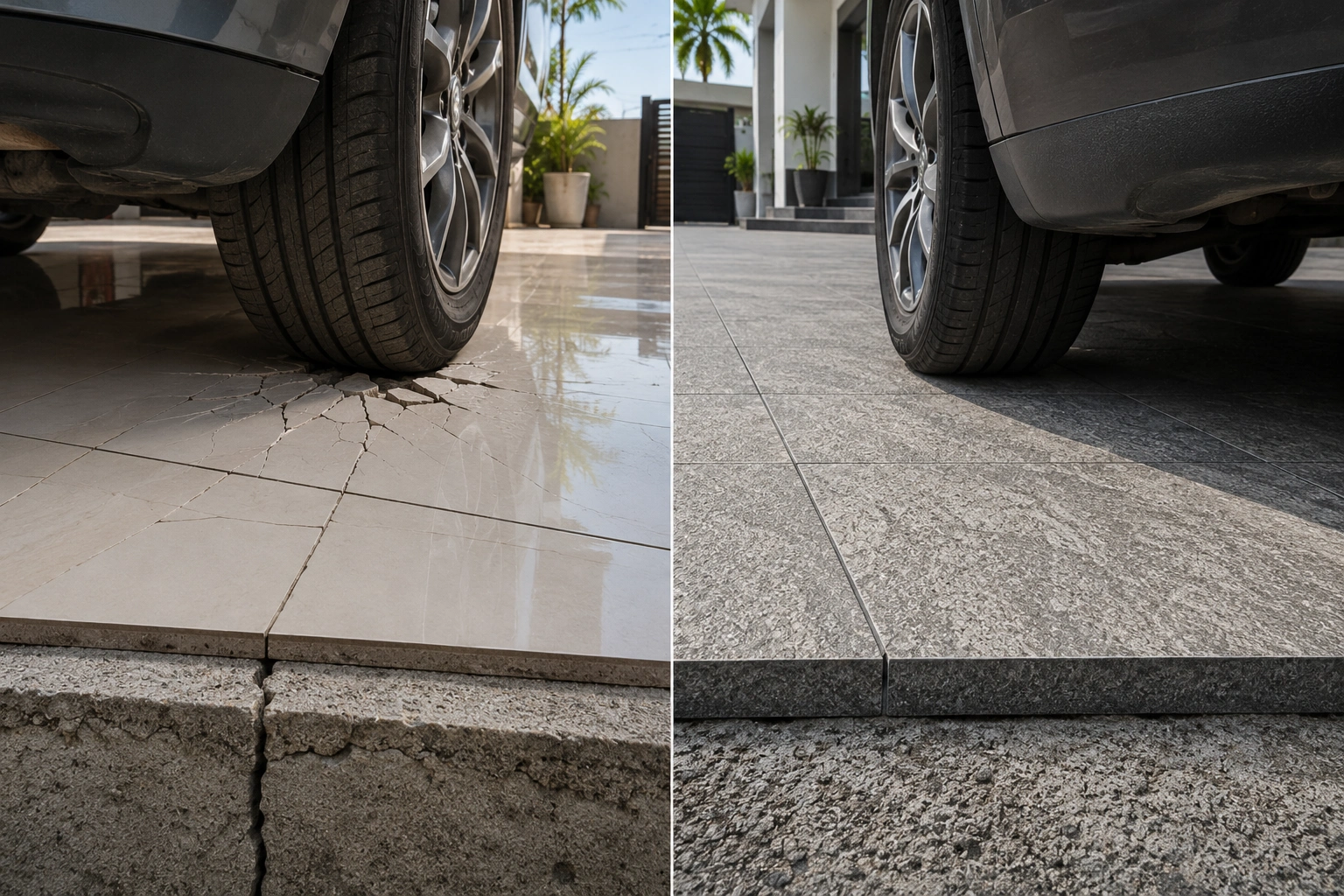
Can I use regular floor tiles for parking? The short answer is no, and breaking strength is the main reason. Load bearing tiles rated for car parking carry breaking strength ratings of 3,000 N and above. A standard regular floor tile used in living rooms or bedrooms carries 1,000 N to 2,000 N.
Breaking strength measures how much concentrated force a tile can take before fracturing. In a car parking area, the tyre edge landing on a tile edge during a parking manoeuvre creates exactly this kind of concentrated point load. A tile rated at 1,500 N will fracture under this scenario within weeks of regular use. Heavy duty vitrified tiles rated at 3,500 N distribute the same load across the tile body without cracking.
Before buying any tile for car parking, ask the dealer for the breaking strength specification on the carton or technical data sheet. Any tile without this number printed clearly should not be used as a car parking floor tile regardless of what the dealer says.
Which Tiles Are Best for Car Parking in India?
Which tiles are best for car parking in India depends on the type of parking area, vehicle load, and budget. The table below covers the most practical combinations for Indian home and society parking.
| Parking Situation | Best Category | Best Finish | Recommended Size | Approx. Price (per sq. ft.) |
| Home car parking (single car) | Full Body Vitrified or GVT outdoor | Matte or GHR | 400x400 mm (16x16) or 500x500 mm (20x20) | Rs. 65 to Rs. 150 |
| Home driveway (two cars) | Full Body Vitrified | GHR or Matte | 500x500 mm (20x20) or 600x600 mm (2x2) | Rs. 90 to Rs. 200 |
| Society parking (multiple cars) | Full Body Vitrified or Concrete | GHR or Textured | 400x400 mm (16x16) or 500x500 mm (20x20) | Rs. 60 to Rs. 180 |
| Covered basement parking | GVT outdoor-rated or Full Body | Matte or GHR | 600x600 mm (2x2) | Rs. 65 to Rs. 150 |
| Two-wheeler parking only | GVT outdoor or Porcelain | Matte | 400x400 mm (16x16) | Rs. 60 to Rs. 120 |
Parking Tiles Price in India per Square Feet: What to Expect
Parking tiles price in India per square feet ranges from Rs. 35 to Rs. 250 depending on category, thickness, and brand. These are approximate 2026 market figures, ex-GST. Add 18% GST and Rs. 40 to Rs. 90 per sq. ft. for installation when calculating the full project cost.
| Category | Thickness | Parking Tiles Price (per sq. ft. ex-GST) | Good For |
| Concrete parking tiles | 25 to 40 mm | Rs. 35 to Rs. 80 | Society and industrial parking, budget projects |
| GVT (outdoor-rated, matte or GHR) | 18 to 20 mm | Rs. 60 to Rs. 150 | Home car parking, covered driveways |
| Full Body Vitrified | 20 to 25 mm | Rs. 90 to Rs. 200 | Open driveways, two-car homes, heavy use |
| Porcelain (outdoor matte) | 18 to 20 mm | Rs. 90 to Rs. 220 | Mid-range home parking, open outdoor areas |
Anti skid parking tiles in GHR or textured finish cost roughly the same as standard matte options within the same category. The finish upgrade adds no significant cost but materially improves safety on slopes, ramps, and open driveways that face rain.
The parking tile design for home does not have to be plain grey or industrial-looking. Full body vitrified tiles now come in stone-look, cobblestone, and textured natural finishes that look good on a home driveway while meeting all the technical parking specifications. Higher-end driveway tiles in designer finishes can cost up to Rs. 250 per sq. ft. but they carry the same parking-rated specs as standard options.
How to Choose Parking Tiles for Your Home Driveway
How to choose parking tiles for home driveway comes down to four questions to answer before visiting a showroom.
First: what vehicle will use the parking area? A car needs tiles rated at 3,000 N minimum breaking strength and 18 mm minimum thickness. A two-wheeler only needs 12 mm to 15 mm. A heavy vehicle or truck needs 25 mm and above with epoxy grout.
Second: is the parking area open or covered? Open outdoor areas need full body vitrified or porcelain tiles with water absorption below 3%. High traffic flooring in covered basement parking can use outdoor-rated GVT with a slightly wider design range.
Third: does the surface slope or have a ramp? Sloped surfaces and ramps need GHR or heavily textured finish to maintain slip resistant outdoor flooring performance when wet. A flat driveway can use matte finish.
Fourth: what is the substrate condition? A new concrete slab needs 28 days to fully cure before tiling. Tiles laid on damp or uncured concrete fail at the adhesive bond within months regardless of how good the tile is. Vitrified tiles for parking area projects need polymer-modified adhesive, not standard sand-cement mix, for outdoor conditions.
Common Mistakes When Choosing Between Parking Tiles and Regular Tiles
Using Indoor GVT or PGVT in Outdoor Parking
Indoor GVT tiles in standard 10 mm thickness look identical to outdoor tiles in the showroom. The body strength, finish, and anti-skid ratings are completely different. PGVT should never be used outdoors. Always confirm the tile is outdoor-rated and check the breaking strength number before buying.
Choosing Glossy or Polished Finish for Parking
Glossy, polished, satin matte, and high-glossy finishes have no place in any parking area. They look good in the showroom and become slip hazards in the first rain. The only finishes suitable for car parking floors are matte, GHR, textured, and rain drops (outdoor-rated version).
Relying on Tile Appearance Over Specifications
A tile's design has no bearing on whether it is safe for parking. A grey stone-look tile at 10 mm in indoor GVT will fail under a car just as fast as a plain white tile. Always ask for the breaking strength rating, anti-skid R-rating, water absorption percentage, and tile thickness before any other decision.
Skipping the Substrate Preparation
Parking tiles are only as strong as the surface they sit on. A 25 mm full body vitrified tile on an uncured or poorly levelled base will crack from below, not above. The concrete base must cure for at least 28 days. Use polymer-modified adhesive and epoxy grout for any outdoor parking tile installation.
Final Tips Before Choosing Car Parking Tiles
The right car parking tiles will hold up for ten to fifteen years in an Indian home driveway without cracking, lifting, or losing grip. The wrong tile, even a good-looking one from a reputable brand, can fail in two monsoons.
Before placing any order, confirm the tile category is outdoor-rated, check the breaking strength specification on the carton, verify the anti-skid R-rating, and confirm the thickness is 18 mm or above for car use. Take these four numbers to any dealer visit and the right tile will be easy to identify.
You can browse car parking tiles by category, finish, thickness, and design on TilesFinders to compare options from Indian manufacturers at different price points before heading to a local showroom.
FAQs
No. Regular floor tiles are not rated for vehicle load. They are pressed and fired for foot traffic only. Under a car, regular floor tiles crack at tyre contact points within weeks because their breaking strength (1,000 to 2,000 N) is too low for vehicle load. Car parking tiles need a minimum breaking strength of 3,000 N, a thickness of 18 mm and above, and an anti-skid surface with an R10 slip rating or higher.
Full body vitrified tiles in GHR or matte finish are the best choice for car parking in India. They absorb less than 0.05% water, carry breaking strength above 3,000 N, and hold their surface grip under tyre friction and monsoon conditions. Outdoor-rated GHR or matte tiles is a strong alternative at a slightly lower cost. Porcelain tiles in matte finish also work for home parking at mid-range prices.
The main differences are thickness, breaking strength, surface finish, and outdoor rating. Parking tiles are 18 to 25 mm thick, carry 3,000 N or more breaking strength, have textured anti-skid surfaces rated R10 and above, and are built for outdoor exposure and vehicle load. Regular floor tiles are 8 to 12 mm thick, carry 1,000 to 2,000 N breaking strength, use glossy or matte decorative finishes, and are made for indoor foot traffic only.
For a single-car home parking area, 18 to 20 mm thickness in full body vitrified or outdoor-rated GVT tiles is the minimum. For two-car driveways or heavier vehicles, 20 to 25 mm is the right specification. For two-wheeler only areas, 12 to 15 mm outdoor-rated tiles are sufficient. Always pair the tile with polymer-modified adhesive and a properly cured concrete substrate.
Yes. Full body vitrified tiles are the strongest and most practical choice for car parking areas in India. The colour and body composition run through the entire tile thickness, so the tile resists chipping from vehicle load and the surface shows no visible damage from minor tyre friction. Their water absorption below 0.05% makes them suitable for monsoon-exposed outdoor parking.
Parking tiles price in India per square feet ranges from Rs. 35 to Rs. 250 ex-GST depending on category and thickness. Concrete parking tiles cost Rs. 35 to Rs. 80. Outdoor-rated GVT tiles cost Rs. 60 to Rs. 150. Full body vitrified tiles cost Rs. 90 to Rs. 200. Porcelain outdoor tiles cost Rs. 90 to Rs. 220. Add 18% GST and Rs. 40 to Rs. 90 per sq. ft. for installation when calculating total cost.
Parking tiles have a textured surface to provide grip for tyres and feet when the floor is wet, dusty, or oiled. A smooth surface becomes slippery in rain and creates a safety hazard in driveways and ramps. GHR (Glaze High Resistance) and matte textured finishes carry slip ratings of R10 to R12, which is the minimum standard for outdoor vehicle areas. Smooth or glossy finishes are not safe for any parking floor.

See our tile guides first
Set TilesFinders as a preferred source and our buying guides surface ahead of the rest for you.
Add as preferred sourceTakes one tap. Nothing to install.
What Readers Say
I was about to redo my parking area with the wrong tile size until I read this. The layout comparisons saved me from a costly mistake.
We reference TilesFinders guides while briefing clients on material selection. The size and pattern breakdowns are accurate and easy to explain visually.
On site, I get asked about grout spacing all the time. This article gave me a solid reference I now share with my team before every job.
Finally a guide that doesn't just push generic advice. The oil stain removal steps actually worked on our clubhouse driveway tiles.
I run a small construction firm and now send this link to clients directly when they ask about entrance tile sizing. Saves me an hour of explaining.
Good practical detail, though I wish there were more examples for compact apartment entrances specifically, not just villas.
My mother-in-law wanted marble, I wanted vitrified. This blog gave us the neutral comparison we needed to actually decide together.
Detailed without being overwhelming. I appreciated that it covered both cost and maintenance, not just the aesthetics.
Used the algae and hard water removal tips on our terrace tiles after the monsoon. Worked better than what our regular cleaner was doing.
As someone who sources tiles for multiple builder projects, I find these comparisons genuinely useful for vendor conversations, not just consumer content.
Recommended this to a client who kept second-guessing the entrance design. The small vs large layout section settled the debate instantly.
Straightforward and honest, no unnecessary jargon. Would like to see a similar breakdown for outdoor pool-deck tiles next.
We've bookmarked several TilesFinders guides for our design handbook. Reliable source when clients want data, not just opinions.
Two paths, one marketplace.
Get free quotes from verified suppliers.
Share your room, budget, and style. Suppliers in Morbi respond within hours.
Get Free QuotesList your business, reach real buyers.
Put your showroom in front of homeowners searching for tiles right now.
List Your Business