Best Tiles for Hospitals & Clinics in India: Material, Design & Durability Guide
A guide to hospital and clinic tiles in India: where vitrified tile works best, where seamless flooring is required for infection control, plus zone-by-zone picks and costs.

- The Infection-Control Logic Behind Hospital Flooring
- Where Tile Belongs, and Where It Doesn't
- Material Choice for the Zones Tile Does Cover
- Grout Is Not Optional Here
- Design Beyond Hygiene: Colour, Wayfinding, and Patient Wellbeing
- What Hospital-Grade Tiling Actually Costs
- Common Mistakes in Hospital Tile Specification
- Specification Checklist for Hospital and Clinic Procurement
- Sourcing Antibacterial and Hospital-Grade Tile
Tile works well in hospital corridors, wards, labs, and washrooms with epoxy grout, rectified edges, and an antibacterial glaze where available, but operation theatres, ICUs, and isolation wards are better served by seamless resin or vinyl flooring per international infection-control guidance.
Most hospital flooring guides make one of two mistakes: they either recommend tile everywhere because it's familiar and affordable, or they recommend seamless resin everywhere because that's what international infection-control literature emphasises. Neither is right for an Indian hospital or clinic project, where budget realities mean most of the building will be tiled, and the genuine question is which specific zones actually need something else.
This guide works from that honest starting point: where vitrified tile with the right grout and finish performs well, and where the infection-control case for seamless flooring is strong enough that tile shouldn't be the default, followed by material choice, zone-by-zone recommendations, and realistic costs.
The Infection-Control Logic Behind Hospital Flooring
The core issue with any jointed flooring, tile included, is the grout line. Even a well-installed, narrow, rectified joint is a seam, and seams are where bacteria and cleaning residue can settle in ways a fully continuous surface doesn't allow. International infection prevention and control (IPC) guidance consistently favours seamless, coved flooring, resin or vinyl heat-welded at every joint and curved up the wall rather than meeting it at a sharp corner, specifically for the highest-risk clinical zones: operation theatres, ICUs, and isolation wards.
That doesn't make tile unsuitable for a hospital generally. For corridors, wards, waiting areas, laboratories, and washrooms, a dense vitrified tile installed with epoxy grout and rectified edges closes most of that gap at a fraction of seamless flooring's cost, which is exactly why the large majority of any Indian hospital's floor area is, and should be, tiled.
Where Tile Belongs, and Where It Doesn't
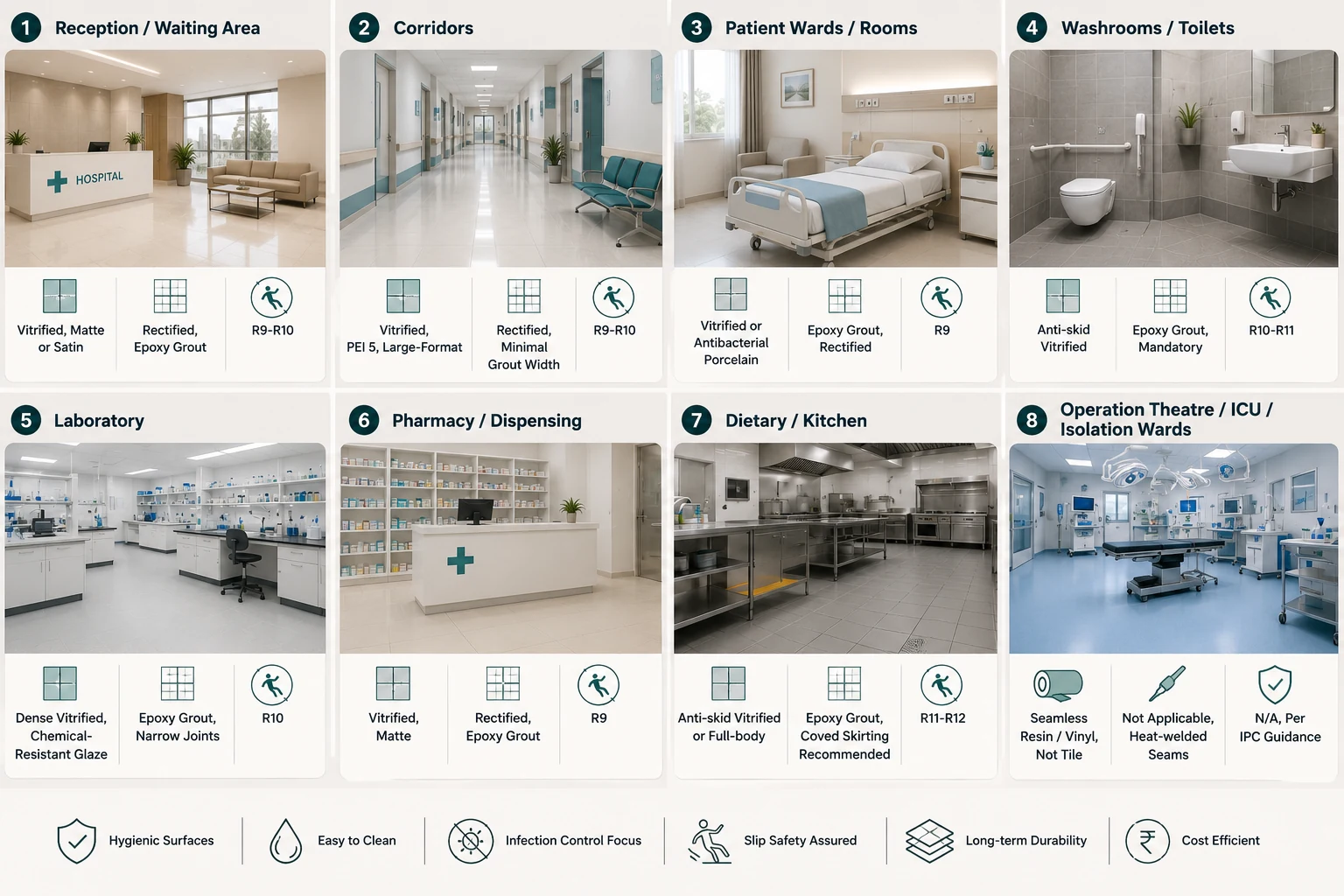
This is the zone-by-zone breakdown that should drive a hospital's flooring specification, rather than picking one material for the entire building.
| Zone | Recommended Surface | Grout Approach | Slip Rating |
| Reception/waiting area | Vitrified, matte or satin | Rectified, epoxy grout | R9-R10 |
| Corridors | Vitrified, PEI 5, large-format | Rectified, minimal grout width | R9-R10 |
| Patient wards/rooms | Vitrified or antibacterial porcelain | Epoxy grout, rectified | R9 |
| Washrooms/toilets | Anti-skid vitrified | Epoxy grout, mandatory | R10-R11 |
| Laboratory | Dense vitrified, chemical-resistant glaze | Epoxy grout, narrow joints | R10 |
| Pharmacy/dispensing | Vitrified, matte | Rectified, epoxy grout | R9 |
| Dietary/kitchen | Anti-skid vitrified or full-body | Epoxy grout, coved skirting recommended | R11-R12 |
| Operation theatre, ICU, isolation wards | Seamless resin/vinyl, not tile | Not applicable, heat-welded seams | N/A, per international IPC guidance |
Operation theatres, ICUs, and isolation wards are listed for completeness; these zones fall outside standard tile specification and should be designed with a flooring specialist experienced in seamless clinical environments.
From The Marketplace
Popular tiles right now
-L1-9a18cdad-47bc-401d-96e2-6060b689485e.jpg)






Material Choice for the Zones Tile Does Cover
Within the zones where tile is the right call, material choice still matters for infection control, not just durability.
| Material | Water Absorption | Infection-Control Fit | Where to Use |
| Ceramic tiles | 12% to 16% | Weakest, higher porosity absorbs fluids and cleaning agents over time | Non-clinical walls, staff area walls only |
| Porcelain tiles (Indian market) | 2% to 6% | Reasonable for lower-risk zones with good glaze | Waiting areas, admin walls, pharmacy walls |
| Vitrified tiles (GVT, Full Body) | Around 0.05% | Best tile-based option; some ranges add antibacterial glaze | Corridors, wards, labs, washroom floors |
Some Indian manufacturers now offer dedicated antibacterial hospital tile ranges, vitrified and porcelain lines specifically positioned for clinics and general hospital areas, combining anti-skid texture with a glaze designed to inhibit bacterial growth on the surface. These are worth prioritising over standard vitrified for wards, corridors, and washrooms specifically, even though they carry a price premium.
Grout Is Not Optional Here
Epoxy grout should be treated as close to mandatory in any hospital or clinic tiling project, not a premium upgrade. Standard cement-based grout is porous enough to absorb disinfectant residue and bodily fluids over repeated exposure, gradually becoming a hygiene liability in exactly the surfaces meant to control infection risk.
Rectified tiles, with precisely machined edges, allow the narrowest possible grout joints, which matters twice over in a healthcare setting: less grout line means less surface area for bacteria to settle in, and a tighter, more seamless-looking floor is also easier to keep visibly clean, which matters for how patients and visitors perceive hygiene even when both floors are equally sanitary underneath.
Design Beyond Hygiene: Colour, Wayfinding, and Patient Wellbeing
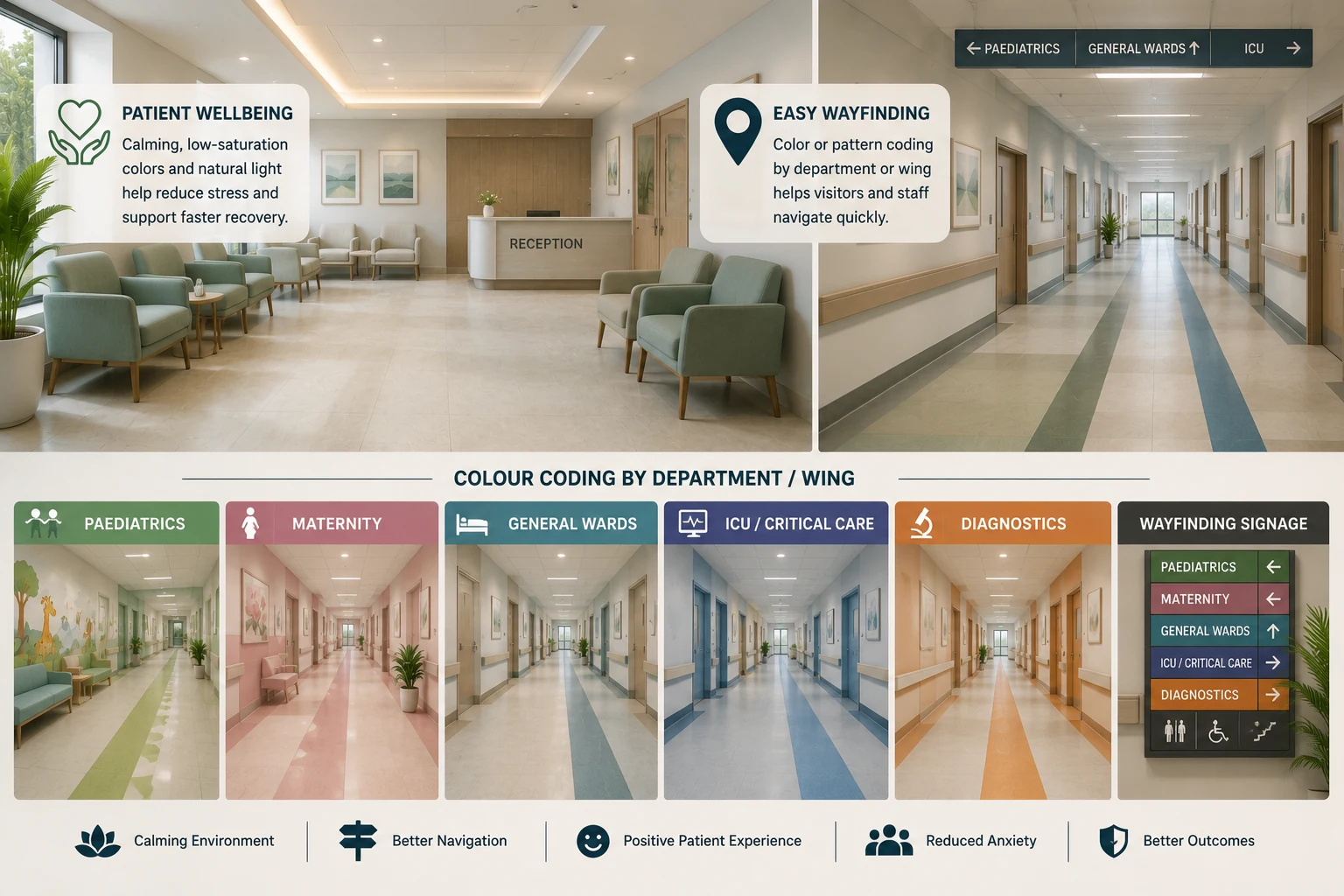
Once infection control and durability are settled, colour and layout still affect how a hospital functions and feels. Calming, low-saturation tones in patient-facing areas, waiting rooms, wards, and corridors are increasingly specified based on evidence connecting colour and lighting to patient stress levels, an important consideration in spaces where people are often already anxious.
In larger hospitals, colour or pattern coding by department or wing, a distinct floor tone for paediatrics versus general wards, for instance, helps visitors and new staff navigate a complex building without constant signage dependence, the same wayfinding logic that applies in large schools.
What Hospital-Grade Tiling Actually Costs
Antibacterial and premium vitrified ranges cost meaningfully more than standard commercial-grade tile, but the gap needs to be weighed against a hospital floor's genuinely brutal duty cycle, constant foot and trolley traffic, multiple daily disinfectant washes, and zero tolerance for the kind of visible wear a retail or office floor could get away with.
| Cost Component | Standard Vitrified (Non-Clinical Zones) | Antibacterial/Premium Vitrified (Wards, Labs) |
| Tile cost (per sq ft) | Rs. 35-90 | Rs. 60-180 |
| Epoxy grout and adhesive | Rs. 10-18 | Rs. 14-22, narrower rectified joints |
| Installation labour | Rs. 25-40 | Rs. 30-50, coved skirting adds cost |
| Typical 10-year cost of ownership | Lower upfront, more frequent deep-clean wear | Higher upfront, better long-term hygiene performance |
Figures are indicative market estimates for budgeting purposes, not fixed quotes. Confirm current pricing and antibacterial certification directly with suppliers.
Common Mistakes in Hospital Tile Specification
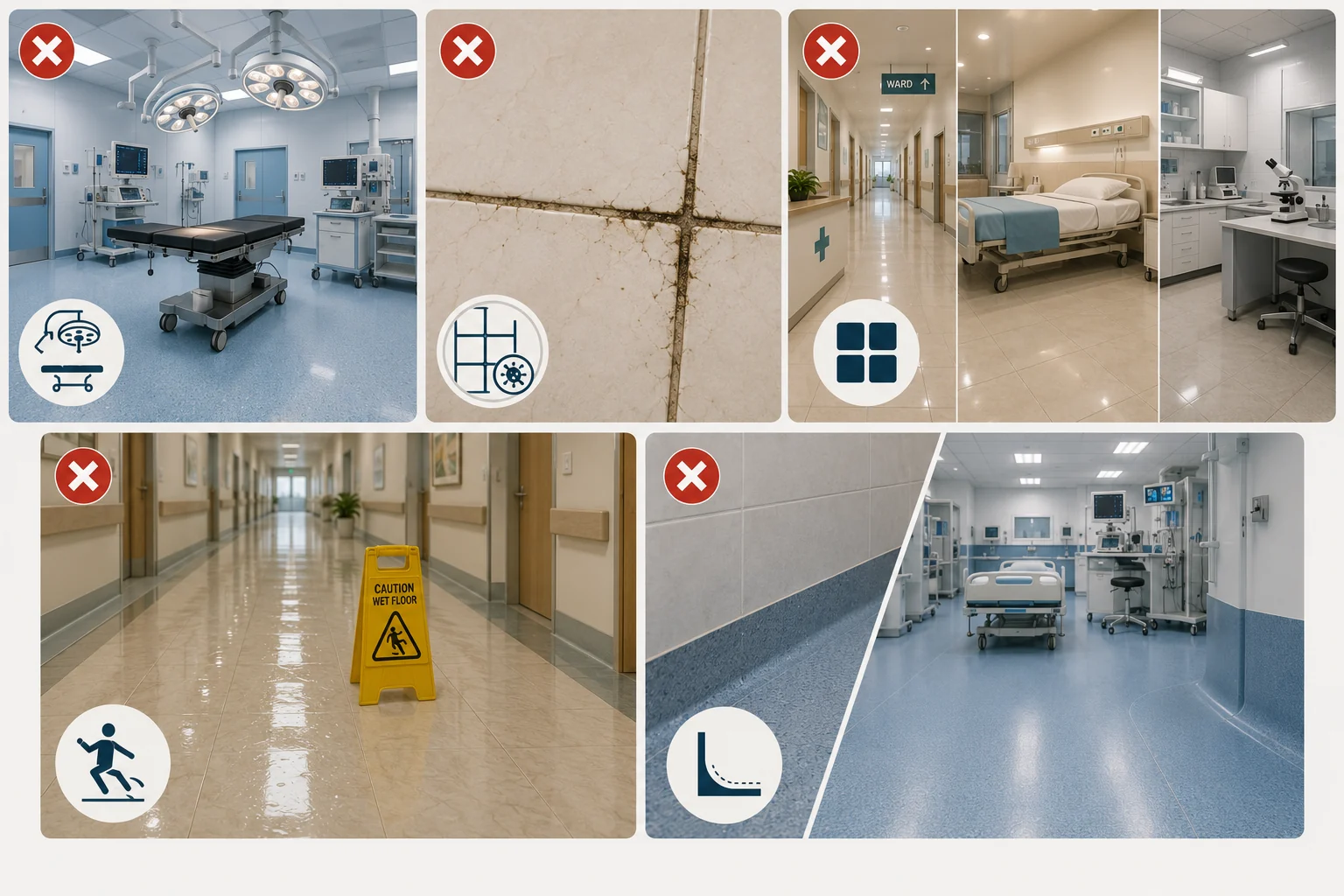
- Assuming tile is unsuitable everywhere in a hospital because of infection-control literature written about operation theatres specifically
- Using standard cement grout instead of epoxy grout to save cost, then facing hygiene compliance issues later
- Specifying the same tile grade throughout the building instead of reserving antibacterial or premium vitrified for wards, labs, and washrooms specifically
- Choosing a glossy finish for corridors and wards where slip risk from frequent wet mopping is a genuine daily concern
- Not budgeting for coved skirting or seamless flooring in the specific zones, OT, ICU, isolation wards, where it's actually required
Specification Checklist for Hospital and Clinic Procurement
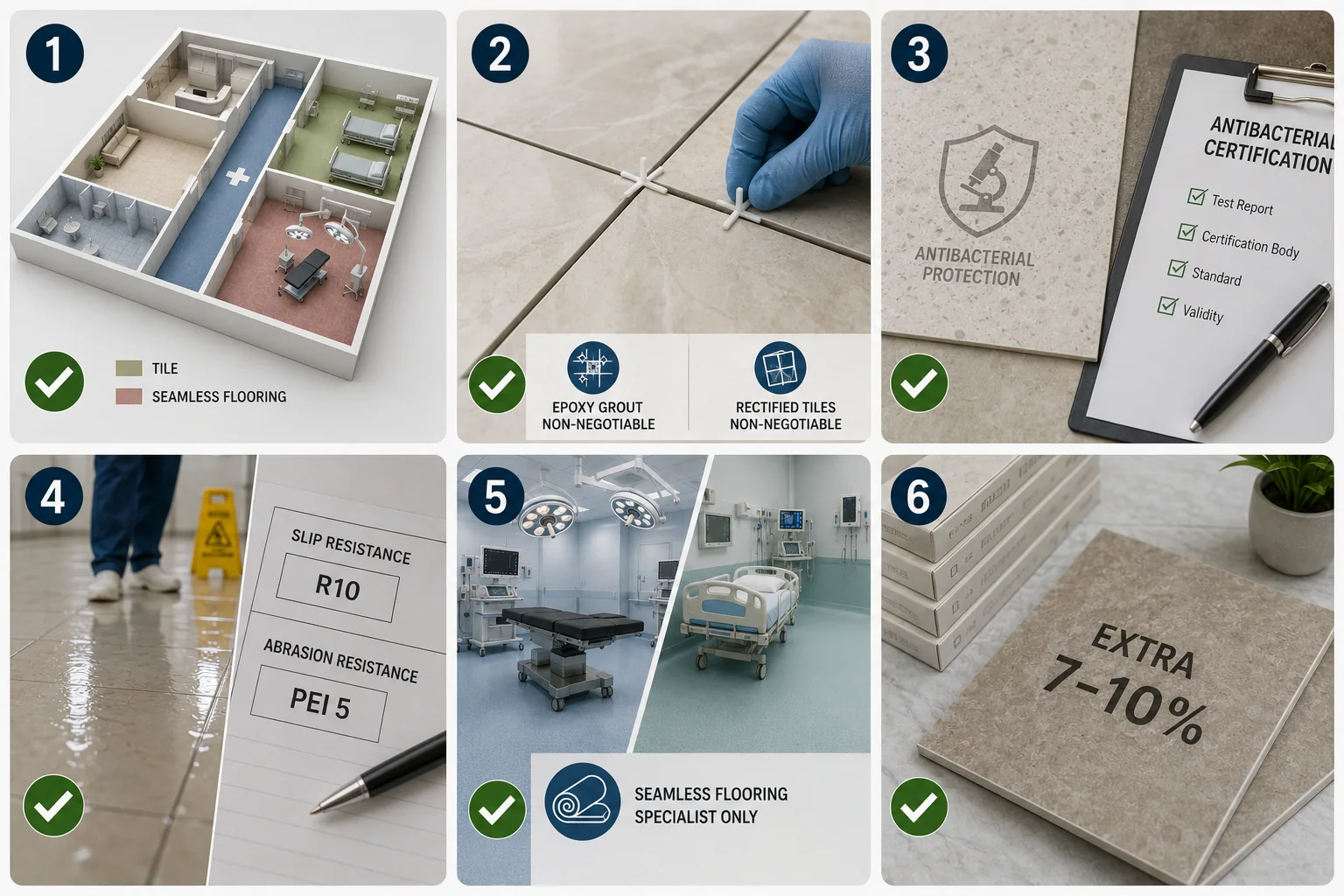
- Map every zone in the facility to either tile or seamless flooring before requesting quotes, don't default to one material building-wide
- Specify epoxy grout and rectified tiles as non-negotiable line items for all clinical and semi-clinical zones
- Ask suppliers directly whether a range carries antibacterial glaze certification, and request documentation, not just a verbal claim
- Confirm slip resistance ratings (R9-R11 depending on zone) in writing alongside PEI abrasion class
- For OT, ICU, and isolation wards, engage a seamless flooring specialist rather than trying to adapt a tile specification to that zone
- Order 7 to 10 percent extra tile per zone to allow for future repairs without a visible shade mismatch
Sourcing Antibacterial and Hospital-Grade Tile
Not every supplier stocks genuine antibacterial-certified tile, and confirming which brands and ranges actually carry that certification saves time before quotes come in. TilesFinders lists verified tile suppliers across India by category and finish, useful for narrowing down hospital-grade options by zone before a procurement decision.
FAQs
Both, depending on the zone. Vitrified tile with epoxy grout and rectified edges performs well in corridors, wards, waiting areas, and washrooms. Operation theatres, ICUs, and isolation wards are better served by seamless resin or vinyl flooring with coved skirting, since grout lines and wall-floor joints, however minimal, still give bacteria more places to establish than a fully seamless surface.
Coved skirting curves the flooring up the wall in a continuous radius rather than meeting it at a sharp right angle, eliminating the corner where dust and bacteria typically accumulate and standard cleaning tools struggle to reach. It's a standard feature in operation theatres and other high-risk zones, achieved with seamless resin or vinyl rather than tile.
Yes. Some Indian manufacturers, including Orientbell, market dedicated antibacterial and anti-skid hospital tile ranges in vitrified and porcelain bodies, positioned specifically for clinics and general hospital areas rather than operation theatres.
Epoxy grout is close to mandatory in healthcare settings, not just recommended. It resists the frequent, harsh disinfectant cleaning hospitals require far better than standard cement-based grout, which is porous enough to absorb cleaning chemicals and bodily fluids over repeated exposure.
A matte or satin finish with a PEI 5 abrasion rating and an R9-R10 slip rating suits most hospital corridors, balancing durability against constant foot and trolley traffic with adequate grip for a frequently wet-mopped surface.
Yes. Calming, low-saturation tones are increasingly used in patient-facing areas based on evidence linking colour and lighting to patient stress levels, while wards and corridors sometimes use colour-coded zoning to help visitors and new staff navigate large facilities.
Dense vitrified tile with a quality glaze holds up well against routine cleaning and mild chemical exposure, but labs handling stronger reagents or frequent spills may still warrant a seamless resin floor in the most exposure-prone work areas, with vitrified reserved for surrounding corridor and storage space.
Antibacterial or premium vitrified ranges suited to wards and labs typically cost 50 to 100 percent more per square foot than standard commercial-grade vitrified, but the gap narrows over a facility's lifetime given better resistance to the wear from constant disinfectant cleaning.


See our tile guides first
Set TilesFinders as a preferred source and our buying guides surface ahead of the rest for you.
Add as preferred sourceTakes one tap. Nothing to install.
What Readers Say
I was about to redo my parking area with the wrong tile size until I read this. The layout comparisons saved me from a costly mistake.
We reference TilesFinders guides while briefing clients on material selection. The size and pattern breakdowns are accurate and easy to explain visually.
On site, I get asked about grout spacing all the time. This article gave me a solid reference I now share with my team before every job.
Finally a guide that doesn't just push generic advice. The oil stain removal steps actually worked on our clubhouse driveway tiles.
I run a small construction firm and now send this link to clients directly when they ask about entrance tile sizing. Saves me an hour of explaining.
Good practical detail, though I wish there were more examples for compact apartment entrances specifically, not just villas.
My mother-in-law wanted marble, I wanted vitrified. This blog gave us the neutral comparison we needed to actually decide together.
Detailed without being overwhelming. I appreciated that it covered both cost and maintenance, not just the aesthetics.
Used the algae and hard water removal tips on our terrace tiles after the monsoon. Worked better than what our regular cleaner was doing.
As someone who sources tiles for multiple builder projects, I find these comparisons genuinely useful for vendor conversations, not just consumer content.
Recommended this to a client who kept second-guessing the entrance design. The small vs large layout section settled the debate instantly.
Straightforward and honest, no unnecessary jargon. Would like to see a similar breakdown for outdoor pool-deck tiles next.
We've bookmarked several TilesFinders guides for our design handbook. Reliable source when clients want data, not just opinions.
Two paths, one marketplace.
Get free quotes from verified suppliers.
Share your room, budget, and style. Suppliers in Morbi respond within hours.
Get Free QuotesList your business, reach real buyers.
Put your showroom in front of homeowners searching for tiles right now.
List Your BusinessMore Blogs
See all
Best High-Traffic Commercial Tiles in India 2026: Full Body and Double Charge B2B Picks
Compare the best full-body and double charge commercial tiles for Indian B2B projects. Learn pric...
Read More
Top 10 Tile Manufacturers & Suppliers in Vadodara: Wholesale & Retail Buyer's Directory
Compare tile dealers and showrooms in Vadodara, with local prices, buying areas, common sizes and...
Read More
Monochrome Tile Pairing Guide: Grout, Trim and Furniture Colour Combinations for Indian Rooms
Learn how to pair monochrome tiles with the right grout, skirting, trim, furniture, and metal fin...
Read More