Wooden Tiles for Bedroom: Pros, Cons & Design Ideas
May 29, 2026 18
Explore wooden tiles for bedroom floors with expert insights on GVT, Full Body, wood tones, plank sizes, herringbone layouts, pricing, pros, cons, and design ideas for Indian homes.

Walk through any tile showroom in Bangalore, Pune, or Surat today and you will find a wooden plank tile section that takes up more floor space than it did five years ago. The shift has been steady, and it reflects a clear change in what Indian homeowners want from their bedrooms: floors that feel residential, warm, and personal rather than clinical or corporate.
The appeal of wooden tiles for bedrooms is real, but so are the trade-offs. Tiles that look stunning in a showroom can disappoint in a finished room if the grain print repeats obviously, if the grout colour was chosen carelessly, or if the contractor has not laid plank tiles in a herringbone pattern before. These decisions matter more with wood-look tiles than with most other categories.
This guide covers what works, what does not, which tile category applies, how to pick the right grain and tone, and the design ideas that suit Indian bedroom proportions in 2026.
Why Wooden Tiles Have Become a Bedroom Staple in Indian Homes
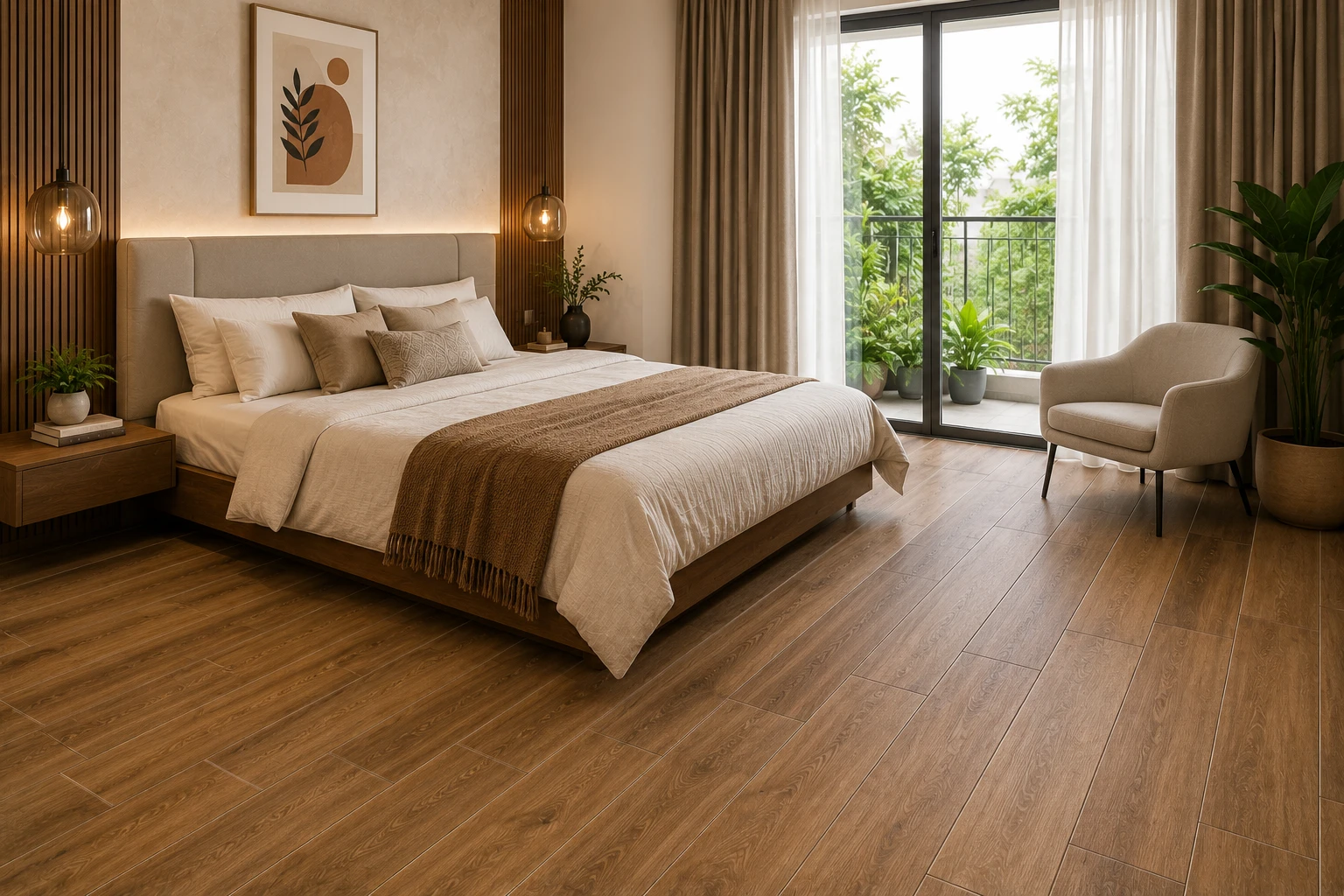
For most of the 2000s, the default bedroom floor in Indian apartments was a plain vitrified tile in beige or cream. It was practical, inoffensive, and thoroughly forgettable. The bedroom looked like an extension of the hallway.
What changed was the wave of renovations that followed the pandemic. Homeowners spending more time at home began to look at their bedrooms differently. The floor became part of the room's identity, not just its base. Looking beyond wood-look flooring? Explore our Bedroom tile guide for colour combinations, finishes, layouts, and comfort-focused ideas that suit modern Indian bedrooms. It helps you compare styles before finalising your flooring direction.
Wood-look tiles filled that gap. They bring a warmth and visual weight that plain square tiles rarely achieve, without the cost, termite risk, or maintenance demands of real hardwood.
Indian manufacturers from Morbi, in particular, significantly improved their wood grain printing quality between 2021 and 2024. Digital printing on vitrified tiles now replicates oak, walnut, teak, ash, and larch with enough realism that the tile reads as wood from a normal viewing distance. That quality jump is what pushed wood-look tiles for bedroom use into the mainstream.
Pros of Wooden Tiles for Bedroom Floors
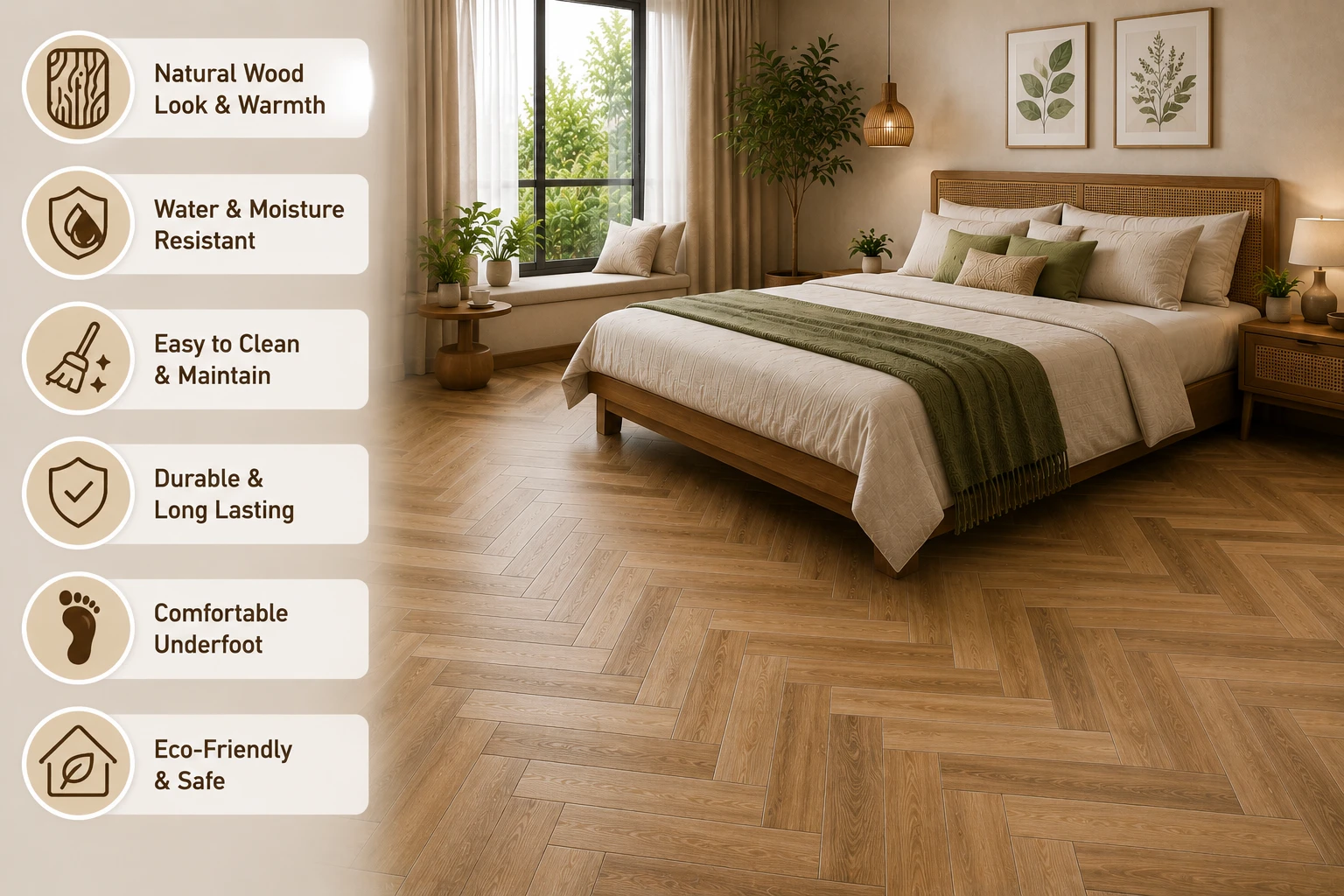
No termite or moisture damage. This is the biggest practical advantage in the Indian context. Real hardwood floors face a serious termite risk across most of the country, and monsoon humidity causes warping, swelling, and gap formation in timber. Vitrified wooden tiles have no organic content. There is nothing for termites to attack, and 0.05% water absorption means monsoon conditions do not affect the tile body.
Low daily maintenance. A damp mop is all these tiles need. No sanding, no sealing, no annual polishing. Real hardwood requires periodic surface treatment to maintain its look. Wood grain tiles hold their printed surface for the life of the tile without any special upkeep.
Wide colour and grain range. Indian manufacturers now offer wood-look tiles in light birch, pale ash, warm oak, mid-tone teak, rich walnut, and dark espresso. Within each tone, grain patterns range from straight and fine to broad and knotted. A 2BHK bedroom in Chennai and a large master bedroom in Delhi can both find a wood grain tile that fits the room's light and proportion.
Consistent appearance across the floor. Real timber has natural variation that is beautiful but unpredictable. Good quality wood look tiles for bedroom floors maintain consistent tone and grain across the entire laying area, which makes the floor look considered and deliberate.
Cost significantly lower than real hardwood. GVT wooden plank tiles start at approximately ₹80 per sq. ft. Real hardwood installation in India typically costs ₹350 to ₹900 per sq. ft. including material, labour, and finishing. For a 150 sq. ft. bedroom, that is a gap of ₹40,000 to ₹1.2 lakh before even considering the maintenance cost difference.
Works across Indian climate zones. From coastal Chennai to dry Ahmedabad to humid Kolkata, vitrified wooden tiles perform consistently. Genuine hardwood flooring requires climate control to stay stable across Indian seasonal extremes. These tiles have no such requirement.
Cons of Wooden Tiles for Bedroom Floors
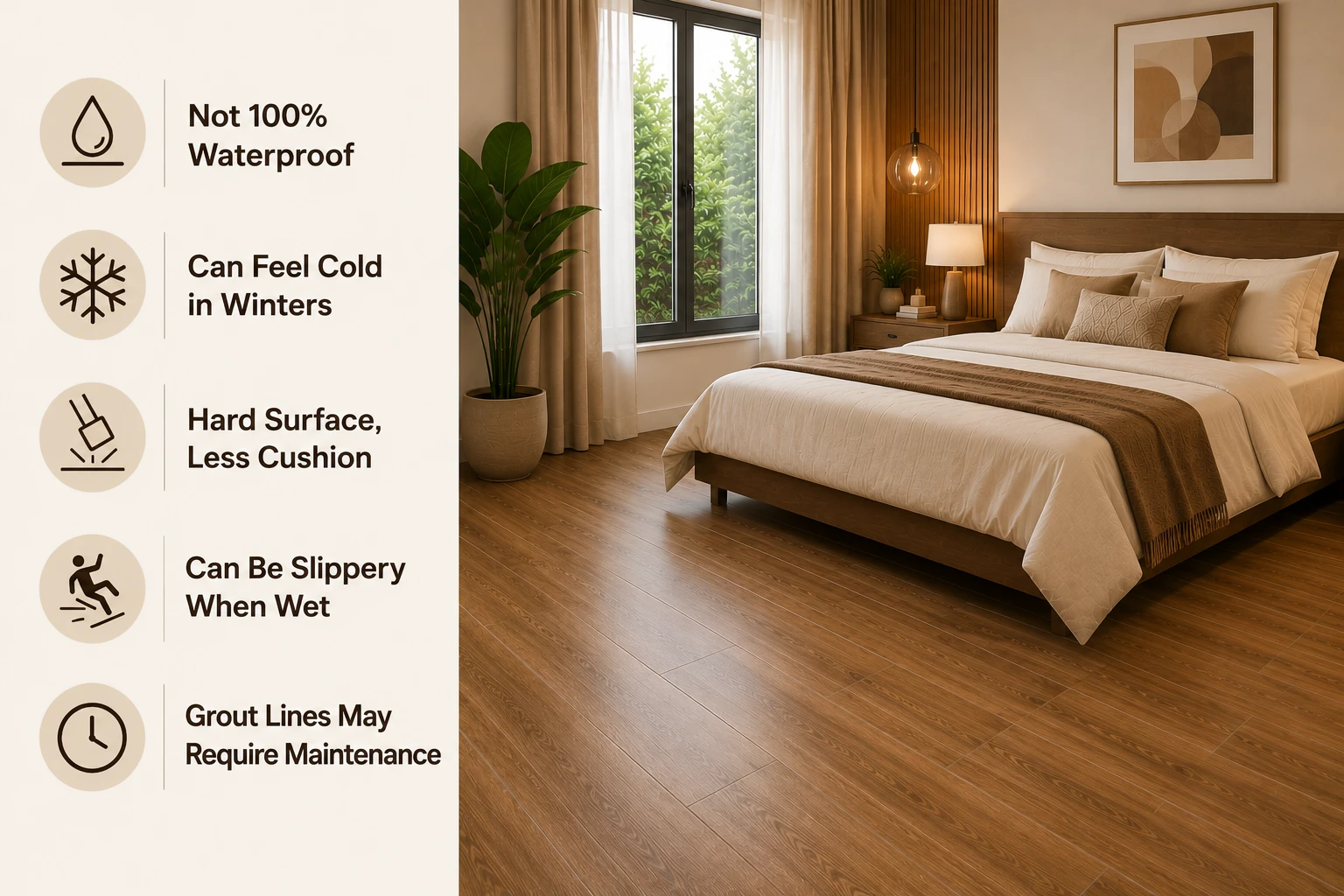
Grout lines break the illusion. This is the most significant limitation of wooden tiles as a flooring material. Real wood floors have no grout. Even with thin 2 mm joints and colour-matched grout using rectified tiles, the lines between planks are visible and remind you that this is tile, not timber. From across the room the effect reads as wood. Up close, especially on hands and knees, the grid is clear.
They feel like tile, not timber, underfoot. Real wood is slightly warm and has a small amount of natural give when you walk on it. Vitrified tiles are hard and, particularly in North Indian winters across cities like Delhi, Chandigarh, and Jaipur, they feel cold underfoot when you step out of bed at 6 a.m. An area rug beside the bed handles this practically, but it is a real difference from the feel of genuine hardwood.
Print quality varies enormously across price points. A ₹90 per sq. ft. wood look tile and a ₹180 per sq. ft. tile from a better manufacturer can look completely different once laid across a full bedroom. The lower-quality option will show an obvious grain pattern repeat every few tiles, which makes the floor look printed rather than natural. This repeat problem is the most common cause of disappointment after installation.
Chips expose the plain tile body underneath. If a wooden plank tile chips at a corner or edge, the exposed body does not match the wood grain surface. On a plain cream or grey tile, a chip at a skirting edge is nearly invisible. On a wood grain print, the chip stands out. Full Body wood-look tiles reduce this somewhat because the body colour is toned closer to the surface, but the grain itself cannot continue through the body.
Installation requires more skill than square tiles. Plank tile herringbone layouts involve more cuts, closer alignment tolerance, and a different pace of work than standard square tile laying. A contractor who has only installed 600x600 mm tiles will struggle with 200x1200 mm planks in a herringbone pattern. The mistake shows clearly in the finished floor.
Which Vitrified Category Should You Choose for Bedroom Wood-Look Tiles
Three categories from the vitrified tile family cover most of the wood look tiles for bedroom market in India. Each has a different technical profile, finish range, and price point. Picking the right one before going to a showroom saves a lot of back-and-forth.
GVT Wooden Plank Tiles: The Everyday Choice
GVT (Glazed Vitrified Tiles) is the standard category for plank tiles for bedroom floors in Indian homes. The tile body is vitrified with a glazed printed surface carrying the wood grain design. Water absorption sits at 0.05%, which means the tile handles all interior conditions including rooms with attached bathrooms.
For bedrooms, the right finish on GVT wood-look tiles is matte or Posh. Matte hides dust between cleanings and does not show barefoot prints. Posh gives a smoother, near-zero-reflection surface that looks more refined without the maintenance demands of a polished tile. Both finishes feel warmer underfoot than a polished surface.
GVT wooden plank tiles are available in the 8x48 (200x1200 mm) and 8x40 (200x1000 mm) plank formats. Price range: approximately ₹80 to ₹160 per sq. ft. depending on brand and grain quality.
Full Body Wood-Look Tiles: Built for the Long Run
Full Body tiles have colour and pattern running through the entire tile thickness. The body tone approximates the wood grain surface colour. A chip or heavy scratch on a Full Body tile is noticeably less visible than on a standard GVT tile because the underlying body colour is closer to the surface.
This makes Full Body wood-look tiles the right choice for bedrooms in homes with young children who move heavy objects, families planning long-term use without replacement, or anywhere the floor might take occasional impact. They cost more than GVT but the argument for longevity is genuine. Price range: approximately ₹120 to ₹200 per sq. ft.
PGVT Wood-Effect Tiles: High Gloss, Higher Upkeep
PGVT (Polished Glazed Vitrified Tiles) is available in wood-effect designs, though far less common than GVT for this use. The polished surface gives the wood grain print a lacquered, rich appearance that some homeowners prefer for a master bedroom with a deliberately luxurious feel.
The trade-off is significant for bedroom use. Barefoot traffic every day on a polished surface leaves visible prints and dust film. Daily wiping is needed to keep the floor looking clean. PGVT is an indoor dry-area tile and must not extend into wet bathroom zones. If the bedroom has good natural light and a lifestyle that allows for regular floor maintenance, it is a valid choice. Price range: approximately ₹90 to ₹160 per sq. ft.
| Category | Best Bedroom Use | Recommended Finish | Approx. Price (per sq. ft.) | Chip Resistance |
| GVT Plank | Most bedroom types across all budgets | Matte, Posh | ₹80 to ₹160 | Good |
| Full Body | High-use rooms, long-term flooring | Matte, Posh | ₹120 to ₹200 | Very Good |
| PGVT Wood-Effect | Dry master bedrooms, low-traffic rooms | Polished Glossy | ₹90 to ₹160 | Moderate |
Wooden Tiles vs Real Wood Flooring: Which Works Better in Indian Bedrooms
This is the question that comes up at almost every bedroom renovation conversation in India. The comparison looks like this in practice.
| Factor | Wooden Tiles (GVT) | Real Hardwood Flooring |
| Installed cost | ₹80 to ₹200 per sq. ft. | ₹350 to ₹900 per sq. ft. |
| Termite risk | None | Moderate to high across India |
| Monsoon performance | Unaffected | Warps, swells, forms gaps |
| Maintenance | Damp mop only | Annual oiling, periodic sanding and sealing |
| Barefoot feel in winter | Cold (tile body) | Warm (natural wood) |
| Surface at 5 years | Unchanged if intact | May dull; refinishing needed |
| Chip or damage visibility | Noticeable on printed surface | Can be spot-sanded and refinished |
| Grout lines | Present; minimised with thin joints | None |
| Replacement ease | Easy: tiles are interchangeable | Complex: matching grain is difficult |
| Best suited for | Most Indian residential bedrooms | Premium projects with climate control |
For most Indian apartment bedrooms, wooden tiles are the more practical and better-value choice. Real hardwood makes sense only in controlled environments: high-budget projects in dry climates with strong termite-prevention measures already in place at the structural level.
Best Sizes for Wooden Tiles in Indian Bedrooms
The plank format is standard for wood grain tiles for bedroom floors, but the specific dimensions affect how the finished floor reads in the room.
| Size | Common Name | Best For | Room Effect |
| 200x1200 mm | 8x48 (plank) | All bedroom sizes; the most common | Closest to real floorboard; looks warm and residential |
| 200x1000 mm | 8x40 (plank) | Compact bedrooms under 100 sq. ft. | Slightly shorter plank; fewer cuts near short walls |
| 600x1200 mm | 2x4 | Wide-plank contemporary look | Broader plank feel; more modern than narrow format |
| 600x600 mm | 2x2 | Small bedrooms only, if plank not preferred | Less convincing as wood; grid pattern more visible |
The 8x48 (200x1200 mm) plank tile works well across the range of Indian bedroom tile sizes: from a compact 90 sq. ft. 1BHK bedroom to a 200 sq. ft. master bedroom in a 4BHK flat. The proportions are closest to an actual timber floorboard, and the format reads as wood more convincingly than any wider or shorter tile.
For 2BHK bedrooms in the 120 to 160 sq. ft. range, which cover the majority of Indian apartment bedrooms, the 8x48 plank in a running bond or herringbone pattern is the standard specification that contractors and interior designers work with most often.
Choosing the Right Wood Tone and Grain for Your Bedroom
Wood tone selection matters more for bedrooms than for any other room. The floor colour you wake up to and step onto every morning has a measurable effect on how the room feels.
Not sure which material or colour works best for better rest? Browse our Bedroom floor tiles guide to compare tile materials, shades, and finishes designed for a calmer sleeping space.
Three factors should guide the choice: natural light in the room, the furniture colours already planned or in place, and the bedroom's compass direction if Vastu is relevant to the household.
| Wood Tone | Natural Light Needed | Pairs Well With | Vastu Bedroom Direction |
| Warm oak (honey, golden) | Works in all light conditions | Cream walls, wood furniture, brass fittings | South-west, south |
| Pale ash (light grey-beige) | Better in well-lit rooms | White or grey walls, chrome, modern furniture | North-west, east |
| Birch (very light, near-white grain) | Needs strong natural light | Minimalist decor, linen tones, white walls | East, north |
| Walnut (medium brown, warm grain) | Suits well-lit rooms | Earthy walls, leather accents, darker furniture | South-west, south |
| Dark espresso or ebony | Needs strong natural light; avoid in north-facing rooms | Light walls mandatory, pale bedding | Avoid in small or low-light bedrooms |
Beyond colour, grain character matters. Fine, straight-grain prints look calm and contemporary. Knotted, distressed, or hand-scraped grain prints feel rustic and heavier. For bedrooms where restfulness is the priority, fine-to-medium grain without prominent knots usually works better than a heavily distressed texture.
If you are deciding between two tones, bring both samples home. Put them on the bedroom floor in the corner near the bed. Look at them in morning light, afternoon sun, and under the room's artificial lighting at night. Two to three days of this test tells you more than any showroom visit.
Wooden Tile Design Ideas for Bedrooms in 2026
The design options for wooden floor tiles in bedroom settings have grown well beyond a straight row of planks. Pattern, tone, and material combination all shape how the finished room feels.
Running Bond in Warm Oak: Timeless and Restful
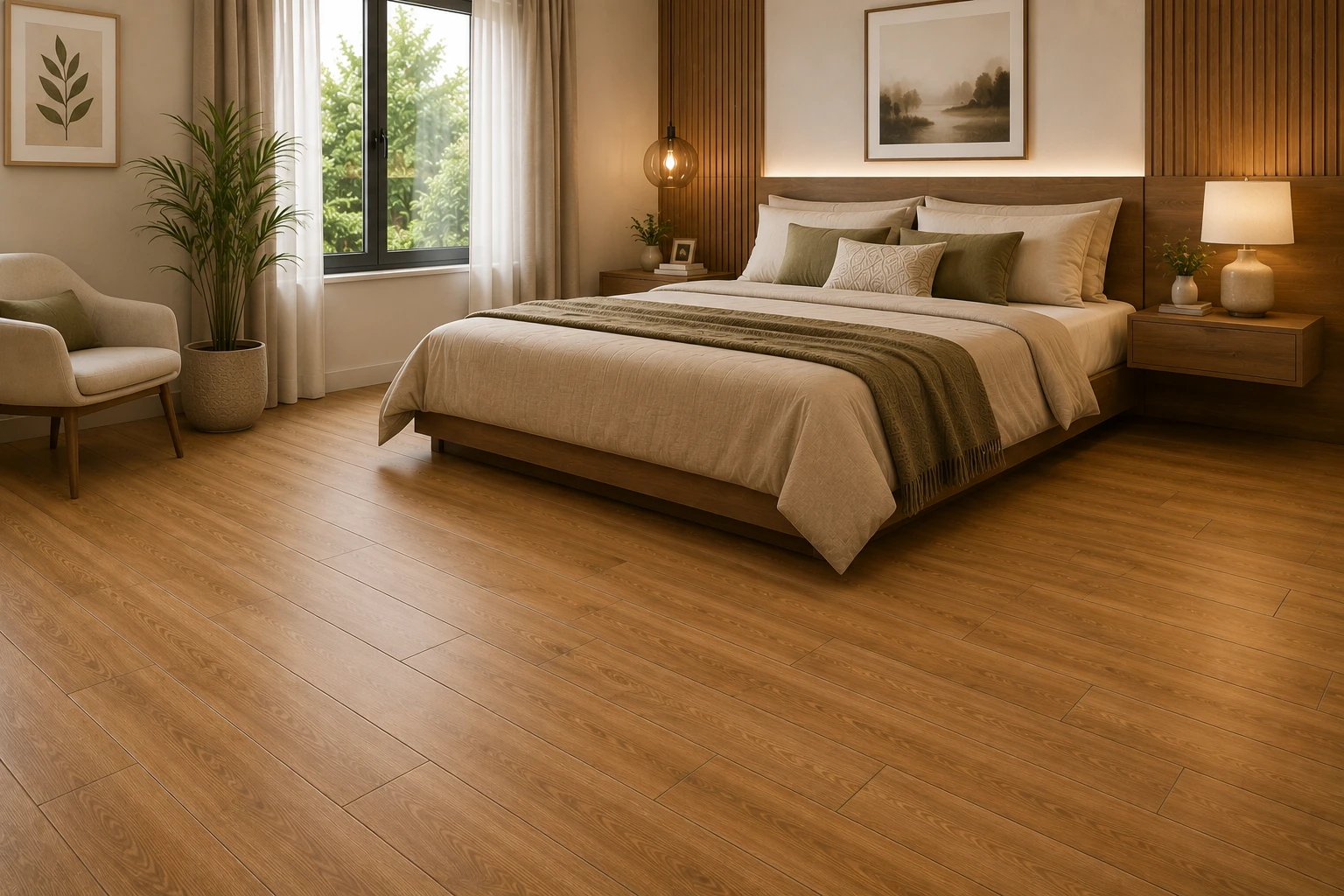
The running bond pattern, where each row of planks is offset by half the tile length, remains the most popular layout for wooden tiles for bedroom floors across India. It directly mimics real hardwood installation and avoids the rigid grid look that comes from aligning all joints. Warm oak and honey tones in this layout, paired with off-white walls and wooden furniture, produce a bedroom that feels genuinely residential and calm.
Herringbone Pattern: High Character, No Extra Cost
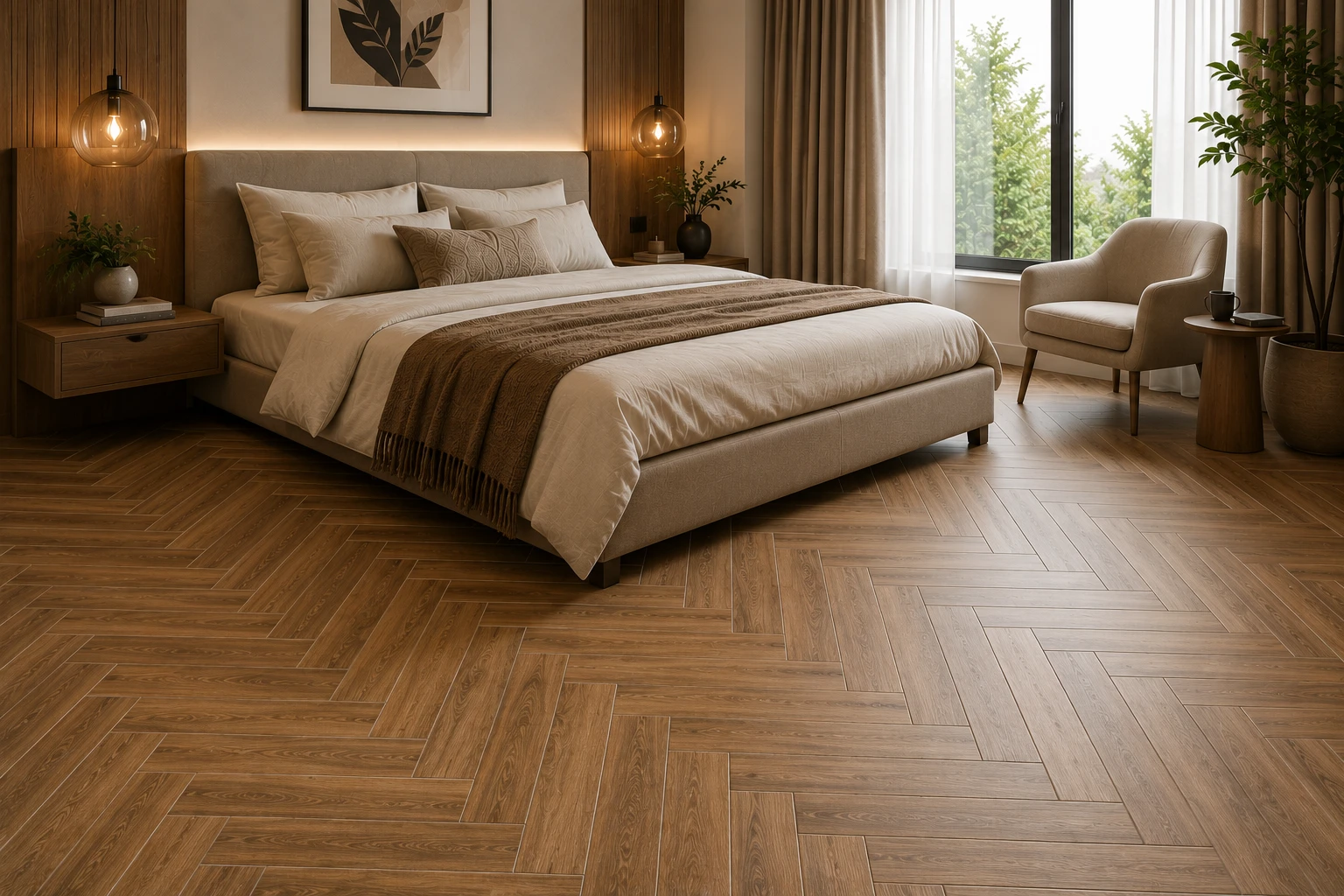
Herringbone is the most requested pattern for plank tiles for bedroom floors in India right now. The 8x48 (200x1200 mm) tile is laid at 45-degree angles in a V-pattern, creating a visual depth and energy that a straight lay cannot match. In pale ash or white birch tones, herringbone makes compact bedrooms feel richer and more considered. In walnut tones, it creates a hotel-level master bedroom feel.
One practical note: herringbone has higher cut waste than straight lay, so budget for 12% extra tile rather than the standard 10%. Also confirm that your contractor has specifically laid herringbone plank tiles before. The alignment tolerance is tighter than for square tiles and misalignment shows clearly in the finished floor.
Pale Ash for Minimalist and Japandi Bedrooms
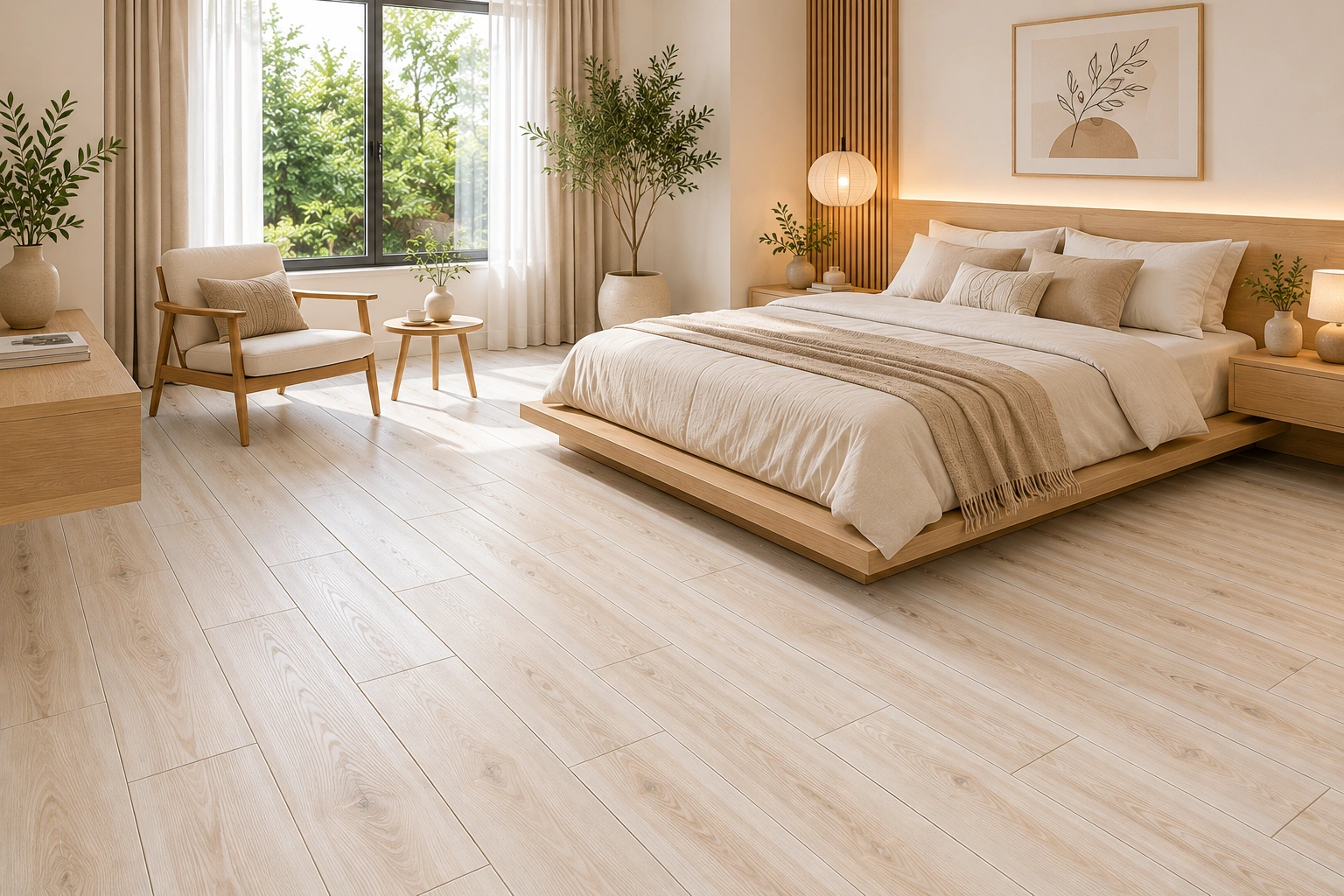
The Japandi design direction, which blends Japanese restraint with Scandinavian warmth, has found a strong following in Indian urban apartments, particularly among homeowners in their 30s renovating for the first time. Pale ash or light grey-tone wooden plank tiles in a running bond, paired with white walls, natural linen bedding, and minimal furniture, produce a bedroom that feels deliberately calm and spare. This is one of the most searched bedroom design directions in Indian cities in 2026.
Dark Walnut for a Moody, Restful Bedroom
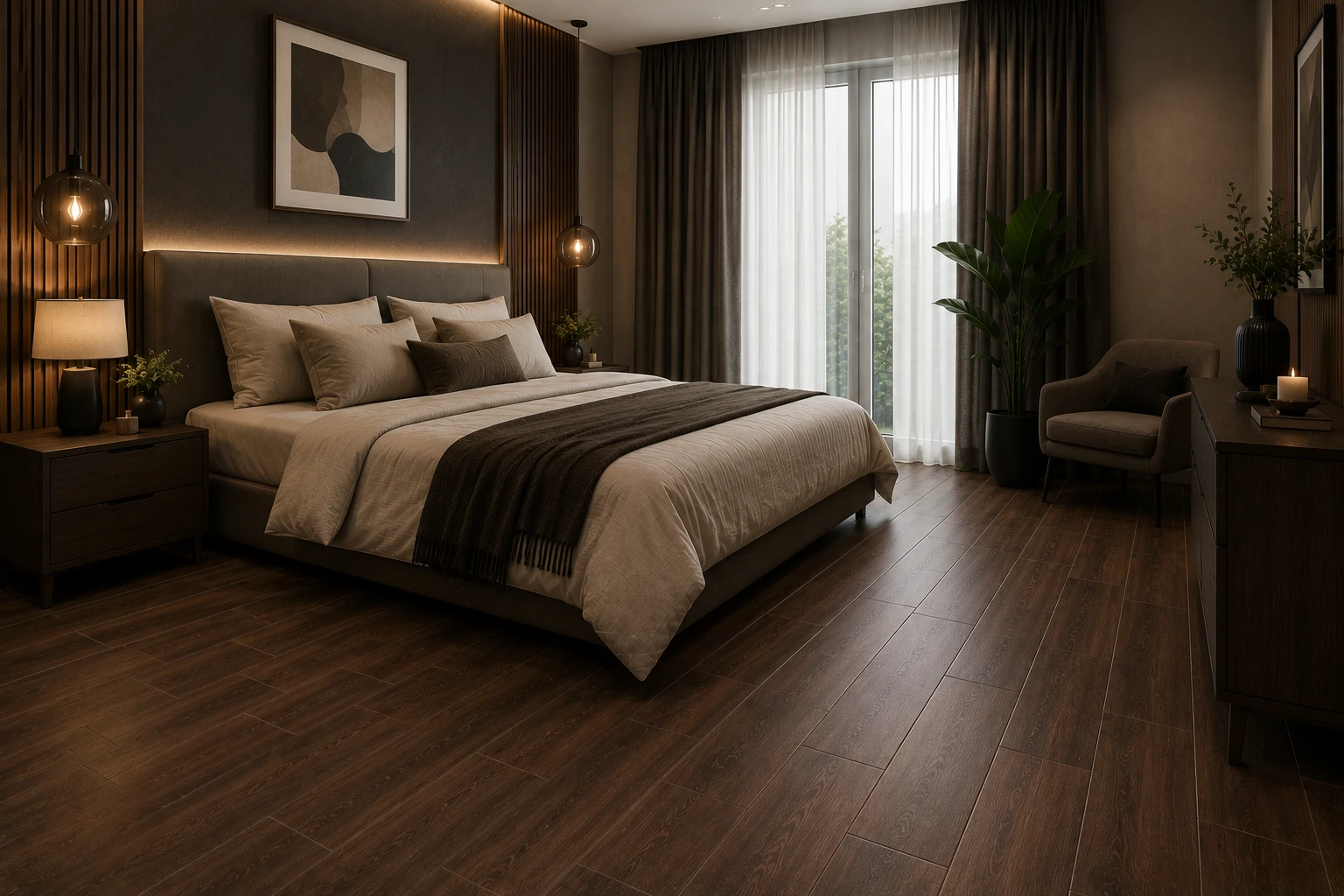
Deep walnut or espresso wooden tiles work in bedrooms where strong natural light is available, and the room faces south or west. The dark floor absorbs some of the brightness that would otherwise make the room feel harsh in afternoon hours, producing a space that stays comfortable through the day. The mandatory pairing is light walls: off-white, warm white, or very pale greige. Dark floors with dark walls in a standard Indian bedroom size will make the room feel closed in.
Mixing Wooden Tiles with Stone-Look in Large Bedrooms
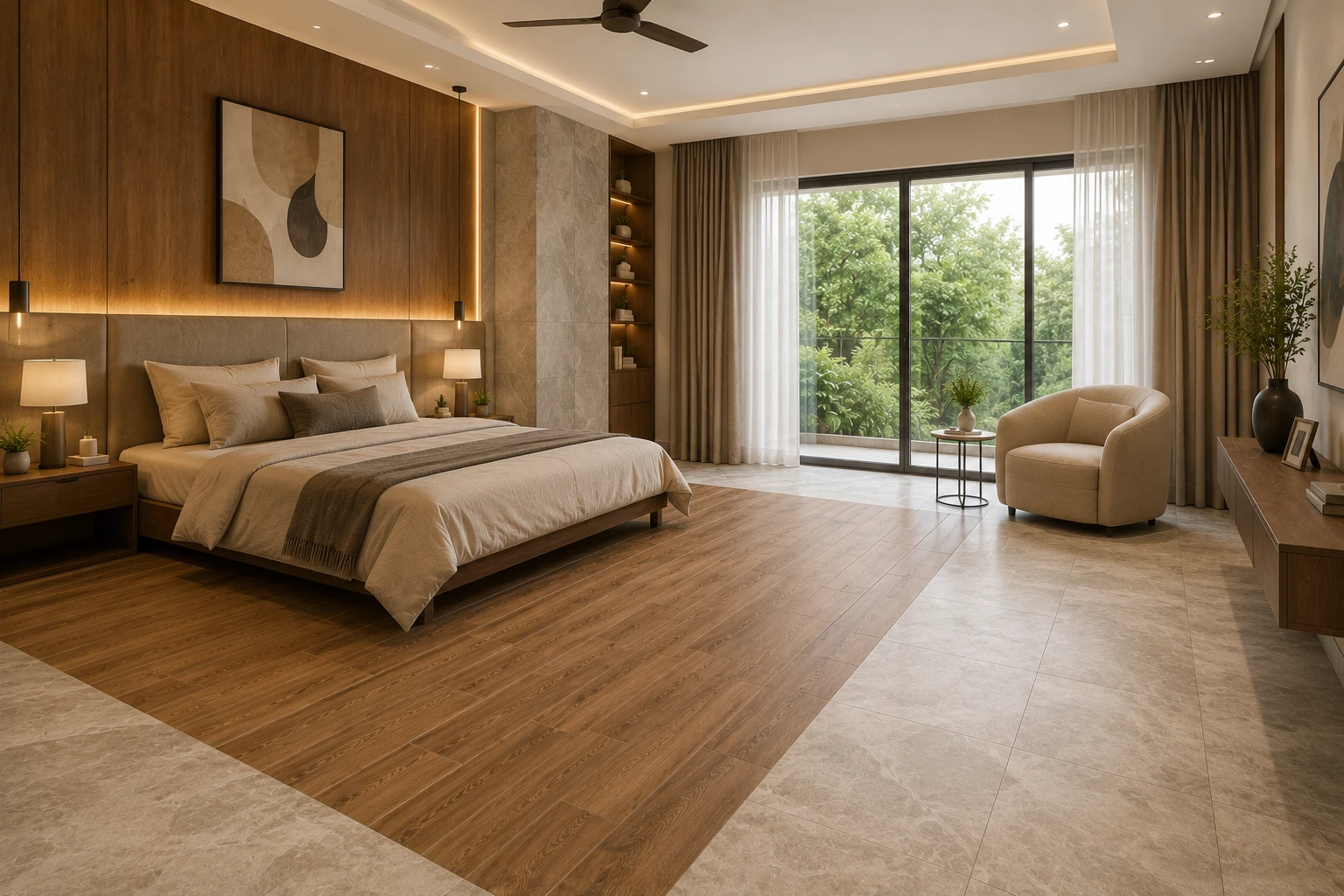
In master bedrooms of 180 sq. ft. and above, a two-zone approach works well. The main sleeping area gets wooden plank tiles; the dressing or sitting area gets a stone-look or marble-look GVT tile in a complementary warm tone, separated by a slim brass or matte black transition strip. Both tiles belong to the same GVT category, so the practical performance is consistent. The visual result is a room with designed zones rather than a single flat surface across the whole floor.
Finish Guide: Matte, Posh and Textured for Bedroom Wood Tiles
Finish choice on wooden tiles affects barefoot feel, dust visibility, and how the grain print reads in different lighting conditions.
| Finish | Barefoot Feel | Dust and Print Visibility | After-Mop Look | Best For |
| Matte | Soft, slightly warm | Low | Clean, no streaks | Most bedrooms; families with children |
| Posh | Smooth, near-velvety | Low to medium | Very clean | Master bedrooms; low-traffic rooms |
| Texture (0.3 to 1 mm depth) | Textured, slightly grippy | Low | Clean | Rooms where slip resistance matters |
| Polished Glossy (PGVT) | Smooth, cooler | High: shows footprints | Streaks visible | Dry rooms only; high-maintenance households |
Matte is the right finish for the majority of Indian bedroom wood-look tiles. It matches the look of actual sanded timber more closely than a polished surface; it does not show the daily barefoot traffic that a bedroom floor takes, and it hides dust between cleanings better in cities where dust settling is constant.
Posh finish is worth considering for a master bedroom where the homeowner wants something that looks a step above plain matte without the upkeep demands of a polished PGVT tile. It splits the difference effectively.
Expert Tips Before Buying Wooden Tiles for Your Bedroom
1. Check the print repeat distance before buying
This is the single most important quality check for wood grain tiles for bedroom floors. Ask your dealer to arrange eight to ten tiles side by side. If you can see the same grain pattern repeating at regular intervals across that spread, the print repeat is too short. When laid across a full bedroom, that repetition becomes obvious and kills the wood-floor illusion. Higher-quality tiles use longer digital print files that delay or randomise the repeat.
2. Always match grout colour to the tile's base tone
White grout between warm oak plank tiles immediately reads as a grid and makes the floor look like large format tiles with a wood print rather than a wood floor. Match the grout to the tile's dominant base colour: beige grout for oak tones, grey grout for ash and pale tones, tan grout for walnut. Keep joints at 2 to 3 mm using rectified tiles for the least visible line.
3. Confirm rectified edges for plank tiles
Rectified tiles are precision-cut to exact dimensions, which allows very thin grout joints. For 8x48 (200x1200 mm) plank tiles, rectified edges are necessary for the floor to lay cleanly. Non-rectified planks require wider joints to accommodate size variation, which makes the grout grid more prominent and the wood illusion weaker.
4. Plan the tile direction before installation begins
Planks laid lengthwise toward the main window or light source make the bedroom feel longer and more open. Planks laid perpendicular to the entrance draw the eye into the room. Herringbone works in any orientation. Once the tiles go down, changing direction means a full reinstallation. Decide with your contractor before the first tile goes in.
5. Verify your contractor's experience with plank tile layouts
Ask specifically whether your contractor has laid 200x1200 mm plank tiles in herringbone before, and ideally ask to see a finished project. Plank tile alignment is less forgiving than square tiles. A small error in the starting angle compounds over a full bedroom floor. This is not the job to trial a new contractor on.
6. Buy 12% extra for plank tile layouts
Plank tiles in herringbone and running bond patterns have higher cut waste than square tiles, particularly around door frames, walls, and built-in wardrobes. Order 12% above your measured floor area. Also keep four to six tiles from the same batch after installation. Production batches change over time and matching a tile five years from now from a different batch is difficult.
7. Test the tile sample in your actual bedroom
Showroom lighting is bright, even, and flattering. Your bedroom has a specific natural light direction, a specific time of day when you occupy it most, and a specific artificial light source. Oak that looks warm golden in a showroom can read orange or yellow under certain LED temperatures at home. Pale ash that looks fresh in a showroom can look cold in a north-facing bedroom with limited sun. Bring the sample home before committing.
Common Mistakes When Choosing Wooden Tiles for Bedrooms
Buying tiles with an obvious grain repeat. The most common post-installation regret is with wood-look tiles for bedroom floors. Check the print repeat before buying. Always view eight or more tiles side by side.
Using contrasting grout colour. White or contrasting grout turns a wood-look floor into a visible tile grid. Colour-match the grout to the tile tone and keep joints thin.
Hiring a contractor without plank tile experience. Herringbone plank installation is a skill that not every tile contractor has. Poor alignment across a bedroom floor is both obvious and permanent. Verify experience before hiring.
Choosing dark espresso tiles for small or north-facing bedrooms. Dark wood tones in rooms under 120 sq. ft. or rooms with limited natural light make the space feel heavy and closed in. Match tone to actual light conditions, not showroom appearance.
Extending PGVT wood-effect tiles into wet bathroom zones. PGVT is an indoor dry-area tile. If the bedroom layout connects to an attached bathroom, use GVT rather than PGVT throughout to handle any boundary moisture safely.
Not buying a buffer stock. Ordering exactly the measured floor area is a common mistake. Cuts, breakage, and herringbone waste require at least 12% extra. Ordering short delays the project and risks batch mismatch if the tile is reordered later.
Skipping the at-home sample test. Every showroom looks great under showroom lighting. The tile that goes on your bedroom floor will be seen under your bedroom light, at your bedroom's natural light angle, for years. Test it at home first.
Choose Bedroom Flooring That Lasts
Wooden tiles get the bedroom floor decision right for most Indian homes. They bring warmth that plain vitrified tiles cannot match, hold up under Indian climate conditions that would damage real timber, and come in a grain range wide enough to suit both compact 1BHK bedrooms and large master bedrooms in premium apartments.
Before finalising any tile, bring your shortlisted options home and live with the samples for a few days. Check the grain repeat. Decide on grout colour before installation begins. Confirm your contractor has laid plank tiles in the pattern you want.
You can explore GVT and Full Body wooden plank tile collections from manufacturers across India on TilesFinders, where specifications, sizes, and finishes are listed clearly so you can compare options before visiting a showroom.
FAQs
Yes. GVT wooden plank tiles are one of the most practical choices for Indian bedroom floors. They carry no termite or monsoon warping risk, need only a damp mop to maintain, and produce a floor that looks warm and residential. The main limitations are that they feel like tile underfoot rather than timber (cold in North Indian winters), and visible grout lines that real wood does not have. For most Indian homes, the practical advantages far outweigh these trade-offs.
The 8x48 (200x1200 mm) plank tile is the right choice for most Indian bedrooms. Its proportions are closest to a real hardwood floorboard and it reads as wood convincingly in both straight and herringbone layouts. For very compact bedrooms under 100 sq. ft., the 8x40 (200x1000 mm) format works well with fewer cuts at short walls. Wider formats like 2x4 (600x1200 mm) in a wood-look print are available but create a broader-plank contemporary look rather than a classic timber floor effect.
Wooden tiles win on most practical factors for Indian conditions: no termite risk, no monsoon warping, significantly lower cost (₹80 to ₹200 per sq. ft. versus ₹350 to ₹900 per sq. ft. for real hardwood installed), and minimal maintenance. Real wood wins on barefoot warmth and the absence of grout lines. For the overwhelming majority of Indian residential bedrooms, GVT or Full Body wood-look vitrified tiles are the more practical and cost-effective choice.
Matte or Posh finish is right for bedroom wooden tiles. Matte hides dust and barefoot prints between cleanings, feels warmer underfoot than a polished surface, and closely matches the look of sanded timber. Posh finish is a step up visually, with a smooth, near-zero-reflection surface that looks more refined without the daily upkeep demands of polished PGVT tiles. Avoid glossy or polished finishes in bedrooms where barefoot traffic is daily.
Yes, and it is one of the most requested bedroom tile patterns in India right now. The 8x48 (200x1200 mm) plank in pale ash or warm oak tones in herringbone creates a floor with far more character than a straight lay. The pattern requires a contractor experienced with angled plank installation, and about 12% extra tiles to account for the higher cut waste at edges and angles.
Check the print repeat before buying. Ask the dealer to lay eight to ten tiles side by side: if you can see the same grain recurring at a regular interval, the repeat is too short. Higher-quality GVT wood grain tiles use longer digital print files that delay or randomise the repeat. Additionally, laying tiles in a running bond (each row offset by half a tile length) breaks up the repeat visually better than a full-joint aligned grid.
GVT wooden plank tiles for bedroom floors range from approximately ₹80 to ₹160 per sq. ft. Full Body wood-look tiles with better chip resistance range from ₹120 to ₹200 per sq. ft. PGVT wood-effect tiles fall between ₹90 and ₹160 per sq. ft. All figures are approximate and vary by brand, dealer, and city. Prices from Morbi-based manufacturers bought through Indian tile marketplaces are often more competitive than buying from branded retail showrooms.
