Top 10 Tile Manufacturers in Italy: Luxury Tile Brands Guide
June 01, 2026 261
2026 Italian Luxury Tile Guide: Navigate Italy's iconic Sassuolo cluster. Compare top brands like Marazzi and Florim, decode gres standards, and master crucial landed-cost calculations.

Italy occupies a distinct position in the global tile industry. The country is not the largest tile producer by volume, but it has consistently set the direction for tile design, surface technology, and large format production for the past four decades. Italian tiles appear on the walls and floors of the world's most closely photographed hotels, residences, and commercial spaces. That reputation was not built on marketing alone.
For Indian importers, architects, and developers working on high-end residential, hospitality, and commercial projects, Italian tile manufacturers are a serious sourcing reference. The product quality, the design depth, and the technical capability of Italy's leading producers sit at a level that few other manufacturing countries have matched at scale.
This guide covers ten of Italy's most significant tile manufacturers in 2026. Each entry notes the company's location, primary product categories, technical strengths, and what Indian buyers specifically need to know before specifying or importing their products.
Understanding Italian Tile Terminology for Indian Buyers
Italian manufacturers use the term gres porcellanato, which translates literally as porcelain stoneware. This term covers tiles with water absorption below 0.5% under the European EN 14411 standard. In the Indian tile trade, this would be equivalent to the vitrified tile category covering GVT, PGVT, and full-body vitrified tiles.
The word porcelain in an Italian or European context does not mean the same product as the Indian porcelain tile category, where water absorption sits between 2% and 5%. When Italian manufacturers describe their floor tiles as porcelain stoneware or gres, they are describing a dense, low-absorption tile that in Indian terminology would be classified as vitrified. This distinction matters when reading technical data sheets and placing specifications.
Throughout this guide, where Italian product descriptions use European terminology, the nearest Indian tile category equivalent is noted so buyers can make accurate comparisons.
Why Italy Leads Global Tile Design and Manufacturing
The Sassuolo ceramic district in the Emilia-Romagna region of northern Italy is the production heart of Italian tiles. The district, which spans the provinces of Modena and Reggio Emilia, houses over 120 tile manufacturing companies within a relatively compact geographic area. The proximity of manufacturers, equipment suppliers, raw material processors, and design studios within this cluster is one reason Italian tile development cycles move faster than most competing countries.
Cersaie, the international tile and bathroom furnishings exhibition held annually in Bologna, is the most important trade fair in the global tile calendar. Italian manufacturers use Cersaie to launch new collections, introduce new format sizes, and set the design agenda that the rest of the industry follows in the following two to three years. Buyers who track Cersaie launches see what will be mainstream in global tile design roughly two seasons ahead of the market.
Italy's manufacturing strengths include thin slab production (tiles at 6mm thickness in large formats), advanced digital printing with depth textures that closely replicate natural stone, and a high share of large format tiles above 6x4 (1200x1800 mm). Confindustria Ceramica, Italy's tile industry association, reports that Italy exports over 80% of its tile production, which means Italian manufacturers are built around international buyer requirements rather than domestic demand alone.
Top 10 Tile Manufacturers in Italy
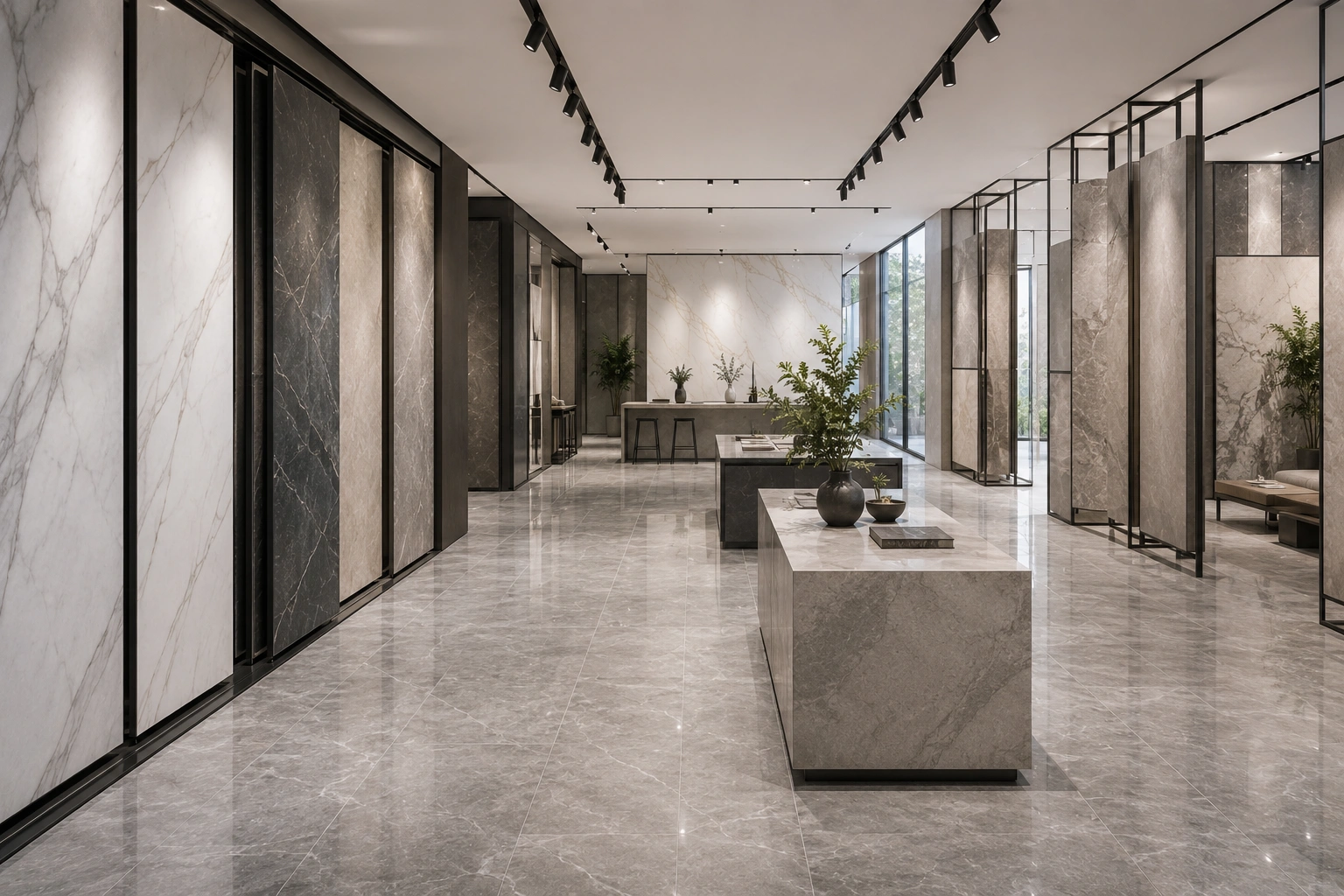
The table below gives a quick reference across all ten manufacturers. Detailed profiles follow for each one.
| # | Manufacturer | Location | Primary Tile Category |
| 1 | Marazzi | Sassuolo, Modena | Gres stoneware, large format, marble-look |
| 2 | Florim | Fiorano Modenese, Modena | Large format slab, thin slab, full body gres |
| 3 | Atlas Concorde | Fiorano Modenese, Modena | Gres floor and wall, marble-look, wood-look |
| 4 | Imola Ceramica | Imola, Bologna | Gres stoneware, outdoor technical, full body |
| 5 | Ragno | Sassuolo, Modena | Ceramic wall tile, glazed gres floor |
| 6 | Refin | Castellarano, Reggio Emilia | Gres wood-look, concrete-look, design-led |
| 7 | Panaria | Finale Emilia, Modena | Gres stoneware, thin slab, large format |
| 8 | Emilceramica | Fiorano Modenese, Modena | Gres floor, cement-look, outdoor technical |
| 9 | Mirage | Sassuolo, Modena | Full body gres, outdoor, anti-skid technical |
| 10 | Rex | Castellarano, Reggio Emilia | Large format gres, marble-look, design-led |
1. Marazzi
Marazzi is one of the oldest and most globally recognised tile manufacturers in Italy, founded in Sassuolo in 1935. The company operates multiple production plants and carries one of the widest collections among Italian producers. Their product covers gres stoneware floor tiles, large format marble-look collections in the 6x4 (1200x1800 mm) and 8x4 (1200x2400 mm) sizes, and ceramic wall tile series for bathroom and kitchen applications.
Marazzi is part of the Mohawk Industries group, which gives the company a distribution reach that extends into North America, Europe, and the Middle East. In India, Marazzi tiles are specified on five-star hotel projects, airport interiors, and luxury residential developments. Indian importers should note that Marazzi's large-format floor tiles in polished marble-look finishes are suited for dry indoor floors. For bathroom wet floors, the structured or matte finish variants from the same collection carry better slip resistance ratings.
2. Florim
Florim, based in Fiorano Modenese, is among the most technically advanced tile producers in Italy and in the world. The company was among the earliest Italian manufacturers to commercialise large-format thin slabs, producing tiles in the 32x96 (800x2400 mm) and 32x120 (800x3000 mm) slab formats at 6mm, 9mm, and 12mm thicknesses. These thin slab tiles are used for wall cladding, countertop surfacing, and feature wall applications in high-end commercial and residential projects.
Florim's full-body gres range carries colour through the entire tile body, which gives clean edges under any cutting or profiling operation. This matters in staircase edge applications, custom countertop cutouts, and any installation where tile edges are visible. Florim exports to over 150 countries and produces under its Casalgrande Padana brand for more accessible price points. For Indian importers, Florim products are most commonly specified on luxury hotel lobbies, airport executive lounges, and high-end commercial developments.
3. Atlas Concorde
Atlas Concorde, from Fiorano Modenese, produces gres stoneware floor and wall tiles across an extensive design range that covers marble-look, wood-look, stone-look, and abstract geometric collections. The company's marble-look range in the 2x4 (600x1200 mm) and 6x4 (1200x1800 mm) sizes with polished and structured finishes is among the most closely referenced by Indian architects specifying international tile brands.
Atlas Concorde holds CE certification and complies with EN 14411 Group BIa standards for water absorption below 0.5%. The company's wood-look collections in the 8x48 (200x1200 mm) plank format are produced in structured matte finishes suited for indoor dry floors and walls. These are glazed tiles and should not be used outdoors where UV exposure and moisture cycling affect the glazed surface over time. Atlas Concorde tiles are distributed across the Middle East and select Asian markets through authorised importer networks.
4. Imola Ceramica
Imola Ceramica, based in the town of Imola in the Bologna province, produces gres stoneware across floor tiles, wall tiles, and outdoor technical tiles. The company has a particularly strong outdoor tile range in the 2x2 (600x600 mm) and 2x4 (600x1200 mm) sizes with natural and bushhammered anti-skid finishes rated for outdoor terraces, pool surrounds, and external walkways. Imola's outdoor tiles carry frost resistance certification, which is relevant for Indian projects in northern regions where winter temperatures can drop significantly.
The company's full body gres range is specified for high-traffic commercial floors including retail shopping centres, hospital corridors, and transit building floors. Full body tiles from Imola have the gres composition running through the entire tile thickness, so surface wear from foot traffic does not change the tile's visible colour. Indian importers sourcing tiles for large commercial projects with long maintenance cycles find this category particularly practical.
5. Ragno
Ragno, also based in Sassuolo and part of the Marazzi group, focuses on ceramic wall tiles and glazed gres floor tiles across residential and light commercial product lines. The company's ceramic wall tile range covers the 12x24 (300x600 mm) and 12x18 (300x450 mm) sizes in a wide selection of colours, textures, and decorative patterns. These are wall-only sizes and are not suited for floor applications.
Ragno's glazed gres floor tiles in the 2x2 and 2x4 sizes cover both indoor and outdoor-rated variants depending on finish and tile classification. The company is known in the European market for accessible pricing relative to Marazzi's premium tier, while maintaining the same factory quality standards. For Indian importers looking for a lower-cost entry into Italian tile sourcing on residential bathroom projects, Ragno is a practical starting point.
6. Refin
Refin, from Castellarano in Reggio Emilia, has built a strong position in design-led tile collections with a focus on wood-look and concrete-look surfaces. Their wood-look gres range in the 8x48 (200x1200 mm) plank size covers detailed oak, walnut, and ash-look finishes in structured matte surfaces. These tiles perform on indoor dry floors and walls. They are not rated for outdoor use as the glazed surface degrades with prolonged UV and moisture exposure.
Refin's concrete-look collection in the 2x4 and 6x4 sizes is among the more realistic cement-effect tiles available from an Italian producer. The collection covers a full palette of grey tones from warm ash to cool anthracite, with both matte and semi-polished finish options. Indian architects working on contemporary commercial interiors and loft-style residential projects frequently reference Refin's concrete-look range as a benchmark for finish quality.
7. Panaria
Panaria, based in Finale Emilia, specialises in large format gres stoneware and thin slab tiles. The company produces tiles in the 6x4 (1200x1800 mm) and 8x4 (1200x2400 mm) sizes in both standard thickness (9mm and 10mm) and thin slab format (6mm). Their thin slab range is used primarily for wall cladding, countertop overlay, and feature wall applications where the reduced weight of a 6mm tile matters for structural or installation reasons.
Panaria's product range covers stone-look and marble-look collections that rank among the more visually precise in the Italian market. For Indian importers, Panaria's thin slab tiles are a relevant sourcing option for luxury bathroom feature wall cladding and kitchen countertop overlay applications where a large uninterrupted surface without grout joints is the design intent. The company exports through select international distributors and is part of the Panariagroup, which also includes the Lea Ceramiche and Blustyle brands.
8. Emilceramica
Emilceramica, from Fiorano Modenese, covers gres floor tiles, cement-look tiles, and outdoor technical tiles across a range that balances design detail with practical performance. Their cement-look tile collection in the 2x2 and 2x4 sizes with matte and lappato (partially polished) finishes has been widely specified on contemporary hospitality and office interior projects across Europe.
The company's outdoor technical gres in the 2x2 and 20x20 (500x500 mm) sizes with R11 anti-skid rating is relevant for Indian project buyers sourcing for resort terraces, poolside areas, and covered outdoor dining spaces. R11 slip resistance under the German DIN 51130 standard corresponds to a good level of anti-skid performance on wet outdoor surfaces. Emilceramica exports to over 80 countries and has a distributor presence in select Middle Eastern markets, from which Indian project importers sometimes source.
9. Mirage
Mirage, from Sassuolo, is one of Italy's most technically focused producers of full body gres stoneware. The company specialises in outdoor and high-performance technical tiles across both standard and large format sizes. Their full body gres in the 2x2, 2x4, and 6x4 sizes carries the tile's mineral composition through the entire body, which gives consistent colour and texture on any cut edge or ground surface.
Mirage's outdoor tiles are rated for heavy pedestrian traffic, vehicle transit in some specifications, and exposed outdoor conditions including frost and UV. For Indian developers sourcing tiles for resort compound areas, landscaped outdoor spaces of luxury villas, and covered outdoor commercial spaces, Mirage's technical outdoor range deserves evaluation. The company does not compete in the budget segment and targets architect-specified commercial and high-end residential projects exclusively.
10. Rex
Rex, from Castellarano and part of the Florim group, focuses on large format gres tiles with a design-led approach to marble-look and stone-look surfaces. The company's marble-look collections in the 6x4 (1200x1800 mm) and 8x4 (1200x2400 mm) sizes with polished and structured finishes are particularly detailed in their veining reproduction and surface depth. Rex is one of the more frequently referenced Italian brands by architects working on luxury residential lobbies and feature wall specifications.
Rex tiles in polished finishes on large format slabs are suited for dry indoor floors, feature walls, and reception area floors in low-footfall spaces. For high-traffic commercial floors or wet area floors, the structured or matte finish variants from Rex's collections carry better slip resistance. The Florim group's production infrastructure means Rex consistently delivers calibrated edge precision on large format tiles, which keeps grout joints tight and visual patterns continuous across large floor areas.
Italian Tile Categories and Their Indian Equivalents
Italian manufacturers use terminology drawn from European standards. The table below maps the most common Italian tile category terms to the nearest Indian tile category, with application guidance for each.
| Italian Term | European Standard | Indian Equivalent | Common Sizes | Application |
| Gres porcellanato (glazed) | EN 14411 Group BIa | GVT or PGVT vitrified | 2x2, 2x4, 6x4, 8x4 | Indoor floor and wall, dry and wet areas |
| Gres porcellanato (full body) | EN 14411 Group BIa | Full body vitrified | 2x2, 2x4, 6x4 | Commercial floor, outdoor, edge-critical areas |
| Lastra sottile (thin slab) | EN 14411 BIa, 6mm | Large format GVT slab | 32x96, 32x120, 8x4 | Wall cladding, countertop overlay, feature walls |
| Gres ceramico (outdoor) | EN 14411 + DIN 51130 | GVT anti-skid | 2x2, 20x20, 2x4 | Terraces, pool surrounds, external walkways |
| Ceramica (wall) | EN 14411 Group BIII | Ceramic wall tile | 12x18, 12x24 | Bathroom and kitchen walls only |
| Gres legno (wood-look) | EN 14411 Group BIa | Wood-look GVT | 8x48, 2x4 | Indoor dry floors and walls only |
A practical note: the EN 14411 Group BIa standard covers tiles with water absorption below 0.5%. This maps to the full vitrified category in India, not to Indian porcelain tiles which have water absorption between 2% and 5%. Always read Italian tile technical data sheets using the European water absorption classification, not the Indian porcelain label.
How Italian Tiles Differ from Spanish and Indian Tiles
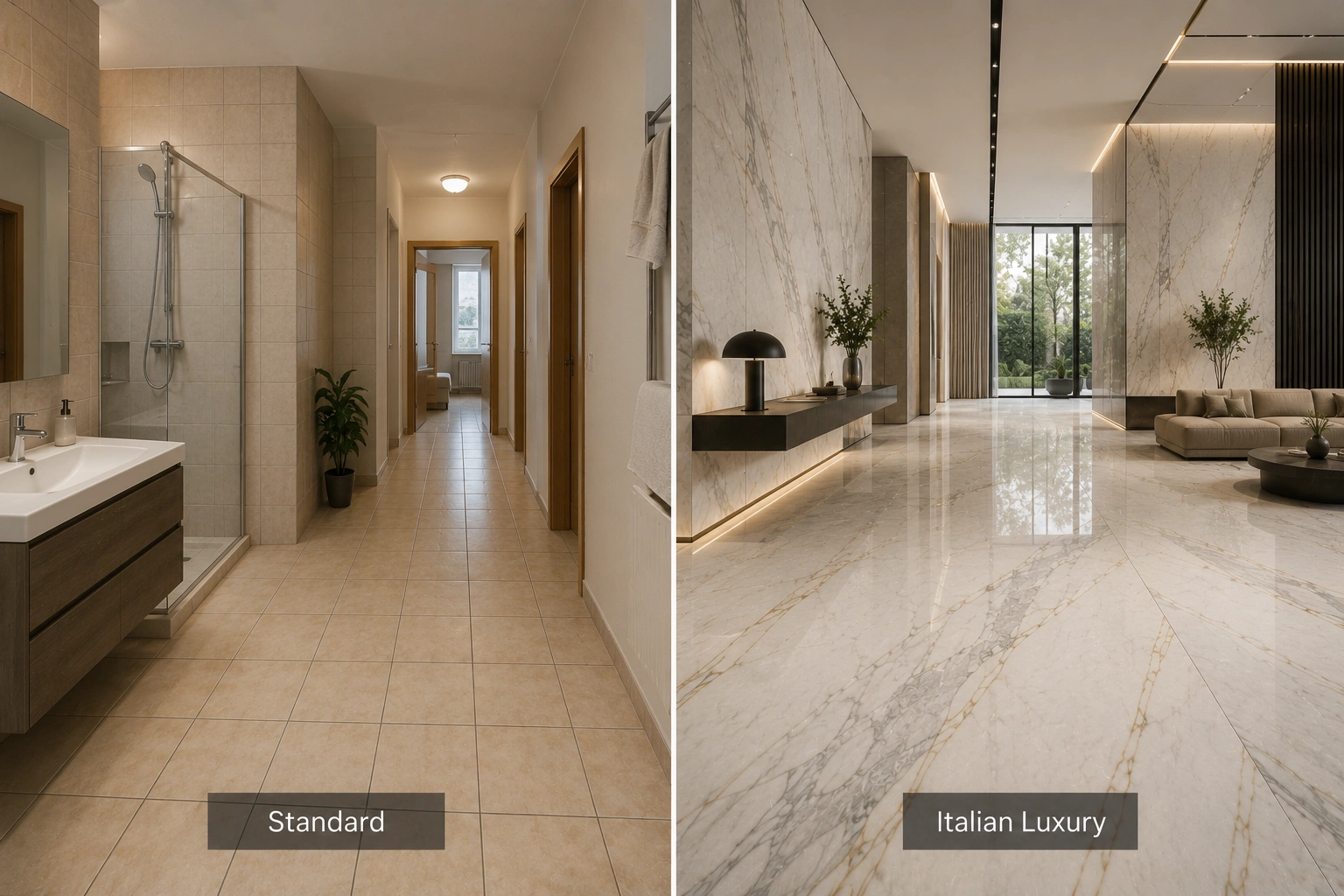
Understanding the practical differences between Italian, Spanish, and Indian tiles helps Indian importers make the right sourcing decision for each project type.
| Factor | Italian Tiles | Spanish Tiles | Indian Tiles (Morbi/Listed) |
| Design leadership | Sets global trends, Cersaie launches | Follows Italian direction, strong design | Follows global trends with 1 to 2 year lag |
| Large format depth | Strongest: thin slab, 8x4, 32x120 | Strong: 6x4, 8x4, 32x96 | Growing: 6x4, 8x4 now available |
| Price (ex-factory) | Highest among the three | Mid to high | Most accessible |
| India landed cost | Very high (60% to 120% above ex-factory) | High (60% to 100% above ex-factory) | Lowest (domestic supply) |
| Technical certification | CE, EN 14411, DIN 51130, Cersaie-tracked | CE, EN 14411, QUALICER | BIS IS 13630 |
| Best project fit | Five-star hospitality, luxury villa, flagship | Premium residential, mid to luxury | Residential to commercial at all tiers |
What Indian Importers Must Know Before Buying Italian Tiles
Total landed cost calculation: Italian tiles carry the highest ex-factory price among the major tile-producing countries. Add sea freight from Italian ports (Genoa, La Spezia, or Livorno) to Indian ports at roughly USD 2,000 to 3,500 per 20-foot container, Indian customs duty at 20% to 40% of assessable value by HS code classification, IGST at 18%, port handling charges, and inland transport. The total landed cost at a project site in India typically runs 70% to 120% above the Italian ex-factory price. This calculation must be completed before quoting any Italian tile to an end client.
Thin slab handling and installation: Italian thin slab tiles at 6mm thickness require specialist adhesive systems, experienced installation teams, and a flat substrate. Thin slab tiles cannot be installed by standard tile-laying crews without specific training. Confirm that the project's installation contractor has experience with large format thin slab tiles before specifying this category, or the result will be tile breakage and adhesion failure regardless of the tile's own quality.
Container load planning: A 20-foot container holds approximately 900 to 1,100 square metres of standard 2x4 tiles. For large format 6x4 tiles, the packing volume is lower because of the increased tile weight per piece. Italian manufacturers typically have higher minimum order quantities than Indian or Spanish producers. Order the full project quantity in one consignment wherever possible to eliminate batch colour matching risk between shipments.
Shade and calibre numbering: Italian tiles carry shade (tono) and calibre (calibro) numbers on every box. Shade refers to the tile's colour batch within a production run. Calibre refers to the exact tile dimension, which can vary slightly between production batches even within the same nominal size. Always record both numbers when placing an order and specify them again on any repeat order. Mixing shades or calibres on the same floor area produces visible colour and joint variation that cannot be corrected after laying.
Authorised import channels: Several Italian tile brands have authorised Indian importers. Buying through an authorised channel gives access to pre-tested stock, accurate import documentation, proper HS code classification, and after-sales technical support. Sourcing through unauthorised channels may result in incorrect duty payment, missing certifications, or tiles that fail to match the advertised technical specification.
Freight insurance on large format tiles: Large format Italian tiles, particularly slabs above 6x4 size, are heavier and more vulnerable to transit damage than smaller format tiles. Confirm that the shipping insurance covers individual tile breakage and does not exclude ceramic goods. Get this confirmation in writing before the container is loaded.
Common Mistakes When Importing Italian Tiles into India
Specifying polished large format tiles for wet bathroom floors: Italian polished gres tiles look exceptional on project mood boards but create a serious slip risk on wet bathroom floors. The same rule applies to Italian tiles as to Indian PGVT tiles. Polished surfaces in wet zones are not safe. Specify the structured or matte finish version from the same Italian collection for bathroom floors, and keep the polished version for dry living room or lobby floors.
Ignoring thin slab weight and substrate requirements: A 6mm thin slab tile over a 1200x2400 mm format weighs significantly less than a standard 10mm tile of the same size, but it still requires a perfectly flat substrate and specialist adhesive. Thin slab tiles cannot go over existing flooring without a proper levelling assessment. Several Indian projects have had thin slab installations fail because the substrate was not flat enough or the adhesive system was incorrect.
Using Italian gres legno tiles outdoors: Wood-look Italian tiles from Refin, Atlas Concorde, and other manufacturers are glazed tiles intended for indoor dry floors and walls. Specifying them for outdoor terraces or balconies will cause glaze degradation from UV and moisture. For an outdoor wood-look finish, confirm the specific tile carries an outdoor technical rating with an R-value slip resistance certification before specifying.
Quoting ex-factory price to end clients: The most common mistake Italian tile importers in India make is presenting the ex-factory European price to the client and then discovering that landed cost is 80% to 100% higher after duty, freight, and handling. Always build the full landed cost calculation before presenting a budget to any client.
Ordering without a 15% buffer on large format tiles: Large format Italian tiles have a higher breakage rate in transit and during cutting on site compared to smaller tiles. A 10% buffer is the minimum for standard tiles; a 15% buffer is sensible for large format slabs above 6x4 and for any tile with a complex veining pattern where a damaged piece is visually obvious and cannot be hidden by positioning.
Confusing ceramic wall tiles with gres floor tiles: Some Italian manufacturers like Ragno produce both ceramic wall tiles and gres floor tiles. The ceramic wall tiles in 12x18 and 12x24 sizes are wall-only products with water absorption unsuitable for floor use. The gres floor tiles are a separate product line. Confirm the tile category from the technical data sheet rather than making assumptions based on the collection name or tile appearance.
Sourcing Italian Tiles for Indian Projects: The Practical Summary
Italy's tile manufacturers produce the most design-current and technically precise tiles available in the global market. For Indian developers and architects specifying five-star hotel interiors, luxury villa flooring, airport executive lounges, or high-end retail flagships, the ten manufacturers in this guide represent the most credible sourcing shortlist.
The economics of Italian tile import into India are demanding. The total landed cost is high, thin slab installation requires specialist contractors, and large format tiles need careful container loading and freight insurance. These are solvable problems for the right project, but they need to be factored into the project budget from day one rather than discovered after the specification is finalised.
You can browse tiles from verified international manufacturers, compare Italian and other premium tile categories, and connect with established Indian importers who stock Italian tile ranges on TilesFinders, a B2B tiles marketplace built for Indian construction and design buyers.
FAQs
For luxury hospitality and large format commercial projects, Florim and Marazzi are the most commonly specified Italian manufacturers in India. For design-led residential projects with wood-look and concrete-look finishes, Refin and Atlas Concorde carry strong product ranges. For outdoor technical tiles on resort and villa projects, Imola Ceramica and Mirage are worth evaluating. Panaria and Rex are strong for large format marble-look slab applications in premium lobbies and feature walls.
Gres porcellanato is the Italian term for dense stoneware tiles with water absorption below 0.5% under the EN 14411 European standard. In Indian tile terminology, this corresponds to the vitrified tile category, which includes GVT, PGVT, and full body vitrified tiles. Italian gres porcellanato is not the same product as Indian porcelain tiles, which have a higher water absorption of 2% to 5% and weaker body strength. When evaluating Italian tiles, read the water absorption figure on the technical data sheet rather than relying on the product label.
Italian tiles carry higher ex-factory prices because of higher production costs in Italy, greater investment in design development and Cersaie launches, more frequent collection updates, and a market positioning built around architect-specified projects where design currency justifies the price. Italian thin slab production and large format calibration technology also require more expensive equipment and tighter process control than standard format tile production. For Indian buyers, the final landed cost difference between Italian and Indian tiles on the same project can be very large once import duties and freight are added.
As a working estimate, the total landed cost of Italian tiles at an Indian project site is typically 70% to 120% above the Italian ex-factory price. This includes sea freight from Italian ports to Indian ports (roughly USD 2,000 to 3,500 per 20-foot container), Indian customs duty of 20% to 40% of assessable value by HS code, IGST at 18%, social welfare surcharge, port handling, customs clearance, and inland transport. Always compute the full landed cost with a licensed customs broker before presenting tile pricing to an end client.
Sassuolo is a town in the Emilia-Romagna region of northern Italy that serves as the production centre for Italy's tile industry. The district, spanning the provinces of Modena and Reggio Emilia, contains over 120 tile manufacturing companies within a small geographic area. The cluster includes tile factories, equipment manufacturers, glaze suppliers, digital printing technology developers, and design studios, all working in proximity. This concentration of expertise is one of the main reasons Italian tile design and production technology stays ahead of other producing countries. Most of the manufacturers in this guide are based in or immediately around the Sassuolo district.
CE marking under EN 14411 is the primary quality certification for Italian tiles. Request the technical data sheet for each specific tile, not just a general brand certificate. Key data points to confirm include water absorption class (Group BIa is below 0.5%, equivalent to vitrified in Indian terms), breaking strength in Newtons, PEI abrasion resistance rating for floor tiles (PEI 3 minimum for residential, PEI 4 to 5 for commercial), slip resistance R-value for outdoor tiles, and chemical resistance classification. For thin slab tiles, also confirm adhesive system recommendations and substrate flatness requirements from the manufacturer's installation guidelines.
Yes, but only specific outdoor-rated categories. Full body gres tiles from Imola Ceramica, Mirage, and Emilceramica that carry outdoor technical ratings and anti-skid R-value certification perform well in Indian outdoor conditions. Standard glazed Italian tiles, including marble-look, wood-look, and concrete-look collections, are not rated for outdoor use and will degrade with prolonged UV and moisture exposure. For any outdoor application, confirm the specific tile's outdoor rating, anti-skid classification, and frost resistance figure from its technical data sheet.
