Tiles for Bedroom Design: Colour & Pattern Combinations
May 30, 2026 20
Discover bedroom tile colour and pattern combinations for Indian homes. Compare warm, modern, Vastu-friendly designs, floor-wall pairings, grout choices, and finish ideas for restful spaces.
Most bedroom tile decisions in India happen in two separate moments: the floor tile gets chosen first, then the wall tile gets picked later to match. The result is often a bedroom where nothing actively clashes, but nothing quite works together either.
The rooms that feel genuinely considered, where the floor and wall tiles read as part of the same design rather than separate decisions, come from thinking about colour, pattern, and finish as a coordinated system from the start.
This guide covers the combinations that work well in Indian bedroom proportions, the Vastu direction rules for bedroom tile colour, how to pair patterns without conflict, and the one grout decision that most buyers overlook until it is too late.
Why Tile Colour and Pattern Choice Shapes the Bedroom's Mood
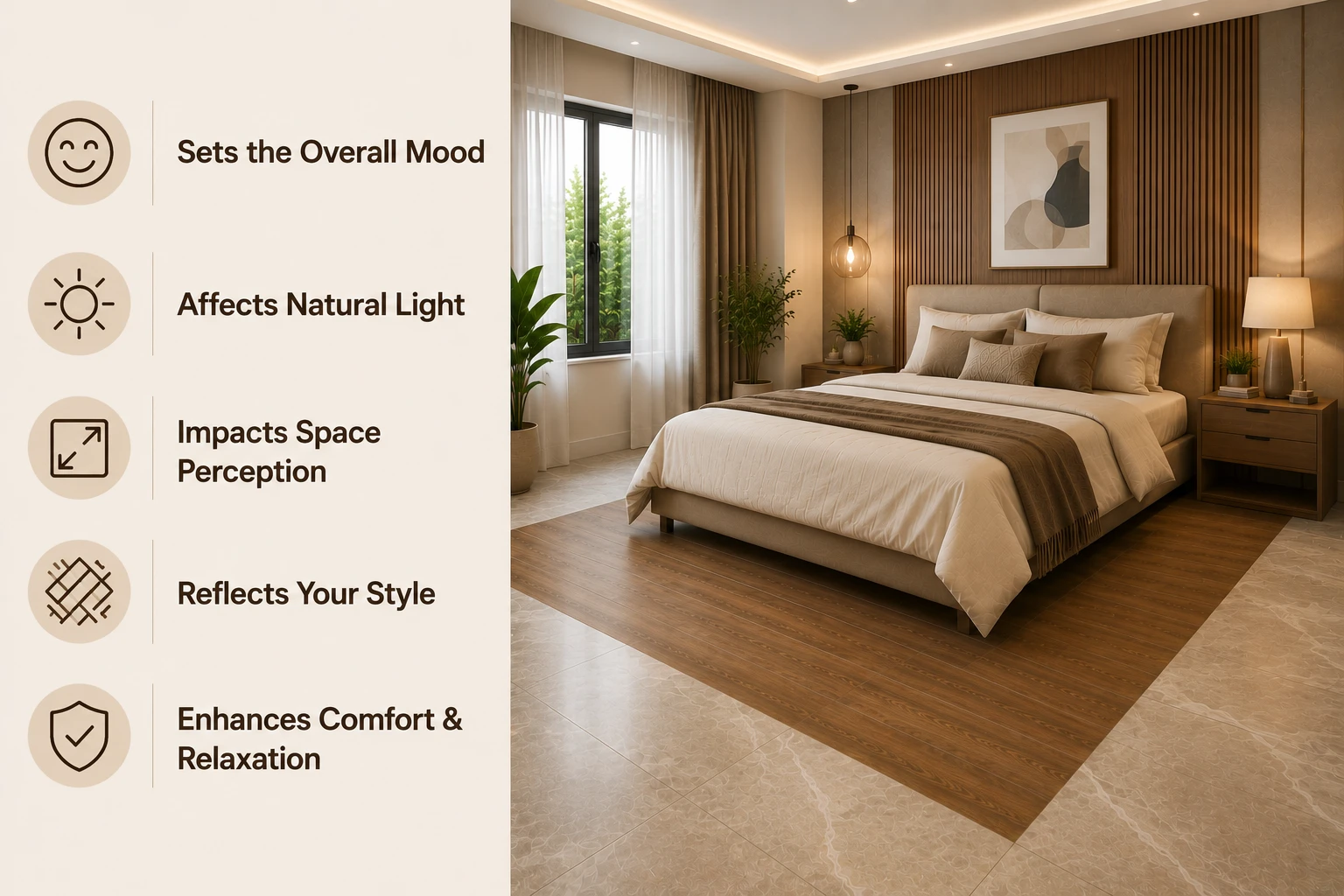
The bedroom is the room you see first thing in the morning and last thing at night. Unlike a living room or kitchen, where the visual experience is shaped by furniture, people, and activity, a bedroom's tile surfaces, the floor you step on and the wall behind the bed, are always visible and always set the room's base mood.
Looking beyond colours and patterns? Our bedroom tile guide covers layouts, materials, finishes, and practical planning tips for Indian homes. It helps you build a bedroom that feels comfortable throughout the year.
Colour psychology applied to tile for bedroom design is straightforward: warm tones in the beige, cream, oak, and greige range promote a calm, enclosed feeling. Cool tones like sage green, dusty blue, and pale grey create a fresh, open atmosphere. High contrast combinations, dark floor with very light wall or vice versa, add energy and definition. Low contrast combinations, similar tones on floor and wall, read as quiet and restful.
Pattern adds a second layer. A plain floor and a patterned accent wall focus visual interest at one point in the room. Two patterned surfaces, if scaled and toned differently, create depth. Two patterns of the same scale and intensity on the floor and wall create visual competition that most bedrooms cannot absorb.
The Four Rules of Bedroom Tile Colour Combinations
These four principles hold across bedroom tile sizes, lighting conditions, and design styles. Think of them as starting constraints rather than creative limits.
Rule 1: Keep floor tone anchored. The floor tile sets the warmth or coolness of the whole room. Choose the floor colour first, then build the wall colour around it. A warm floor with a cool accent wall works. A cool floor with a warm wall often fights itself.
The floor sets the tone for the entire room, which is why choosing the right bedroom floor tiles matters before any wall finish. Material, colour, and texture all influence how restful the space feels.
Rule 2: One pattern surface, one plain surface. If the bedroom floor tile has a wood grain, herringbone, or marble vein pattern, the dominant wall tile should be plain or near-plain. The accent wall can carry a geometric or textured tile, but only one wall and only if the floor pattern is subtle.
Rule 3: Contrast in finish, tone match. A matte tile for the floor and a glossy or satin wall tile in a similar colour family always works better than two matte or two glossy surfaces of different tones. The finish contrast adds life while the tone match keeps the room cohesive.
Rule 4: Grout is part of the colour combination. White grout on a warm beige floor makes the grid visible and cool. Warm sand grout makes the floor read as a continuous surface. Grout colour is a tile colour decision, not an afterthought.
Bedroom Tile Colour Combinations That Work for Indian Homes
Each of the five combinations below follows the four rules and has been tested against the actual light conditions and apartment proportions that Indian bedroom floors encounter.
Warm Beige Floor with Cream or Off-White Wall Tiles
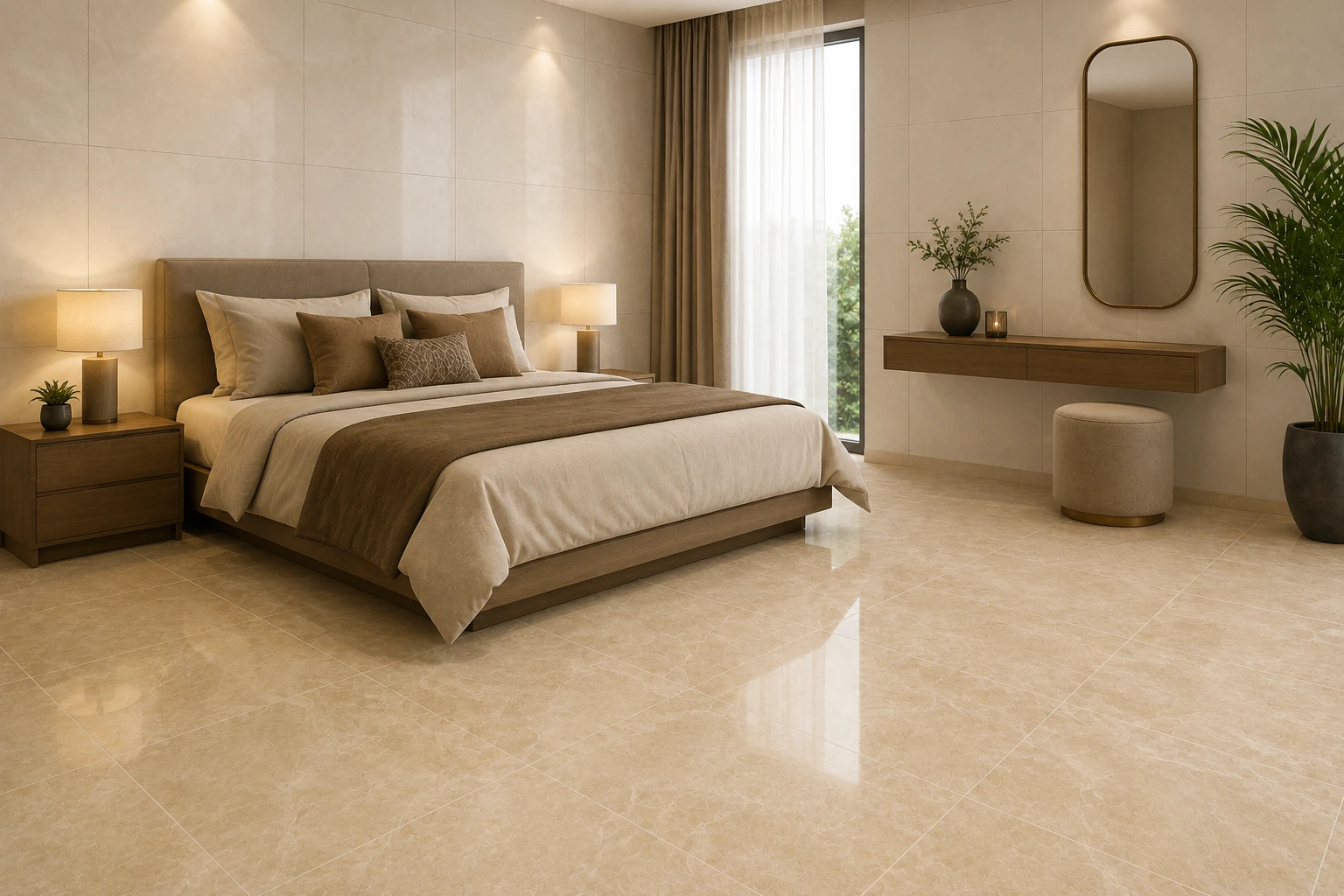
The most widely used bedroom floor and wall tile combination in Indian homes. A warm beige GVT floor tile in matte finish (2x4 / 600x1200 mm) paired with cream or off-white wall tiles on three walls, with a slightly textured or subtle veined tile on the headboard wall, produces a bedroom that reads as calm, clean, and residential across all light conditions: morning sun, afternoon shadow, and warm LED at night.
This combination works in north-facing and east-facing bedrooms where natural light varies significantly across the day, because the warm base tones prevent the room from feeling cold in low light.
Greige Floor with Sage Green Accent Wall Tiles
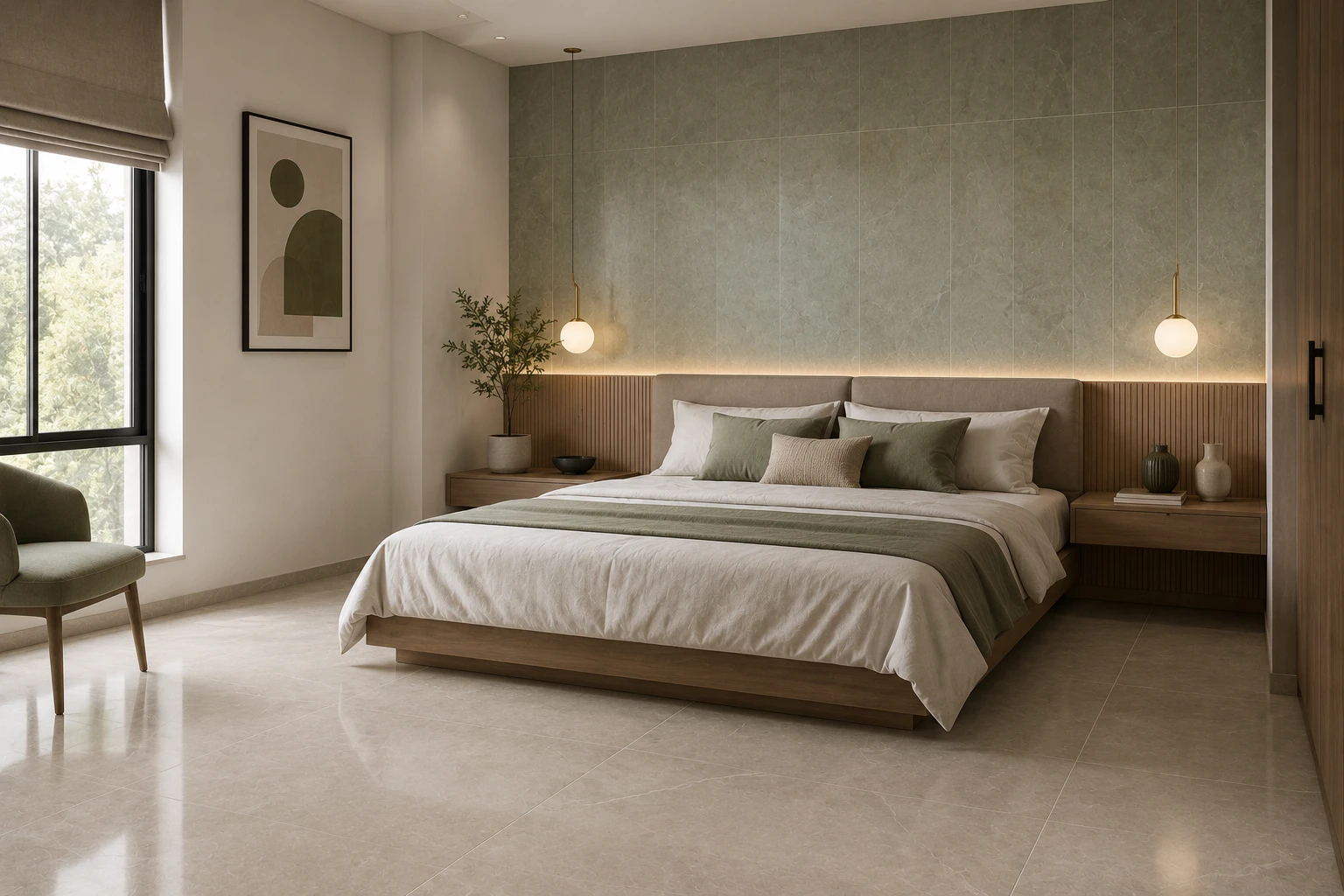
Greige (warm grey-beige) GVT floor tile paired with plain off-white walls and a sage green ceramic or GVT tiles on the headboard wall is one of the strongest nature-inspired bedroom colour combinations for 2026. The greige floor is neutral enough not to conflict with the green accent, and sage is muted enough to feel restful rather than energetic.
Keep the sage accent wall tile in a matte or textured finish. A glossy green in a standard Indian bedroom reads as too bold. The combination pairs naturally with wooden furniture, brass or matte black hardware, and linen tones in bedding.
Warm Oak Wood-Look Floor with Stone-Look Feature Wall
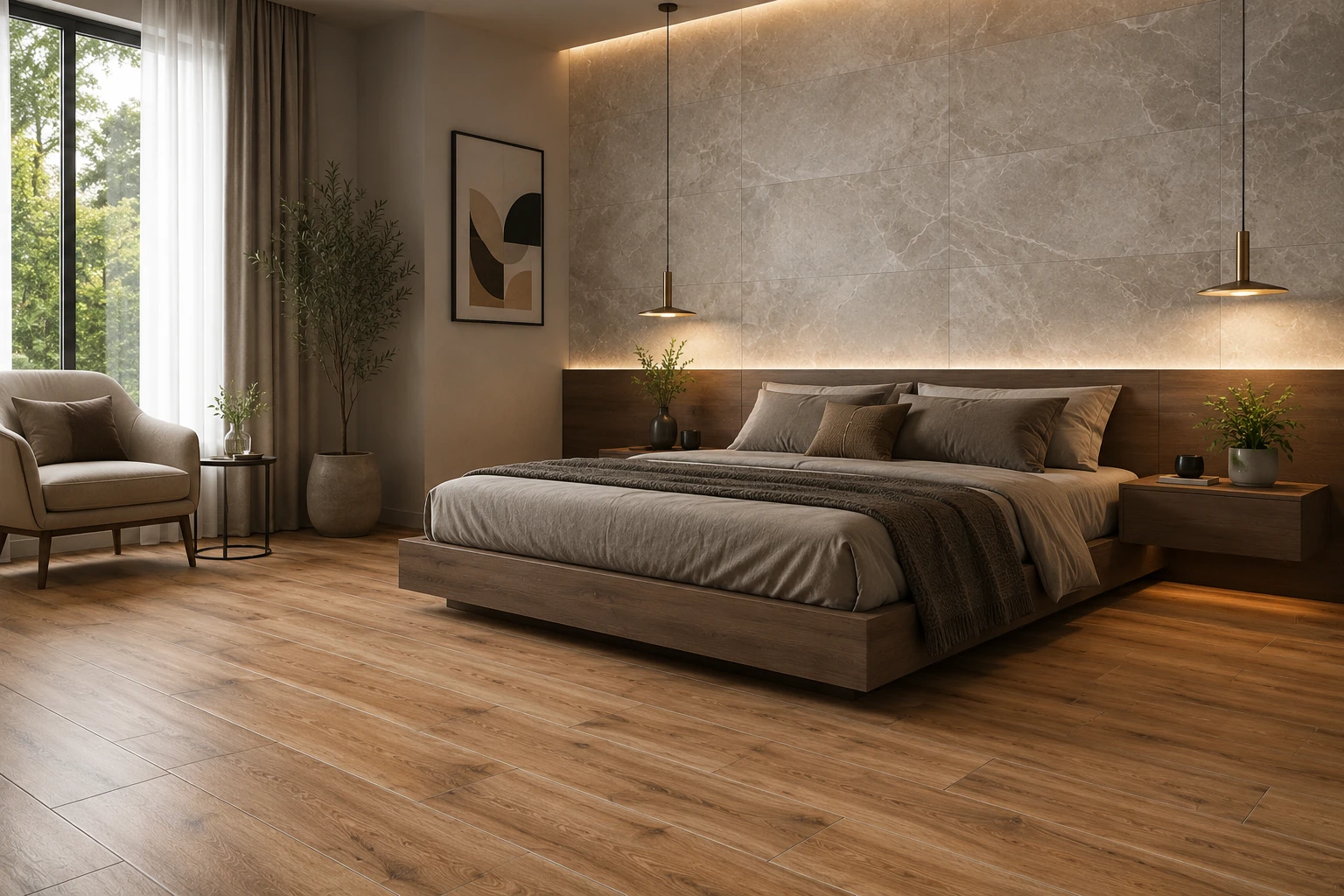
A warm oak GVT plank tile floor (8x48 / 200x1200 mm) combined with a stone-look or concrete-look GVT tile on the headboard wall produces a bedroom that brings two natural material references together. Both surfaces are GVT, so the technical performance is consistent, but visually, the room reads as layered and considered.
If you like the warmth of timber but want a low-maintenance surface, wooden bedroom tiles are worth considering. They offer the appearance of natural wood while handling everyday wear far more easily.
For this combination, the stone-look tile on the wall should share the oak floor's warm base: a warm grey or sandy stone rather than a cool blue-grey stone. The warm undertone is what holds the two surfaces together. Pair with light-coloured remaining walls, ideally painted or in plain off-white ceramic tile.
White Marble-Look Floor with Deep Navy or Charcoal Accent Wall
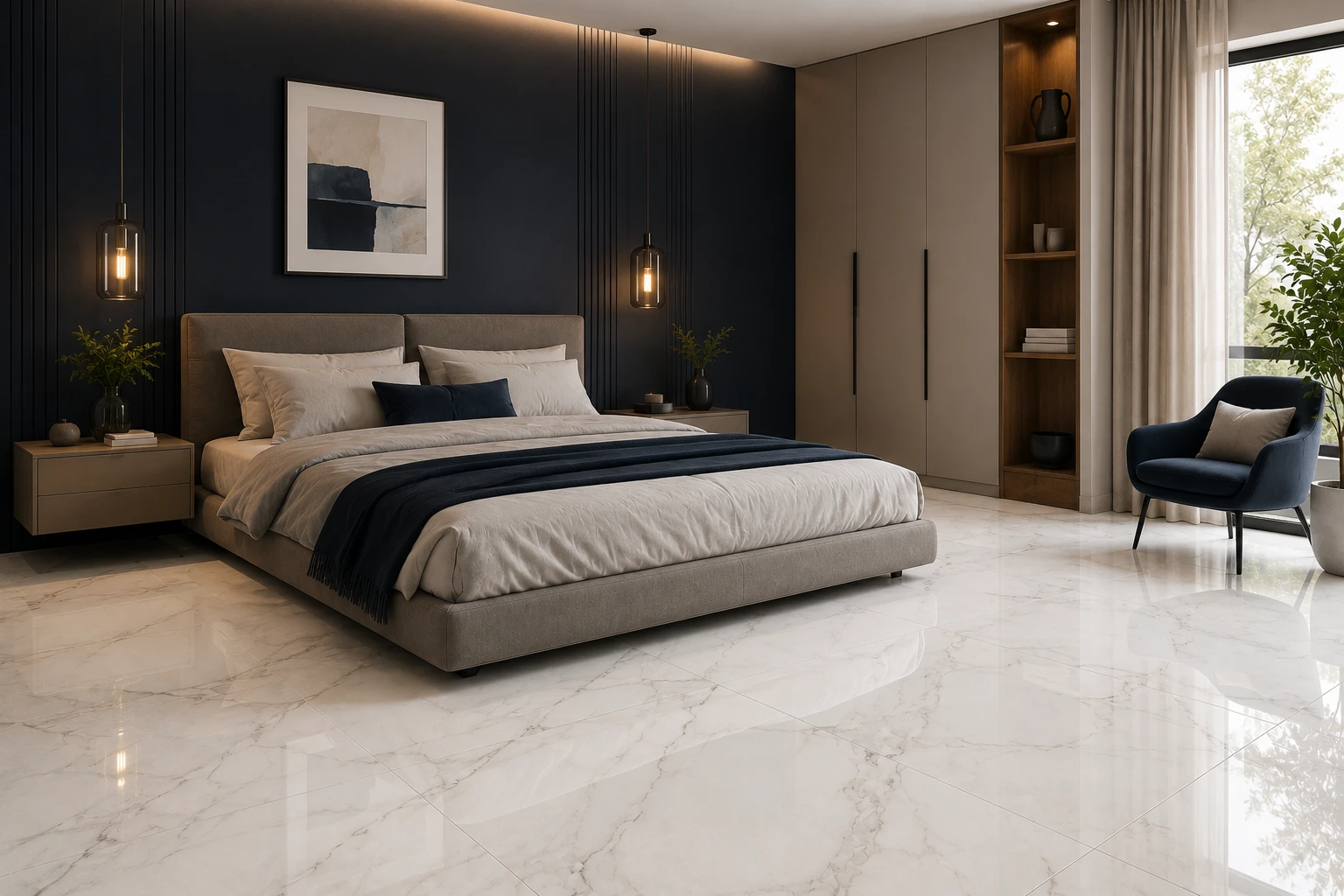
A white or light cream marble-look PGVT or GVT floor in matte or Posh finish with a single deep-toned accent wall in navy, charcoal, or forest green is a high-contrast bedroom tile colour combination that works in large, well-lit master bedrooms with strong natural light.
The accent wall tile should be plain and matte: a flat, dark matte GVT or ceramic tile on one wall, floor to ceiling. The three remaining walls stay white or off-white. The marble-look floor lightens the room enough to balance the dark accent. This combination does not work in small bedrooms (under 120 sq. ft.) or north-facing rooms with limited daylight.
Pale Ash Floor with Warm Sand Wall Tiles
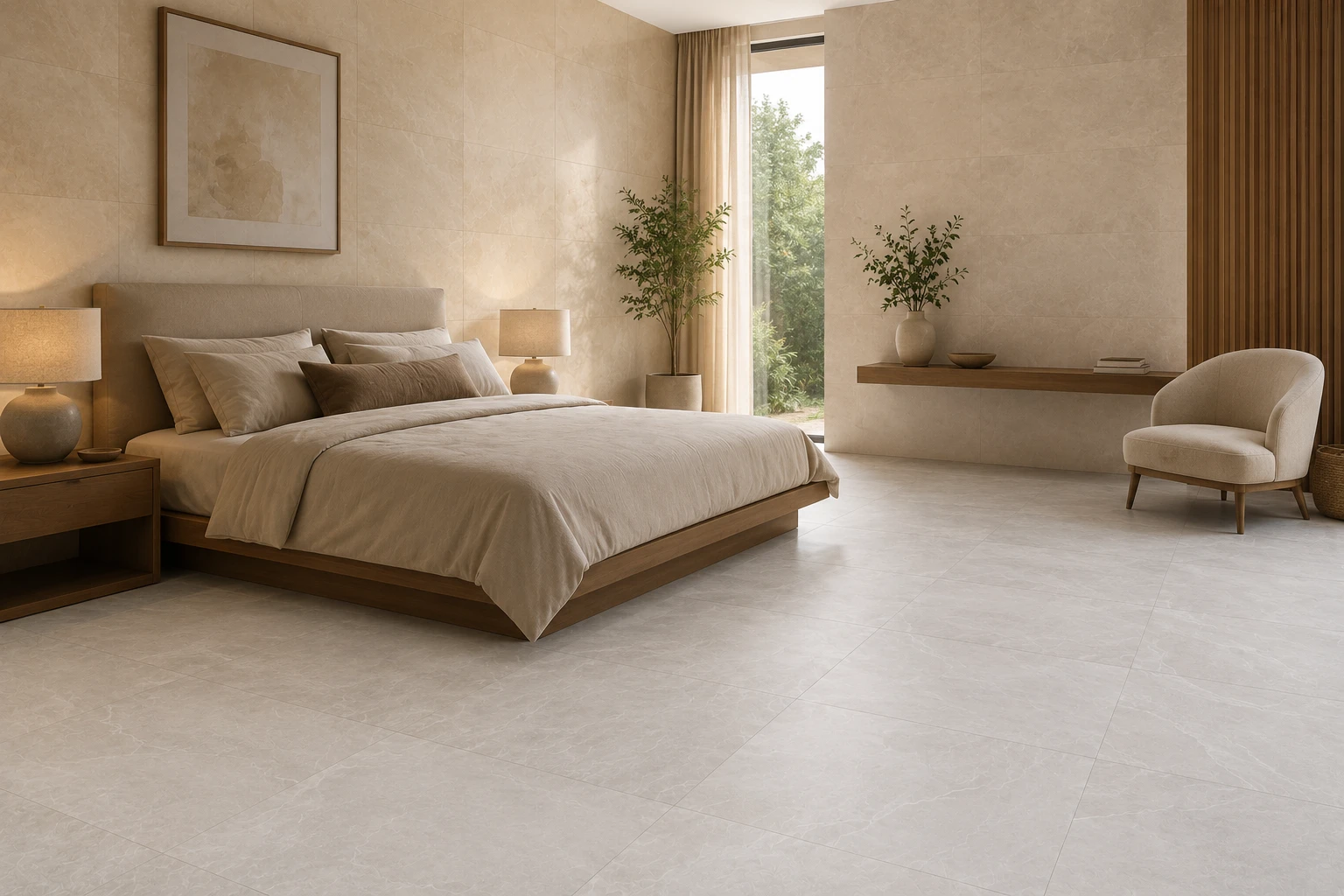
Pale ash grey GVT plank tiles on the floor, combined with warm sand or terracotta-beige wall tiles creates a Nordic-meets-Indian combination that suits minimalist bedrooms in well-lit south or east-facing rooms. The cool floor and warm wall offset each other, producing a room that feels balanced through the day as natural light shifts.
Both surfaces should be matte. A glossy warm sand wall tile and a pale ash matte floor read as mismatched in surface quality. Thin grout lines on the floor in pale grey and warm beige grout on the wall tie each surface to its own tone system.
Tile Colour as Per Vastu for Bedroom Direction
Vastu Shastra assigns directional energy to each bedroom location, which maps onto colour recommendations for both floor and wall tiles.
| Bedroom Direction | Recommended Floor Tile Colour | Recommended Wall Tile Colour | Avoid |
| South-West (master bedroom) | Earthy beige, warm cream, light brown | Off-white, warm sand, muted terracotta | Cool blues, stark white, black |
| South (couples' bedroom) | Peach, warm pink-beige, off-white | Cream, pale gold, soft coral accent | Dark grey, black, cool tones |
| North-West (guest bedroom) | Grey-white, pale greige, silver-tone | White, pale grey, light sage | Red, deep orange, dark brown |
| East (children's room) | Pale yellow, cream, light green-grey | Cream, soft mint, warm white | Dark tones, heavy saturated colours |
| North (study or spare room) | Soft green-grey, cream, pale sage | White, pale green, cool beige | Red, deep, warm tones, black |
Pattern Combinations That Work in Bedroom Tiles
Pattern in tile for bedroom design works on one principle: the floor pattern and the wall pattern should not compete for visual attention at the same scale. One leads, one supports.
Running Bond Floor and Plain Wall: The Safe Base
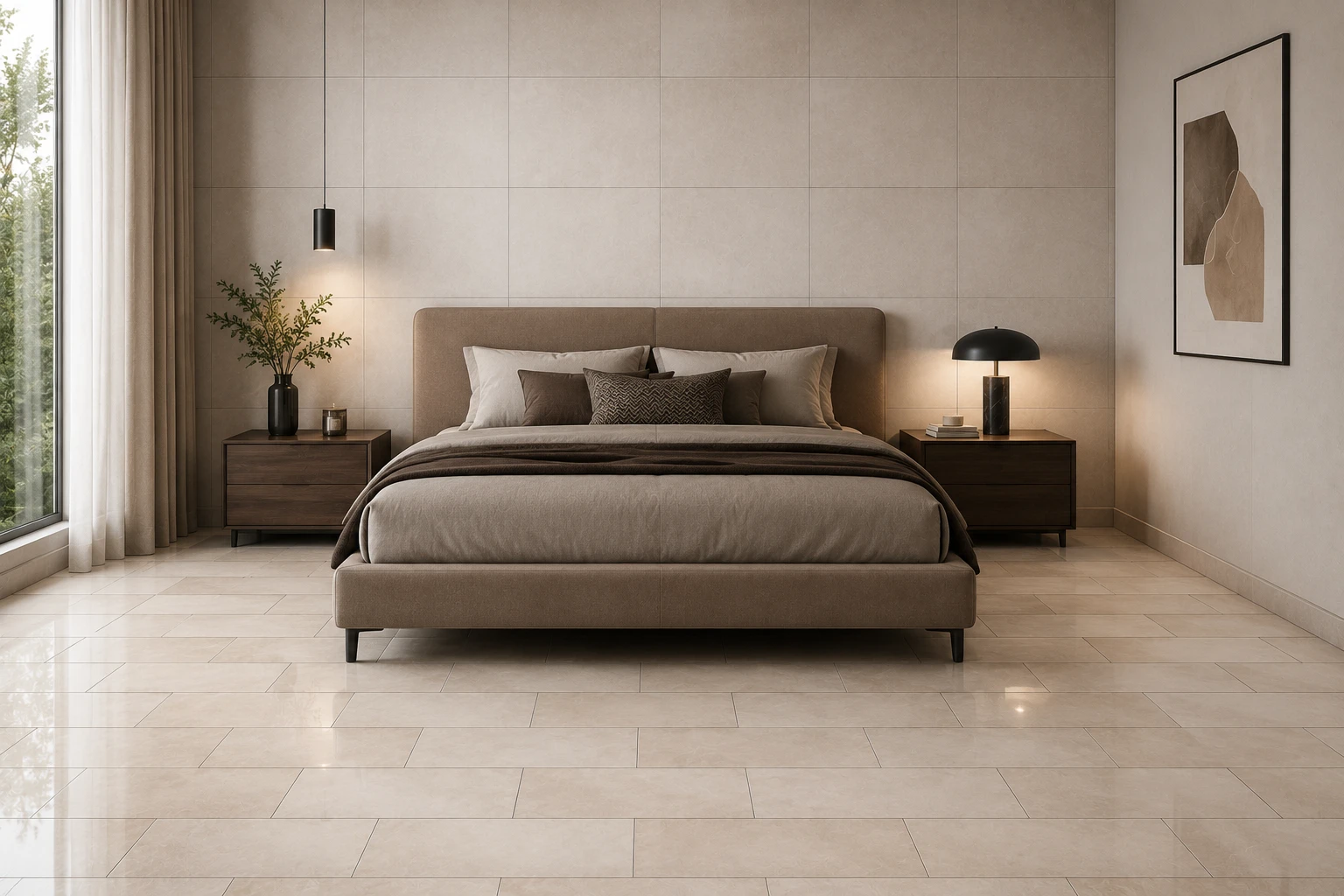
A wood-grain or marble-look tile laid in running bond on the floor, combined with plain or near-plain tiles on all walls, is the most stable bedroom tile pattern combination. The floor carries the visual interest. The walls rest. This combination reads as designed without being busy, which suits the bedroom's function as a rest space better than any high-pattern approach.
Herringbone Floor and Vertical Stack Wall: Directional Contrast
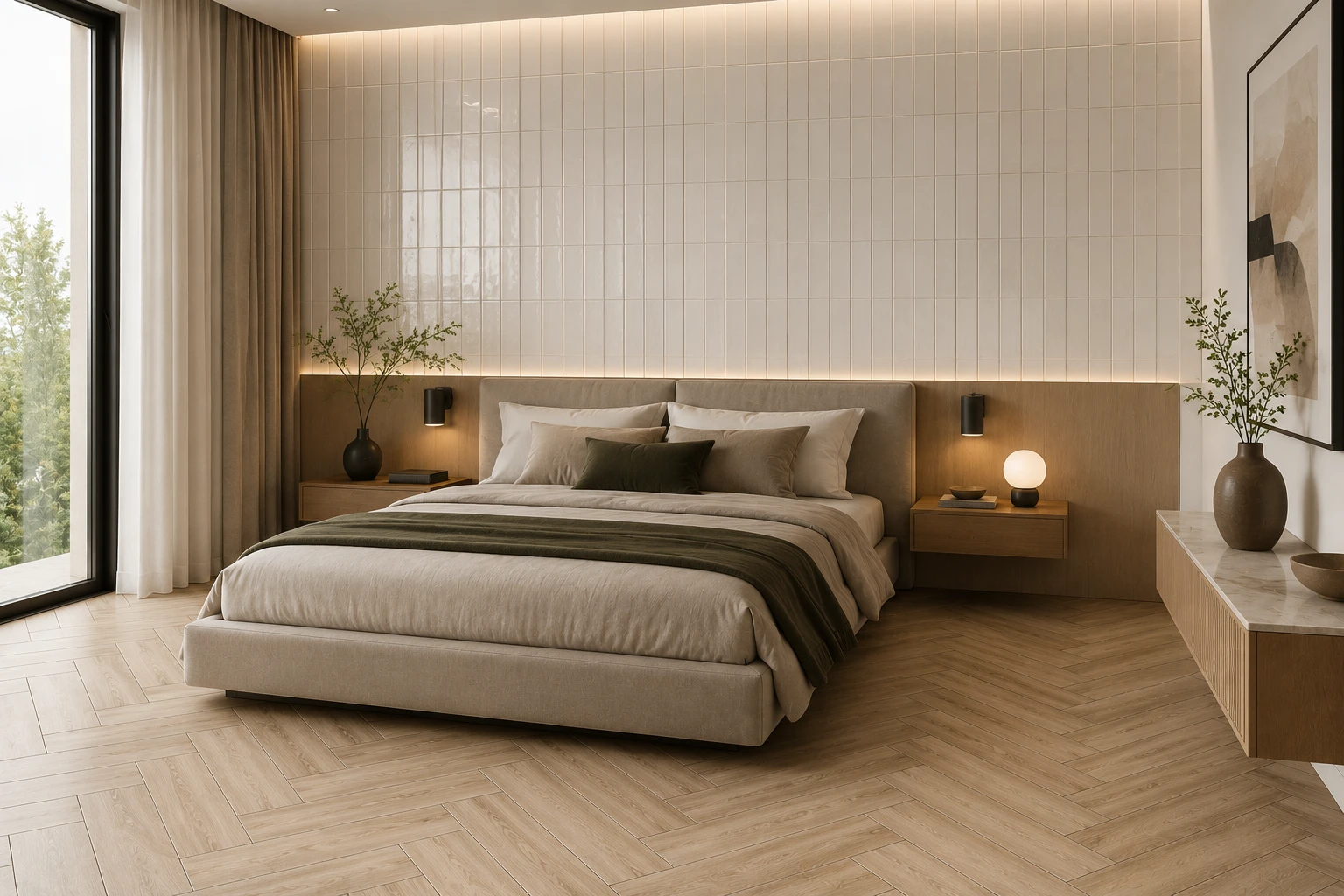
A herringbone plank tile on the floor, combined with a vertically stacked plain tile on the accent wall, creates directional contrast that adds depth without visual competition. The herringbone moves diagonally; the vertical stack on the wall moves upward. The two patterns are geometrically distinct enough that they read as a system rather than a clash.
For this combination to work, both tile surfaces must share a similar tone family. Warm ash herringbone floor with warm cream vertical stack wall. Not an ash herringbone floor with a cool blue vertical stack wall, which introduces a tone conflict on top of the pattern contrast.
Geometric Accent Wall with Plain Floor: Pattern Focus
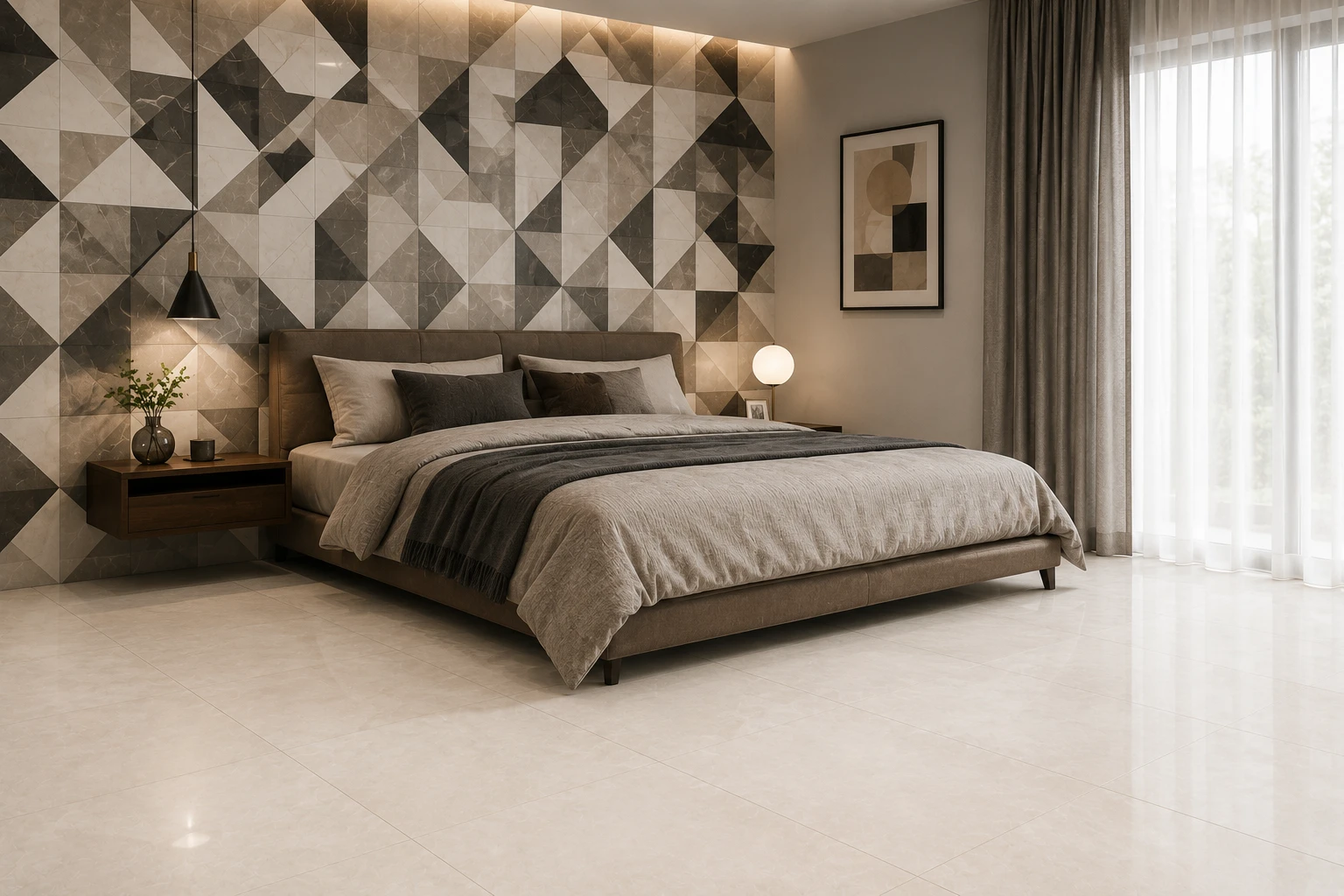
A geometric or textured bedroom accent wall tile, such as a 3D wave, raised hexagon, or printed geometric tiles, works best when the floor is completely plain and neutral. The accent wall is the room's single design statement. A patterned floor under a geometric wall is too much for a standard Indian bedroom to absorb.
Use this approach on the headboard wall only, in a light base tone with the geometric element in relief or subtle print rather than high-contrast colour. Limit the accent wall to one surface; the remaining three walls stay plain.
Matte Floor and Glossy Wall: The Finish Combination That Works
Finish is a colour decision. Matte and glossy surfaces of the same tile colour will read as two different tones under light because of how each surface reflects.
The practical rule for bedroom tile design is matte or Posh finish on the floor, glossy or satin on the wall. Matte on the floor hides dust, feels warm underfoot, and does not show barefoot traffic. Glossy on the wall reflects light, makes the room feel brighter, and is easy to wipe clean. This pairing is both practical and visually balanced because the floor absorbs light while the wall reflects it.
Avoid a glossy finish on bedroom floors. Polished tiles show footprints from the first day of use and feel cold underfoot. Avoid matte on all four walls in a low-light bedroom: it absorbs whatever light is available and makes the room feel dim.
Grout Colour as Part of the Bedroom Colour Combination
Grout covers 5 to 8% of the visible floor surface in a typical tiled bedroom. That is a significant portion of the room's colour system, and most buyers choose it at the last moment without thinking about what it does to the overall combination.
| Floor Tile Tone | Recommended Grout Colour | Effect | Avoid |
| Warm beige or cream | Sand or warm beige grout | Floor reads as a continuous surface | White grout (creates cool grid) |
| Warm oak or walnut wood-look | Mid brown or tan grout | Planks read as timber boards | White grout (kills the wood illusion) |
| Pale ash grey plank | Light cool grey grout | Thin lines match the tile tone | Warm cream grout (clashes with cool tile) |
| White marble-look | Pale warm grey grout | Subtle lines, warm balance | Bright white grout (lines disappear, but cold) |
| Greige (grey-beige) | Greige or warm grey grout | Near-invisible joints | Contrasting dark grout (too strong) |
Tile Size and Pattern Scale: What Fits Indian Bedroom Dimensions
Pattern scale must match the room scale. A large geometric pattern in a small room, or a very small mosaic tile across a large floor, both look out of proportion.
| Bedroom Size | Best Floor Tile Size | Best Wall Tile Size | Pattern Guidance |
| Under 100 sq. ft. (compact 1BHK) | 2x2 (600x600 mm) or 8x40 plank | 12x24 (300x600 mm) wall tile | Plain floor, subtle textured wall; avoid geometric patterns |
| 100 to 160 sq. ft. (typical 2BHK) | 2x4 (600x1200 mm) or 8x48 plank | 12x24 or 2x4 wall tile | Running bond or herringbone floor; plain or single-accent wall |
| 160 to 220 sq. ft. (3BHK master) | 2x4, 32x48 (800x1200 mm), or 8x48 plank | 2x4 or larger wall tile | Herringbone or stone-look floor; geometric accent wall works here |
| Above 220 sq. ft. (large master) | 32x48, 6x4 (1200x1800 mm), or wide plank | 2x4 or slab wall tile | Two-zone floor, bold accent wall; full-height feature wall possible |
Common Mistakes in Bedroom Tile Colour and Pattern Choices
Choosing floor and wall tiles in separate showroom visits. The two tiles will always look different in showroom lighting. Bring both samples home and look at them together in the actual bedroom light before committing.
Using white grout on warm-toned tiles. White grout on a beige or oak floor immediately pulls the room toward cool and breaks the warm combination. Match grout to the tile's base tone.
Putting a geometric accent tile on the largest wall. Accent means accent: one wall, the headboard wall, not the full room. A geometric pattern across all four walls of an Indian bedroom creates visual fatigue rather than interest.
Running two active patterns at the same scale. A herringbone floor under a geometric accent wall can work if the tone contrast is low. A herringbone floor under a high-contrast Moroccan accent wall does not. One pattern must visually recede.
Choosing a dark accent wall in a small, low-light room. A deep navy or charcoal accent wall in a north-facing bedroom under 120 sq. ft. makes the room feel compressed. Save dark accent walls for south or west-facing bedrooms with strong natural light.
Picking tile colours only from the showroom display. Showroom lighting is designed to make every tile look good. The tile that goes in your bedroom will be seen under your specific light, at your room's natural light angle, at 6 a.m. on a grey morning. Test samples at home before the final order.
Shortlist Bedroom Tile Combinations with Confidence
Getting bedroom tile colour and pattern right does not require a designer. It requires deciding the floor tone first, building the wall tile around it, choosing grout that belongs to the same tone family, and keeping the pattern to one active surface at a time.
Before finalising any combination, bring full tile samples home and lay the floor sample on the floor and the wall sample against the wall at the same time. Look at both together in morning light and in the room's evening light. That test reveals combinations that work on the showroom floor but do not work in your actual room.
You can browse floor and wall tile options by colour, look, and finish across Indian manufacturers on TilesFinders to shortlist options before visiting a showroom, which saves time and makes the in-person comparison more focused.
FAQs
Warm beige or greige floor tiles with cream or off-white wall tiles is the most reliable bedroom tile colour combination for Indian apartments. It works across all light directions, reads as restful, and complements almost any furniture and bedding colour. For a more current look, greige floor tiles with a sage green accent wall on the headboard side is one of the strongest combinations for 2026 in Indian bedroom interiors.
They should coordinate, not necessarily match. Matching the exact tile on the floor and wall makes the room feel like a box. A better approach is to match in tone family (both warm or both cool) while contrasting in finish: matte floor, glossy or satin wall. This gives the room visual depth while keeping the palette cohesive. One accent wall in a contrasting colour is also a practical alternative to matching all four walls to the floor.
A plain or near-plain floor tile in a light colour, paired with plain wall tiles on three sides and a subtly textured tile on the headboard wall, works best for bedrooms under 100 sq. ft. For medium bedrooms in the 100 to 160 sq. ft. range, a 2x4 (600x1200 mm) tile or 8x48 plank tile in running bond is the most proportionate floor pattern. Geometric patterns on all four walls should be avoided in any compact Indian bedroom.
Yes, but the two patterns must not compete at the same scale or intensity. A safe rule: if the floor has a directional pattern (herringbone, running bond), the wall accent should be a plain tile or a subtle texture, not another strong geometric pattern. Directional contrast works: herringbone on the floor with a vertical stack on the accent wall reads as a system because the two patterns move in different directions without fighting visually.
Vastu recommends earthy, warm tones for south-west master bedrooms: beige, warm cream, and light brown on floors, with off-white or warm sand on walls. North-west guest bedrooms suit grey-white and pale greige tiles. East-facing children's rooms work well with pale yellow, cream, or light green-grey floors. In all cases, dark tones and stark cool colours are generally avoided on bedroom floor tiles in Vastu principles.
Yes, significantly. Grout covers 5 to 8% of the floor surface and its colour shifts how the overall combination reads. White grout on a warm beige floor introduces a cool grid that fights the warmth of the tile. Matching the grout to the tile's base tone (sand grout for beige tiles, grey grout for ash tiles, tan grout for wood-look tiles) makes the floor read as a continuous surface and strengthens the room's overall colour coordination.
