Modern Living Room Tiles: 2026 Trends to Watch
May 28, 2026 31
Explore 2026 living room tile trends in India with marble-look, wood-look, matte, fluted, and large-format tiles. Compare sizes, finishes, prices, and design ideas.
The living room is the first space visitors see and the one your family uses every day. Choosing the right living room tiles for this area means balancing what looks good with what holds up under daily use. In 2026, tile choices in Indian homes have shifted noticeably. Large slab sizes, calmer earthy colours, tactile finishes, and bold feature walls are replacing the shiny, busy patterns common five years ago. This guide covers the key trends, tile types, sizes, finishes, and prices you need to know before laying vitrified tiles in your hall or drawing room.
Why Living Room Tile Trends Shifted in 2026
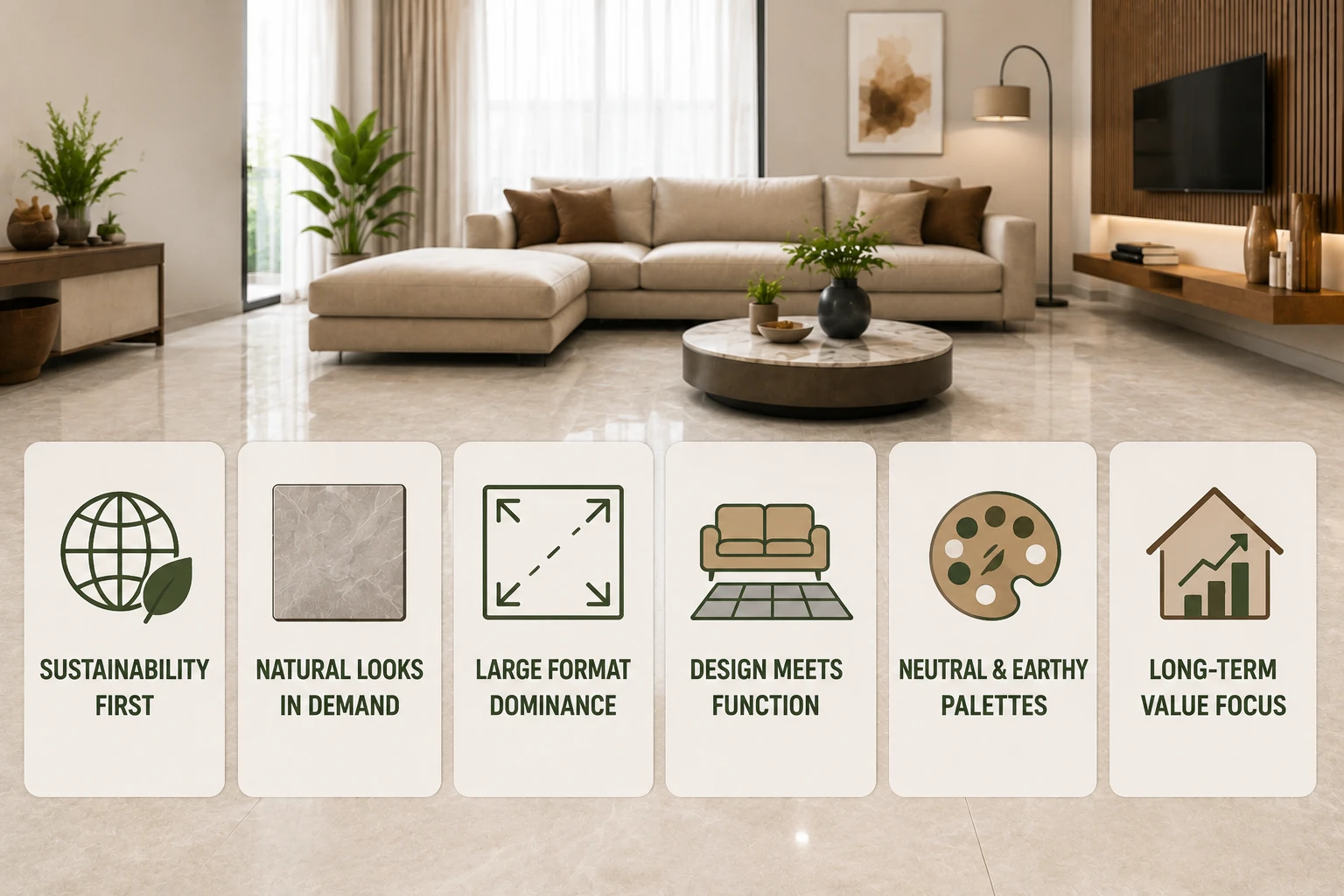
Three things changed how people think about tiles for their halls and drawing rooms.
First, open-plan living became more common in Indian flats. A larger shared space needs tiles that create a continuous, calm look rather than drawing attention to themselves. Architects designing open-plan layouts are specifying single tile types across the full floor area, connecting the living room, dining area, and passage without colour breaks.
Second, dust and smudge visibility became a real concern. High-gloss tiles show every footprint. People now choose matte finish and sugar finish tiles that look clean between mopping sessions and are safer underfoot.
Third, the market for large format tiles above 1200x600 mm grew rapidly from Morbi, Gujarat, making slab tiles that were once only for commercial projects accessible at prices between Rs. 100 and Rs. 250 per sq.ft for Indian homeowners.
Trending Living Room Tile Design Styles for 2026
1. Marble Look Tiles
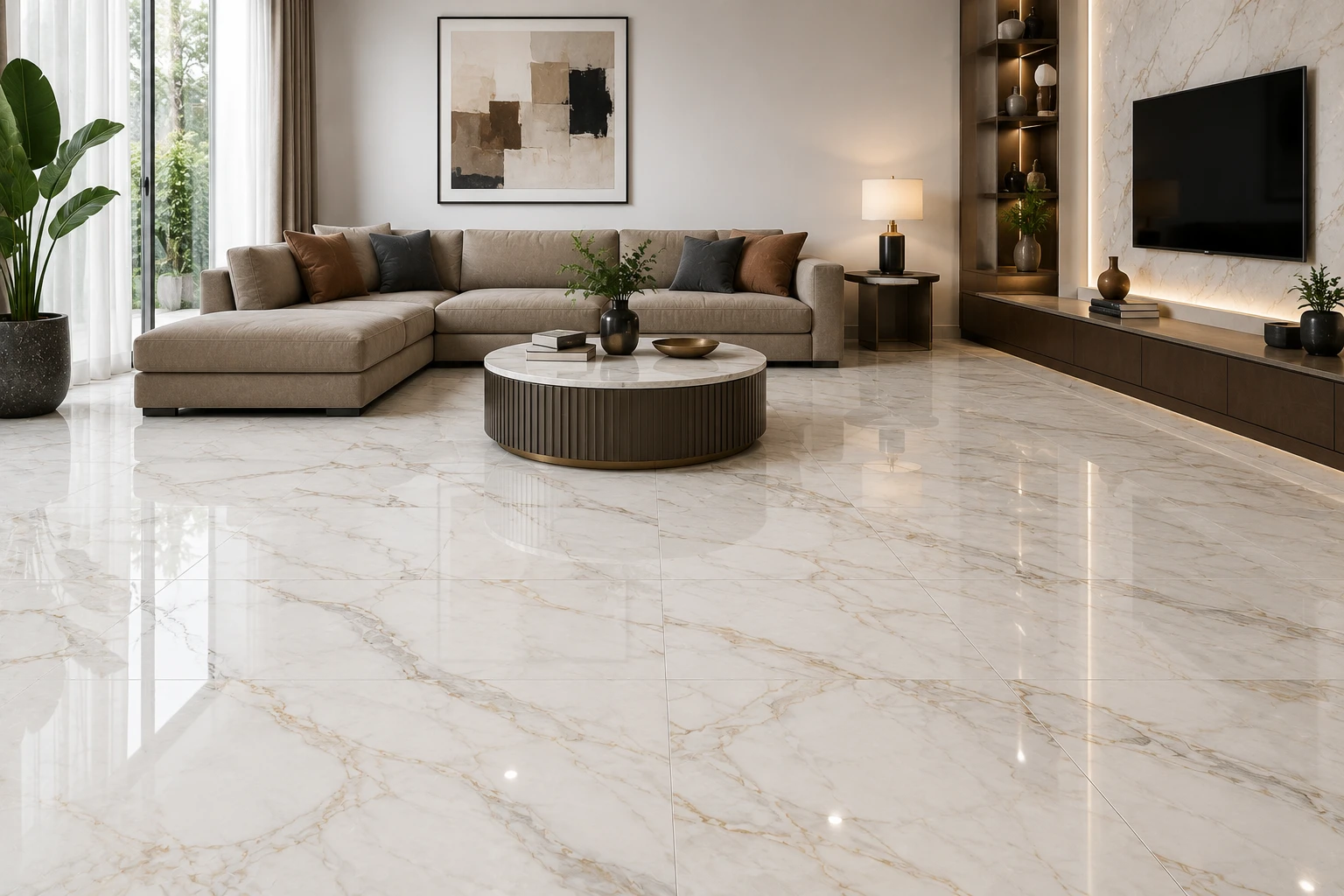
Marble look tiles in cream, ivory, warm white, and light grey remain the most searched living room tile design in 2026. These are GVT or PGVT tiles printed digitally to replicate natural marble veining, including Statuario, Calacatta, and Carrara patterns. The key advantage over real marble: water absorption stays below 0.08% as per IS 15622, which means no staining from spills, no sealing needed, and no risk of etching from household cleaners.
Available sizes range from 800x800 mm for standard rooms to 1200x2400 mm for luxury floor-to-ceiling book-match feature walls. A book-match layout mirrors the veining of two tiles placed side by side like an open book, creating a dramatic continuous pattern that architects use on TV unit walls and entryway panels.
Laying options: straight stack for a formal look, diagonal for smaller rooms to make them feel wider, or offset at 30% for a contemporary running-bond pattern. Prices run from Rs. 70 to Rs. 180 per sq.ft depending on the vein density and slab size. Buy all boxes from the same batch number to keep veining consistent across the floor.
Pro Tip: Pair white marble look PGVT floors with a warm beige or greige accent wall tile. The contrast stops the room from looking cold and clinical.
2. Wood Look Tiles
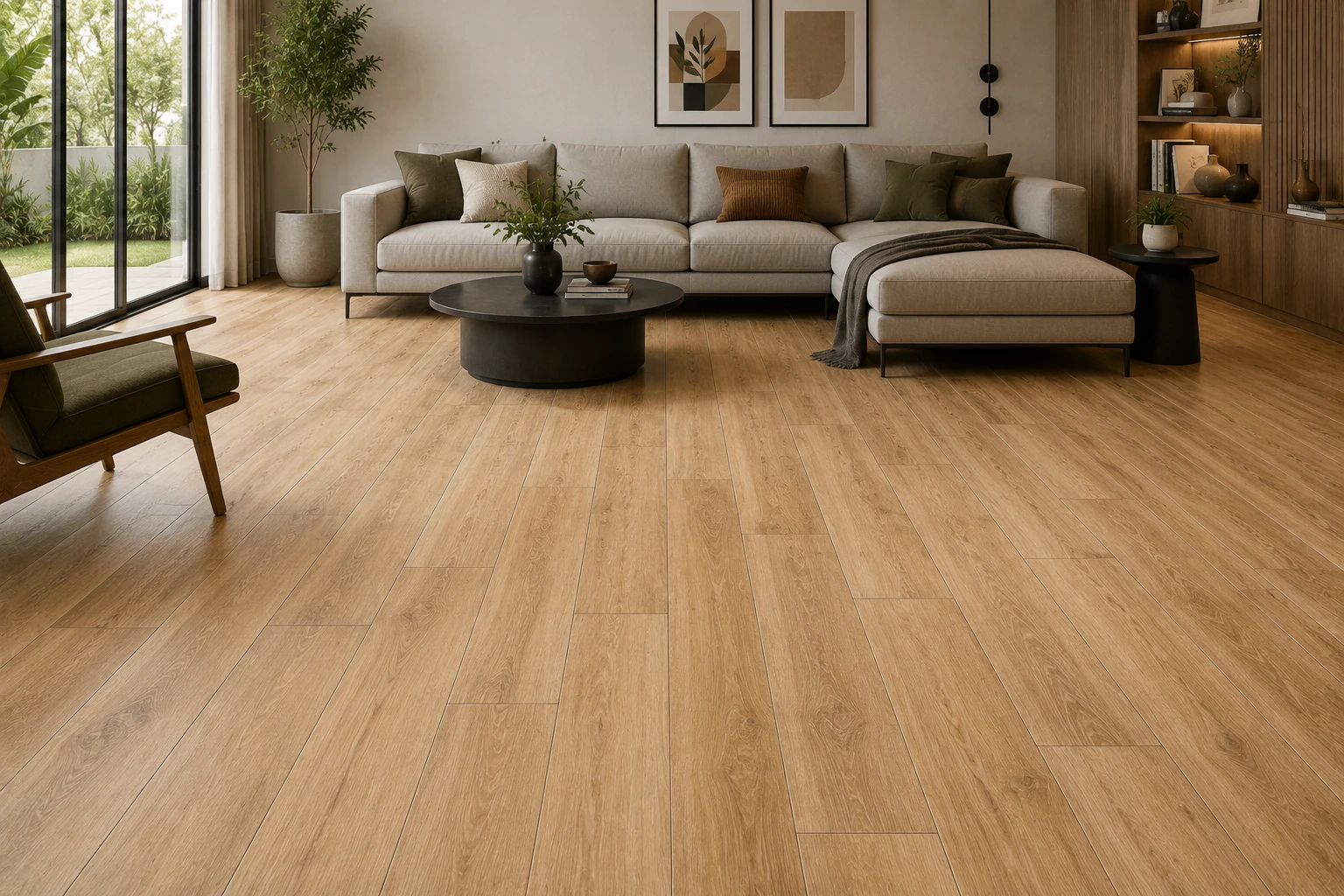
Wood look tiles have moved well beyond the bathroom shelf. In 2026, people are using them in the living room to bring warmth and a natural, lived-in feel without the upkeep of real wood. These are GVT tiles in rectangular plank formats: 200x1200 mm, 200x1000 mm, and 300x1200 mm are the most common sizes used in Indian living rooms.
The grain patterns now look far more realistic than earlier generations. You get options in walnut brown, honey teak, ash grey, whitewashed pine, and dark wenge tones. Water absorption in quality GVT wood look tiles sits below 0.5% as per IS 15622, which means they handle monsoon humidity without warping, unlike real wood floors.
Laying patterns make a big difference. A straight-lay pattern in the direction of natural light makes the room look longer. A herringbone pattern at 45 degrees creates a focal point on the floor and pairs well with neutral furniture. A Versailles pattern using two or three plank sizes adds a classic European look that architects specify in independent bungalows.
Prices start around Rs. 55 per sq.ft for standard ranges and go up to Rs. 130 per sq.ft for premium large-format wood look planks with embossed grain textures. Wood look tiles with a nano-coating on the surface need only dry mopping for daily upkeep.
Pro Tip: Use wood look tiles only on the floor. Repeating the same wood look on both the floor and walls in one room looks flat and heavy. Keep walls plain or use a complementary stone look tile on one accent panel.
3. Earthy Tone and Terracotta Tiles
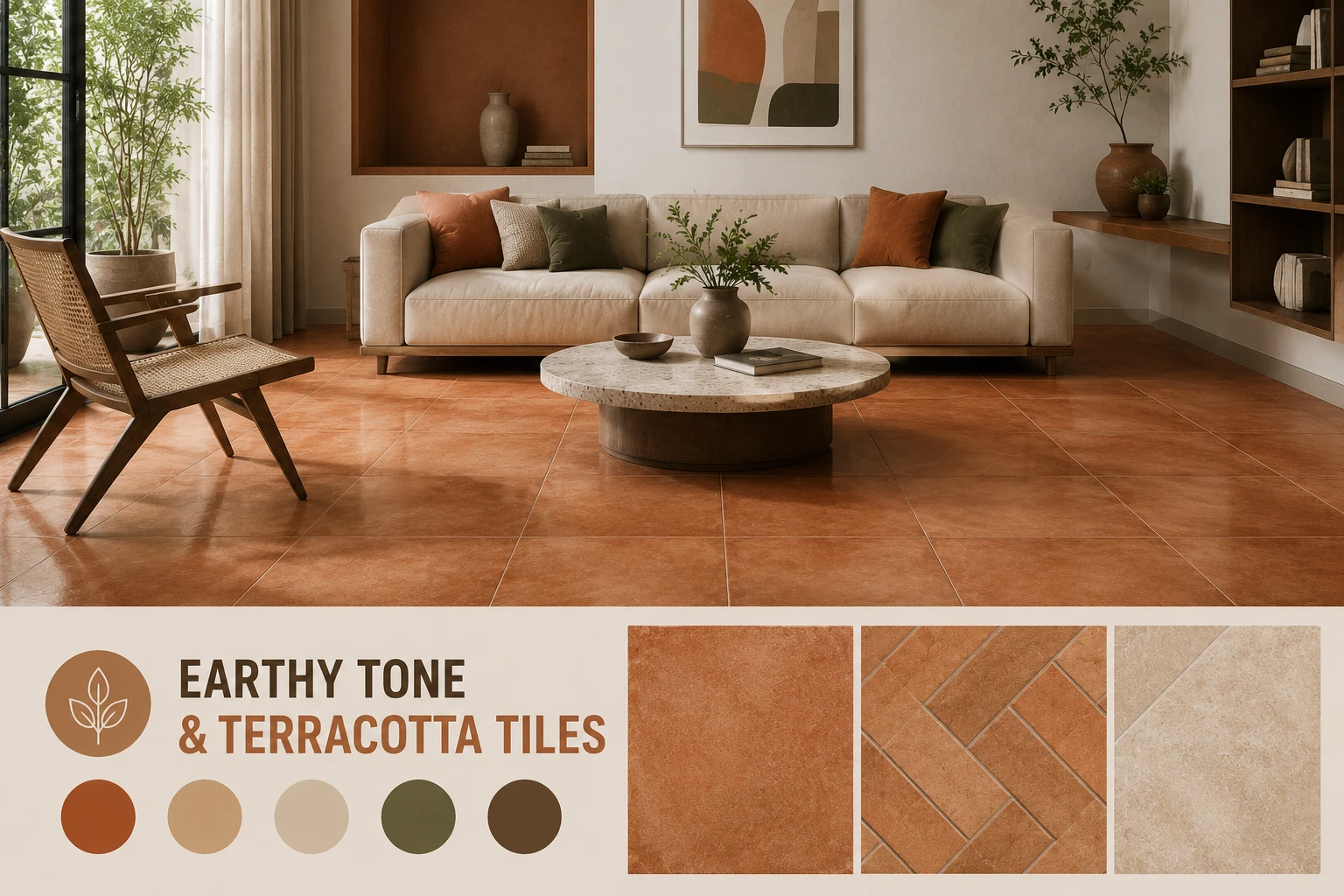
Warm earthy tones are the biggest colour shift of 2026. Terracotta, warm beige, ochre, clay-brown, and dusty rose tiles are replacing the cool whites and stark greys that dominated the past few years. This shift is driven partly by the Pantone colour direction toward warm, grounding tones and partly by what Indian homeowners actually want: surfaces that feel welcoming, hide dust in dry seasons, and do not show every scuff mark.
In Indian homes, terracotta-toned GVT tiles in matte finish work particularly well in living rooms that face west and receive strong afternoon sun. The warm tone absorbs the harsh light and makes the room feel comfortable rather than washed out. These tiles pair naturally with cane furniture, cotton dhurries, jute rugs, and brass accent pieces that are trending in Indian interiors.
For a balanced look, use earthy floor tiles in a mid-tone beige and choose one accent wall in a deeper terracotta or clay red. Sizes from 600x600 mm to 1200x1200 mm all work. Matte GVT tiles in these tones are priced between Rs. 50 and Rs. 120 per sq.ft.
Pro Tip: Avoid mixing more than two earthy tones in one room. One tone on the floor and one on the accent wall gives the room structure. More than two creates a muddy, unfocused look.
4. Large Format and Slab Tiles
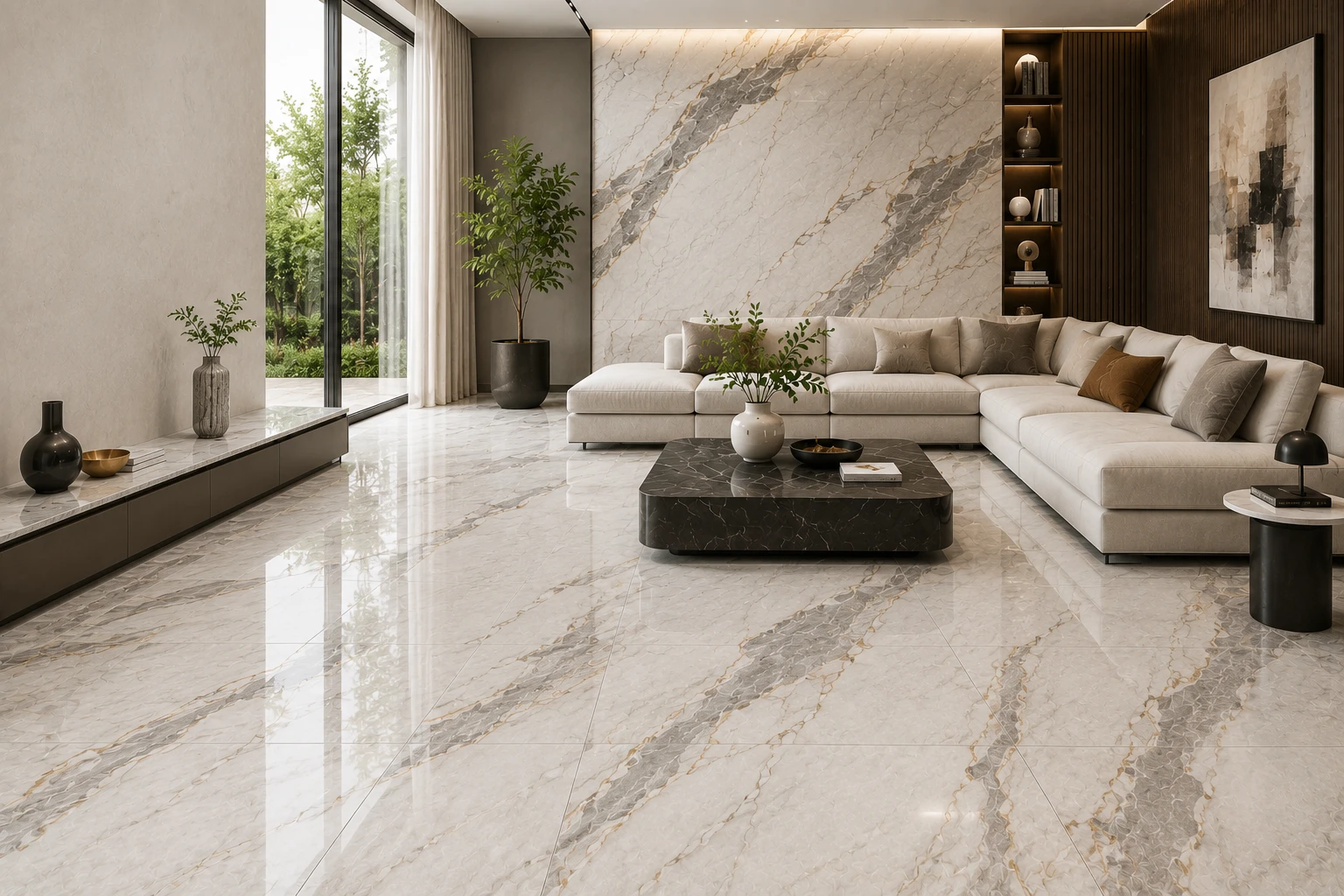
Large format tiles reduce the number of grout lines on a floor, which makes the space look bigger and easier to clean. A 1200x1200 mm tile on a 200 sq.ft floor has roughly 60% fewer grout joints than the same floor in 600x600 mm tiles. This matters in mid-size Indian flats where the living room is between 150 and 200 sq.ft.
In 2026, three distinct large format categories are being used in Indian living rooms. The first is the 800x800 mm to 1200x1200 mm range, which suits most new construction flats and works with standard screed floors. The second is 1200x1800 mm to 1200x2400 mm, which is a true slab tile used in luxury homes and high-end apartments. The third is book-match panels for walls, where two matched tiles of 1200x2400 mm are placed side by side so the veining pattern mirrors across both surfaces.
Large format PGVT tiles in marble and stone looks are the top choice for new construction projects in cities like Ahmedabad, Pune, Hyderabad, and Bengaluru. Prices range from Rs. 100 to Rs. 250 per sq.ft for floor slabs.
Note: Large format tiles above 1200x600 mm need a flat, well-prepared screed base. The floor surface must not vary by more than 3 mm over 3 metres. Lippage (visible tile edges at joints) is the most common complaint with large format tiles and is almost always caused by an uneven base, not a tile defect.
5. Fluted and 3D Textured Feature Wall Tiles
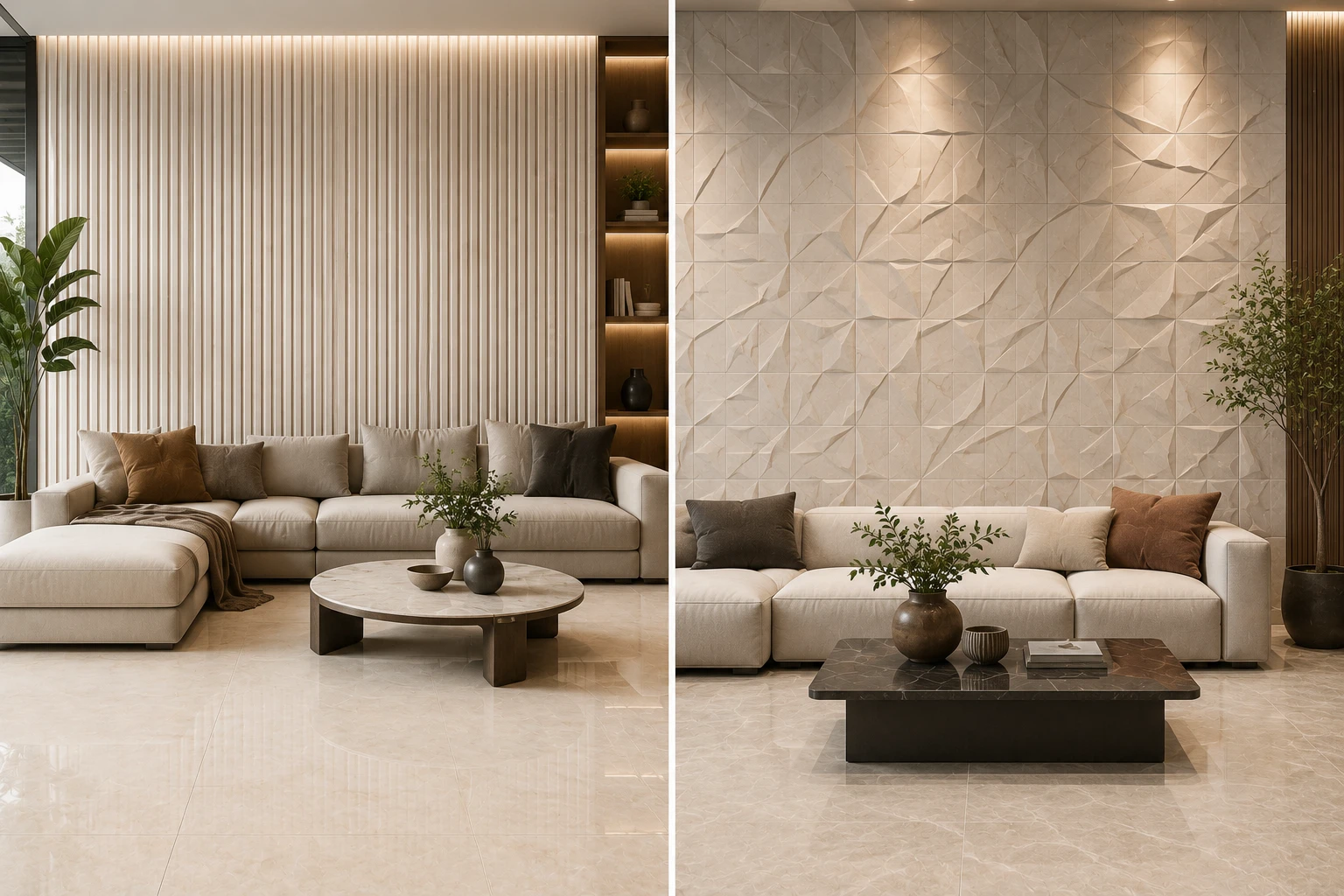
Fluted tiles, which have parallel vertical ridges on the surface, are the most visible wall tile trend in living rooms in 2026. The ridges interact with ambient light to create moving shadows throughout the day, giving the wall a sense of depth without adding colour or pattern.
These tiles are mostly used on the TV unit wall or behind the sofa. The most common sizes are 300x900 mm for narrow vertical strips and 600x1200 mm for full-panel coverage. Most fluted tiles in the Indian market are ceramic or GVT wall tiles with water absorption between 3% and 10% as per IS 13630, which means they are rated for walls only.
3D textured tiles with geometric reliefs, wave patterns, and carved stone surfaces are the next step up. These are used in boutique hotel lobbies and luxury home living rooms. Carving depth ranges from 3 mm to 12 mm. Deeper carvings create stronger shadow lines and work best in rooms with focused directional lighting. Prices for 3D textured wall tiles start at Rs. 80 per sq.ft and go up to Rs. 250 per sq.ft for hand-finished relief tiles.
Note: Fluted and 3D wall tiles must not be used on floors. The ridged surface traps grit, is difficult to clean underfoot, and will chip under load.
Pro Tip: If using fluted tiles on a full-height TV wall, run the flutes vertically. This draws the eye upward and makes the ceiling feel higher. Horizontal flutes work better on low, wide panels like a console wall or half-height dado.
6. Terrazzo and Geometric Pattern Tiles
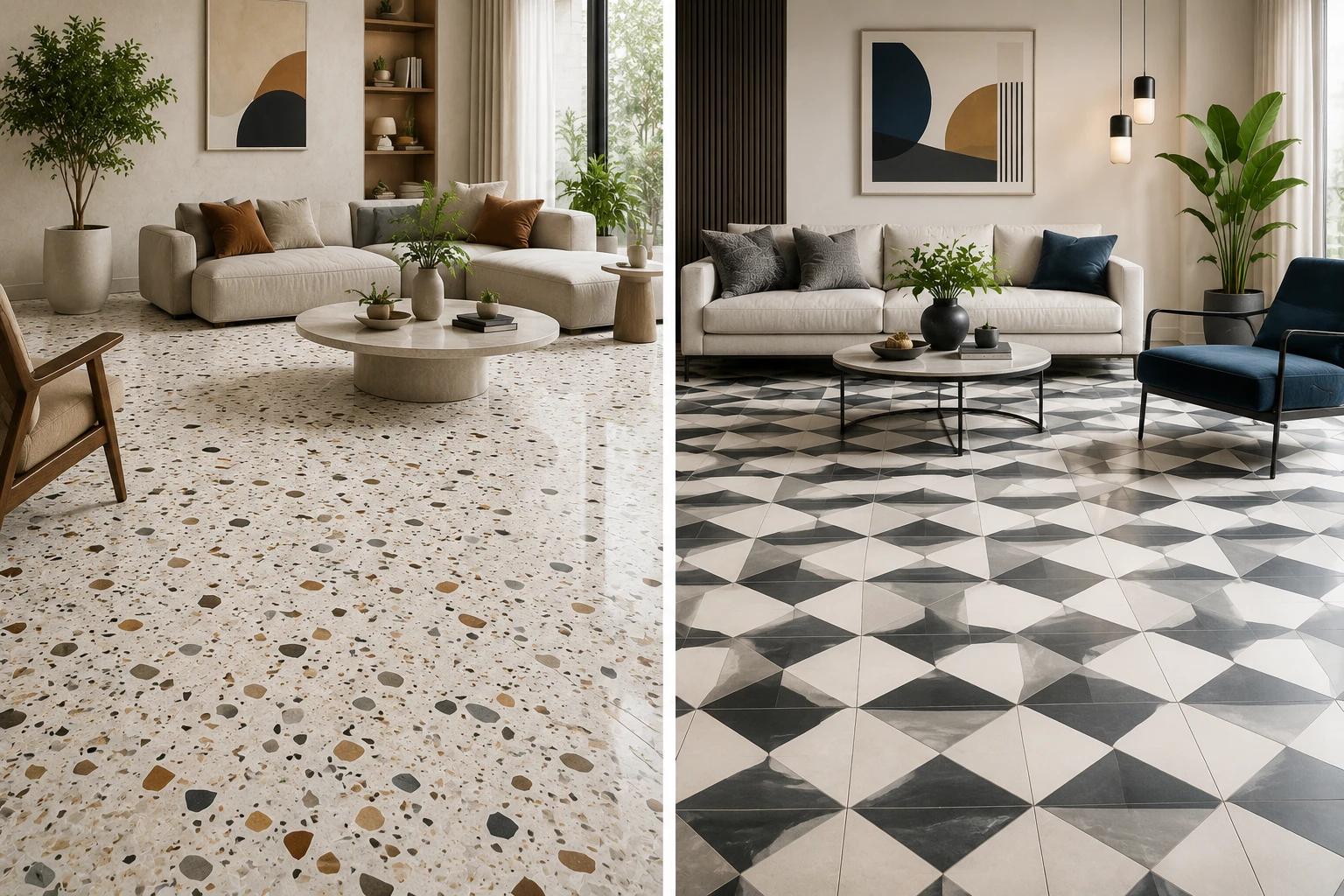
Terrazzo-look tiles with embedded chips in muted, earthy tones are gaining steady ground in 2026. The chips can be large and bold in primary colours for a retro 1970s feel, or small and muted in cream, grey, and beige for a restrained, contemporary look. The second style is what architects are specifying most in Indian projects this year.
Terrazzo GVT tiles come in 600x600 mm and 800x800 mm sizes and work well as floor tiles in rooms with neutral furniture. Avoid using bold multicolour terrazzo across an entire floor: it works better as an entry zone tile, a carpet tile insert, or a feature strip within a plain floor.
Geometric pattern tiles in hexagon, arabesque, and herringbone formats are being used as TV wall accent panels, foyer floors, and bathroom-adjacent transition zones. Large hexagon tiles in matte black or dark grey on a white wall create a graphic look that architects use in contemporary living rooms with industrial accents.
Pro Tip: Use terrazzo tiles only in a defined zone, such as the area under the centre table. Border it with a plain tile in a matching tone. A full floor in terrazzo becomes visually busy and makes furniture placement harder.
7. Stone Look and Concrete Look Tiles
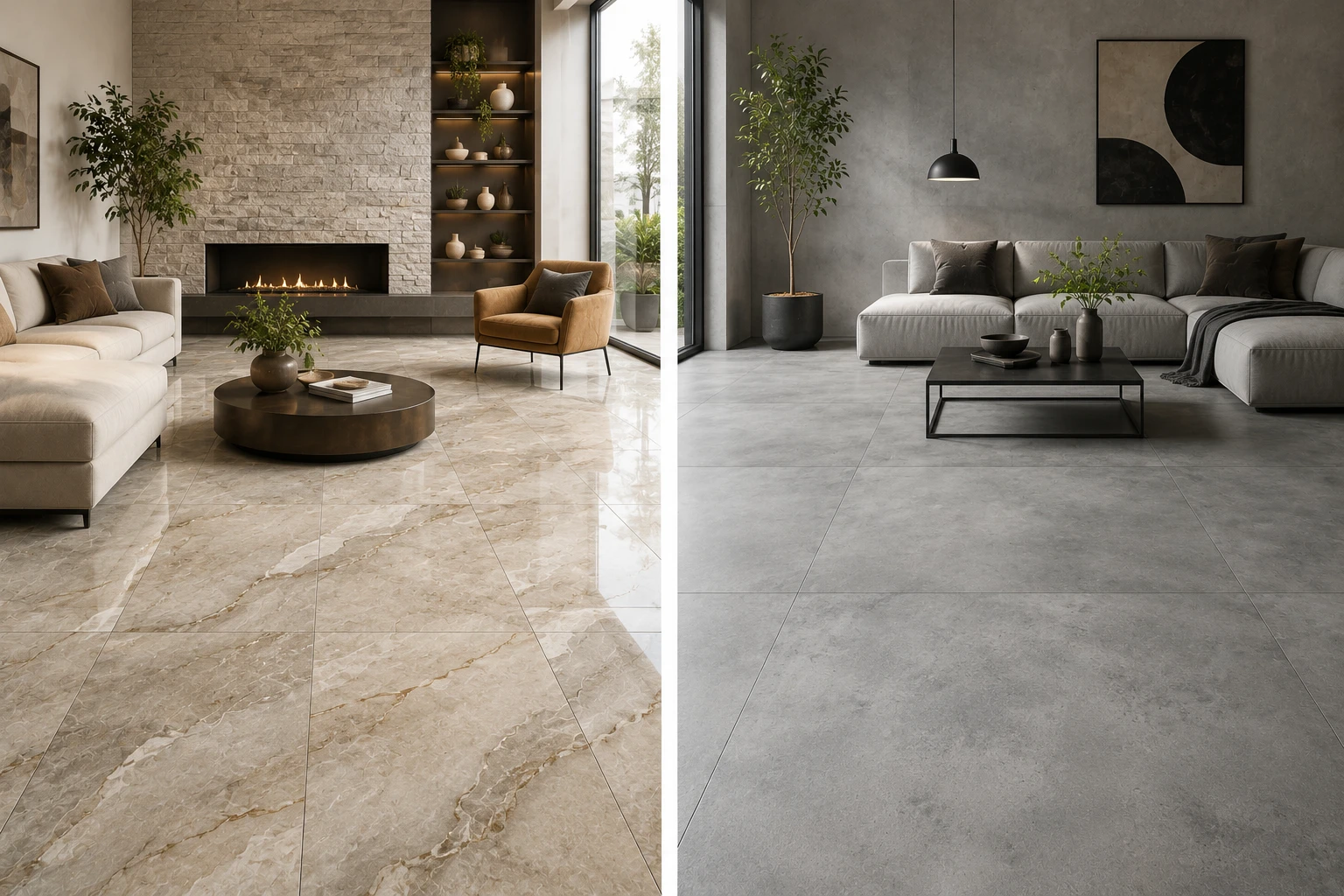
Stone look tiles replicating sandstone, slate, basalt, and travertine are being used in living rooms that want a natural, outdoor-indoor connection. These GVT tiles have a low-sheen matte surface with subtle texture variation that gives them an organic, hand-finished look. Sizes in 600x600 mm and 600x1200 mm work well for floors.
Concrete look tiles in warm grey, off-white, and light brown are the choice for industrial and minimalist living rooms. They carry almost no pattern variation across the surface, which makes the room feel very calm and neutral. Architects designing open-plan homes use concrete look GVT tiles across the full ground floor of villas and independent houses to create a unified look from the entrance through to the kitchen.
Prices for stone and concrete GVT tiles range from Rs. 55 to Rs. 140 per sq.ft depending on size and surface texture depth.
Tile Types for Living Room Floors: Comparison Table
The tile market in India offers five main categories for living room use. This comparison is based on IS 15622 and IS 13630 specifications:
| Tile Type | Water Absorption | Best Areas | Price (Rs./sq.ft) | Finishes | IS Standard |
| PGVT | Below 0.08% | Living room floor, walls | Rs. 60 to Rs. 150 | Polished, lappato | IS 15622 |
| GVT | Below 0.5% | Living room, bedroom | Rs. 45 to Rs. 120 | Matte, satin, sugar, GHR | IS 15622 |
| Full Body Vitrified | Below 0.05% | High-traffic halls, commercial | Rs. 80 to Rs. 180 | Polished, matte | IS 15622 |
| Double Charge Vitrified | Below 0.08% | Heavy-traffic living areas | Rs. 55 to Rs. 130 | Polished only | IS 15622 |
| Ceramic (wall) | 10% to 20% | Accent walls only | Rs. 25 to Rs. 70 | Glossy, matte, textured | IS 13630 |
For most Indian living rooms, GVT tiles in matte or satin finish cover the widest range of needs. Our living room tiles guide explains these finishes and room-wise applications in more detail. If the hall sees heavy foot traffic or has children, full body vitrified tiles with a PEI rating of 4 or 5 are a better pick. Use PGVT for formal drawing rooms where the visual finish matters more than scratch resistance.
Size Guide: Floor Tiles and Wall Tiles for Living Rooms
Floor Tile Sizes
Tile size affects how large or small the room looks. Use this reference for living room floors in Indian homes:
| Floor Tile Size | Best For (Room Area) | Visual Effect | Price Range | Recommended Tile |
| 600x600 mm | Small rooms under 100 sq.ft | Neat, compact feel | Rs. 45 to Rs. 90 | GVT matte |
| 800x800 mm | Medium rooms 100 to 180 sq.ft | Open, spacious look | Rs. 60 to Rs. 120 | GVT / PGVT |
| 1200x600 mm | Rectangular halls 120 to 200 sq.ft | Long, flowing lines | Rs. 70 to Rs. 140 | PGVT / GVT |
| 1200x1800 mm | Large rooms 180 to 300 sq.ft | Minimal grout, seamless floor | Rs. 100 to Rs. 180 | Full body / PGVT |
| 1200x2400 mm | Luxury rooms 250 sq.ft+ | Large slab, near-seamless | Rs. 130 to Rs. 250 | PGVT large slab |
| 200x1200 mm (plank) | Wood-look floor, any size room | Timber plank impression | Rs. 55 to Rs. 130 | GVT wood look |
For rooms under 120 sq.ft, stick to 600x600 mm or 800x800 mm. Going larger in a small room makes grout lines disappear but creates more edge cuts at the perimeter walls, increasing wastage. Plan for 12 to 15% wastage when cutting 1200x1200 mm tiles in irregular room shapes.
Wall Tile Sizes
Living room wall tiles follow different rules from floor tiles. The size depends on whether you are covering a full wall or a feature panel. Refer to this guide:
| Wall Tile Size | Best Application | Visual Effect | Price Range | Tile Type |
| 300x450 mm | Small accent sections, borders | Defined, patterned look | Rs. 30 to Rs. 70 | Ceramic / GVT |
| 300x600 mm | Fluted panels, vertical feature strips | Tall, architectural feel | Rs. 40 to Rs. 90 | Ceramic fluted |
| 600x600 mm | Full accent wall behind sofa or TV | Balanced, classic grid | Rs. 45 to Rs. 110 | GVT / PGVT |
| 600x1200 mm | TV unit feature wall, full-height panel | Tall, dramatic, modern | Rs. 60 to Rs. 150 | GVT / PGVT |
| 800x1600 mm | Statement wall in large living rooms | Large slab, luxurious | Rs. 90 to Rs. 200 | PGVT large slab |
| 1200x2400 mm | Floor-to-ceiling book-match feature wall | Seamless marble or stone look | Rs. 150 to Rs. 280 | PGVT book-match |
Note: Tiles above 800x1600 mm on walls need metal or concealed bracket fixing systems in addition to adhesive. Standard cement mortar is not strong enough to hold large wall slabs. Confirm the fixing method with your contractor before ordering.
For TV unit feature walls, 600x1200 mm is the most practical size. It gives the wall a tall, modern look without the structural complexity of very large slabs. For full-height walls in rooms with 10-foot ceilings, 600x1200 mm tiles laid vertically with minimal grout lines give a clean, continuous surface.
Finish Guide: All Options Used in Living Rooms in India
The finish determines how the tile surface looks, how it feels underfoot, how much maintenance it needs, and which setting it suits best. Here is a complete breakdown of all finishes used in living room applications in 2026:
| Finish | Sheen Level | Best Use in the Living Room | Dust / Footprint Visibility | Who Uses It | Price Premium |
| Full Polish | Very high | Formal drawing rooms | High | Homeowners wanting luxury look | Standard |
| Lappato | Medium-high | Living room floor, feature wall | Medium | Architects, premium home buyers | +10 to 15% |
| Satin Matte | Very low | Minimalist living rooms | Very low | Interior designers, architects | +5 to 10% |
| Matte | None | Family halls, daily-use rooms | Very low | Families, practical buyers | Standard |
| Sugar / GHR | Low-medium | Floor + partial wall combo | Low | Mid-segment homeowners | Standard |
| Carving / Relief | Varies by cut | TV wall, accent panel | Low on recessed areas | Boutique hotels, luxury homes | +20 to 30% |
| Metallic / Mirror Gloss | Very high | Feature wall accent strips | High | Commercial, high-end residential | +25 to 40% |
| Honed / Bush-hammered | Very low | Industrial-style living rooms | Low | Architects, contemporary projects | +15 to 25% |
Finish Details for Each Option
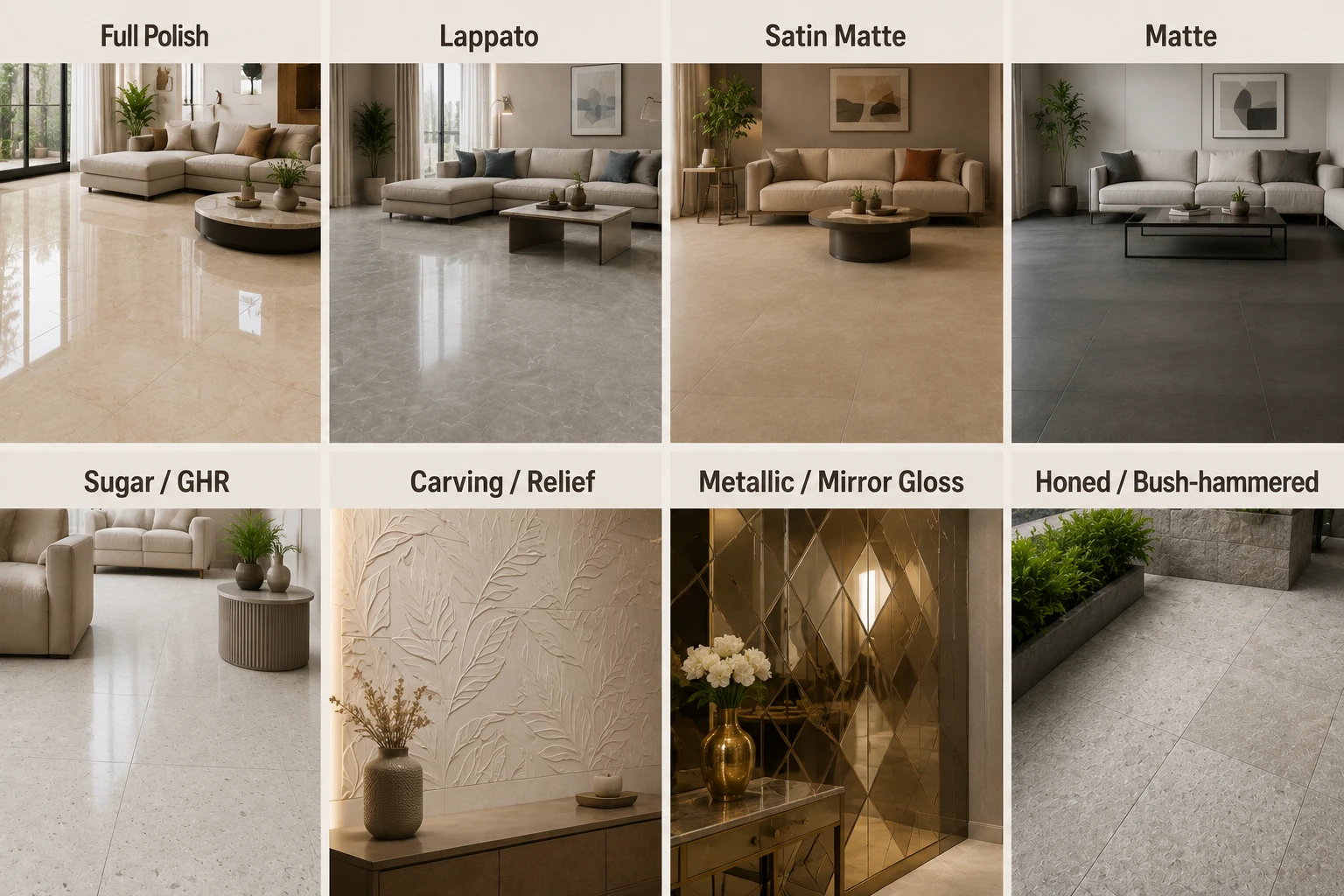
Full Polish: The surface is ground and polished to a mirror-like shine. Light reflects strongly, which makes the room feel brighter. Downside: every footprint and smudge is visible. Needs frequent wet mopping. Slippery when wet. Use only in formal drawing rooms with controlled foot traffic.
Lappato: A semi-polished surface created by partially honing the tile after firing. The result is a soft, satiny sheen, brighter than matte but not as reflective as full polish. Dust and footprints are less visible than on polished tiles. Architects specify lappato for living rooms where the client wants the look of marble without the maintenance of full polish. Prices run 10 to 15% above standard polish.
Satin Matte: Very flat, almost zero sheen. The surface has a soft, powdery quality. It is the cleanest-looking finish for minimalist living rooms. Satin matte hides dust and footprints very well. Interior designers specify it most often for earthy-tone and stone-look tiles in contemporary Indian homes. Prices run 5 to 10% above standard matte.
Matte: No sheen, smooth surface. The most practical finish for family living rooms. Hides dust and footprints well. Comfortable underfoot. Easy to mop. Works with almost any tile design. The most common finish in the GVT category.
Sugar / GHR (Glossy High Relief): A textured surface with gentle raised patterns and moderate gloss. More grip than polished, better dust tolerance than full gloss. The middle-ground finish that mid-segment homeowners choose when they want some shine without the maintenance of full polish. Good for combination floor and partial wall use.
Carving / Relief: The tile surface is mechanically carved or pressed with geometric or organic patterns. The 3D depth ranges from 3 mm to 12 mm. Used mainly on accent walls and TV unit panels. Light and shadow play across the surface as ambient lighting changes through the day. Boutique hotels and luxury residential projects use this finish to create surfaces that look different at different times of day. Prices run 20 to 30% above flat tiles in the same category.
Metallic / Mirror Gloss: Tiles with metallic pigments in the glaze or a very high mirror-like gloss finish. These are used as accent strips or inlay bands within a plain wall rather than as full-surface tiles. Too much metallic finish on one wall creates visual noise. Architects use one or two rows of metallic tiles as a feature element within a larger plain tile application.
Honed / Bush-hammered: The tile surface is mechanically abraded to create a flat, rough texture. No gloss whatsoever. The effect is close to hand-cut stone. Architects working on industrial-style, contemporary, or Japandi-influenced living rooms specify this finish for its raw, honest quality. Works best in rooms with natural light from multiple directions, which reveals the surface texture.
Note: Polished, lappato, and metallic finishes are slippery when wet. Never use these as floor tiles in areas where water exposure is possible, such as rooms adjoining open balconies or entry lobbies exposed to rain splash.
Feature Wall Tiles: TV Unit and Accent Panel Ideas
A feature wall behind the TV unit or sofa is the fastest way to change the character of a living room without full renovation. You can also explore more hall tiles ideas for modern Indian interiors. The right wall tile does this without paint, cladding, or wallpaper.
Marble look PGVT tiles in book-match layout give a luxurious panel. Two tiles are placed side by side with veining mirrored across both surfaces. This works best with large slab sizes: 1200x2400 mm for a floor-to-ceiling TV wall, or 600x1200 mm for a panel up to 8 feet high.
Fluted GVT tiles in warm grey or cream give a textured backdrop without colour distraction. Dark charcoal or deep olive GVT wall tiles in 600x1200 mm create strong contrast against light-coloured sofas and beige floor tiles.
Keep feature walls to one surface only. Two or more accent walls in the same room compete with each other and make the space feel heavy and unfocused.
Pro Tip: The feature wall tile should be at least 30% darker or lighter than the floor tile to create separation. If both are the same tone, the wall disappears into the floor and the feature wall effect is lost.
Expert Recommendations: What Architects and Interior Designers Choose
In 2026, the choices architects and interior designers make for living room tiles in India follow some clear patterns. These recommendations come from projects across Ahmedabad, Mumbai, Bengaluru, Pune, and Hyderabad.
For Family Homes and Daily-Use Living Rooms
Specification: GVT tiles in matte or satin matte finish, 800x800 mm or 1200x600 mm. Earthy tones: warm beige, clay grey, or off-white. One feature wall in a fluted ceramic tile, 300x900 mm, behind the TV unit. Grout in a matching tone to minimise joint visibility. Budget: Rs. 70 to Rs. 120 per sq.ft for floor tiles, Rs. 40 to Rs. 80 per sq.ft for the feature wall.
Architects choose matte GVT over polished for family living rooms because it performs consistently after 5 to 10 years of daily use. Polished tiles dull with foot traffic and micro-scratches over time. Matte tiles look the same at year 10 as they did at year 1.
For Formal Drawing Rooms and Independent Homes
Specification: PGVT marble look tiles in full polish or lappato finish, 1200x1200 mm or 1200x1800 mm. White or ivory Calacatta-pattern floor tiles with a matching book-match feature wall in 1200x2400 mm. Grout in white or near-white to keep the look seamless. Budget: Rs. 130 to Rs. 220 per sq.ft for floor tiles, Rs. 150 to Rs. 280 per sq.ft for the book-match wall panels.
Interior designers working on formal drawing rooms and villa projects specify large slab PGVT because clients want a luxury look that reads well in photographs and holds its visual impact over time. Lappato finish over full polish is increasingly preferred because it shows less wear and needs less frequent cleaning.
For Contemporary and Minimalist Living Rooms
Specification: Concrete look or stone look GVT tiles in satin matte or honed finish, 1200x600 mm or 1200x1200 mm. Warm grey or taupe floor. One accent wall in a darker grey concrete look tile to add depth. No decorative pattern on the floor, clean straight joints. Budget: Rs. 80 to Rs. 140 per sq.ft for floor tiles.
Architects designing open-plan homes for young professionals are specifying concrete look and stone look matte GVT tiles because they work across all the interconnected spaces: living room, dining area, kitchen, and passage, without needing a tile break at every threshold.
For Open-Plan Layouts with Continuous Flooring
Specification: Single tile type across the full ground floor. Large format matte GVT or full body vitrified tiles in 1200x1200 mm or 1200x600 mm. Colour: warm neutral, typically a greige or warm grey. Grout: same tone as tile for a monolithic look. The same tile continues from the entrance lobby through the living and dining area to the kitchen boundary. Budget: Rs. 90 to Rs. 160 per sq.ft including wastage.
Continuous flooring without tile breaks makes open-plan spaces feel larger and reduces visual noise. Architects specify rectified tiles (tiles cut to exact dimensions within 0.5 mm tolerance) for this application because tight 1.5 mm grout lines are only achievable with rectified tiles. Standard non-rectified tiles need 3 to 5 mm grout joints, which break the seamless effect.
For Luxury and High-End Projects
Specification: Full body vitrified tiles in polished finish for floors, 800x800 mm to 1200x1200 mm. Book-match PGVT slabs in 1200x2400 mm for the feature wall. Carving or relief tiles for one accent strip or niche. Metallic tile inlay band at the junction of floor and feature wall. Concealed LED lighting behind the book-match wall panel. Budget: Rs. 180 to Rs. 300 per sq.ft for floors, Rs. 200 to Rs. 400 per sq.ft for feature wall and accents.
High-end residential and boutique hotel projects in India are using a layered material approach: plain polished floor, book-matched marble wall, textured relief niche, and metallic accent band. Each layer has a different finish so the room has visual richness without needing decorative furniture to fill the space.
Pro Tip from Architects: Always specify tiles from a single production batch for the full project area. Batch shade variation is the most common complaint on completed projects. Order 12 to 15% extra for cuts and keep a few boxes in reserve for future repairs.
Living Room Tile Price Guide for India 2026
Price varies by category, brand, finish, and size. These are indicative market ranges. Prices vary by region, brand, and purchase volume.
- Ceramic wall tiles for accent panels: Rs. 25 to Rs. 70 per sq.ft
- GVT tiles in standard sizes (600x600, 800x800 mm): Rs. 45 to Rs. 120 per sq.ft
- PGVT tiles in marble look (800x800 to 1200x1200 mm): Rs. 70 to Rs. 180 per sq.ft
- Full body vitrified tiles: Rs. 80 to Rs. 180 per sq.ft
- Large slab tiles (1200x1800 mm and above): Rs. 130 to Rs. 250 per sq.ft
- Fluted and 3D textured wall tiles: Rs. 80 to Rs. 250 per sq.ft
- Lappato and satin matte premium finish: 10 to 15% above standard price
- Relief and carving finish tiles: 20 to 30% above standard price
Laying charges in India in 2026 run from Rs. 30 to Rs. 50 per sq.ft for standard sizes. Large format tiles above 1200x600 mm cost Rs. 50 to Rs. 80 per sq.ft for laying. Budget an extra 10 to 12% of tile quantity for cutting wastage on standard layouts, and 15% for diagonal or herringbone patterns.
How to Choose Living Room Tiles: Buyer Checklist
- Measure the room length and width. Add 10 to 15% to the total area for wastage.
- Check traffic level: heavy family hall needs PEI 4 or 5. Formal drawing room can use PEI 3.
- Choose finish: matte for daily family use, lappato for formal rooms, satin matte for minimalist spaces.
- Match tile size to room: 800x800 mm for under 180 sq.ft, 1200x1200 mm or larger for bigger rooms.
- Check the IS standard: IS 15622 for vitrified and GVT tiles, IS 13630 for ceramic tiles.
- Verify the base: floor flatness must be within 3 mm over 3 metres for large format tiles.
- Specify batch numbers: order all tiles from one batch to avoid shade variation.
- Ask for rectified tiles if you want tight 1.5 mm grout joints in a large format layout.
- Buy 5% extra from the same batch and store for repairs. Discontinued tile series are difficult to match later.
Final Thoughts
The living room tile market in India in 2026 gives buyers more choice than ever before. Large format slabs, earthy tones, matte and lappato finishes, fluted feature walls, and a wider range of surface textures are the defining directions this year.
Architects and interior designers are moving toward single-material continuous floors, tactile wall finishes, and book-match feature panels that create high visual impact without pattern complexity. Buy tiles that meet IS 15622 for floors, check water absorption and PEI ratings before laying, and always specify batch numbers.
Browse the full range of living room tiles on Tilesfinders to compare sizes, finishes, and designs before you decide.
FAQs
PGVT and GVT tiles are the most widely used choice for living room floors in India in 2026. PGVT gives a polished finish with water absorption below 0.08% as per IS 15622. For high-traffic halls, full body vitrified tiles with absorption below 0.05% last longer and resist surface wear better. Prices range from Rs. 60 to Rs. 180 per sq.ft depending on size and finish.
For rooms between 150 and 200 sq.ft, 800x800 mm or 1200x600 mm tiles give a spacious look. For larger living rooms above 200 sq.ft, 1200x1200 mm or 1200x1800 mm tiles reduce grout lines and make the floor look continuous. For wall applications, 600x1200 mm is the most common size for TV unit feature walls. Always add 10% extra tiles for cutting wastage.
Yes. Matte finish tiles hide footprints, dust, and light scratches better than polished tiles. They also grip better underfoot. In Indian homes where family members walk barefoot, matte GVT or sugar finish tiles rated R9 or above are a practical choice. Architects working on family homes mostly specify matte or satin matte over polished for floor areas.
Living room tile costs vary by type. Ceramic wall tiles start from Rs. 25 per sq.ft. Mid-range GVT tiles run Rs. 45 to Rs. 120 per sq.ft. PGVT tiles in large format sizes cost Rs. 80 to Rs. 180 per sq.ft. For a 200 sq.ft living room, the total tile and laying cost typically falls between Rs. 18,000 and Rs. 40,000 depending on size and finish chosen.
Yes, with one condition. The tile must meet floor-grade strength with a PEI rating of 3 or above and water absorption below 0.5% as per IS 15622. Many GVT and PGVT tiles in 1200x600 mm and 800x800 mm sizes work on both surfaces. Do not use wall-only ceramic tiles on floors because they scratch and chip under foot traffic.
Warm earthy tones lead in 2026: cream, beige, warm grey, terracotta, and off-white. Marble-look tiles in white and ivory remain popular for a clean drawing room look. For accent walls, dark tones like charcoal grey and deep olive green are used in single-wall applications to add depth. Architects are pairing these darker wall tiles with warm-toned matte floor tiles.
A feature wall tile goes on one wall of the living room to create a visual focal point, usually behind the TV unit or sofa. Fluted GVT tiles, 3D textured tiles, and large slab marble-look tiles in 1200x600 mm or 600x1200 mm work well. Keep the remaining three walls plain so the feature wall stands out. Architects recommend using a tile at least 30% darker or lighter than the floor tile on the feature wall.
Interior designers and architects in India mostly specify lappato or satin matte finish for living room floors in 2026. Lappato gives a soft sheen that photographs well and does not show every smudge. Satin matte is preferred for minimalist interiors with warm earthy tones. Full polish is chosen mainly for formal drawing rooms in bungalows or independent homes where foot traffic is controlled.
