Italian vs Indian Marble Tiles: Which Should You Choose?
May 23, 2026 66
The ultimate marble showdown. Compare Italian and Indian marble on hardness, 2026 pricing, and climate suitability. Learn the smart "mixed strategy" architects use for Indian homes.
Every homeowner planning marble flooring in India faces the same question at some point. Italian marble looks extraordinary. Indian marble costs a fraction of it and lasts longer in daily use. Both are natural stones. Both are beautiful. The choice between them is not obvious until you understand what each one actually does to your floors, your maintenance calendar, and your budget over ten years.
The wrong choice is expensive. Italian marble laid in a high-traffic family kitchen will stain, etch, and dull within two years. Indian marble used as a living room statement wall will not carry the same prestige as a Statuario slab, no matter how well it is polished. These two materials have very different strengths, and placing them in the wrong rooms costs money and creates regret.
This guide compares both types of marble tiles honestly, covers the specific varieties within each category, maps them to rooms and usage types in Indian homes, and gives you a clear framework to decide which one belongs where in your home.
Why This Comparison Matters for Indian Homeowners
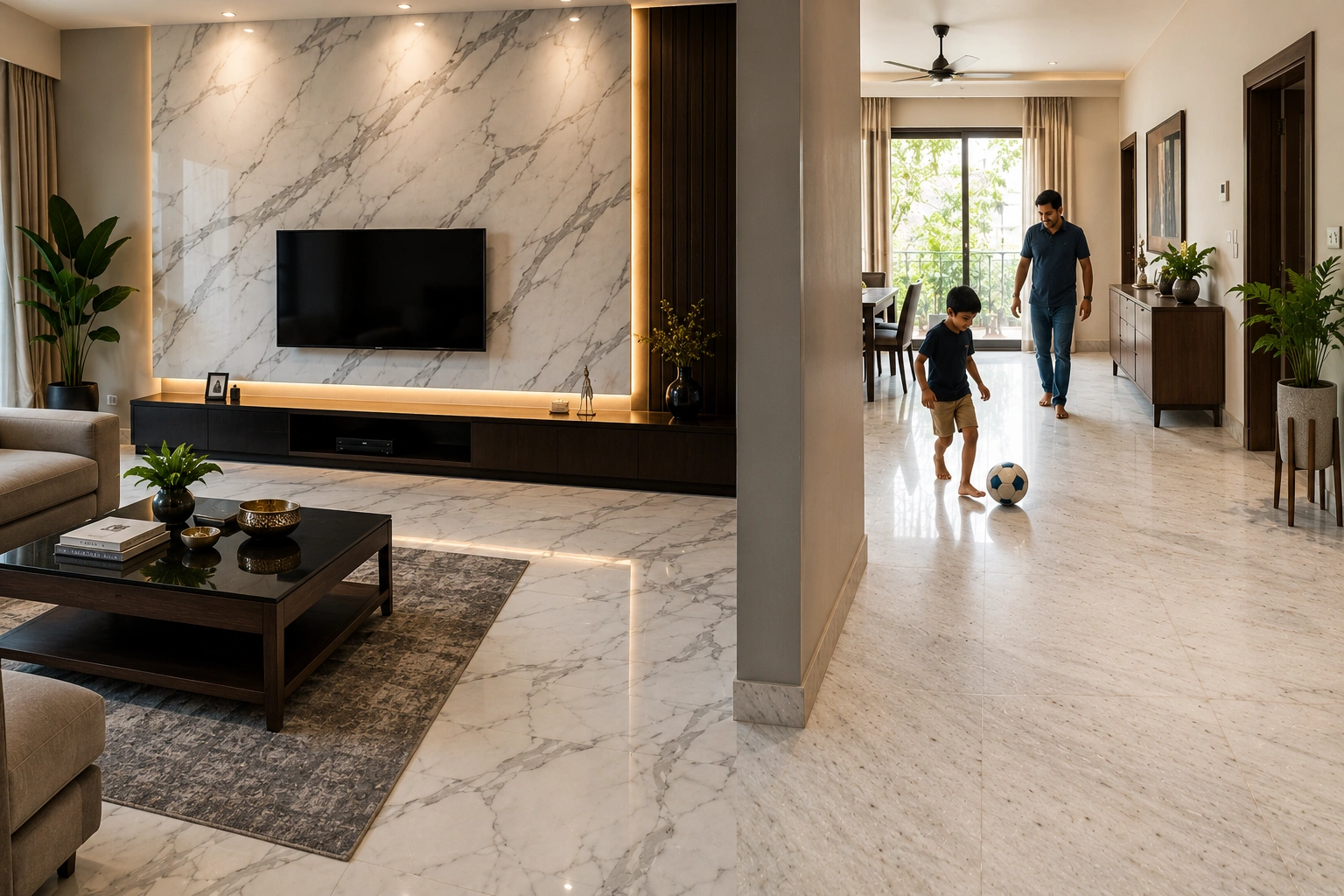
India is one of the largest marble-producing and marble-consuming markets in the world. Kishangarh in Rajasthan is among the biggest marble trading hubs globally. The same market sells Indian marble quarried locally and Italian marble imported from Carrara, Verona, and Sicily. Both sit in the same showroom, sometimes at very different price points, sometimes at surprisingly similar ones.
Indian homes have specific challenges that affect this decision. Monsoon humidity in Mumbai and Kochi. Extreme summer heat in Rajasthan and Gujarat. Hard water in Delhi and Jaipur. Joint families with children, frequent guests, and daily puja routines in the living room. These are not conditions that any marble handles equally well.
Italian marble, being softer and more porous, absorbs moisture and stains more easily. In coastal cities with salt air and high humidity, unsealed Italian marble deteriorates faster than in the controlled environments of European interiors for which it was originally quarried. Indian marble, being denser and harder, handles heat, humidity, and heavy foot traffic significantly better, which is one reason the Taj Mahal in Agra has stood for nearly four centuries using Makrana marble.
The decision is not about which marble is better. It is about which marble belongs in which room, in which city, for which household. Homeowners comparing marble flooring should also understand the broader differences between marble types, finishes, maintenance needs, and room suitability before finalising a material.
Indian Marble Tiles: Types, Character and Strengths
India quarries marble primarily from Rajasthan (Makrana, Kishangarh, Udaipur), Madhya Pradesh (Katni, Jabalpur), and Gujarat (Ambaji). The range of colours and characters available across Indian marble is wider than most homeowners realise. White, beige, pink, green, grey, and black varieties all come from Indian quarries.
Major Indian Marble Varieties
| Marble Name | Origin | Colour Profile | Key Strength | Best Use |
| Makrana White | Rajasthan | Pure white, fine grain, minimal veins | Hardest white marble in the world; used in Taj Mahal | Living rooms, pooja rooms, foyers, heritage projects |
| Rajnagar White | Rajasthan | White with soft grey veins | Good polish quality, widely available | Floors and wall cladding across room types |
| Ambaji White | Gujarat | Pristine white, clean grain | High whiteness value, close to Italian quality visually | Premium residential floors and pooja rooms |
| Katni Beige | Madhya Pradesh | Warm beige, brown veins | Very hard, good for high-traffic areas | Drawing rooms, dining areas, traditional bungalows |
| Kishangarh Pink | Rajasthan | Soft pink to peach tones | Distinctive character, warm and light | Bedrooms, accent walls, residential interiors |
| Udaipur Green (Forest Green) | Rajasthan | Deep forest green with black veins | Highly chemical-resistant, distinctive look | Statement floors, feature walls, architect-led projects |
| Bhainslana Black | Rajasthan | Deep black with gold veins | High density, dramatic appearance | Bathrooms, feature walls, luxury interiors |
| Rainforest Brown | Rajasthan | Brown with cream-gold web pattern | Naturally textured surface, hides marks well | Offices, commercial lobbies, heavy-use floors |
Indian marble does not require sealing for basic use in most cases, though sealing is recommended for kitchens and bathrooms. It can be cut and laid by most experienced local masons without specialist labour. Replacement and repair are also more straightforward since matching stone is available within the country.
Italian Marble Tiles: Types, Appeal and Trade-offs
Italian marble comes from quarries in the Apuan Alps near Carrara, the Lombardy region, and parts of southern Italy. The stone is composed of high-purity limestone that has been compressed over millions of years. This gives Italian marble its characteristic translucency and depth of veining, qualities that Indian marble varieties rarely match.
In India, Italian marble is imported as slabs and cut locally, or imported as pre-cut tiles. The cost includes the stone itself, import duties, freight, and in many cases a quality premium for branded Italian quarry origins. Fake or low-grade stone sold as Italian marble is unfortunately common in Indian showrooms. Always ask for import documentation and quarry certificates before buying.
Major Italian Marble Varieties
| Marble Name | Colour Profile | Character | Best Use in Indian Homes |
| Carrara | White-grey with fine feathery veins | The most widely used Italian marble globally; clean and timeless | Bathroom walls, kitchen backsplash, living room feature walls; medium prestige |
| Statuario | Bright white with bold grey-gold veins | More dramatic than Carrara; considered the premium white Italian marble | Living room floors and feature walls in low-traffic luxury spaces; high prestige |
| Calacatta | Creamy white with thick warm veins | Rarest and most expensive of the white Italians; each slab is unique | Signature walls, master bathroom walls, island counters; maximum prestige |
| Botticino | Cream-beige with fine brown veins | Warm tone; used in hotel lobbies and premium commercial interiors | Formal drawing rooms, foyers, hotel lobbies; warm luxury look |
| Nero Marquina | Deep black with white veins | Dramatic contrast stone; Spanish origin, often grouped with Italian marble in Indian market | Bathroom feature walls, modern interiors, accent flooring; high contrast effect |
| Emperador | Dark brown with cream veins | Warm and earthy; works with traditional and contemporary schemes | Bedroom floors, accent walls in traditional bungalows |
Italian marble generally requires specialist installation. The stone is softer and more fragile than Indian varieties, and it often comes with a nylon mesh backing or epoxy resin reinforcement to prevent breakage during transport and cutting. Standard local masons are not trained to handle this correctly, which adds to the project cost.
Head-to-Head Comparison: Italian vs Indian Marble Tiles
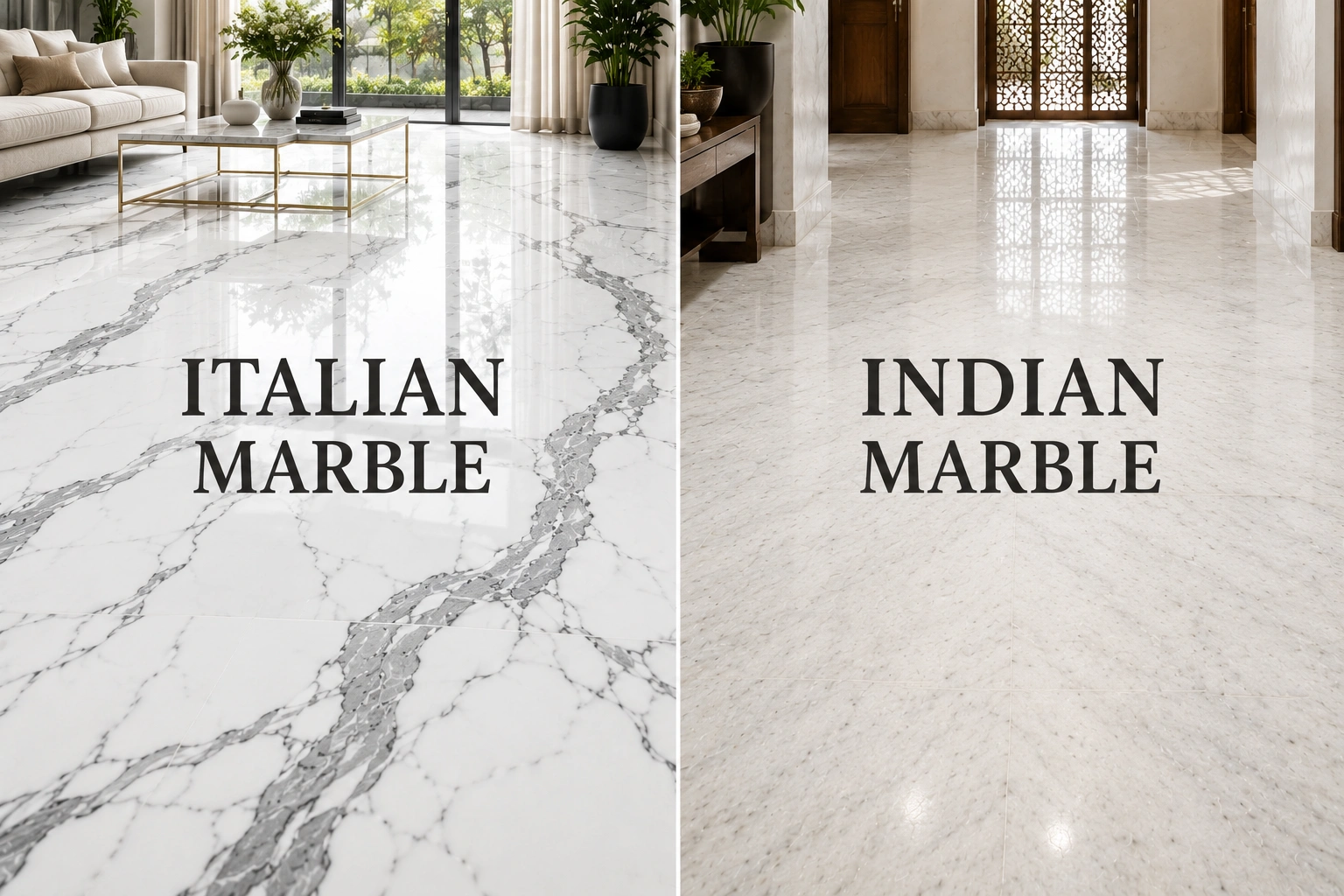
The key differences between Italian and Indian marble tiles affect not just appearance but long-term performance, maintenance, and total cost of ownership over the lifetime of your floor.
| Factor | Italian Marble Tiles | Indian Marble Tiles |
| Hardness (Mohs) | 2.5 to 3 (softer; scratches more easily) | 3 to 4 (harder; better scratch resistance) |
| Marble water absorption | Higher porosity; stains and etches faster with acidic liquids | Lower porosity; handles moisture, turmeric, and oil better |
| Marble durability | Lower for high-traffic areas; needs careful placement | Strong for daily use; handles foot traffic, furniture load well |
| Marble sealing requirement | Needs sealing before use and every 1 to 2 years | Sealing optional for general use; recommended in kitchens |
| Marble maintenance cost | Higher; specialist cleaning products, regular polishing needed | Lower; standard cleaning, occasional machine polishing every few years |
| Marble polishing frequency | Annual or biannual for high-use areas | Every 3 to 5 years for normal residential use |
| Appearance | Translucent depth, dramatic veining, mirror-like polish; very difficult to replicate | Good luster, clean grain; less translucency than Italian but strong visual appeal |
| Colour range | Primarily white, cream, grey, black, brown | White, beige, pink, green, grey, black, brown; wider variety |
| Installation | Needs specialist mason; fragile under cutting and transport | Handled by most experienced local masons in India |
| Climate suitability | Needs sealing in humid, coastal, or monsoon-heavy zones | Naturally suited to Indian climate variations; handles heat and humidity well |
| Marble scratch resistance | Lower; shows wear faster in daily use | Higher; stays looking good longer in high-traffic areas |
| Marble thickness (standard slab) | 18 mm to 20 mm standard; some slabs need mesh backing | 18 mm to 30 mm; harder stone can be cut thicker without fragility |
| Resale value impact | High if maintained well; Italian marble adds perceived property prestige | Good if clean and polished; Makrana in good condition is respected |
Marble Tiles vs Marble Slabs: What Indian Buyers Should Know
Both Italian and Indian marble come in two forms in the Indian market: slabs and tiles. The distinction matters for planning and budgeting.
Marble slabs: Full-size raw or polished slabs cut from the quarry block. These are cut on site into the dimensions you need. Slabs are preferred for large continuous floors because they allow the mason to control vein direction and create a more seamless appearance. They are also used for countertops, window sills, and wall cladding. Italian marble is most commonly available as slabs in India; buying slabs allows you to inspect each piece before cutting.
Marble tiles: Pre-cut tiles in standard sizes (usually 2x2 or 2x4) processed in factories and sold as finished products. Marble tiles are easier to install without specialist labour, come with consistent thickness and calibrated edges, and suit homeowners who want a faster, more straightforward installation. Indian marble is widely available as pre-cut tiles. Italian marble tiles are also available but carry a higher per-unit price than equivalent slab-cut stone.
For most Indian homes, tiles work well for floors and wall cladding in standard rectangular rooms. Slabs make sense for large living room floors, kitchen counters, and any area where a continuous, nearly seamless look is the goal.
Room-by-Room Guidance: Which Marble Works Where
The cleanest way to approach this decision is by room type and how the space is actually used in a typical Indian home.
| Room | Recommended | Avoid | Reason |
| Living room floor | Makrana, Rajnagar, or Italian Statuario (low-traffic luxury rooms) | Italian marble in active family living rooms with children | Indian marble handles foot traffic and chair movement better; Italian suits showcase living rooms |
| Living room feature wall | Italian Calacatta or Statuario (high visual impact) | Rough-cut or unpolished Indian marble on a statement wall | Wall cladding sees no foot traffic; Italian marble's visual depth makes a stronger statement |
| Kitchen floor | Katni beige, Makrana, Rainforest Brown | Italian Carrara or Calacatta on kitchen floors | Indian marble handles oil, turmeric, and wet spills better; Italian etches from acidic kitchen liquids |
| Kitchen backsplash (wall only) | Italian Carrara or Calacatta as PGVT marble finish tiles | Natural Italian marble slab on a backsplash behind the hob | Marble-look PGVT tiles give the Italian aesthetic on walls without the acid-stain risk; heat and oil splashes require very prompt cleaning on natural stone |
| Bathroom wall | Italian Carrara, Statuario as wall tiles; Indian Makrana or Bhainslana Black | Polished Italian marble on bathroom floors | Bathroom walls suit Italian marble well since there is no foot-traffic load; bathroom floors need anti-skid finishes and Indian marble handles moisture better as a floor |
| Bathroom floor | Indian marble with honed (matte) finish; anti-skid marble tiles | Polished Italian marble on wet bathroom floors | Polished marble is slippery when wet; Italian marble in this application is also a sealing and maintenance burden |
| Bedroom floor | Kishangarh Pink, Katni Beige, Italian Botticino or Emperador | Very dark Italian marble in small bedrooms | Bedrooms have low traffic and no moisture; Italian marble performs well here; warm tones suit bedroom atmosphere |
| Foyer or entry hall | Italian Statuario or Calacatta (statement entry) | Unpolished or rough-textured marble in high-visibility entry | The foyer takes footwear traffic but less furniture movement; Italian marble here delivers the strongest first impression; seal thoroughly before use |
| Pooja room | Makrana White or Ambaji White | Dark marble in small pooja niches | White Indian marble is the traditional and practical choice; resists incense stains better with basic cleaning; culturally and spiritually associated with purity |
| Staircase | Makrana, Rajnagar, or Katni with honed or GHR finish on treads | Polished Italian marble on stair treads | Stairs need non-slip surfaces; Indian marble in a honed finish is safer and wears far better on stair treads than polished Italian |
Marble Flooring Cost in India 2026: Italian vs Indian
Price is often the first number homeowners compare. But the true cost of marble flooring includes material, installation, sealing, maintenance, and polishing over the life of the floor. The numbers look very different when you calculate across ten years.
Material Cost Comparison
| Marble Type | Material Cost (approx. per sq. ft.) | Notes |
| Indian marble (Katni, Kishangarh, basic grades) | Rs. 40 to Rs. 150 | Widely available; local transport; easy to source in quantity |
| Indian marble (Makrana White, Ambaji premium grade) | Rs. 150 to Rs. 350 | Premium Indian stone; Makrana commands higher prices for export-quality slabs |
| Italian marble (Carrara, Botticino, standard grade) | Rs. 350 to Rs. 900 | Imported; price includes freight and import duty; varies with USD rate |
| Italian marble (Statuario, Calacatta, premium grade) | Rs. 900 to Rs. 4,000+ | Top-tier Italian stone; price rises sharply for large-vein, high-luster slabs |
| Marble-look PGVT vitrified tiles (marble finish) | Rs. 60 to Rs. 250 | Italian marble aesthetics on a vitrified body; no sealing needed; see tile constraints note below |
Note: PGVT tiles with marble finish are an Indian-manufactured vitrified tile category, not actual marble. They carry a digitally printed marble texture and polished vitrified body. They are not suitable for wet floors or outdoor use due to the polished surface finish. See full finish and application notes in the tile constraints reference.
Installation and Maintenance Cost Over 10 Years
| Cost Component | Italian Marble (per sq. ft.) | Indian Marble (per sq. ft.) |
| Installation (specialist labour for Italian) | Rs. 60 to Rs. 120 | Rs. 35 to Rs. 70 |
| Initial sealing (Italian mandatory; Indian optional) | Rs. 15 to Rs. 30 | Rs. 0 to Rs. 15 (if done) |
| Re-sealing every 2 years (Italian) vs 5 years (Indian) | Rs. 15 to Rs. 30 x 5 = Rs. 75 to Rs. 150 over 10 years | Rs. 10 to Rs. 20 x 2 = Rs. 20 to Rs. 40 over 10 years |
| Marble polishing (machine polish) | Rs. 20 to Rs. 40 per sq. ft., every 1 to 2 years | Rs. 15 to Rs. 30 per sq. ft., every 3 to 5 years |
| Total estimated 10-year cost (material + all above) | Rs. 700 to Rs. 5,500+ per sq. ft. | Rs. 250 to Rs. 700 per sq. ft. |
These are approximate figures that vary by city, contractor, and stone grade. The key takeaway: Italian marble costs 3 to 10 times more than Indian marble over its lifetime, not just at the point of purchase. Most architects recommend placing Italian marble selectively, in rooms where it truly makes a difference, and using Indian marble for full-house flooring.
Which Marble Works Better in Indian Climate Zones?
India does not have one climate. The performance of both marble types varies significantly depending on where in the country the home is located.
| Indian Climate Zone | Italian Marble Performance | Indian Marble Performance |
| Coastal (Mumbai, Kochi, Chennai, Vizag) | Higher risk; salt air and humidity accelerate staining if not sealed frequently; yellowing possible over time | Handles coastal humidity well; lower porosity resists salt air; Makrana and Rajnagar hold up without frequent sealing |
| Arid and hot (Rajasthan, Gujarat) | Performs better here than in coastal zones; dry heat is less damaging than humidity; still needs sealing | Very well suited; Indian marble is quarried in this region and is conditioned for this climate; Makrana is ideal |
| Monsoon-heavy (Kolkata, Kerala, Northeast) | Needs very rigorous sealing regime; prolonged moisture exposure causes staining and dullness without it | Good performer; dense Indian marble handles repeated monsoon moisture significantly better than Italian stone |
| North Indian plains (Delhi, Lucknow, Jaipur) | Moderate suitability; dry winters reduce moisture damage; hot summers cause minor thermal expansion; sealing is still needed | Excellent suitability; high temperature range handled well; Indian marble from nearby Rajasthan readily available at low freight cost |
| South Indian plateau (Bangalore, Hyderabad, Coimbatore) | Good for Bangalore (mild climate); Hyderabad summers can stress unsealed stone; sealing needed | Well suited across most South Indian cities; consistent year-round performance; no special maintenance beyond standard care |
Marble Maintenance Guide: What Each Type Actually Needs
Maintenance is where Italian marble and Indian marble diverge most sharply in real-life experience. Many homeowners underestimate Italian marble's upkeep before installing it.
Italian Marble Maintenance
Sealing: Seal before first use with a penetrating stone sealer. Reseal every 12 to 18 months in high-use rooms and coastal or humid cities. Resealing every 2 years is the minimum in drier interior cities.
Cleaning: Use only pH-neutral cleaners made for natural stone. Never use vinegar, lemon juice, baking soda, or multi-surface cleaners. Acidic liquids etch the surface permanently, dulling the polish.
Spill protocol: Wipe spills immediately. Italian marble etches within minutes of contact with acidic liquids including wine, citrus juices, and tomato sauce. A cloth on the table during meals is a practical standard in Italian marble dining areas.
Marble polishing: Professional polishing every 12 to 24 months restores the glossy marble finish in high-traffic areas. This adds significantly to annual maintenance cost.
Is Italian marble slippery: Yes, especially on wet surfaces. A polished Italian marble floor in a bathroom or near a kitchen sink is a genuine safety risk when wet. Use a honed or matte finish for any wet-area application, and add bath mats in bathrooms.
Indian Marble Maintenance
Sealing: Optional for dry living areas. Recommended for kitchens, bathrooms, and pooja rooms where water and staining agents are common. A single sealing lasts 3 to 5 years in normal conditions.
Cleaning: Standard floor cleaners work well. Avoid harsh acid-based cleaners regardless of marble type. A mild pH-neutral soap and warm water is sufficient for daily mopping.
Spill tolerance: Indian marble handles turmeric, oil, and food spills better than Italian stone. Wipe spills within a few minutes rather than immediately. The denser stone absorbs less before the surface can be cleaned.
Marble polishing: Machine polishing every 3 to 5 years maintains the luster. For a home with normal residential use, the full floor polishing cycle is manageable and affordable.
Expert Buying Tips Before Choosing Marble Tiles
1. Buy from importers with documentation for Italian marble: Genuine Italian marble carries quarry certificates and import documentation. Fake or low-grade stone sold as Italian marble in Indian showrooms is unfortunately common. Ask the dealer directly: does this stone come with quarry origin papers? If not, treat the claim with caution.
2. Use the mixed strategy for most Indian homes: Italian marble for the living room feature wall, foyer, or master bedroom floor. Indian marble for the kitchen, staircase, pooja room, and general bedrooms. This approach gives you the statement moments Italian marble is worth paying for, without the maintenance overhead across the entire home.
3. Always test with a sample tile in your room: Take a sample of both marble types to your actual space. Observe them at different times of day. Marble looks very different under showroom lighting versus natural Indian daylight or evening LEDs. This one step removes most second-guessing.
4. Hire specialist labour for Italian marble installation: Italian marble is fragile under cutting and requires correct adhesive and bedding preparation. A mason who has not laid Italian stone before will break slabs and create an uneven surface. The specialist labour cost is not optional for Italian marble.
5. Plan grout colour carefully: White or very light grout with white Italian marble stains over time in high-use areas. A light grey grout with white marble stays cleaner looking for longer. For dark marble interiors like Nero Marquina or Bhainslana Black, a matching dark grout gives a seamless effect.
6. Order 10 to 12% extra material: Natural stone varies between quarry batches. Cut loss, breakage during installation, and future repairs all need buffer stock. For Italian marble especially, ordering extra from the same slab batch is critical since shade-matching from a different shipment is extremely difficult.
7. Check marble thickness before ordering: Standard marble slabs for residential flooring are 18 mm to 20 mm. Thinner slabs (12 mm) are used for wall cladding only. Confirm the thickness with your dealer; thinner stone on a floor cracks under furniture load.
Common Mistakes When Choosing Between Italian and Indian Marble
Buying Italian marble for the entire house: Italian marble is designed for signature spaces with lower traffic, not for a full-house flooring project in a busy Indian family home. Placing it in the kitchen, staircase, and children's room creates a maintenance burden that most households cannot sustain. Use it selectively.
Assuming Indian marble is low prestige: Makrana white marble was used to build the Taj Mahal. It is one of the most durable and visually beautiful natural stones quarried anywhere in the world. The prestige of Indian marble depends on the grade and finish, not on it being locally sourced.
Skipping sealing on Italian marble before first use: This is the most common and costly Italian marble mistake in India. An unsealed slab on the floor of a home stains within days of use. Sealing must happen before the house is occupied, not after.
Using polished Italian marble on bathroom floors: Italian marble in a polished finish is slippery when wet. A glossy marble finish in a bathroom or near any water source is a safety hazard. Always specify a honed or anti-skid finish for wet area flooring in either marble type.
Not factoring in the 10-year cost: Many homeowners choose Italian marble based on the tile price per sq. ft. and do not factor in installation specialist cost, sealing, annual polishing, and the higher replacement cost when a section cracks. The 10-year number is what matters, not the showroom sticker.
Using standard masons for Italian marble installation: Italian stone is fragile. Laying it with the same team who does general tile work leads to cracked slabs, uneven edges, and voids under the stone. Find a mason with verified Italian marble installation experience before work begins.
Choosing the Right Marble for Each Room in Your Home
The most practical approach for most Indian homes is not a single answer but a room-by-room decision. Use Italian marble where the visual impact is worth the investment and where daily use is lower. Use Indian marble where the floor needs to hold up across years of daily life without constant upkeep.
Before finalising any marble order, note the room, its typical foot traffic level, whether it has moisture exposure, and the maintenance time your household can realistically commit to. Take sample tiles of both types into your actual space and observe them in the light conditions the room gets at the times you use it most.
You can compare both Italian marble tiles and Indian marble varieties, along with marble-look vitrified tile options, through TilesFinders. The platform helps you match the right stone to each room in your home, compare price ranges from verified suppliers, and connect with dealers without visiting multiple showrooms.
FAQs
Neither is universally better. Italian marble has greater visual depth, translucency, and prestige value. Indian marble is harder, more durable in daily use, lower on maintenance, and suited to Indian climate conditions. The right choice depends on the room, traffic level, city climate, and how much maintenance the household can realistically manage. Most architects in India recommend Italian marble for signature spaces and Indian marble for everyday flooring.
Yes, significantly. Italian marble material cost in India starts at approximately Rs. 350 per sq. ft. for standard grades and rises to Rs. 4,000 or more per sq. ft. for premium Calacatta or Statuario. Indian marble starts at Rs. 40 per sq. ft. for basic grades and reaches Rs. 350 per sq. ft. for export-quality Makrana. When you include installation, sealing, and polishing over 10 years, Italian marble costs 3 to 10 times more than an equivalent Indian marble floor.
For full-house flooring in Indian homes, Indian marble is the better choice. It handles foot traffic, furniture load, Indian heat and humidity, and turmeric or oil spills far better than Italian stone. Makrana white, Rajnagar, and Katni beige are the most popular grades for residential Indian marble flooring. Italian marble is better placed as a feature element in the living room, foyer, or master bedroom where its visual impact is highest and foot traffic is lowest.
Italian marble is softer than Indian marble and cracks more easily during cutting, transport, and installation. Many Italian marble slabs come with a nylon mesh backing to compensate for this fragility. After correct installation with proper sub-base preparation and skilled labour, a well-laid Italian marble floor does not crack under normal residential use. The risk comes during installation and from heavy point loads like furniture legs on soft bedding.
Indian marble requires significantly less maintenance than Italian marble. Most Indian marble grades do not need sealing for general residential use. Cleaning with a mild pH-neutral solution is sufficient for daily care. Italian marble needs sealing before first use, resealing every 1 to 2 years, and professional polishing annually or biannually in high-use areas. Over ten years, Indian marble maintenance costs are a fraction of Italian marble upkeep costs.
Italian marble is not recommended for kitchen floors. The stone is porous and etches quickly when it comes into contact with acidic liquids including tomato, citrus juice, vinegar, and even some cleaning products. Indian marble handles kitchen conditions better because of its lower porosity and higher hardness. If the Italian marble aesthetic is important for the kitchen, a marble-look PGVT tile on the floor and a sealed Italian marble backsplash tile on the wall (not behind the hob) is a practical approach.
Indian marble is clearly the better choice for high-traffic areas. Makrana, Rajnagar, Katni beige, and Rainforest Brown all handle the daily demands of hallways, staircases, kitchens, and family living rooms without the scratch and etch damage that affects Italian stone. For very high-traffic commercial spaces, full body vitrified tiles in a marble finish give the look of marble with a harder, more scratch-resistant vitrified body.
Imported marble (primarily Italian) is quarried in Europe and shipped to India, adding import duties and freight to the cost. It is softer, more porous, and more visually translucent than most Indian varieties. Indian marble is quarried domestically, costs less in transport, and is harder and denser, making it more forgiving in Indian climate conditions. Both are natural stone; the core difference is hardness, porosity, visual character, and total cost of ownership over the lifetime of your floor.
