Hall Tiles Design: 30+ Modern Ideas for Indian Halls
May 28, 2026 16
Explore modern hall tiles design ideas for Indian homes. Compare GVT, marble, wooden, matte, and large-format hall tiles with sizes, finishes, colours, and 2026 prices.
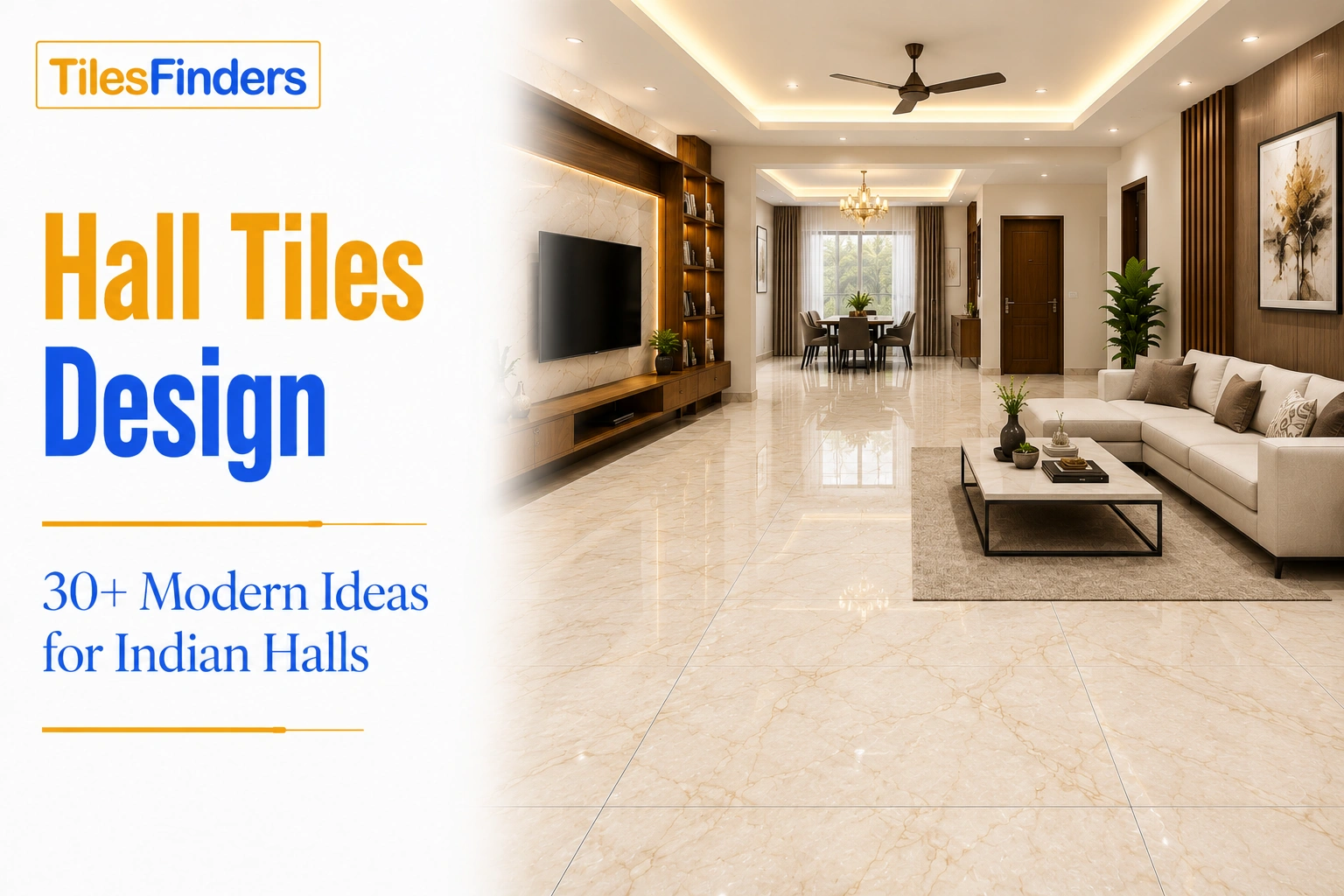
The hall is the first floor anyone walks on when they enter an Indian home. It carries footwear from outside, festival foot traffic, daily family movement, and guest first impressions all at once. Every home has one. Few homeowners give it enough thought before laying the tiles.
Most hall tile design decisions happen at the end of the renovation budget, after the kitchen, bathrooms, and living room have been sorted. The hall gets whatever tile is left over, or whatever is cheapest, or whatever matches the entry door. That usually means a tile that looks dated in two years, shows every mark, or cracks under the pressure of hard Indian use.
This guide covers 30 modern hall tiles design ideas for Indian homes, the tile categories that actually work in halls, colour combination guidance, size choices, finish options, and a price reference to plan the project properly from the start.
What Makes Hall Tiles Different from Other Room Tiles
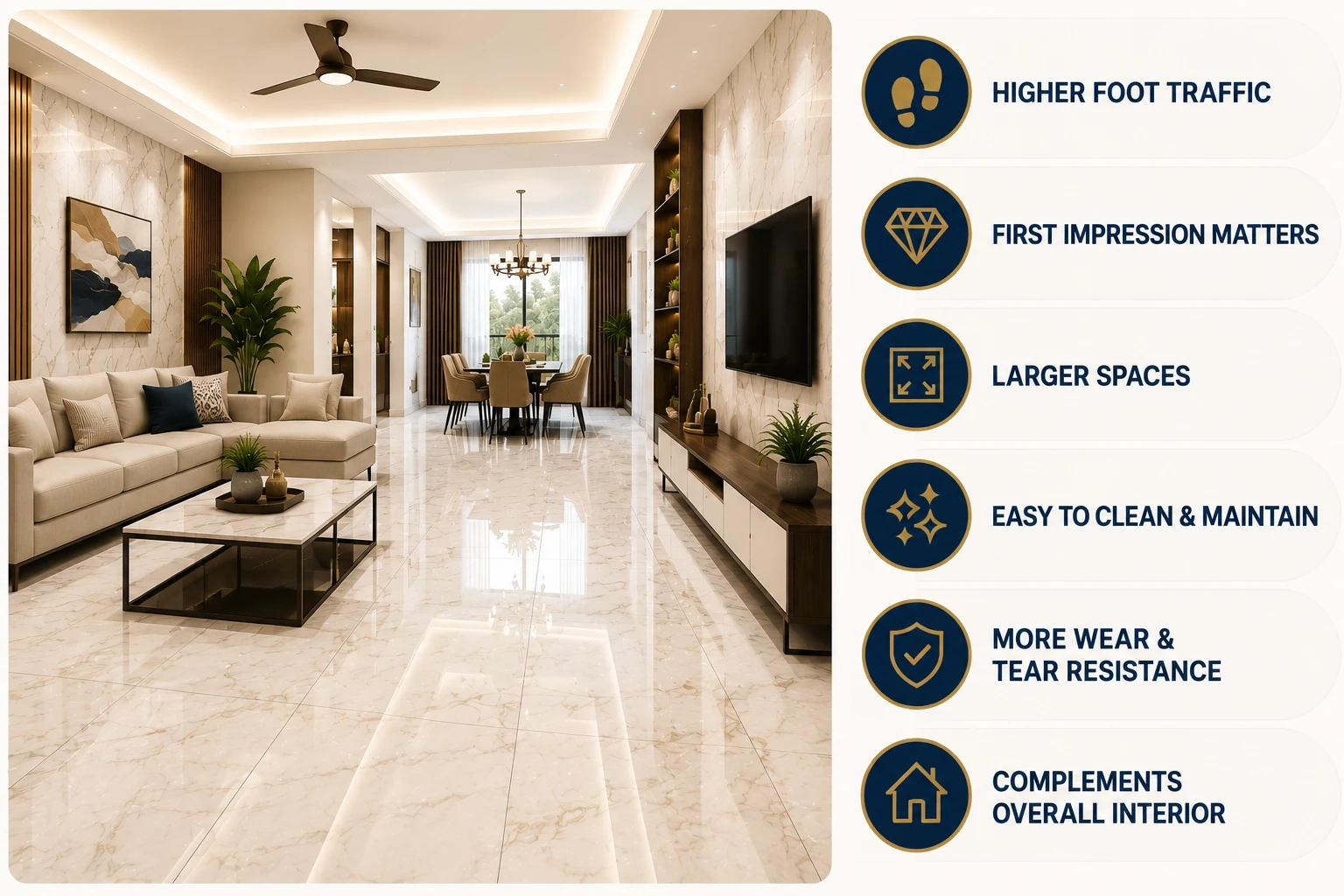
The hall in an Indian home faces conditions that no other room does quite as harshly. Footwear from outside brings grit, sand, monsoon water, and hard tarmac debris onto the floor daily. Guests who visit during Diwali or a housewarming often do not remove their footwear. Festivals bring rangoli, flower petals, and kumkum close to the hall floor.
The hall also has the heaviest foot traffic of any room. A bedroom gets a few walks per day. The hall gets dozens. In joint family homes and society apartments, the hall often connects to the kitchen, the dining area, and the balcony, making it a corridor that is never truly at rest.
This means hall tiles need to handle abrasion, surface grit, and heavy use that living room tiles or bedroom tiles are not designed for. The tile category, the finish, and the thickness all matter more in a hall than in any other dry indoor space. Getting the floor tiles for the hall right from the start saves a relaying cost within 3 to 5 years.
Hall Tile Categories: Which Type Works for Indian Halls
Five tile categories are commonly used for hall flooring in India. Each has a different body strength, maintenance profile, and suitability for the hall environment.
| Category | Water Abs. | Traffic Rating | Hall Strength | Best Hall Application |
| GVT (Glazed Vitrified) | 0.05% | High | Strong body, wide design range, outdoor-rated; GHR or matte finish for halls | Standard residential and society hall flooring; most popular tiles for hall in India |
| PGVT (Polished Glazed Vitrified) | 0.05% | Moderate | High visual impact; not for wet entry zones or hall with direct outdoor exposure | Dry covered halls; formal drawing room entry; society lift lobbies (dry) |
| Double Charge Vitrified | 0.05% | Very High | Highest scratch resistance of all vitrified categories; limited designs | High-traffic hall flooring in commercial buildings, large society lobbies, builder-finish homes |
| Marble (Natural Stone) | Varies | Good (Indian marble); Moderate (Italian) | Indian marble handles hall use well; Italian marble needs sealing and careful entry zone placement | Formal hall in bungalows; marble tiles design for hall in premium apartments; drawing room entry |
| Full Body Vitrified | Near-zero | Very High | Colour runs through the full tile body; best for edge-visible applications and heavy use | Hall flooring in independent homes, builder-grade projects, and renovation where long life matters |
Ceramic tiles are not recommended for hall flooring. With 12 to 16% water absorption, they are unsuitable for any hall that connects to an outdoor entry or gets monsoon water tracked in. The one exception is 300x300 mm (1x1) ceramic used on covered indoor hall floors that stay completely dry, but even then, GVT is the better choice.
You can compare GVT and PGVT tiles across sizes, finishes, and marble-look or stone-look designs on TilesFinders, and also explore our living room tiles guide before visiting a showroom.
30+ Modern Hall Tiles Design Ideas for Indian Homes
The following hall tilerenovations design ideas are grouped by visual category. Each idea includes the tile type, size, and finish that makes it work technically and aesthetically in an Indian hall context.
White and Light Marble Look Hall Tiles Design
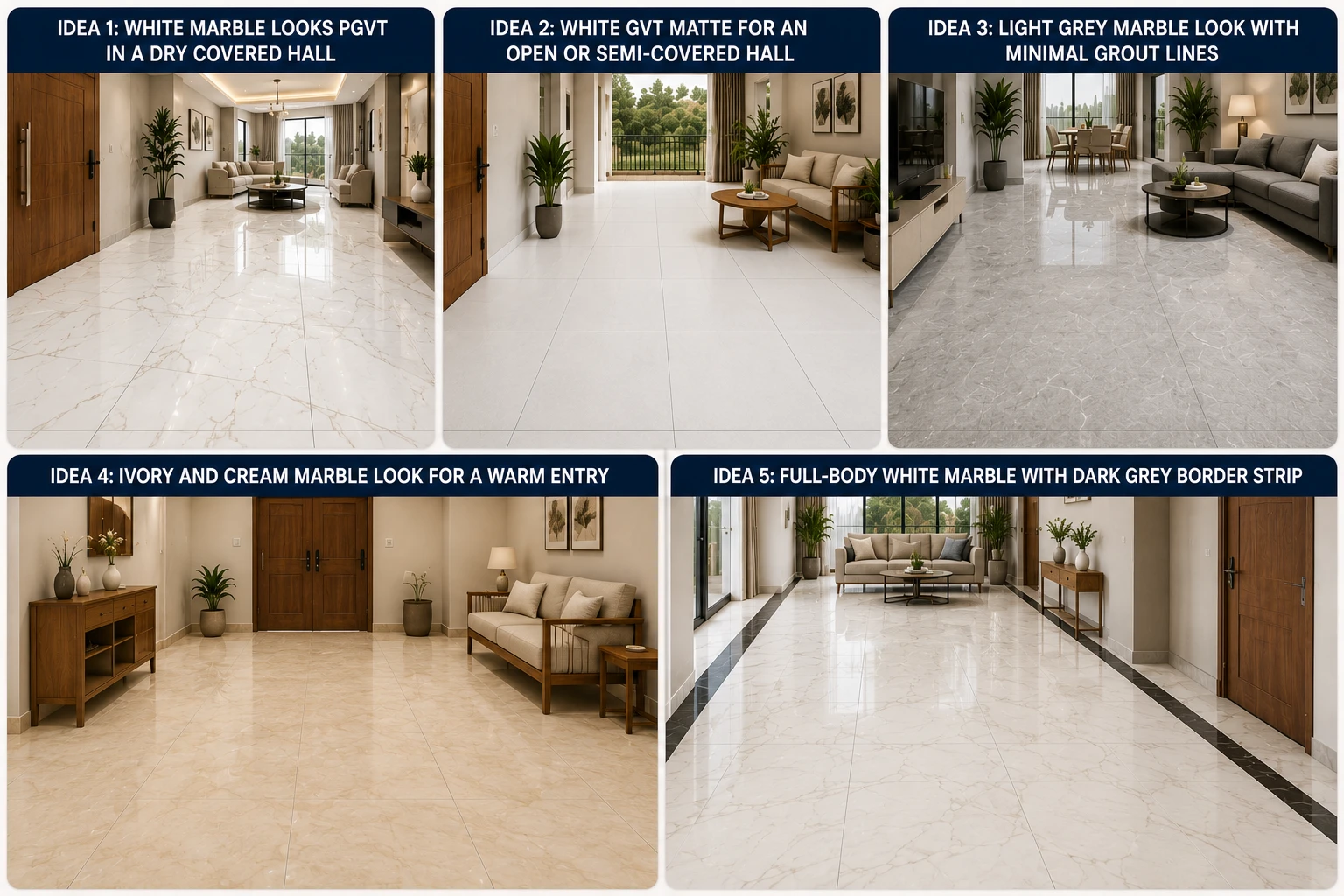
Idea 1: White marble looks PGVT in a dry covered hall: A PGVT tile in a white Statuario or Calacatta finish in 600x1200 mm (2x4) laid in a straight grid across a dry covered hall. The polished, glossy surface reflects ceiling lights and makes the entry look spacious. Use only in completely dry, covered halls; polished vitrified tiles become slippery when wet, making them unsuitable for any hall that gets monsoon water near the entry door.
Idea 2: White GVT matte for an open or semi-covered hall: A white GVT tile in a matte finish in 600x1200 mm (2x4) handles both dry and lightly wet conditions that a semi-open Indian hall faces. The matte surface hides light marks better than polished and stays safe underfoot. This is the most practical white hall tile design for 2BHK and 3BHK Indian apartments.
Idea 3: Light grey marble look with minimal grout lines: A light grey marble look GVT tile in 800x1200 mm (32x48) with rectified edges and 1 mm grout lines in a straight grid. This modern hall tile design makes an average 10x12 ft hall look nearly seamless. Grey marble tiles designed for the hall hide everyday dust, and light marks significantly better than white in active households.
Idea 4: Ivory and cream marble look for a warm entry: An ivory or cream-toned marble look GVT in 600x600 mm (2x2) for a compact hall up to 80 sq. ft. The warm cream tone works with wooden entry doors and warm-painted walls. Cream hall tiles colour is one of the most forgiving choices for Indian homes because it suits every furniture finish from teak to white laminate.
Idea 5: Full-body white marble with dark grey border strip: Full-body vitrified tiles in white marble finish (600x1200 mm) as the main hall floor with a 3 to 4 inch dark grey border tile running along the entry wall. The border visually frames the hall and makes the floor feel designed rather than plain.
Grey and Concrete Look Hall Tiles Design
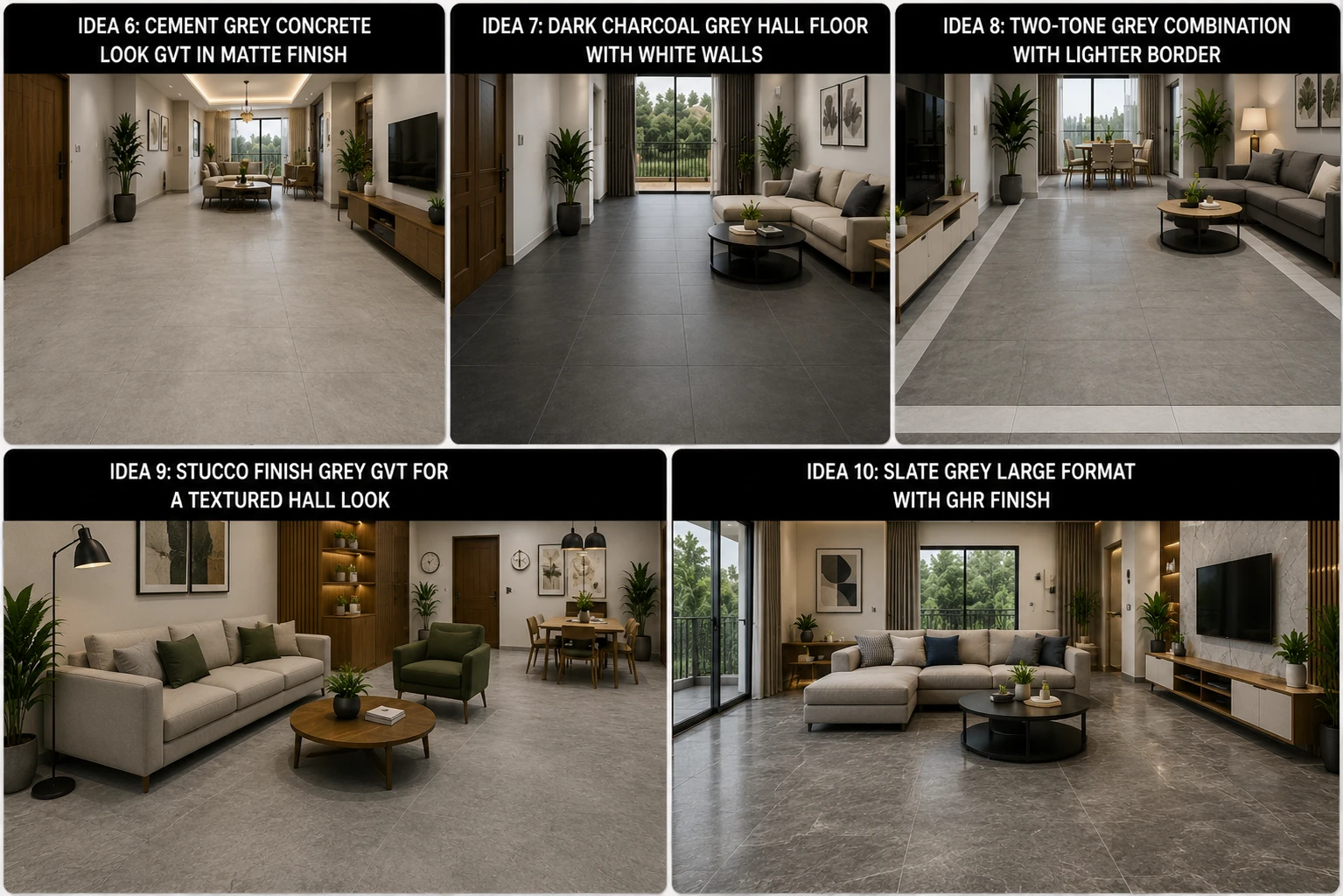
Idea 6: Cement grey concrete look GVT in matte finish: A cement-look grey GVT tile in matte or Posh finish in 600x1200 mm (2x4) is one of the most popular modern hall tiles design choices in Indian urban apartments in 2026. The grey concrete look tiles for the hall hide grit, dust, and light monsoon marks between cleaning cycles. Grey concrete look tiles are available from most Morbi manufacturers at ₹70 to ₹120 per sq. ft.
Idea 7: Dark charcoal grey hall floor with white walls: A deep charcoal grey matte GVT tile in 600x600 mm (2x2) or 600x1200 mm (2x4) paired with white or off-white walls. The dark floor and light walls create a strong contrast that reads as contemporary and confident. Use a matching dark grey grout to avoid the grid pattern breaking the visual continuity.
Idea 8: Two-tone grey combination with lighter border: A medium grey main hall floor tile in 600x1200 mm with a lighter grey or white rectified border tile along the perimeter. The two-tone grey colour combination for the hall gives the floor structure without bold contrast. Very common in architect-designed society apartments in Pune, Bengaluru, and Hyderabad.
Idea 9: Stucco finish grey GVT for a textured hall look: A Stucco finish grey GVT tile in 600x600 mm (2x2) gives the hall floor a cement-plaster texture that is tactile and contemporary. The Stucco finish is semi-matte and handles grit and dust well. This hall tile texture idea works particularly well in industrial-leaning or minimal contemporary Indian interiors.
Idea 10: Slate grey large format with GHR finish: A slate-look grey GVT in GHR (Glaze High Resistance) finish in 800x1200 mm (32x48). The GHR finish gives a stone-like texture with excellent grip underfoot, making it one of the safest hall tile designs for homes with elderly family members or young children.
Wooden and Warm Tone Hall Tiles Design
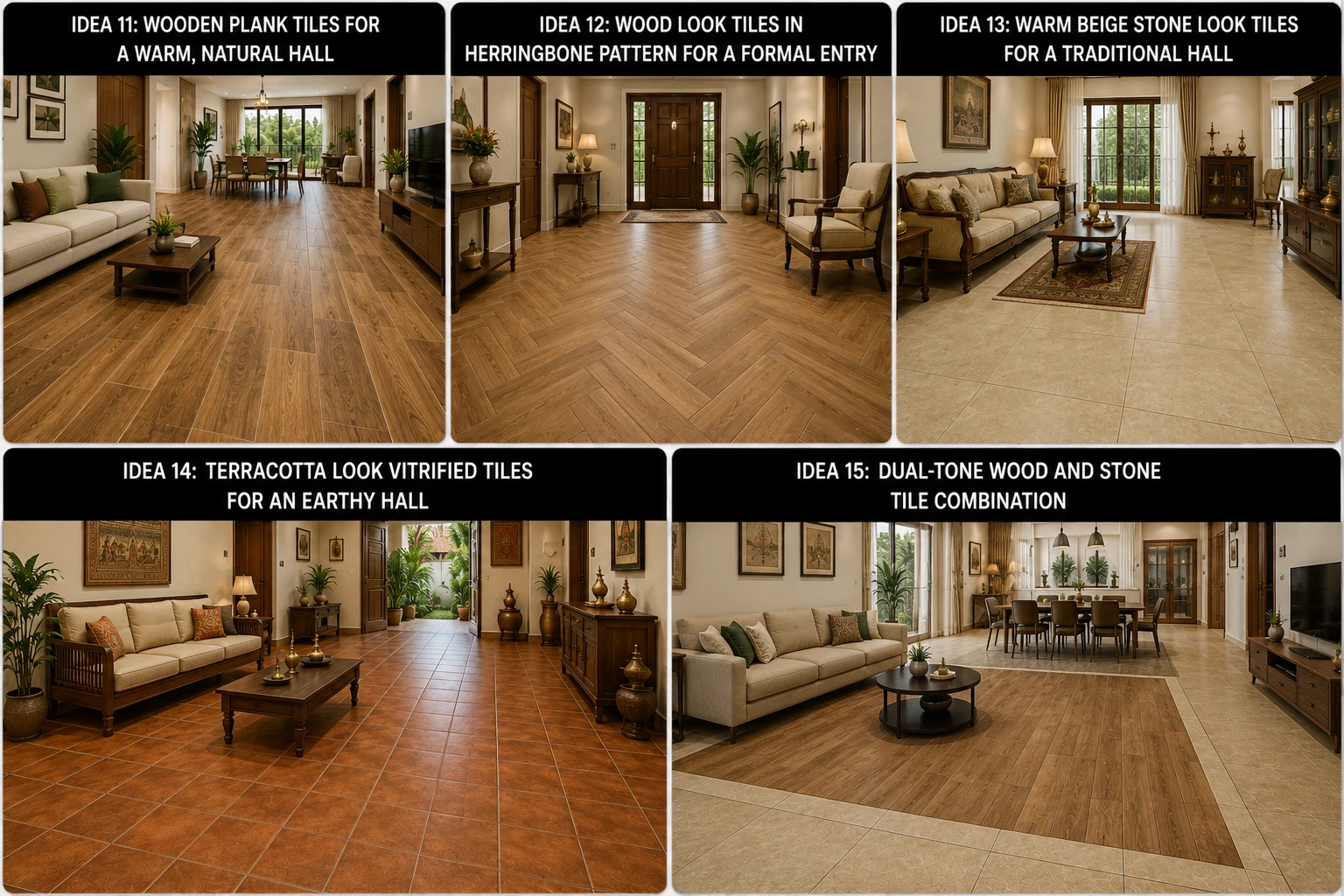
Idea 11: Wooden plank tiles for a warm, natural hall: Wooden tiles for hall use, specifically GVT plank tiles in 200x1200 mm (8x48) in a warm oak, walnut, or teak finish. Laid lengthwise in the hall, plank tiles create a visual corridor effect that makes the space feel longer and warmer. This is the most popular hall tile design idea for standalone bungalows and villas in South India and Maharashtra.
Idea 12: Wood look tiles in herringbone pattern for a formal entry: GVT wood look tiles in 200x1200 mm (8x48) or 600x1200 mm (2x4) laid in a herringbone pattern across the hall floor. The herringbone tile pattern adds visual movement and a classic quality that suits formal drawing room entries. Use a warm beige or light walnut tone for a traditional Indian home.
Idea 13: Warm beige stone look tiles for a traditional hall: A warm beige or sandstone-look GVT tile in 600x600 mm (2x2) in a matte or GHR finish. The beige hall tile colour is one of the most forgiving in Indian homes, as it reads well in both morning sunlight and evening lamp light. The beige tone suits traditional Indian interiors with brass the accents and dark wood furniture.
Idea 14: Terracotta look vitrified tiles for an earthy hall: A terracotta or rust-brown GVT tile in 600x600 mm (2x2) in a matte finish. This warm earth-tone hall tile design suits homes with Rajasthani or South Indian heritage aesthetics. Terracotta look vitrified tiles give the character of traditional clay tiles without the maintenance and fragility of actual terracotta.
Idea 15: Dual-tone wood and stone tile combination: GVT wood look plank tiles (200x1200 mm, 8x48) in the main hall area with a stone look GVT border tile (600x600 mm, 2x2) in a contrasting beige or grey around the edges. This house hall tiles design creates a defined entry zone within a larger open-plan living and hall area.
Dark and Contrast Hall Tiles Design
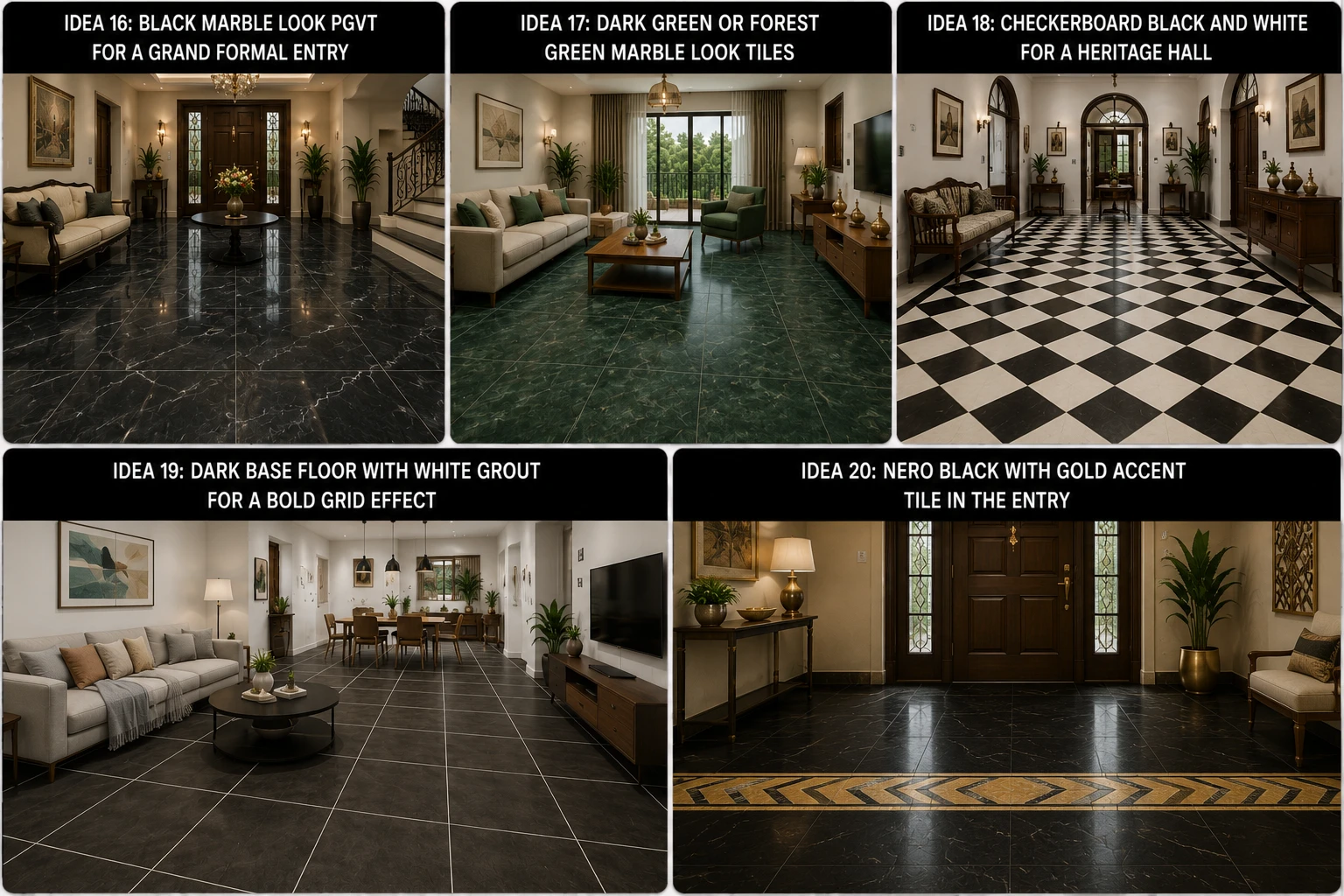
Idea 16: Black marble look PGVT for a grand formal entry: A black or dark anthracite marble look PGVT tile in 600x1200 mm (2x4) in a formal, dry-covered hall of a large bungalow or villa. Black hall tiles create a dramatic first impression and suit homes with high ceilings and strong architectural detail. Use only in dry covered halls where moisture will not reach the floor.
Idea 17: Dark green or forest green marble look tiles: A deep green marble look GVT tile in matte finish in 600x600 mm (2x2) or 600x1200 mm (2x4) for a hall design that stands out. Deep green hall tile colour is growing in popularity in 2026 in Indian homes, drawing from heritage and nature-inspired aesthetics. Pair with warm brass accents and natural wood furniture.
Idea 18: Checkerboard black and white for a heritage hall: Classic 600x600 mm (2x2) black and white GVT tiles laid in a diagonal checkerboard pattern across the hall floor. This hall tile design idea suits older Indian bungalows, colonial-style homes, and homes with eclectic heritage decor. The diagonal layout makes a square hall look wider.
Idea 19: Dark base floor with white grout for a bold grid effect: A dark charcoal or espresso-brown matte GVT tile in 600x600 mm (2x2) with white epoxy grout. The white grout on a dark tile creates a very visible grid pattern that some homeowners use deliberately as a hall floor tile texture idea. The contrast is bold and works in compact halls where a graphic pattern adds character.
Idea 20: Nero black with gold accent tile in the entry: A black or very dark matte GVT tile as the main hall floor with a small gold or yellow marble look accent tile strip near the entry door. The gold strip near the entry creates a welcome threshold that is warm, visible, and culturally resonant in many Indian households.
Hall Wall Tiles Design Ideas
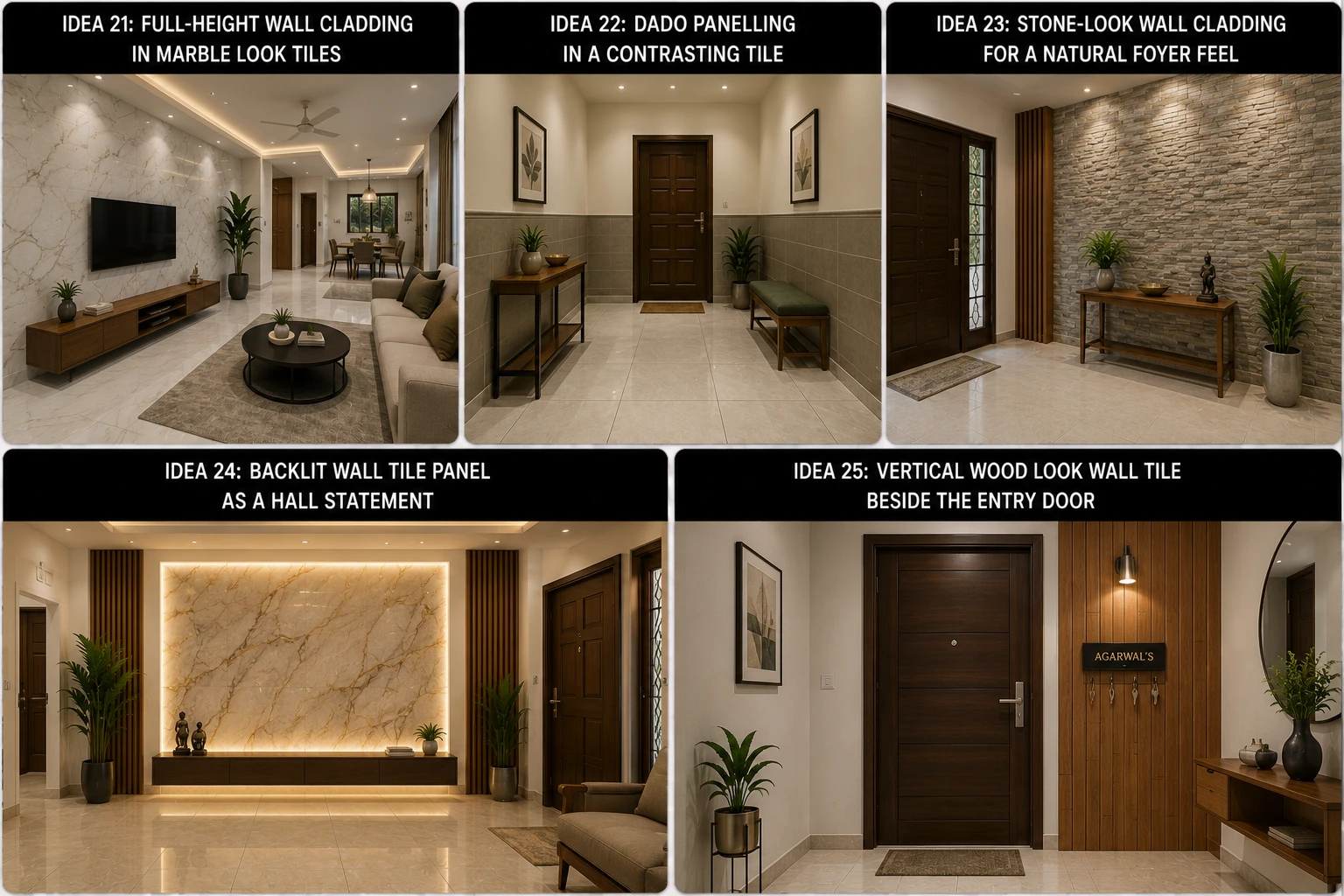
Idea 21: Full-height wall cladding in marble look tiles: GVT tiles in a marble look finish in 600x1200 mm (2x4) used as full-height wall cladding on one side of the hall. This creates a feature wall without any painting and handles the marks and scuffs that hall walls accumulate from bags, furniture edges, and daily use. Wall tiles in the hall are far easier to clean than painted surfaces.
Idea 22: Dado panelling in a contrasting tile: A tile dado (the lower 3 to 4 ft of the wall) using 300x600 mm (12x24 wall-only) ceramic tiles in a contrasting colour to the upper painted wall. A dark grey or beige tile dado in the hall protects the wall from marks and scuffs while adding a structured, finished look. This hall wall tile design is common in builder-finish society apartments.
Idea 23: Stone-look wall cladding for a natural foyer feel: High depth (2.5 to 5 mm depth) stone-look wall tiles in 300x600 mm (12x24) for the main accent wall inside the entry of a large hall. The textured stone surface gives a natural, raw look that works with wood elements and plants. These are wall-only tiles; never use High Depth tiles on floors.
Idea 24: Backlit wall tile panel as a hall statement: A 600x1200 mm (2x4) GVT or PGVT tile in a translucent or light-passing marble look, installed on a wall with LED strip lighting behind the panel. The backlit effect gives the hall a distinctive glow at night. This premium hall tile design works in bungalows and large 4BHK apartments with a dedicated entry zone.
Idea 25: Vertical wood look wall tile beside the entry door: A narrow strip of vertical GVT wood look plank tiles (200x1200 mm, 8x48) installed on the wall beside the entry door, running floor to ceiling. This warm, textured wall element creates a visual anchor at the entry point without covering the entire wall. A small name plate or key hook mounted on this panel completes the design.
Luxury and Large Format Hall Tiles Design
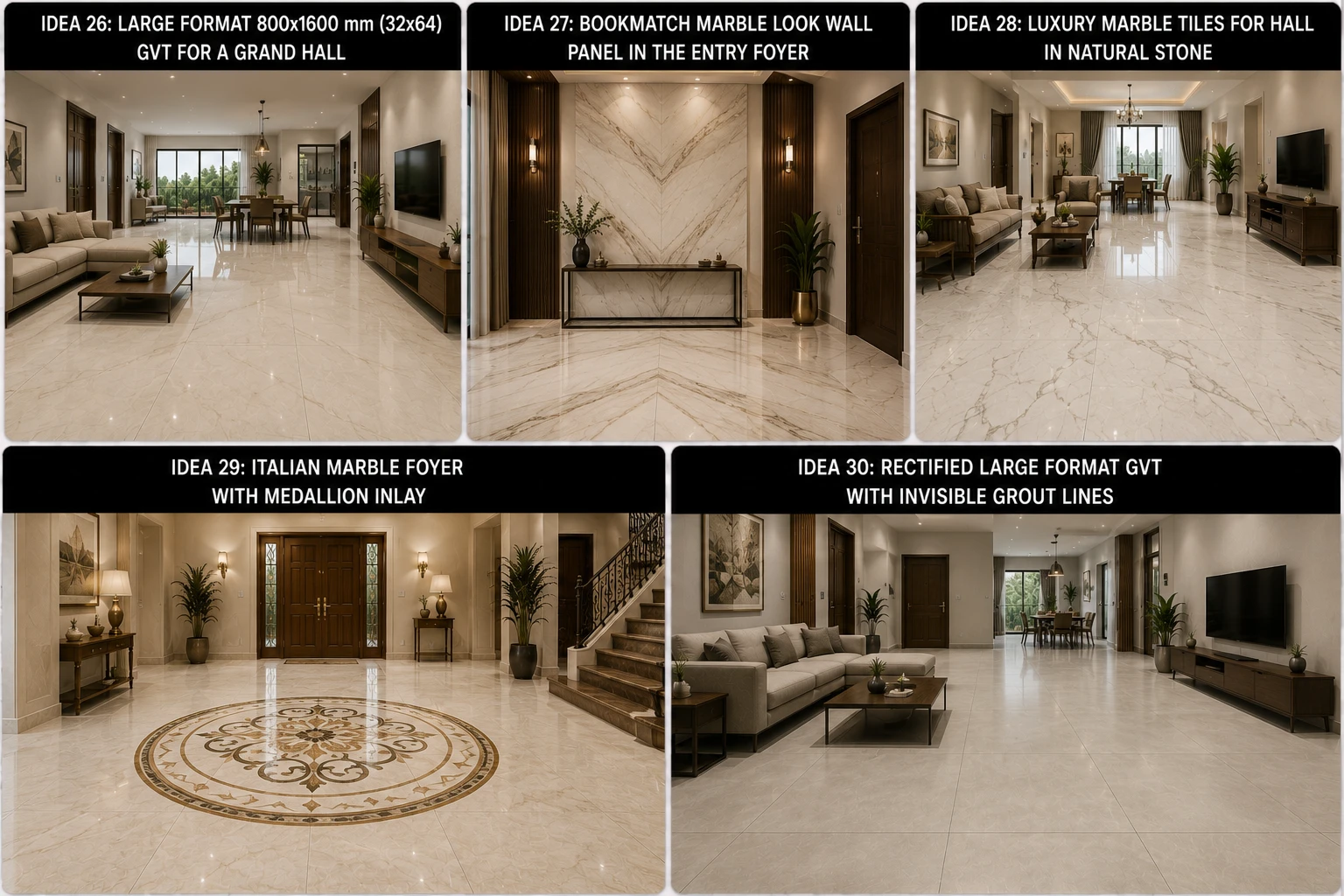
Idea 26: Large format 800x1600 mm (32x64) GVT for a grand hall: An 800x1600 mm (32x64) GVT tile in a marble or stone look with a matte or GHR finish laid across the full hall floor. Fewer tiles, minimal grout lines, and a near-slab appearance. These large tiles for hall approach work in halls above 120 sq. ft. and rerequire perfectly level subbase and skilled installation. The result is as close to a stone-slab hall floor as vitrified tiles can achieve.
Idea 27: Bookmatch marble look wall panel in the entry foyer: A 1200x1800 mm (6x4) or 800x1600 mm (32x64) GVT tile in a marble look finish used as a single large panel on the entry wall, paired with matching tiles on the floor. This bookmatch-inspired approach creates a dramatic foyer without requiring natural marble. Very popular in premium Indian apartment interiors in 2026.
Idea 28: Luxury marble tiles for hall in natural stone: Natural Makrana white or Rajnagar white Indian marble in 600x1200 mm (2x4) slabs laid across the hall floor with polished finish. Marble tiles designed for a hall in natural stone give a visual depth that vitrified tiles cannot fully replicate. Indian marble handles hall traffic well; seal before use and reseal every 3 to 5 years.
Idea 29: Italian marble foyer with medallion inlay: Natural Italian Botticino or Statuario marble in the main hall floor with a custom marble medallion inlay at the entry centre. This is the most labour-intensive and high-cost hall tiles design option, exclusively suited to bungalows and large independent homes. Italian marble in the hall should be sealed before use and maintained carefully.
Idea 30: Rectified large format GVT with invisible grout lines: Rectified 600x1200 mm (2x4) GVT tiles laid with 1 mm epoxy grout in a matching tile colour. The near-invisible grout lines give the hall a continuous slab-like appearance at a fraction of the cost of natural stone. This modern floor tile design for the hall is the most popular upgrade choice in Indian apartment renovations in 2026.
Hall Tiles Colour Combination Guide for Indian Homes
Hall tile colour affects how big the space feels, how visible marks are between cleans, and how well the floor connects to the rest of the home. The colour combination of the hall floor tile, the wall colour, and the ceiling matters more in a compact Indian hall than in any other room.
| Hall Tile Colour | Wall Colour Pairing | Furniture/Door Tone | Effect and Best Use |
| Pure white / cream | Light grey or off-white | Light wood or white | Opens up small halls; shows dust faster; best in covered, low-grit entries |
| Light grey marble look | White or soft grey | Any; very versatile | Most practical hall tiles colour combination in Indian apartments; hides marks well; suits all lighting. |
| Warm beige/sandstone | Warm cream or terracotta | Teak, walnut, dark wood | Warm and inviting; suits traditional Indian homes; Diwali lighting makes beige tiles glow. |
| Dark charcoal grey | White or light grey (high contrast) | Brass accents or black fixtures | Contemporary urban Indian aesthetic; hides grit completely; makes large halls feel architectural |
| Dark green / forest green | Off-white or warm cream | Natural wood or black | Nature-inspired, heritage look; strong character; best in halls with good natural light |
| Black or anthracite | White or light stone grey | Gold or chrome fixtures | Grand formal entry; luxury hall floor tiles look; suited to large bungalow foyers only |
| Wood look (oak, walnut) | Warm white or cream | Any wood tone | Warm, residential feel; connects hall to adjacent living space; popular in South Indian homes |
For the most asked question about hall tiles colour combination in compact Indian apartments: a light grey or warm beige marble look tile in 600x1200 mm (2x4) with white walls and a 1 to 2 mm grout line in a matching tile tone gives the best visual outcome across most hall dimensions and natural lighting conditions.
Best Hall Tiles Size for Indian Homes
Hall tile size affects how big the space feels, how many grout lines appear, and how much cutting waste you get at the edges. The right tile size for hall flooring in India depends on the hall's actual dimensions.
| Size (mm) | Size Name | Best Hall Application |
| 600x600 mm | 2x2 | Compact halls up to 60 sq. ft.; bathroom entries and passage corridors; checkerboard or diagonal patterns |
| 600x1200 mm | 2x4 | The most popular hall floor tile size in India in 2026;,suits halls from 60 to 300 sq. ft.; straight grid gives a seamless, spacious appearance |
| 800x1200 mm | 32x48 | Medium to large halls from 100 sq. ft. upward; gives fewer grout lines than 2x4; good for open-plan hall and living room combinations |
| 800x1600 mm | 32x64 | Large halls above 150 sq. ft. in bungalows and premium apartments; near-slab look; requires flat subbase and skilled installation |
| 1200x1800 mm | 6x4 | Grand foyers and entries in villas above 250 sq. ft.; most dramatic large format effect; specialist installation mandatory |
| 200x1200 mm | 8x48 | Wooden plank format for hall; suits halls where a warm, natural look is the goal; lay lengthwise to create a corridor effect. |
The single most impactful size decision for any Indian hall: moving from 600x600 mm (2x2) to 600x1200 mm (2x4 tiles). The number of grout lines drops by half, and the hall immediately looks larger. For halls below 60 sq. ft., stick with a 2x2 layout and a diagonal layout to achieve the same visual widening effect.
Hall Tile Finish Options: What Works and What to Avoid
The finish of a hall tile determines how the floor looks day to day, how safe it is underfoot, and how often it needs cleaning. In an Indian hall that faces both dry indoor conditions and occasional monsoon water near the entry, the finish choice matters.
Matte finish hall tiles: The most practical finish for hall flooring in India. Matte surfaces have high scratch resistance and stay non-slip even when lightly damp. They hide grit marks and light dust better than polished or glossy surfaces. Matte finish hall tiles need cleaning less frequently between full mop cycles. Use matte for any hall that has direct or semi-direct access to the entry door.
GHR (Glaze High Resistance) finish: The GHR finish gives a stone-like textured surface with strong grip and abrasion resistance. It is the best hall tile finish for homes with elderly family members, young children, or any hall that regularly gets wet near the entry. GHR tiles in grey or beige tones are one of the safest and most practical hall tile design choices in 2026.
Posh finish: Smooth matte with near-zero light reflection. The Posh finish looks like Italian marble and feels smooth underfoot. It is non-slip and scratch-resistant. This finish suits halls where a clean, flat matte look is preferred over the tactile texture of GHR. Available in most marble-look GVT tile designs.
Stucco finish: Cement-plaster appearance, semi-matte, with visible surface texture. The Stucco finish works well in contemporary and industrial-look Indian interiors. It handles grit and dust well and gives the hall floor a lived-in, tactile quality that suits homes with exposed brick, raw concrete, or industrial-style interiors.
Glossy floor tiles for hall: Glossy finish GVT tiles are suitable for dry, covered halls where water will not reach the floor. They reflect ceiling lights and make compact halls feel larger and brighter. The risk is slipperiness when wet: a glossy tile near an entry door that gets monsoon rain is genuinely dangerous. Use glossy hall floor tiles only in completely dry, covered spaces.
PGVT (Polished High Gloss) in the hall: PGVT tiles give the most mirror-like reflective surface available in vitrified tiles. They look outstanding in formal dry entry halls of bungalows and premium apartments. PGVT in the hall is strictly for dry, covered spaces with no exposure to outside weather. The polished surface becomes slippery when wet and wears unevenly in high-traffic conditions. Not the right choice for everyday residential halls.
Hall Tiles Price in India 2026
Hall tiles price in India varies by tile category, size, finish, and brand origin. The table below gives approximate material cost ranges for 2026. All prices exclude GST and installation.
| Tile Type and Category | Price Range (per sq. ft.) | Notes |
| GVT (matte / GHR / Posh finish) | ₹60 to ₹150 | Most popular tiles for hall in India; wide design range; works for floor and wall |
| PGVT (polished glossy) for dry hall use | ₹70 to ₹150 | Only for dry covered halls; not for wet or semi-exposed entry areas |
| Double charge vitrified tiles | ₹70 to ₹140 | Best for high-traffic hall flooring; limited design variety; very strong build |
| Full body vitrified tiles | ₹90 to ₹200 | Long life; colour through full tile; good for renovation projects expecting 15+ years of use |
| Marble look vitrified (GVT marble finish) | ₹80 to ₹250 | Marble aesthetics in a vitrified body; no sealing needed; wide design range |
| Indian marble (Makrana, Rajnagar) natural stone | ₹150 to ₹350 (material only) | Premium home hall tiles design; seal before use; add ₹40 to ₹70 per sq. ft. for installation |
| Italian marble (Botticino, Statuario) natural stone | ₹400 to ₹2,000+ | Luxury hall floor tiles; formal entries in bungalows; specialist installation required |
| Wooden plank GVT tiles (200x1200 mm, 8x48) | ₹80 to ₹180 | Warm look for residential halls; easy to clean; no maintenance beyond standard mopping |
Installation adds approximately ₹25 to ₹60 per sq. ft. for GVT and vitrified tiles and ₹40 to ₹80 per sq. ft. for natural marble. Large format tiles (800x1600 mm and above) need skilled laying and may cost more. Always order 10% extra for wastage and future replacements. GST on tiles currently runs at 18% on most categories; confirm with your dealer before finalising the hall tiles budget.
Expert Buying Tips for Hall Tiles in Indian Homes
1. Visit the hall at different times of day before choosing the tile tone: Hall lighting changes from morning sunlight to afternoon shade to evening artificial light. A cream tile that looks warm and inviting in the morning may appear dull in the evening under LED strips. Bring sample tiles home and observe them across the day before committing to the hall tiles design.
2. Test the finish for slip resistance before buying: Ask the dealer to wet a sample tile with water and test grip underfoot. Matte and GHR finishes hold grip; polished and glossy finishes lose it immediately when wet. In Indian halls that face monsoon season, this test matters more than any catalogue description.
3. Match grout colour to tile tone, not just to the grout catalogue: Grout is visible in the hall every day. White grout on light tiles shows marks quickly. A grout tone 1 to 2 shades darker than the tile itself stays cleaner looking between mop cycles. Use epoxy grout in hall areas that get monsoon water near the entry; cement grout stains permanently in wet conditions.
4. Plan the hall tile transition to the living room at the design stage: If you want the living room tiles design to continue from the hall without a threshold break, specify this to your contractor before any tiling starts. The subbase needs to be at the same level across both spaces, and the tile size and direction need to be agreed upon before ordering. This decision cannot be made as an afterthought without cutting and relaying.
5. Confirm rectified edges for large format hall tiles: For 600x1200 mm (2x4) and larger hall tiles, rectified edges (cut to precise dimensions) allow 1 to 2 mm grout lines that give the seamless look. Non-rectified tiles need wider grout lines, and the floor reads as more segmented. Always confirm rectified edge quality before ordering premium hall tile designs in large format.
6. Order at least 10% extra stock from the same production batch: Hall tiles get replaced when cracked or chipped. Getting a matching tile 2 years later from a different production run is very difficult because tile colours and patterns vary between batches. Order 10% extra upfront and store it safely, whether it is GVT or natural marble.
7. Choose the right subbase depth for large format tiles: 800x1200 mm (32x48) and larger tiles need a flatter, thicker subbase than standard 600x600 mm tiles. If the hall subbase has any unevenness greater than 3 mm over 2 metres, the large tiles will crack or rock. Confirm subbase preparation with your contractor before buying large-format hall flooring tiles.
Common Mistakes When Choosing Hall Tiles for Indian Homes
Using polished PGVT tiles in a hall that gets monsoon water: This is the most common and costly hall tiles mistake in Indian homes. A polished vitrified tile near an entry door becomes slippery when wet. In monsoon-heavy cities like Mumbai, Kochi, and Chennai, this is a safety issue. Use matte or GHR finish for any hall with direct or semi-direct outdoor exposure.
Choosing a very light tile colour for a busy family hall: Pure white or very light cream hall tiles look beautiful on day one and show every mark by day two. In a joint family home with children, daily shoe traffic, and monsoon grit, a light hall tile needs mopping every day to look clean. Grey or warm beige holds its appearance far longer between cleans.
Using small 600x600 mm tiles in a long, narrow hall: A narrow corridor hall tiled with 600x600 mm (2x2) tiles looks choppy and fragmented. The grout lines across the width of the hall emphasise how narrow the space is. Using 600x1200 mm (2x4) with the long edge running lengthwise makes the same corridor feel wider and more open.
Not planning for the hall-to-living room tile transition: Many Indian homeowners tile the hall and living room separately, using different tile categories or sizes, and then discover the transition looks awkward. Plan the tile continuation or the threshold detail before work starts, not after both rooms are done.
Buying ceramic tiles for the hall floor: Ceramic tiles have a water absorption rate of 12 to 16%, making them unsuitable for hall flooring where monsoon moisture or outdoor grit is present. Standard 300x300 mm or 300x600 mm ceramic tiles are wall tiles. Using them on a hall floor leads to cracking and staining within a year in typical Indian conditions.
Skipping expansion joints in large hall areas: Indian summer temperatures cause tiles to expand. Without expansion joints at regular intervals in a large hall, tiles buckle at the grout lines within one to two summer cycles. Confirm with your contractor that expansion joints are planned, especially for halls above 150 sq. ft. or for tiles larger than 800x800 mm.
Choosing Hall Tiles That Work for Your Home
The hall is the most walked-on floor in an Indian home. Getting the tile category, finish, size, and colour right from the start means a hall that holds up for 15 years, stays clean with normal care, and looks as good on day 1,000 as it does on day one.
Before finalising any order: confirm the finish is non-slip for your entry type, confirm the size suits your hall dimensions, take sample tiles home and observe them in the actual hall light, and confirm the subbase preparation with your contractor before work begins.
You can explore a wide range of hall tile designs across categories, sizes, finishes, and colour combinations from Indian manufacturers through TilesFinders. The platform lets you compare modern hall tile design options from verified suppliers across India and connect with dealers without visiting multiple showrooms.
FAQs
GVT tiles in a matte, GHR, or Posh finish in 600x1200 mm (2x4) are the most practical hall tiles for most Indian homes. They handle foot traffic, grit, and lightly damp conditions well, need no sealing, and come in a wide range of hall tiles design options. For premium halls and formal entries, natural Indian marble (Makrana, Rajnagar) in 600x1200 mm with a polished finish works well. For very high-traffic halls in commercial or institutional settings, double charge vitrified tiles in 600x600 mm (2x2) or 800x800 mm are the strongest option.
For the hall, Indian marble (Makrana white, Rajnagar white, Katni beige) handles daily foot traffic better than Italian marble because Indian stone is harder and denser. For living rooms where traffic is lower and the visual impact of the stone matters more, Italian Statuario or Calacatta look tiles in a PGVT finish give the best result without the sealing demands of real Italian stone. Natural Italian marble in the living room suits formal, low-traffic drawing rooms in bungalows and villas.
Start with the hall size and traffic level. For compact halls below 80 sq. ft., choose a 600x1200 mm (2x4) GVT in a light tone with matte or Posh finish. For medium halls from 80 to 200 sq. ft., move to 800x1200 mm (32x48) or stick with 2x4 in a marble look or concrete look GVT. For large halls and foyers above 200 sq. ft., 800x1600 mm (32x64) or natural marble makes the strongest statement. In all cases: matte or GHR finish for any hall with outdoor access, polished or high gloss only for fully dry covered halls.
The best colour combination is one that continues visually from the hall into the living room without a jarring contrast. The most widely used approach in Indian homes in 2026 is a light grey or warm beige marble-look tile in the hall, continuing into the living room floor, with white or off-white walls in both spaces. If the hall and living room use different tiles, keep the tones within the same colour family (both warm or both cool) and use a thin matching threshold tile to make the transition clean.
Yes, consistently. A 600x1200 mm (2x4) tile in a 50 sq. ft. hall has roughly half the grout lines of a 600x600 mm (2x2) tile covering the same area. Fewer grout lines mean the eye reads the floor as a single surface rather than a grid, which makes the space feel significantly more open. Pair the larger tile with a light tone, lay it lengthwise, and use a grout colour that matches the tile; the result feels noticeably larger than its physical dimensions.
Matte and GHR finish hall tiles are the right choice for any Indian home hall with direct or semi-direct exposure to monsoon weather. These finishes stay non-slip even when damp and handle the grit tracked in from outside without showing wear as quickly as polished surfaces. Glossy, high-gloss, and PGVT polished finishes are slippery when wet and should only be used in completely dry, covered hallways where outdoor weather will never reach the floor.
Sweep or dry-mop daily to remove grit and sand before it scratches the tile surface. Mop with a pH-neutral floor cleaner once a week. Use a doormat at the entry to reduce the amount of grit tracked onto hall tiles. For marble hall tiles, wipe spills immediately and reseal every 3 to 5 years for Indian marble, every 12 to 18 months for Italian marble. For GVT and vitrified hall tiles, a standard mild floor cleaner is sufficient; no sealing is required. Replace cement grout that has cracked or stained with epoxy grout for a longer-lasting finish.
