Marble Tiles Maintenance: Complete Care and Cleaning Guide
May 26, 2026 99
Stop ruining your marble tiles! Learn why vinegar and everyday floor cleaners etch natural stone, and discover the exact pH-neutral routine required to keep tile surfaces pristine.
Marble tiles are one of the most looked-after floors in Indian homes. They cost more than most alternatives, they look better than most alternatives, and they punish neglect faster than most alternatives.
The number of households that install good marble and then clean it with vinegar, lemon water, or cheap detergent every week is higher than most marble dealers would like to admit. Marble is a calcium carbonate stone. Acid dissolves it slowly and steadily, dulling the surface permanently in ways that no amount of polishing fully reverses.
This guide covers everything that actually matters for marble tile maintenance in Indian homes: the daily routine, stain removal by room and stain type, sealing, polishing, what to never put on marble, and specific care notes by marble variety. If you have marble floors and want them to look the same in ten years as they do today, this is the reference to keep.
Why Marble Tiles Need Different Care Than Other Floors
Marble is a natural stone flooring material made primarily of calcium carbonate. This composition is what gives marble its warmth, translucency, and ability to take a high polish. It is also what makes marble chemically sensitive in ways that ceramic, vitrified, or porcelain tiles are not.
Calcium carbonate reacts with acids. Citric acid in lemon juice, acetic acid in vinegar, and the mild acids in many commercial floor cleaners all attack the marble surface at a microscopic level. The reaction produces a dull, rough patch on the surface called etching. Etching looks like a water stain but cannot be wiped off because it is not a surface mark; it is actual surface damage.
The second challenge is porosity. Natural marble absorbs liquids at varying rates depending on the type and grade of stone. An unsealed marble surface in a kitchen or bathroom absorbs oil, coloured liquids, and hard water minerals into the stone body. Once absorbed, these stains are significantly harder to remove than surface marks.
Italian marble varieties like Carrara marble, Statuario marble, and Calacatta marble are softer and more porous than Indian varieties. They etch and stain faster and need more frequent care. Indian marble types like Makrana, Katni, and Rajnagar are harder and denser, which gives them better resistance to daily wear, though they still need the right care to maintain their surface over the years.
Italian and Indian marble differ significantly in porosity, maintenance frequency, durability, and long-term care requirements. Compare Italian vs Indian marble before choosing for your home.
Marble Tiles Maintenance by Marble Type
Different marble varieties have different hardness levels, porosity, and surface sensitivity. What works for one type may not suit another. This table maps maintenance priorities to each major marble type found in Indian homes.
| Marble Type | Hardness | Porosity | Key Vulnerability | Maintenance Priority |
| Makrana White (Indian) | High | Low | Yellowing without polishing; turmeric staining in kitchens | Annual polish; seal in kitchens and bathrooms; neutral pH mop daily |
| Rajnagar White (Indian) | High | Low | Grey vein lines darken if liquid sits too long | Quick spill cleanup; reseal every 3 years in living rooms |
| Katni Beige (Indian) | High | Low to medium | Cooking oil and grease absorption in kitchen areas | Oil-resistant sealer; avoid wet mopping without drying; reseal every 18 months in kitchens |
| Kishangarh Pink (Indian) | Medium | Medium | Colour fading under direct UV and harsh chemical cleaning | UV-resistant sealer; gentle non-abrasive cleaning; keep from direct afternoon sun where possible |
| Udaipur Green (Indian) | High | Low | Chemical weathering from strong cleaners; chips show clearly against dark background | Neutral cleaners only; seal annually in high-use areas |
| Bhainslana Black (Indian) | High | Low | White water marks and soap residue highly visible on dark surface | Dry-buff after every clean; distilled or filtered water for final rinse in hard water cities |
| Carrara (Italian) | Low to medium | High | Etching from acidic liquids; grey veins darken with absorbed moisture | Seal before use; reseal every 12 to 18 months; no acidic products ever |
| Statuario (Italian) | Low to medium | High | Bright white shows etching and stains most visibly of all marble types | Highest maintenance of white Italian marbles; seal frequently; wipe spills within 30 seconds |
| Calacatta (Italian) | Low to medium | High | Most expensive marble; any visible etching or stain has the highest visual and financial impact | Professional sealing and marble maintenance recommended; not for kitchens or wet floors |
| Emperador Brown (Italian) | Low to medium | Medium | Cream veins absorb staining liquids; scratches show less on dark body | Seal annually; works well in bedrooms where traffic and moisture are lower |
Different marble types also suit different rooms based on durability, maintenance needs, and appearance. Explore popular marble designs for living rooms, kitchens, bedrooms, and more.
Daily Marble Cleaning: The Right Routine
The most important thing about daily marble tile cleaning is what you do not use. Most damage to Indian marble floors comes from inappropriate cleaners used regularly over months and years, not from single accidents.
The Correct Daily Routine
- Dry sweep or dust-mop first. Use a soft microfiber mop or a dry dust mop to remove grit, sand, and dust from the marble surface before mopping. Grit is abrasive. Mopping over it drags fine particles across the surface and slowly scratches the polish. In Indian homes near construction zones or dusty streets, this step matters every single day.
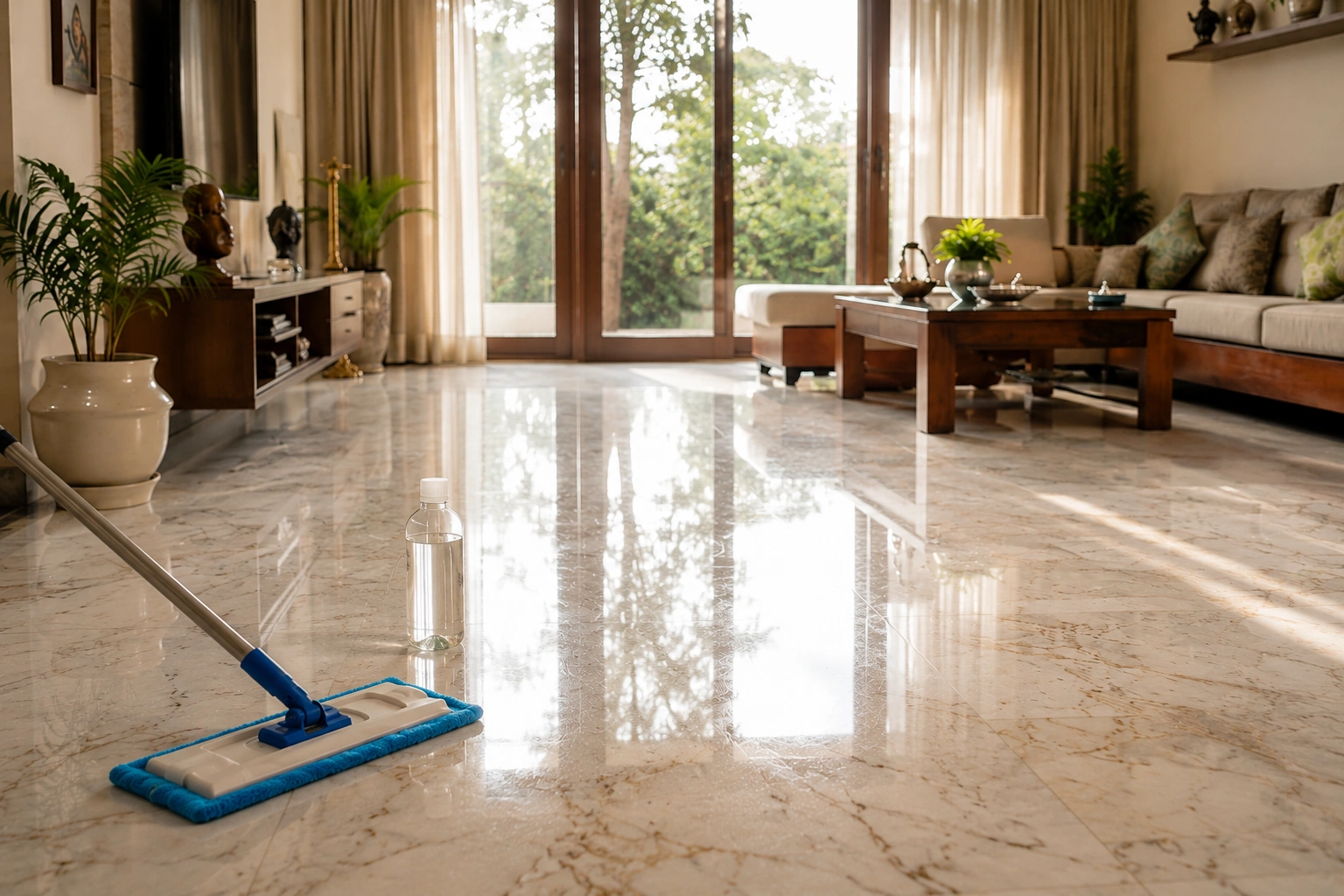
- Damp mop with clean warm water and a pH neutral cleaner for marble. Use a dedicated stone cleaner with a neutral pH (between 7 and 8). Apply the solution to a well-wrung microfiber mop, not a soaking wet mop. Marble should be damp-cleaned, not wet-flooded. Excess water sitting in grout lines and at edges causes long-term moisture damage.
- Do not let water pool or air-dry slowly. After mopping, dry the floor promptly with a clean dry microfiber cloth or let a fan run. Standing water, especially hard water from Indian municipal or borewell supplies, leaves calcium and mineral deposits on the marble surface over time.
- Wipe spills immediately. This is the single most important habit in marble floor care. A glass of fruit juice, a drop of vinegar, or a splatter of tomato gravy sitting on marble for ten minutes begins to etch the surface. Keep a soft cloth nearby in kitchens and dining areas at all times.
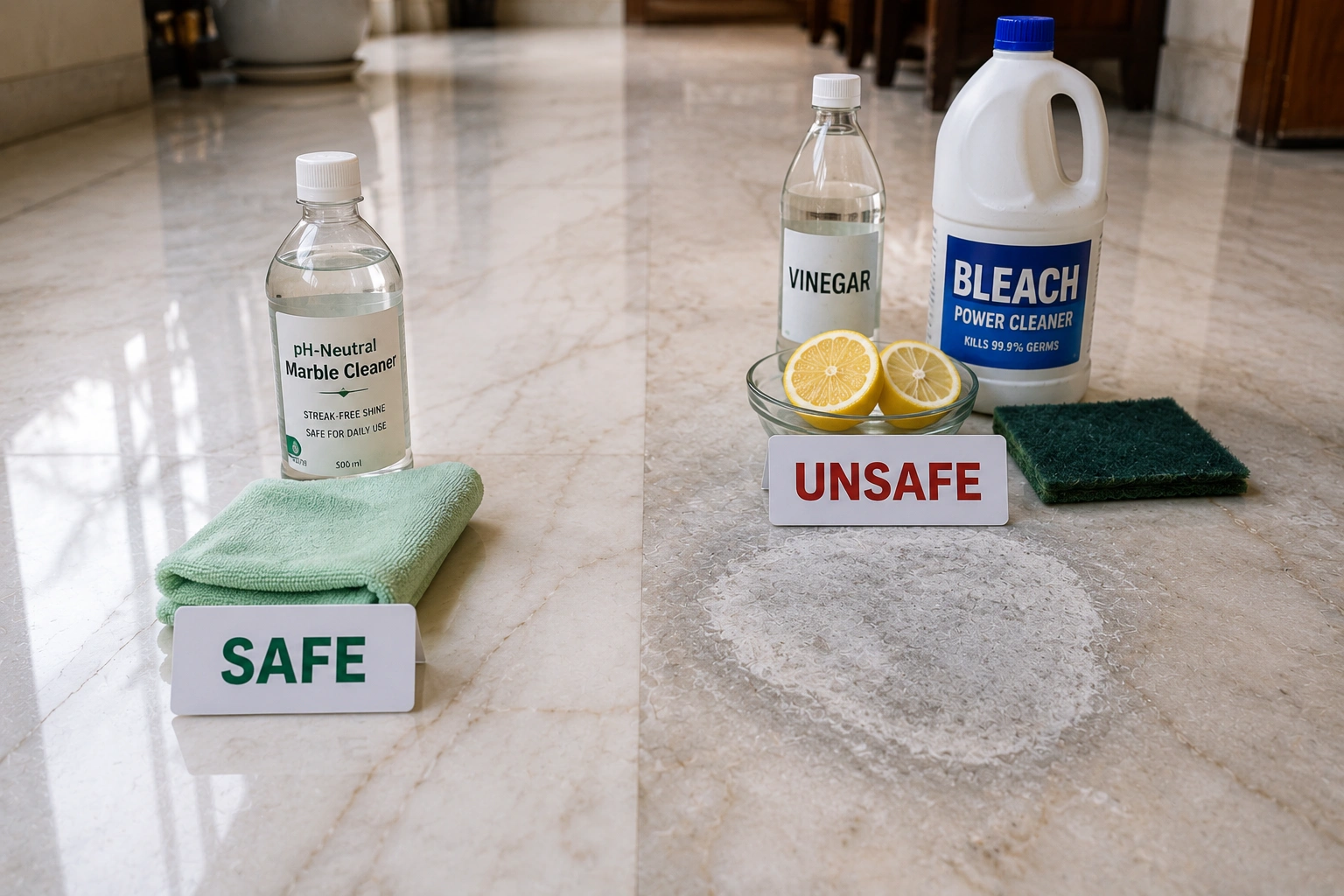
Safe vs Unsafe Products for Daily Marble Floor Cleaning
| Product | Safe? | Notes |
| pH neutral stone cleaner (labelled for marble) | Yes | Best daily marble tile cleaner; check the label for pH 7 to 8 specifically |
| Plain warm water | Yes | Acceptable for light daily cleaning; use distilled or filtered water in hard water cities |
| Mild dish soap (a few drops in warm water) | Occasionally | Tolerable very occasionally; builds residue over time if used daily; rinse thoroughly each time |
| Vinegar or lemon juice | Never | Acid etches marble permanently; most common cause of marble floor damage in Indian homes |
| Baking soda paste | Never | Mildly abrasive; scratches polished marble; also disrupts the sealer over time |
| Bleach or ammonia-based cleaners | Never | Breaks down the stone sealer; causes discolouration on coloured marble varieties |
| Multi-surface disinfectants (Lizol, Domex, Dettol Floor) | Never | Most contain acids or ammonia; not pH neutral; not safe for natural stone tile maintenance |
| Steel wool or abrasive scrubbers | Never | Scratches polished marble surface; causes permanent visible damage |
Weekly and Deep Cleaning for Marble Floors
Beyond daily sweeping and damp mopping, marble floors benefit from a more thorough weekly clean and a periodic deep clean every 2 to 3 months, depending on room usage.
Weekly Cleaning
Use a fresh pH-neutral solution: Prepare a bucket with warm water and the correct amount of stone cleaner as directed on the label. Do not estimate the amount. Too much cleaning leaves a residue on the marble surface that dulls the shine over time.
Mop in sections: For a large marble living room floor, mop in sections of about 6 to 8 sq. ft. at a time. Rinse the mop frequently so you are not redistributing dirty water across the floor.
Pay attention to marble grout cleaning: Grout between marble tiles absorbs dirt and household bacteria. Use a soft nylon brush (not metal) with the same pH neutral solution to clean grout lines gently once a week. This keeps buildup manageable without leading to permanent staining in the joints.
Dry promptly: Run a clean dry microfiber pad over the wet surface after mopping. In humid cities like Mumbai, Chennai, or Kochi during the monsoon season, moisture sitting on the marble floor longer than necessary contributes to mould growth in grout joints.
Deep Cleaning Every 2 to 3 Months
Deep cleaning for marble tiles uses the same products as weekly cleaning, but more thoroughly. Move furniture off the floor. Clean grout lines with a dedicated stone-safe grout cleaner that is pH neutral or very mildly alkaline. Let the cleaner sit for the time stated on the label, then scrub with a soft brush and rinse thoroughly.
After deep cleaning, check whether the marble surface needs resealing. Pour a few drops of water on different areas of the floor. If water beads and stays on the surface for at least 4 to 5 minutes, the sealer is holding. If water absorbs into the stone within a minute or two, resealing is due before the next use cycle.
Marble Stain Removal: Room by Room
Stains on marble fall into categories based on their chemistry. The removal method differs depending on what caused the stain, which is why a single cleaner does not handle all situations.
Stain Removal Quick Reference
| Stain Type | Common Source | Removal Method | What to Avoid |
| Turmeric (haldi) | Cooking, puja rituals | Paste of hydrogen peroxide (3%) and plain flour; leave 30 min covered; remove gently; rinse with water | Lemon juice or bleach; both etch and discolour marble further |
| Oil and cooking grease | Kitchen floor near the stove | Cornstarch or talcum powder over the stain; leave 30 min to absorb; brush off gently; clean with neutral stone cleaner | Scrubbing immediately; this spreads the oil deeper into the stone pores before it can be drawn out |
| Hard water stains (white mineral rings) | Municipal or borewell water; wet bathroom areas | Non-acidic hard water remover formulated for natural stone; damp cloth; gentle circular motion; rinse; dry buff | Acidic descalers, CLR, or bathroom fixture lime-scale removers; these etch marble severely |
| Soap scum removal | Bathroom floor and walls near shower | Stone-safe soap scum remover; soft cloth; rinse and dry buff thoroughly | Heavy scrubbing with abrasive pads; soap scum is surface-level and lifts with the right product |
| Ink or pen marks | Home office, study, writing areas | Small amount of acetone on a cotton ball; dab the stain; do not rub; rinse with water | Do not use acetone on coloured marble (green, pink, brown); it can lift the mineral colour from the stone |
| Coffee, tea, red wine | Living room, dining area | Blot immediately; hydrogen peroxide (3%) on a cloth held over the stain for a few minutes; rinse; repeat if needed | Carbonated soda water; carbonic acid in fizzy water also etches marble |
| Rust stains | Metal furniture legs, iron pipes near wet areas | Stone-safe rust remover specifically for natural stone; follow label; professional anti-stain treatment for deep rust | Standard rust removers and hydrochloric acid products; they damage marble severely and permanently |
| Agarbatti ash and kumkum | Pooja room, mandir area | Dry sweep first; damp cloth with warm water; for kumkum staining on white marble, hydrogen peroxide paste with flour left 20 min | Scented surface cleaners with disinfectants; most contain acids or ammonia that damage marble |
Water Stains on Marble: The Hard Water Problem in India
Hard water stains on marble surfaces are the most common complaint from Indian homeowners, particularly in Delhi, Jaipur, Ahmedabad, Hyderabad, and parts of Tamil Nadu where borewell and municipal water has high mineral content.
When hard water evaporates on marble, it leaves calcium and magnesium deposits behind. These look like white cloudy rings or a general dullness across the surface. The mistake most people make is reaching for an acidic descaler, which removes the mineral deposits but simultaneously etches the marble surface underneath, worsening the problem visibly.
The correct approach is a non-acidic hard water stain remover specifically made for natural stone. Apply on a damp cloth, rub gently in a circular motion, and rinse with clean water. For homes with chronic hard water problems, using distilled or filtered water for the final rinse after mopping significantly reduces weekly mineral buildup.
Marble Bathroom Cleaning: Specific Challenges
Marble bathroom cleaning faces two challenges not present in living rooms: constant moisture exposure and soap scum. The combination of hard water, soap, shampoo, and body oils creates a film on marble bathroom tiles that needs weekly attention.
After every shower, a quick squeegee of marble wall tiles and a dry-buff of marble floor tiles reduces cleaning effort dramatically over time. Where this is not practical, a weekly clean with a stone-safe bathroom cleaner handles accumulated soap film without affecting the marble. For grout in marble bathrooms, a soft nylon grout brush with the stone cleaner solution works for weekly upkeep. If mould appears in grout joints during the monsoon (common in Mumbai and Kerala homes), a stone-safe anti-mould grout cleaner addresses it without damaging the adjacent marble tiles.
Marble Kitchen Floor Maintenance
The kitchen is the hardest room in the house for marble tiles maintenance. Oil spatters, turmeric, acidic food liquids, and heavy foot traffic all affect the surface. Indian marble handles this significantly better than Italian marble, but no marble is fully immune.
The key in a kitchen is response time. Oil spilled on unsealed marble should be covered immediately with cornstarch or flour to draw it out before it penetrates the stone. Acidic spills (tamarind water, lemon juice, dal with tomato) need wiping within seconds. Sealing is not optional for marble in Indian kitchen floors; it must be done before the kitchen is used and renewed every 12 to 18 months in active cooking homes.
Marble Tile Sealing: When, Why, and How
Sealing is the single most protective step in marble tile care. A quality stone sealer fills the microscopic pores on the marble surface, slowing down liquid absorption and giving you more time to wipe spills before they stain.
Sealing does not make marble acid-proof. An acidic liquid on sealed marble still etches the surface if left long enough. The sealed marble surface primarily protects against oil, coloured liquid, and mineral deposit absorption into the stone body.
Sealing Frequency by Marble Type and Location
| Situation | Reseal When | Notes |
| New marble floor (any room, any type) | Before first use | Never occupy the space before sealing; first-use stains on unsealed stone are permanent |
| Italian marble (Carrara, Statuario, Calacatta) in any room | Every 12 to 18 months | High porosity; frequent resealing is mandatory in active households |
| Indian marble (Makrana, Rajnagar) in dry living rooms | Every 3 to 5 years | Dense stone; sealer lasts longer; do the water bead test before resealing |
| Any marble in bathrooms and kitchens | Every 12 to 18 months | Constant moisture and cleaning product exposure burns through sealers faster than in dry rooms |
| Marble in coastal cities (Mumbai, Kochi, Chennai, Vizag) | Every 12 months | Salt air and humidity accelerate sealer breakdown; Indian marble here also needs annual resealing |
| Marble in dry interior cities (Jaipur, Ahmedabad, Nagpur) | Every 2 to 4 years for Indian marble | Dry climate is gentler on sealers; Italian marble still needs 12 to 18 month intervals regardless of city |
How to Seal Marble Tiles: Step by Step
- Clean the marble thoroughly and let it dry completely for at least 24 hours. A clean, dry surface takes better sealer than a damp or dusty one.
- Choose a penetrating stone sealer specifically for marble. Penetrating sealers go into the stone pores and do not affect the polished finish. Topical sealers create a film on the surface that peels over time.
- Apply with a clean soft cloth or foam applicator in sections of 4 to 6 sq. ft. Spread the sealer evenly, let it absorb for the time on the label (usually 10 to 15 minutes), then wipe off any excess before it dries. Dried excess sealer leaves a haze.
- Apply a second thin coat after the first is absorbed. Two thin coats give more even and durable protective coating than one heavy application.
- Allow full curing before use. Most sealers need 24 to 48 hours before the surface is ready for foot traffic. Follow the label exactly on this.
Marble Floor Polishing and Shine Restoration
Marble floors lose their shine over time from foot traffic, cleaning product residue, and micro-abrasion from dust. The surface dulls gradually rather than all at once, which is why many homeowners do not notice until the change is significant.
At-Home Shine Restoration
For light dulling on polished marble, marble polishing powder applied with a soft cloth and buffed by hand or with a low-speed electric buffer can restore moderate shine. These products work by micro-abrading the surface to a fresh polish level. Work in small sections of 1 to 2 sq. ft. at a time for even results.
Marble polishing powder is widely available in Indian tile stores and online. It is mixed with water to a paste, applied to a small section, buffed with a soft cloth in circular motions, and then wiped clean. This marble shine restoration method works well for Indian marble in dry rooms with light dulling.
Professional Marble Polishing
For floors with visible etching, deep scratches, or overall loss of gloss across large areas, professional marble maintenance using industrial diamond polishing machines is the correct approach. Professional polishing uses progressively finer grit pads to restore the stone to its original finish level.
In Indian cities, professional marble polishing costs approximately Rs. 8 to Rs. 20 per sq. ft. depending on the marble type, the city, and how deep the restoration needs to go. Italian marble polishing sits at the higher end because the softer stone requires more careful handling. For a standard 3BHK with marble in the living room and master bedroom, professional polishing every 3 to 5 years for Indian marble and every 1 to 2 years for Italian marble is the right frequency.
Marble Tile Scratch Repair
Light surface scratches on polished marble can be addressed at home with marble polishing powder using the same method as shine restoration. Apply to the specific scratched area with gentle hand pressure.
Deep scratches that catch your fingernail when you run it across them need professional attention. Treating deep scratches at home with abrasive compounds without professional equipment often makes the repaired area visibly different in sheen from the surrounding floor.
What to Never Use on Marble Tiles
This section covers the cleaning mistakes Indian homeowners most commonly make with marble. Most of these feel logical because the products are natural, mild, or antibacterial, but all of them are chemically incompatible with calcium carbonate stone.
Vinegar, in any dilution: Acetic acid etches marble regardless of how much you dilute it. There is no safe dilution ratio. Even a mild white vinegar solution causes visible etching on Italian marble and dulling on Indian marble over repeated use. This is the most common cause of marble floor damage in Indian homes.
Lemon juice and citrus cleaners: Citric acid behaves identically to vinegar on marble. Natural citrus-based floor cleaners, however gentle they smell, are acid-based and etch marble surfaces with each application. Avoid any floor cleaner that lists citrus, lemon, or lime as a key ingredient.
Baking soda: Baking soda is mildly abrasive and slightly alkaline. The abrasive quality scratches polished marble surfaces. The alkalinity is less harmful than acid but disrupts the sealer over time with repeated use.
Bleach and ammonia-based cleaners: These break down the stone sealer and, with repeated use, affect the marble's crystalline surface. Bleach also discolours marble, particularly coloured Indian varieties like Kishangarh pink and Udaipur green.
Multi-surface disinfectant cleaners: Products like Dettol Floor, Lizol, and similar Indian household disinfectants are formulated for tiles that can handle chemical exposure. Most are not pH neutral and are not safe for marble tile cleaning. Use only if the label specifically states pH neutral and safe for natural stone.
Steel wool and abrasive scrubbers: Even the gentler green scotch brite pads scratch polished marble. Use only soft microfiber cloths or a soft nylon brush for grout lines.
High-pressure water jets: Pressure washing is not appropriate for marble floors. High-pressure water forces moisture into grout joints and any surface micro-cracks, contributing to moisture damage and sealer breakdown over time.
Expert Tips for Choosing Marble Cleaning Products
1. Look for pH 7 to 8 specifically, not just 'gentle' or 'natural': The label must state a pH value. Words like 'eco-friendly' and 'natural' say nothing about whether the product is safe for marble. A pH between 7 and 8 is the safe range for a marble tile cleaner.
2. Buy a penetrating stone sealer, not a general tile sealer: General tile sealers may not penetrate marble pores correctly. Look for products specifically labelled for natural stone or marble. Penetrating sealers (also called impregnating sealers) give better protection than topical sealers for marble.
3. Test any new product on a hidden area first: Before applying a new cleaner or sealer to the full floor, test it on a small area inside a cupboard or behind a door. Wait 24 hours and inspect for discolouration, hazing, or surface change before proceeding.
4. Stock marble polishing powder for light at-home maintenance: Marble polishing powder is available in tile stores across India and online. Keeping a small packet allows you to address light dulling or minor surface marks on your own schedule rather than waiting for a professional visit.
5. Use a dedicated microfiber mop for marble, separate from other floors: Residue from other cleaning products on a shared mop transfers to the marble surface with every use. Keep a separate clean microfiber mop specifically for marble floors.
6. Buy a stone-safe hard water stain remover if your city has hard water: In Delhi, Jaipur, Ahmedabad, Hyderabad, and most North Indian cities, hard water is unavoidable. A non-acidic hard water remover made for natural stone is more practical than letting calcium deposits build up to the point where professional removal is needed.
Common Mistakes in Marble Tiles Maintenance
Using kitchen or bathroom cleaners on marble as a shortcut: This is the most common and most damaging error. Indian households use whatever is under the sink to clean marble, which typically includes products with citric acid, bleach derivatives, or mild ammonia. These damage marble surfaces invisibly at first and then visibly after a few months.
Ignoring spills in the pooja room: Kumkum and haldi stains are treated as minor in most Indian homes. Left unwiped on white marble, they penetrate unsealed stone within minutes. The pooja room marble needs exactly the same immediate attention as the kitchen marble does.
White marble remains a preferred choice for mandirs because of its traditional appeal, but pooja spaces need quicker stain care than most homeowners expect. Learn why many families choose pooja room marble.
Mopping wet and leaving the floor wet: Excess water sitting on marble for extended periods causes moisture to work into grout joints. Over time this contributes to grout darkening, loosening, and mould growth, especially in ground-floor Indian homes with high ambient humidity.
Polishing marble without cleaning it first: Buffing a dirty or gritty marble surface drags abrasive particles across it under the polishing pad. Always clean the marble completely and let it dry before any polishing step.
Waiting too long to reseal: Most Indian homeowners seal marble once on installation and never again. By year two or three, the sealer in a bathroom or kitchen marble floor is gone. The floor looks fine to the eye but absorbs stains like an unsealed surface. The water bead test takes two minutes and tells you exactly when resealing is due.
Using the wrong grout cleaner: Many grout cleaners sold in India are acidic. They work on cement-based grout but etch the marble tiles immediately adjacent to the grout line at the same time. Always use a stone-safe grout cleaner, or work very carefully with a narrow brush and rinse the tile surface immediately after cleaning.
Keeping Your Marble Tiles Looking Good for Years
Marble tile maintenance is not complicated once you understand what the stone can and cannot handle. The right cleaner every day, quick spill response, sealing on schedule, and avoiding the very common mistake of acidic or abrasive products are the four habits that make the difference.
The difference between marble that looks fresh after ten years and marble that has been etched, stained, and dulled is almost entirely in the care routine, not in the quality of stone originally installed.
If you are still planning your marble floor and want to compare types that suit your household's lifestyle and your city's climate before buying, TilesFinders lets you explore marble tiles across Indian and Italian varieties, sizes, finishes, and price ranges from verified suppliers across India.
FAQs
Use a dry microfiber mop first to remove dust and grit, then damp mop with a pH neutral cleaner made for natural stone. Wring the mop well so the floor is damp, not wet. Dry the surface after mopping. Never use vinegar, lemon juice, baking soda, bleach, or standard multi-surface disinfectant cleaners on marble. These are the core rules of safe marble tile care.
A pH neutral stone cleaner labelled for marble or natural stone is the best marble tile cleaner for daily use. Look for a pH value stated on the label between 7 and 8. Products from brands like Lithofin, HG, and Black Diamond are widely available in Indian tile stores and online. Confirm the pH range before purchase; do not rely on words like 'gentle' or 'natural' alone.
Yes, permanently. Vinegar contains acetic acid. Acid dissolves calcium carbonate, which is what marble is made from. Vinegar on marble creates a permanently dull, rough patch called etching. This cannot be cleaned away; it can only be removed by professional polishing that grinds the surface back to a fresh level. This applies to any dilution of vinegar, including very mild solutions.
Italian marble in bathrooms and kitchens needs resealing every 12 to 18 months. Italian marble in living rooms needs resealing every 18 to 24 months. Indian marble in kitchens and bathrooms needs resealing every 12 to 18 months. Indian marble in dry living areas lasts 3 to 5 years per sealing. The water bead test confirms exactly when resealing is needed: pour a few drops of water on the floor; if it absorbs in under a minute, reseal immediately.
No. Baking soda is mildly abrasive and slightly alkaline. The abrasive quality scratches polished marble surfaces. Even though baking soda is often described as a gentle natural cleaner, it is not appropriate for marble. The best homemade approach for marble is plain warm water with a very small amount of mild dish soap used very occasionally, followed by a thorough rinse. A dedicated pH neutral stone cleaner is better than any homemade option.
Dust mop daily to remove grit that causes micro-scratches. Clean with a pH neutral cleaner and a well-wrung microfiber mop. Dry the surface after cleaning to prevent water mark buildup. Use marble polishing powder for light at-home marble shine restoration on dulled areas. Reseal on schedule. For full marble floor polishing across a large area, professional machine polishing every 2 to 5 years depending on marble type is the most effective approach.
Use a non-acidic hard water stain remover made for natural stone. Apply to a damp cloth and rub the area in gentle circular motions. Rinse with clean water and dry buff. Never use acidic descalers or lime-scale removers designed for bathroom plumbing or kitchen appliances; these etch marble badly. For preventing future buildup, use filtered or distilled water for the final rinse when mopping in hard water cities like Delhi, Jaipur, or Ahmedabad.
