Full Body Vitrified Tiles: When & Where to Use Them
May 26, 2026 66
Learn where full body vitrified tiles work best for outdoor floors, staircases, parking, and heavy-traffic spaces. Compare finishes, sizes, durability, and pricing in India.
Pick up any standard vitrified tile and look at its edge. The top surface carries the design and colour. Below that thin surface layer, the tile body is a different colour entirely, usually grey or off-white. Now imagine that tile chipping at a corner or an exposed edge in a staircase, a countertop, or a doorway threshold. The chip reveals a different-coloured body, and no amount of grouting conceals it.
Full-body vitrified tiles are built so that this problem does not occur. The colour and design run through the entire thickness of the tile body. A chip at the edge reveals the same material as the surface. That single structural difference is what defines when and where full-body tiles belong, and why architects, commercial contractors, and serious residential renovators specify them for particular situations that other vitrified categories cannot handle as well.
What Makes Full Body Vitrified Tiles Different from Every Other Category
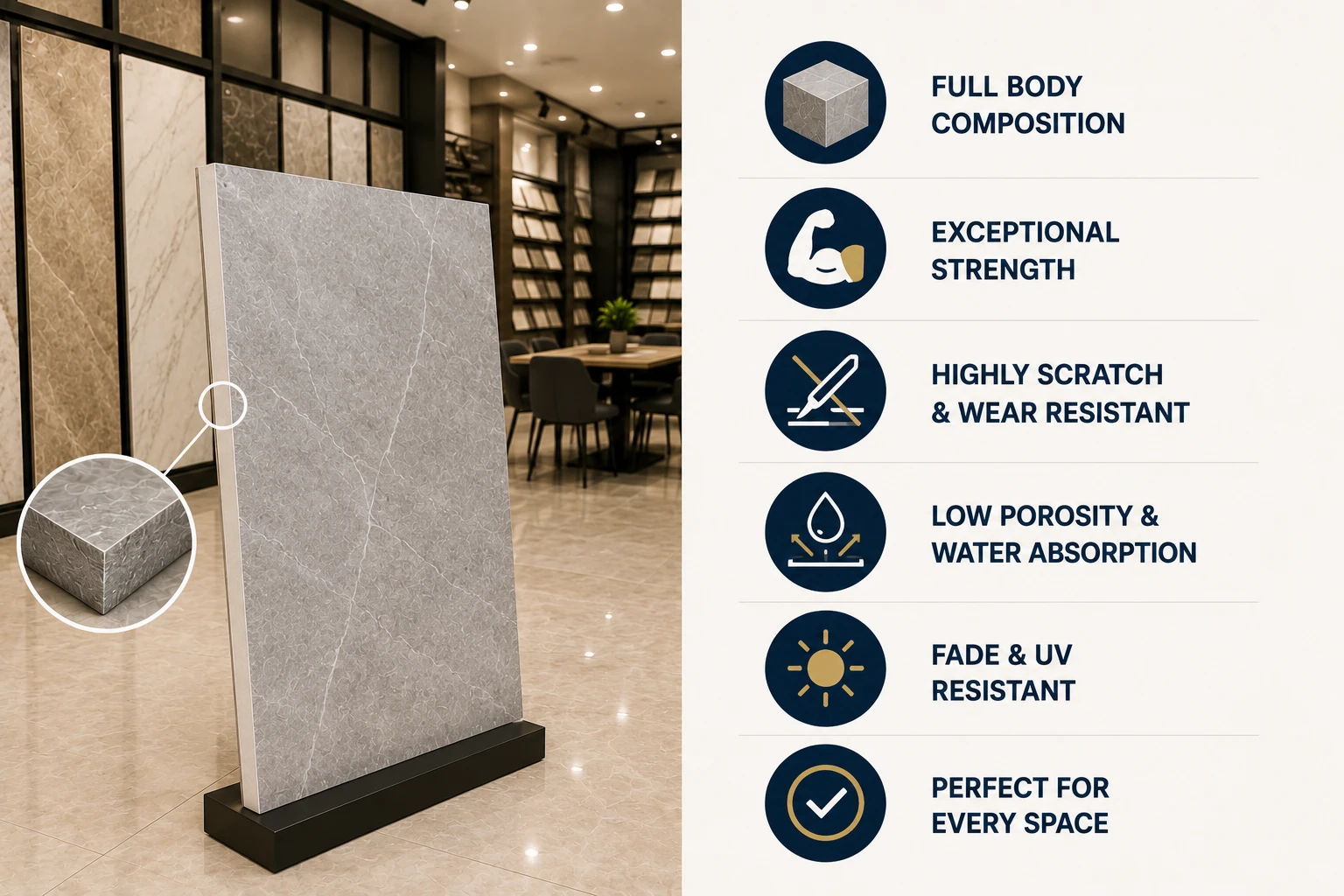
In GVT, PGVT, and double charge tiles, the design is carried in a surface layer: a digital glaze in GVT and PGVT, a compressed pigment layer in double charge. That surface layer, however thick, sits on top of a vitrified body whose colour does not match the design. In full-body tiles, the pigment is mixed into the tile material before pressing and firing. The colour and design are homogeneous throughout the entire tile thickness.
This makes full-body tiles the leading chip-resistant floor tiles for applications where tile edges are exposed, where impact is a regular risk, and where the installation must look consistent even if individual tiles are damaged or cut. In standard interior flooring with grouted edges and skirting tiles, this advantage is theoretical. In outdoor spaces, commercial kitchens, parking areas, staircases, and countertop edges, it is a practical daily reality.
Beyond edge consistency, full-body tiles share the vitrified category's core properties: water absorption below 0.05%, stain resistance without sealing, and the strength that makes vitrified tiles the preferred category for both residential and commercial Indian interiors. The homogeneous body adds to these properties rather than replacing them.
If you also want to compare full-body tiles with GVT, PGVT, and double charge categories, read our complete vitrified tiles buying guide for Indian homes.
Where Edge Integrity Actually Matters
Edge integrity is not a concern in most standard interior flooring situations. When tiles are laid on a floor with grout joints and skirting tiles covering the perimeter edges, neither chipping at hidden edges nor colour mismatch at exposed cuts is visible. In these conditions, GVT or double charge delivers comparable daily performance to the full body at a similar or lower cost.
Edge integrity becomes a real specification requirement in specific situations:
| Situation | Why Edge Integrity Matters Here | Full Body Advantage |
| Staircase nosing and treads | Stair edges take direct impact from footfall. Chips at stair nosings are visible and dangerous. | Chip reveals the same colour as the surface. No colour mismatch at worn stair edges. |
| Countertop and kitchen platform edges | Counter edges are cut and exposed without grout covering. Any chip is immediately visible. | Cut edge shows the same design material as the surface. Clean, consistent edge finish. |
| Outdoor pathways and garden edges | Outdoor tiles at path edges are exposed to impact from garden tools, furniture, and foot traffic. | Homogeneous body handles edge impact without revealing a different-coloured base. |
| Commercial floor edge transitions | In large commercial floors, tile edges at doorways, column bases, and wall junctions are exposed. | Consistent edge colour maintains the professional finish in client-facing spaces. |
| Swimming pool surrounds and wet deck areas | Pool edge tiles are cut to size and the cut edge is often visible. Wet conditions accelerate wear. | Full body handles wet conditions and the visible cut edge stays consistent in colour. |
| Window sills and architectural ledges | Narrow sills require cut tiles where the edge is always visible. Other categories show a grey body at the cut. | Cut edge in full body matches the tile face, giving a finished appearance without additional edging. |
Full Body Tiles for Outdoor: The Strongest Use Case
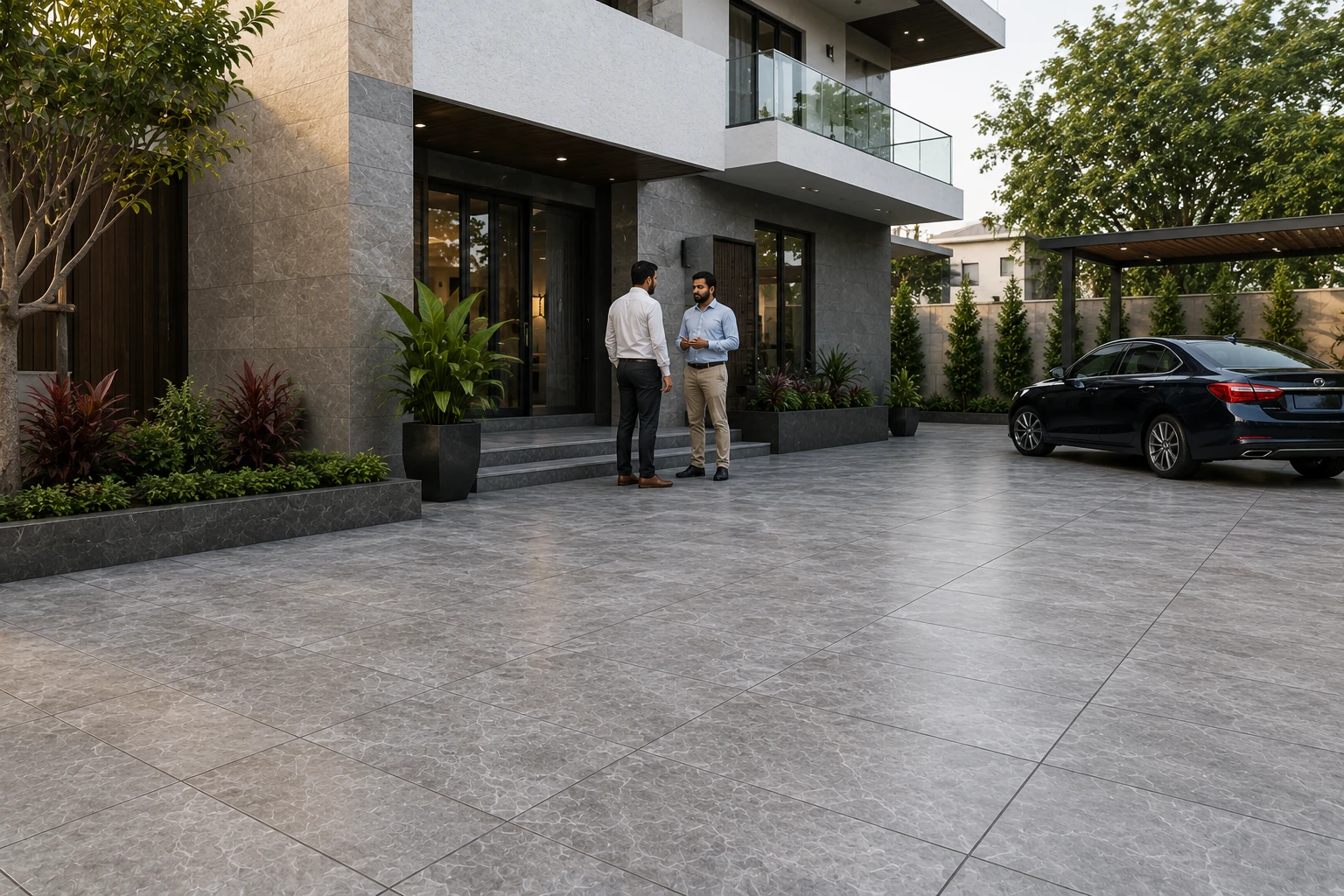
Full-body tiles for outdoor applications are the single most differentiated use case for this category. GVT in a matte or GHR finish handles outdoor conditions. Full-body tiles in a matte or textured finish handle outdoor conditions with an additional structural property: the homogeneous body expands and contracts more uniformly throughout the tile thickness under Indian outdoor temperature cycling than surface-glazed tiles, which have different expansion rates between the glaze layer and the body.
In Indian outdoor conditions, tiles are exposed to monsoon water saturation followed by intense summer heat. This cycling stresses the interface between the surface glaze and the tile body in GVT. Full body tiles have no such interface to stress. The same material runs through the thickness, and thermal expansion is consistent throughout.
Full body for parking areas, driveways, and car porches. Combine this structural advantage with the weight-bearing capacity needed for vehicle loads. The homogeneous vitrified body in full-body handles the compressive load of a car or two-wheeler better than tiles with a thin glaze layer over a softer base body. Sizes suited for parking are 2x2 (600x600 mm) and 2x4 (600x1200 mm) in a matte, or GHR finish for anti-skid grip on a surface that receives rainwater and oil drips.
Other outdoor applications where full body is the correct specification: building elevation cladding, terrace flooring, garden pathways, outdoor commercial corridors, and swimming pool surrounds. In all of these, the tile faces direct weather exposure, possible impact, and conditions where edge visibility is common.
Full Body Vitrified Tiles for Flooring: Room by Room
Full body vitrified tiles for flooring cover a wider application range than double charge because they are available in a matte finish suitable for wet areas, unlike double charge, which is polished only.
| Room / Area | Full Body Suitable? | Recommended Finish | Recommended Size | Notes |
| Living room floor | Yes | Matte or polished | 2x2 or 2x4 | Works well. GVT is often sufficient here. Full body is worth specifying when exposed edges are present at room junctions. |
| Kitchen floor | Yes | Matte or GHR | 2x2 or 2x4 | Matte full body handles cooking water and wet mopping safely. Anti-skid grip in matte finish is maintained. |
| Bathroom floor | Yes | Matte or GHR | 2x2 or 1x1 | Full body for bathroom flooring handles wet conditions. Anti-skid matte finish prevents slipping. |
| Bedroom floor | Yes | Matte or polished | 2x2 or 2x4 | GVT is typically sufficient. Full body is over-specified unless edge visibility or outdoor connection warrants it. |
| Hallway and entrance | Yes | Matte or GHR | 2x2 or 2x4 | High-traffic dry zone. Full body holds up well. Double charge is also strong here. |
| Staircase treads and nosing | Yes. Recommended. | Matte or GHR | 2x2 cut to tread width | Full body's edge consistency is the key advantage here. Other categories show body colour at stair nosing edges. |
| Commercial floor (office, lobby) | Yes | Matte or polished | 2x4, 6x4, or 8x4 | Strong choice for commercial floors with exposed edges at column bases and wall junctions. |
| Parking and driveway | Yes. Recommended. | Matte or GHR | 2x2 or 2x4 | Best tile category for vehicle-load outdoor flooring with edge exposure. |
| Outdoor terrace and garden path | Yes. Recommended. | Matte or GHR | 2x2 or 2x4 | Full-body handles Indian outdoor weather cycling better than surface-glazed tiles. |
| Swimming pool surround | Yes | Matte or GHR | 2x2 | Wet edge conditions make full body's consistent cut edge a practical advantage here. |
Full body tiles for bathroom floors in a matte or GHR finish are a strong choice specifically because the tile handles both the water exposure and the cutting required around floor drains, toilet bases, and bathroom door thresholds. At these cut and exposed points in a bathroom, the full body's colour consistency through the tile thickness keeps the floor looking finished.
Full body tiles for commercial floor applications in lobbies, office corridors, and retail spaces combine the edge-consistency advantage with the wide size range. In large commercial spaces where tiles are cut around column bases, drainage channels, and service entry points, every cut is a potential edge exposure. Full body eliminates the colour mismatch at those points.
Large Format Full Body Tiles: Sizes and What They Work For
Large-format full-body tiles are one of the strongest arguments for specifying this category in premium residential and commercial projects. Full body is available in sizes that GVT also covers and extends to slab formats: 2x2, 2x4, 32x64 (800x1600 mm), 6x4 (1200x1800 mm), 8x4 (1200x2400 mm), 32x96 (800x2400 mm), and 32x120 (800x3000 mm).
In large-format applications on outdoor terraces, building elevations, and commercial floors, the edge-consistency advantage of full body becomes more pronounced. A 6x4 or 8x4 full-body slab panel on a building elevation or a terrace floor has many more exposed cut edges than a small-format tiled surface. At this scale, the difference between a tile that shows a grey body at every cut edge and one that shows the same design material is significant in the finished appearance.
For indoor residential use, large-format full-body tiles in 2x4 or 32x64 on living room floors with visible edge junctions, open-plan kitchen-to-living transitions, or staircase landings give a seamless appearance that smaller-format tiles with multiple grout lines do not.
Full Body Tile Design Range
Full body marble tiles in a white or cream base with grey or beige veining are the most popular design within this category, appearing in living rooms, lobbies, and outdoor terraces where the marble aesthetic is wanted with the structural performance of a homogeneous body. The veining in a full-body marble tile runs through the tile thickness, which means a cut edge shows veining rather than a plain grey body.
Beyond marble-look tiles, full-body tiles are available in stone-look (slate, sandstone, granite-style), solid colour (white, cream, beige, grey, charcoal), and concrete-look designs. The design range is narrower than GVT, which benefits from digital printing at higher resolution and a wider finish variety. Full body's design complexity is limited by the pigment-mixing process, which produces more uniform and less intricate patterns than digital glazing.
Finishes available in full body include matte, GHR, polished, and textured surfaces. The matte and GHR finishes are the most commonly specified for outdoor and wet-area floor use. Polished full body is used in indoor feature walls and dry commercial floors. Textured full body in a high-depth relief finish is used for building elevation cladding and outdoor accent walls.
Full Body Tiles vs Double Charge and GVT: Where Each Wins
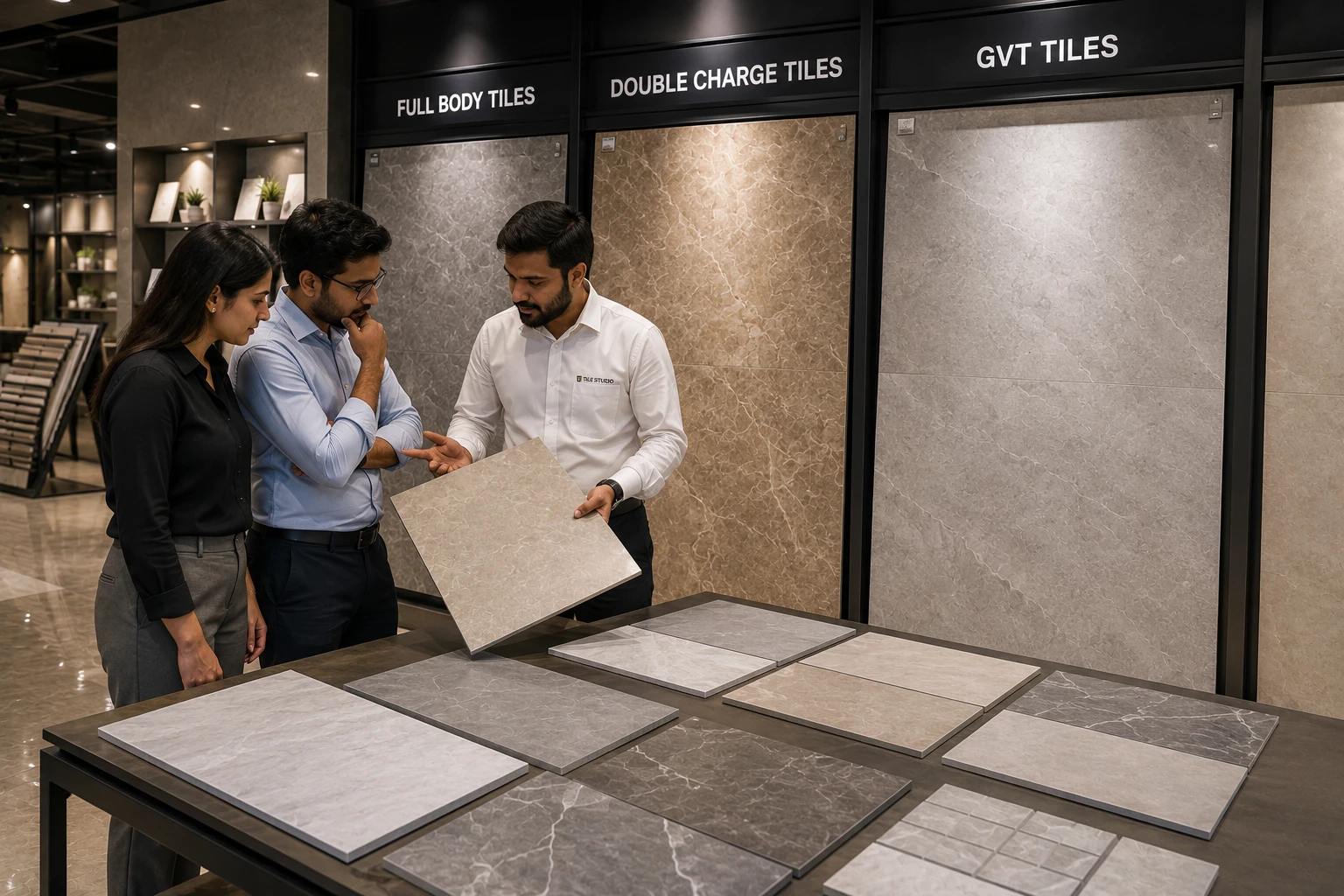
Full body tiles vs double charge is the most direct comparison for high-durability floor applications. Both categories are stronger than standard GVT for heavy-use floors, but they win in different situations.
Double charge wins on: scratch resistance at the polished surface for dry high-traffic indoor floors, cost-effectiveness for large commercial indoor areas like mall concourses and hotel lobbies, and the specific construction where 2 to 3mm of design depth handles surface abrasion better than GVT's thinner glaze in those conditions.
Full body wins on: outdoor and wet-area floor use (double charge is polished and slippery in wet conditions, full body in matte or GHR is anti-skid), edge consistency at exposed cuts and stair nosings, building elevation and façade cladding, swimming pool surrounds, and any application where the tile edge is visible. Full body also has a wider size range extending to 32x120 slabs, while double charge tops out at 2x4.
Against standard GVT, full body's primary advantage is edge consistency and outdoor durability. GVT wins on design variety (wider range of digital prints and finishes), indoor wall use, wood-look plank format (8x48 in 200x1200 mm, not available in full body), and price for applications where edge exposure is not a concern. For most standard indoor floors and walls, GVT tiles in the right finish are a practical and cost-effective choice. Full body is specified when the structural or edge-related properties it uniquely offers are genuinely needed.
Full Body Vitrified Tiles Price in India
Full body vitrified tiles price in India runs from approximately ₹90 to ₹200 per sq. ft. for standard sizes in domestic designs. Large-format slab sizes in 6x4, 8x4, and 32x96 reach ₹150 to ₹300 or more per sq. ft., depending on the design, finish, and brand.
Full body tiles are priced higher than standard GVT and double charge because the homogeneous body requires more raw material pigment through the full tile thickness, and the manufacturing process is more material-intensive than applying a surface glaze or a top layer. The price premium over GVT at comparable sizes is typically 20 to 40 percent, which is worth evaluating against the specific application. For outdoor and edge-exposed installations where full body's properties genuinely apply, the premium reflects real structural value. For standard indoor floors where edge exposure is not an issue, GVT at a lower price delivers comparable daily performance.
All prices are approximate and vary by brand, dealer city, finish, and order volume. Commercial bulk orders typically negotiate below catalogue pricing.
What to Confirm Before Buying Full Body Vitrified Tiles
Confirm the tile is genuinely full body, not Colour Body. Colour Body vitrified tiles have a body shade that matches the surface design, but are not fully homogeneous through the entire thickness. They are often marketed similarly and look the same as a sample. Ask for the technical data sheet confirming the tile type as full body before ordering for applications where homogeneous edge colour matters.
Match the finish to the application. Matte and GHR finish full body for any outdoor, wet-area, or high-traffic floor. Polished full body only for dry indoor floors and walls. Textured or high-depth relief only for wall cladding and elevation, not for floors. Confirm the finish before ordering.
Check the size range for your specific application. Full body is available in 2x2, 2x4, 32x64, 6x4, 8x4, 32x96, and 32x120. Not every design or finish is available in every size. Confirm that the specific combination of design, finish, and size you need is available from your supplier before finalising the specification.
For outdoor installation, confirm the slip resistance rating. Anti-skid performance varies within the matte and GHR finish category depending on the surface texture depth. For parking floors and outdoor areas that will be wet from monsoon rain, confirm the slip resistance rating (coefficient of friction) with the supplier rather than assuming matte finish alone is sufficient.
Buy 12 to 15% more than the measured area. Full-body tiles in large formats generate more cutting wastage per cut than small-format tiles. For outdoor installations with irregular boundaries, staircase applications, and countertop edges, wastage can exceed 15% in complex layouts. Buffer stock also protects against future batch colour variation in repairs.
Compare Full Body Vitrified Tiles by Finish, Size, and Application on TilesFinders
Full-body vitrified tiles are not the right specification for every situation. For standard indoor floors and walls where edges are covered, and outdoor conditions do not apply, GVT at a lower price delivers comparable daily performance.
Full body is the right specification when the tile edge will be visible: staircases, countertops, parking floors, outdoor terraces, building elevations, and commercial floors with exposed edge junctions. In those situations, the homogeneous body earns its price premium by eliminating the edge colour mismatch that other vitrified categories cannot avoid.
You can browse full-body vitrified tiles by size, finish, design, and application on TilesFinders to compare options from Indian manufacturers and shortlist before visiting a showroom.
FAQs
A full body vitrified tile is a type of vitrified tile where the colour and design pigment is mixed into the tile material before pressing and firing, running uniformly through the entire tile thickness. Unlike GVT, PGVT, and double charge tiles, where the design is carried in a surface glaze or top layer, full body tiles have no separate surface layer. The result is a homogeneous tile where a chip or cut at any edge reveals the same colour and material as the surface. This makes full-body tiles the preferred choice for applications where tile edges are visible and edge colour consistency matters.
It depends on the application. Full body tiles are better for outdoor flooring, parking areas, staircases with exposed nosings, countertop edges, building elevations, and any installation where the tile edge is visible and colour consistency through the thickness matters. GVT is better for standard indoor floors and walls where edges are covered, because GVT has a wider range of digital print designs, more finish options, including the wood-look plank format, and a lower price for equivalent daily performance in those situations. In short: full body when edge integrity or outdoor use is the specification driver, GVT for most standard indoor applications.
Yes. Full-body vitrified tiles in a matte or GHR finish are one of the best tile categories for outdoor use in India. The homogeneous body expands and contracts more uniformly under Indian outdoor temperature and monsoon humidity cycling than surface-glazed tiles. The anti-skid matte or GHR finish handles rainwater safely. Full body is appropriate for outdoor terraces, garden paths, car porches, parking areas, building elevations, and swimming pool surrounds. Polished full body, like all polished vitrified finishes, should not be used on outdoor floors where rain contact makes the surface slippery.
Full-body vitrified tiles in India cost approximately ₹90 to ₹200 per sq. ft. for standard sizes (2x2 and 2x4) in domestic designs and finishes. Large-format sizes in 6x4, 8x4, and 32x96 slab formats range from approximately ₹150 to ₹300 or more per sq. ft., depending on design and brand. Prices are approximate and vary by city, dealer, finish, and order volume. Full-body tiles are typically 20 to 40 percent more expensive than comparable GVT tiles because the homogeneous body requires more pigment material through the full tile thickness.
Full body tiles are the strongest specification for rooms and areas where edge exposure, outdoor conditions, or wet-area floor use are the key concerns. Specifically: outdoor terraces, parking and driveways, staircases, kitchen countertop edges, bathroom floors, commercial floors with exposed edge junctions at columns and doorways, and building elevation cladding. For standard indoor rooms like living rooms and bedrooms where tile edges are covered and outdoor conditions do not apply, full body's advantages over GVT are less practically relevant, though the tiles perform well in those rooms too.
Yes. Full body vitrified tiles handle heavy foot traffic well because the vitrified body is strong and the homogeneous construction distributes load stress evenly through the tile thickness without the glaze-to-body interface that can delaminate under extreme pressure or thermal cycling. For indoor heavy-traffic dry floors like hotel lobbies and mall concourses, double charge vitrified is slightly more cost-effective because its polished surface has higher scratch resistance. For outdoor heavy-traffic floors like car parks and commercial courtyards, full body in a matte or GHR finish is the stronger choice because double charge's polished surface is not safe on wet outdoor surfaces.
Full body tiles can chip at edges under direct impact like any tile, but the chip reveals the same colour and material as the tile surface rather than an exposed grey or off-white base body. In practical terms, this means that edge damage in a full body installation is far less visually disruptive than the same damage in a GVT, PGVT, or double charge tile. A chipped stair nosing in a GVT tile shows a grey body and is immediately visible. The same chip in a full body tile shows the same stone or marble colour as the rest of the tile face and reads as a minor surface mark rather than structural damage.
