Best Vitrified Tiles for Living Room Floor: 2026 Picks
May 27, 2026 40
High-gloss glare or calm matte? Discover 2026's top 5 vitrified tile trends for Indian living rooms, featuring large-format concrete looks and stain-proof, wood-grain planks.
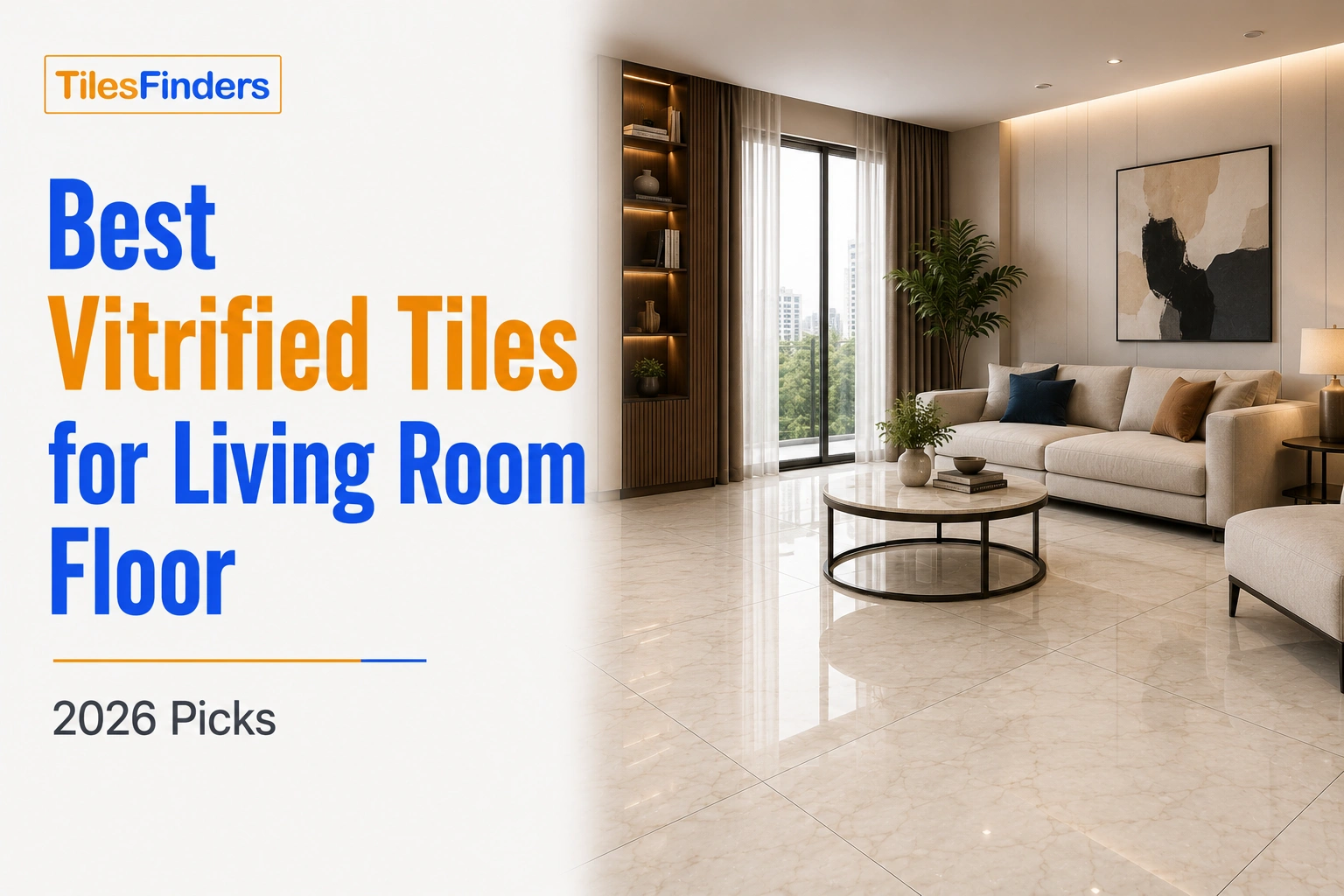
The living room floor is the first surface a visitor's eye lands on when they enter an Indian home. Before the sofa, before the TV unit, before the curtains, the floor sets the character of the room. Vitrified tiles for living room floor applications dominate Indian residential renovations for one practical reason: they hold their appearance through years of daily foot traffic, hard water mopping, and the physical demands of a room that is genuinely used every day.
Living room tiles design 2026 is moving in clear directions. Large formats are reducing grout lines. Marble-look prints are carrying more detail. Wood-look planks are warming open-plan layouts. Matte finishes are replacing high-gloss as the default in contemporary homes.
This guide covers the five design picks that are working in Indian living rooms this year, followed by a size guide, finish guide, category recommendation, and price breakdown to help make the decision before showroom visits. If you also want a broader understanding of vitrified tile categories like GVT, PGVT, double charge, and full-body tiles before choosing your living room flooring, read our complete vitrified tiles buying guide for Indian homes.
What the Living Room Floor Needs to Do in 2026
Floor tiles for living room spaces in Indian homes carry a different set of demands than any other room. The living room sees more daily foot traffic than the bedroom, more entertaining use than the kitchen, and more visual scrutiny than the bathroom. The floor needs to look good in morning light, afternoon glare, and evening lamp glow simultaneously. It needs to handle wet mopping after Diwali celebrations and dry sweeping through dusty Rajasthan summers without degrading in appearance.
The tile also has to age gracefully with the furniture around it. Sofas get changed. TV units get upgraded. The floor lasts for fifteen to twenty years. A tile choice that looks contemporary in 2026 but ties too tightly to a specific passing trend will age poorly. The picks in this guide balance current design relevance with visual staying power.
Five Vitrified Tile Design Directions Trending in 2026
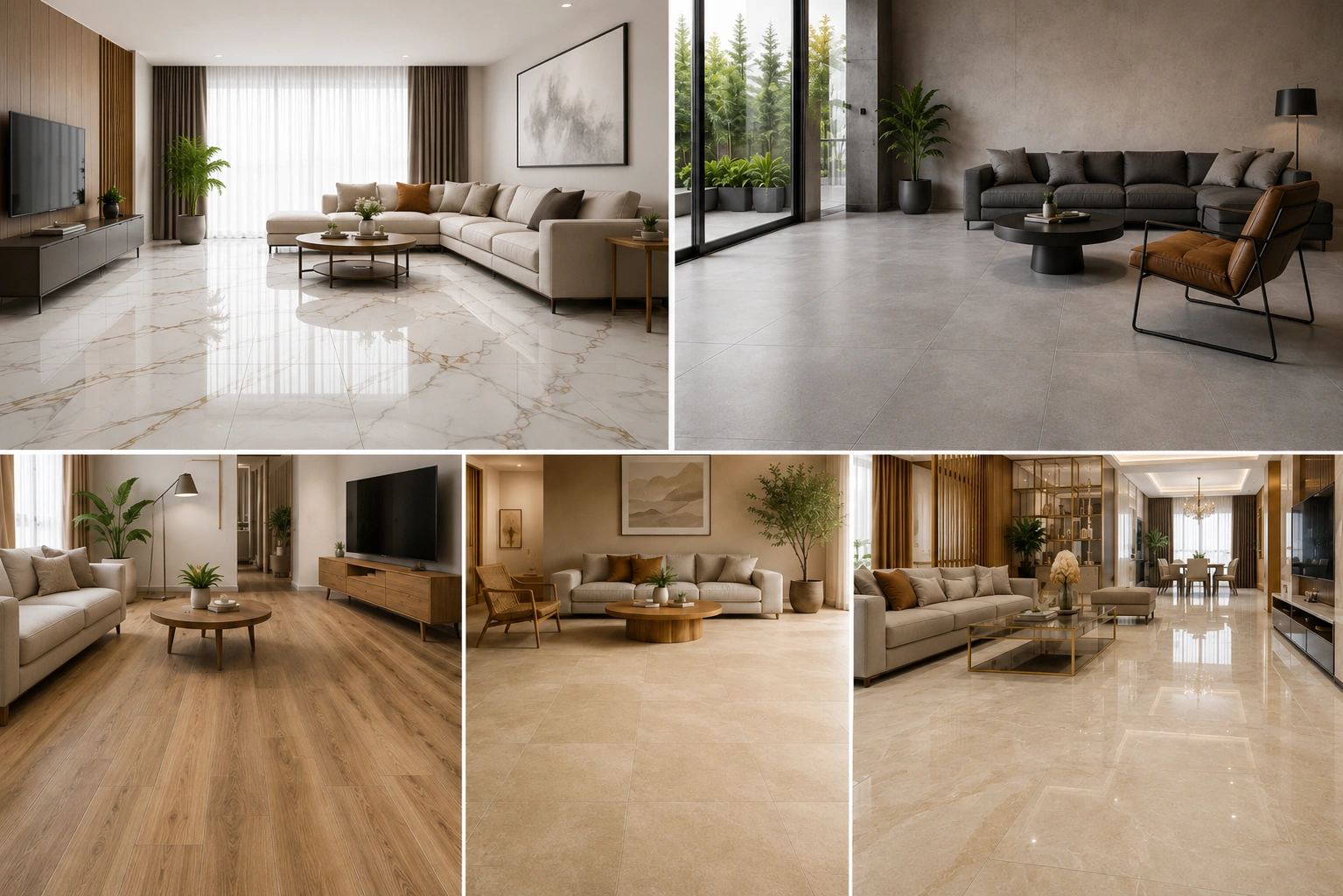
Pick 1: Marble-Look in Large Format
Marble-look tiles for living room floors are the dominant design direction in Indian residential interiors in 2026. The Statuario white with soft grey veining on a 2x4 (600x1200 mm) GVT tile in a matte or glossy finish covers the largest share of renovation projects in metros and Tier 1 cities this year.
Material: GVT in matte or glossy finish for the floor. Look: Statuario, Calacatta, or Carrara marble-look print. Size: 2x4 (600x1200 mm) for rooms above 150 sq. ft., 2x2 (600x600 mm) for smaller rooms. The matte tiles are the more practical choice for a living room floor: it does not show dust footprints between cleanings, handle wet mopping safely, and do not create glare under direct sunlight. Glossy finish gives a brighter, more reflective appearance that works in rooms with controlled lighting but shows every smudge in bright natural light.
Pairs with: PGVT marble-look in the same design family on the feature wall behind the sofa or TV unit. The floor in matte and the wall in polished is the standard premium combination for Indian living rooms in 2026. Pairs with white, grey, off-white, or navy cabinetry and furniture.
Pick 2: Large Format Concrete or Stone-Look
Large-format tiles for living room floors in a concrete-look or grey stone-look design are the strongest minimal-modern direction in 2026. A 2x4 or 32x64 (800x1600 mm) GVT tile in a warm grey concrete finish in matte or GHR surface reads as architectural and understated in a way that marble-look does not.
Material: GVT in matte or GHR finish. Look: concrete-look, slate-look, or grey stone-look. Size: 2x4 or 32x64. The large format in this look works particularly well in open-plan apartments where the living room connects to the dining area and the same tile runs across both spaces, eliminating the floor-level visual break between the two zones.
Pairs with: warm wood furniture, white or off-white walls, brushed metal hardware, and pendant lighting. The concrete-look floor grounds an otherwise light interior without adding visual weight in the way a dark-coloured tile would. Works in both 2BHK and larger 3BHK living rooms.
Pick 3: Wood-Look Plank Tiles
Wood look tiles for living room floor applications in the 8x48 plank format (200x1200 mm) are the fastest-growing residential floor trend in Indian cities in 2026. The plank tile brings the warmth and visual character of timber to the living room without the warping, termite risk, and maintenance burden of real wood flooring.
Material: GVT in matte finish in the 8x48 (200x1200 mm) format. Look: oak, walnut, or teak wood-grain print. The 8x48 format is available in GVT only and comes in matte finish, which is anti-skid and practical for a living room floor that gets daily mopping. Mid-tone oak or warm walnut finishes are the most popular for Indian living rooms. Very dark wood-look (ebony, wenge) shows every dust particle and is harder to maintain in north Indian cities with high ambient dust.
Pairs with: white or cream walls, Scandinavian-influenced furniture with clean lines, hanging pendant lights, and indoor plants. Works best in open-plan living rooms of 150 sq. ft. or more where the plank length reads well. In very small living rooms below 100 sq. ft., the long plank format can make the floor feel striped rather than expansive.
Pick 4: Matte Stone Tiles in Warm Neutral Tones
Matte floor tiles for living room spaces in beige, warm cream, sand, or taupe tones are the design pick for homeowners who want a floor that does not read as a statement but ages the best of any option. The warm neutral matte GVT in 2x2 or 2x4 is the tile equivalent of a well-painted wall: it supports everything placed on or around it without competing.
Material: GVT in matte finish. Look: stone-look, sandstone-look, or plain solid warm neutral. Size: 2x2 or 2x4. This pick is deliberately not marble-look or wood-look: it is a plain or subtly textured matte in a warm earth tone that does not date. It pairs with any sofa colour, any wall colour, and any furniture style from traditional to contemporary.
Particularly strong choice for joint family homes where the living room sofa, curtain, and furniture change every eight to ten years. The floor does not need to be updated to match the new furniture; a warm neutral matte always coordinates. Also works well in north and west-facing rooms where natural light is limited, since a warm tone compensates for the cooler ambient light.
Pick 5: High-Gloss Large Format for Open-Plan Luxury
Luxury floor tiles for living room spaces in a high-gloss GVT or PGVT polished finish in 2x4 or larger slab formats are the premium direction for open-plan apartments and villas where the living room is a design statement. A PGVT 2x4 in a marble-look or solid cream-white polished finish on the living room floor makes the space feel larger and brighter, particularly in south and west-facing rooms where the high-gloss surface amplifies available light.
Material: PGVT polished or GVT high-gloss finish. Look: marble-look in Statuario, Calacatta, or plain white-cream. Size: 2x4 or 32x64. The important caveat: high-gloss and polished tiles on living room floors show every footprint, smudge, and dust particle between cleanings. In families with children, elderly members at slip risk, or pets, the matte or GHR finish picks above are more practical. This pick suits adult-occupied contemporary apartments where cleaning frequency can be maintained.
Pairs with: dark charcoal or navy feature walls, minimal furniture, brass or matte gold accessories, and directional recessed lighting that makes the polished floor reflect light intentionally rather than randomly.
2026 Living Room Floor Tile Trend Summary
| Design Pick | Material | Look | Finish | Best Size | Trending Most In |
| Marble-look large format | GVT | Statuario or Calacatta marble | Matte or glossy | 2x4 | Metro apartments, 3BHK and 4BHK renovations, all cities |
| Concrete or stone-look | GVT | Concrete-look, grey slate-look | Matte or GHR | 2x4 or 32x64 | Open-plan apartments, contemporary homes, Bangalore, Mumbai |
| Wood-look plank | GVT | Oak, walnut, teak wood-grain | Matte only (8x48 format) | 8x48 | Tier 1 cities, Scandinavian-influenced interiors, new 3BHK flats |
| Warm neutral matte | GVT | Stone-look, sandstone, plain solid | Matte | 2x2 or 2x4 | Joint family homes, north-facing rooms, traditional to contemporary |
| High-gloss luxury | PGVT or GVT high-gloss | Marble-look or plain white-cream | Polished or high-gloss | 2x4 or 32x64 | Premium villas, luxury apartments, adult-occupied contemporary homes |
Choosing the Right Tile Size for Your Living Room
Tile size changes how a living room feels before colour or design does. A large-format tile in a small room can feel overwhelming. A small-format tile in a large room creates too many grout lines and reads as fragmented.
| Living Room Area | Recommended Size | Why | Avoid |
| Below 100 sq. ft. (compact 1BHK or 2BHK) | 2x2 (600x600 mm) | Proportionate to the room. Does not require heavy cutting at edges. | 2x4 or larger; overscales the room and generates significant cutting wastage. |
| 100 to 150 sq. ft. (standard 2BHK or 3BHK) | 2x2 or 2x4 (600x1200 mm) | 2x4 reduces grout lines without overwhelming the room dimensions. | 8x4 or slab sizes; too large for standard room widths without heavy cuts. |
| 150 to 250 sq. ft. (large 3BHK or open-plan) | 2x4 or 32x64 (800x1600 mm) | Large format reads seamlessly. Fewer grout lines in a larger area. | 2x2 in this area size; grout lines become visually busy at scale. |
| Above 250 sq. ft. (villa or premium open-plan) | 32x64, 6x4 (1200x1800 mm), or 8x4 (1200x2400 mm) | Large slab format gives a near-continuous floor surface. Impressive scale. | 2x2 or 2x4; too many tiles and grout lines in a very large space. |
| Wood-look plank format (any size room) | 8x48 (200x1200 mm) | Plank format reads correctly at this size. Works in rooms above 100 sq. ft. | 8x48 in rooms below 100 sq. ft.; the long plank makes a small room feel narrow. |
Finish Guide: What Works for Indian Living Rooms in 2026
| Finish | Light Reflection | Shows Dust Between Cleanings? | Slip Safety | Best For | Avoid When |
| Matte GVT | Low. Calm, non-glare surface. | Low. Forgiving of dust and smudge marks. | High. Anti-skid. | Families with children or the elderly, high-dust cities, joint family homes, any room size. | When the priority is maximum brightness or light reflection. |
| GHR (Glaze High Resistance) | Low-moderate. Subtle texture catches light. | Very low. Most forgiving of any finish. | Highest. Stone-textured surface. | Highest-traffic living rooms, north-facing rooms, homes in dusty cities. | Premium design contexts where a smooth surface finish is the aesthetic. |
| Glossy GVT | Moderate-high. Brighter than matte. | Medium. Shows smudges and water marks more than matte. | Low. Slippery when wet. | South and west-facing rooms needing more brightness. Dry living rooms with careful maintenance. | Homes with children, elderly, or anyone with a slip risk. |
| High Glossy or PGVT Polished | Very high. Mirror-like. | High. Shows every footprint and dust particle. | Very low. Slippery when wet. | Premium adult-occupied apartments, villas, low-traffic showcase living rooms. | Families with children, elderly members, or homes with high daily foot traffic. |
| Sugar GVT | Moderate. Small glossy drops on matte surface. | Low. The texture of drops breaks up smudge visibility. | Moderate. Better than glossy, not as good as matte. | Contemporary living rooms wanting visual interest without a fully glossy surface. | Wet-contact floors; some sugar finishes can be slippery when very wet. |
| Matte Carving | Low-moderate. Glossy veins on matte surface. | Low. Matte base hides dust well. | High. Matte surface grips well. | Marble-look tiles where some sheen on the veins is desired without a fully polished floor. | Rooms needing maximum light reflection. |
Which Vitrified Tile Category Works Best for Living Room Floors
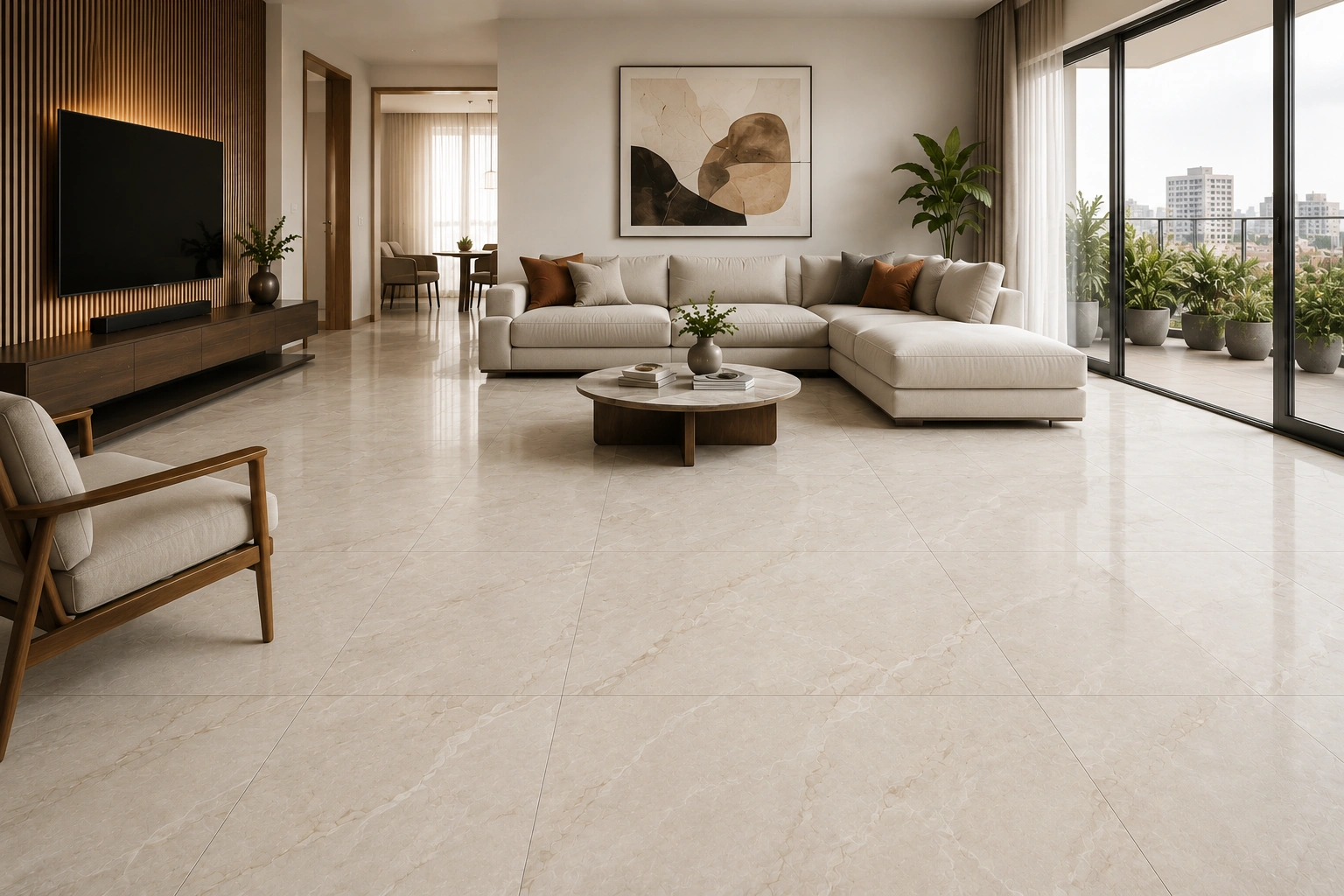
GVT tiles for living room floor applications are the strongest recommendation for most Indian homes. The category has the widest design range (marble, stone, concrete, wood-look), the widest finish range (matte, GHR, glossy, sugar, carving), the widest size range (including the 8x48 plank format), and the practical anti-skid properties in matte or GHR finish that make it safe for daily living room use.
Vitrified floor tiles in the PGVT category work on living room floors in dry conditions where the premium polished appearance and light-reflection properties are the priority. The important qualification: PGVT tiles on a living room floor must be maintained with dry or barely damp mopping. Regular wet mopping creates a slip risk on the polished surface. For families with elderly residents, children, or anyone with mobility concerns, matte GVT is always the safer choice.
Double-charged vitrified works well for the living room floor tiles, where the family wants a polished finish with higher scratch resistance than PGVT. The 2 to 3mm design layer handles daily scuff marks from furniture legs and foot traffic better than the thinner PGVT glaze. The trade-off is a narrower design range (cream, ivory, beige patterns only) compared to the wider print options of GVT and PGVT.
Vitrified Tiles Price for Living Room Floors in India
Vitrified tiles price for living room floors varies across a wide range depending on the category, finish, size, and brand. Here is the current price bracket for each category relevant to living room floors.
| Category | Finish | Common Sizes | Price Range (per sq. ft.) | Notes |
| GVT (matte, stone or marble-look) | Matte, GHR, Sugar | 2x2, 2x4, 8x48 | ₹60 to ₹130 | Most popular living room floor category. Widest design range. Best value at this price. |
| GVT (glossy or high-gloss) | Glossy, High Glossy | 2x2, 2x4 | ₹65 to ₹140 | Brighter than matte. Slippery when wet. Not for families with slip risk. |
| PGVT (polished) | Polished, High Glossy Polished | 2x2, 2x4, 32x64, 6x4 | ₹70 to ₹160 | Premium look. Dry-use only on floors. Shows footprints frequently. |
| Double Charge | Polished, Semi-Gloss | 2x2, 32x32, 2x4 | ₹40 to ₹120 | Higher scratch resistance than PGVT. Limited design range. Good for high-traffic dry living rooms. |
| Full Body (matte) | Matte, GHR | 2x2, 2x4, 32x64 | ₹90 to ₹200 | Edge consistency advantage. Worth specifying when tile edges at room junctions are visible. |
| GVT large format (32x64 and above) | Matte or Glossy | 32x64, 6x4, 8x4 | ₹100 to ₹220 | Premium large-format picks for open-plan rooms above 200 sq. ft. |
All prices are approximate, vary by city, dealer, and order volume, and exclude GST and installation. For a standard 2BHK living room of 150 sq. ft., mid-range GVT matte tiles in 2x4 at ₹80 to ₹100 per sq. ft. would put the tile material cost at approximately ₹12,000 to ₹15,000 before installation.
Six Things to Confirm Before Ordering
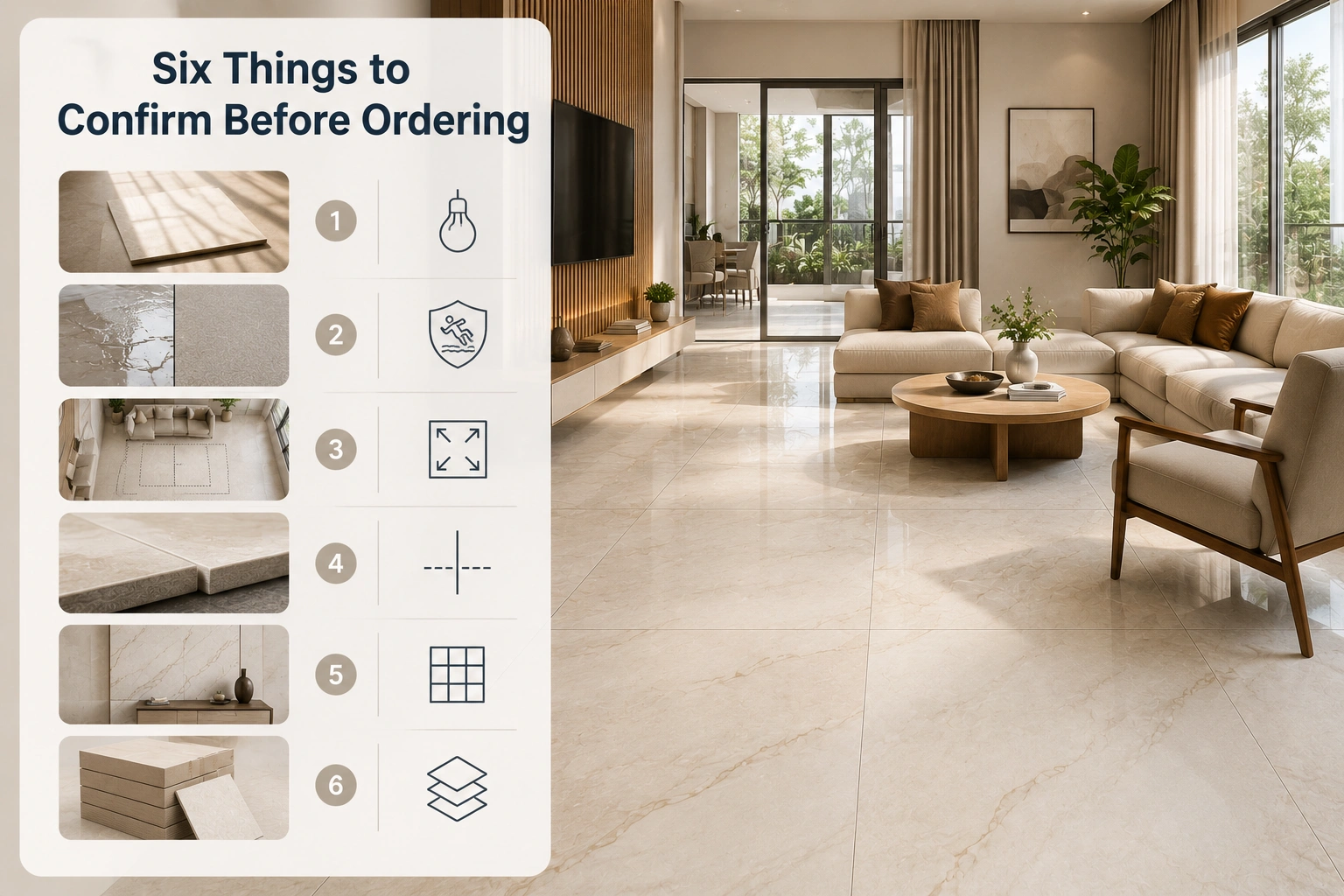
1. Take a sample home and check it in your living room's light at the time you spend most in the room. A tile seen under showroom spotlights looks different under morning daylight from an east-facing window, afternoon sun from the west, and evening warm LED. The tile you live with is the tile you see at those times, not under the showroom's curated lighting.
2. Confirm the finish is slip-safe if the family includes elderly members or young children. Matte and GHR are the safe choices. Glossy, high-gloss, polished, satin matte, and semi-polished are not recommended for living room floors in homes with a slip risk.
3. Check whether the tile is rectified. Rectified tiles allow grout joints as narrow as 1 to 2mm. Non-rectified tiles need wider joints. For large-format tiles in 2x4 and above, where the seamless look is part of the appeal, rectified tiles are the correct specification. Confirm with the dealer before ordering.
4. Match the tile size to your room area using the table above before visiting a showroom. Arriving with a size range in mind prevents the common mistake of falling in love with a 32x64 format in the showroom and ordering it for a 100 sq. ft. living room, where it will need heavy cutting and look out of scale.
5. Decide the feature wall tile before confirming the floor tile. In most Indian living rooms, a feature wall tile (PGVT marble-look or GVT stone-look) is chosen alongside the floor. Choosing the floor tile first and then trying to find a compatible wall tile limits options. Start with the feature wall, then choose a floor tile in the same design family in a different finish.
6. Buy 10 to 12% more tiles than your measured living room area. Living rooms have L-shapes, furniture alcoves, doorway cuts, and skirting details that generate cutting wastage beyond a rectangular area. The extra buffer also protects against future batch colour variation in repairs.
Conclusion
The living room floor is a fifteen-to-twenty-year decision. A tile that looks right in 2026 should still look appropriate in 2036 when the sofa has changed, the curtains are different, and the TV unit has been replaced twice. The picks in this guide lean toward design directions with staying power, not just current trendiness.
Before ordering, take the size guide above and match it to your room area. Take a sample of your shortlisted tile home and check it at the times of day your living room receives its worst light. Confirm the finish against the practical needs of your household.
You can compare vitrified living room floor tiles across GVT, PGVT, and double charge categories by size, finish, design, and price on TilesFinders to shortlist before visiting a showroom.
FAQs
GVT (Glazed Vitrified Tiles) in a matte or GHR finish in 2x4 (600x1200 mm) size with a marble-look or stone-look design is the strongest all-round recommendation for most Indian living room floors in 2026. The matte finish is anti-skid and practical for daily use, the 2x4 format reduces grout lines in rooms above 150 sq. ft., and the marble-look or stone-look design range has the most staying power across interior style changes. For premium open-plan living rooms, PGVT in 2x4 or 32x64 in a polished marble-look finish is the luxury direction, used with awareness that the polished surface needs dry or barely damp mopping.
For most Indian families, matte is the more practical choice for living room floors. Matte tiles are anti-skid, hide dust and smudge marks between cleaning sessions, and do not show footprints. Glossy and polished tiles look more impressive in showroom photographs and reflect light well in living rooms with limited windows, but they show every footprint and smudge in daily use and become slippery when wet from mopping. If the family includes elderly members or young children, matte or GHR finish is the safer and more practical choice. Glossy or polished floors suit adult-occupied contemporary homes where the maintenance routine can be maintained.
The right size depends on the room area. For living rooms below 100 sq. ft., 2x2 (600x600 mm) is proportionate. For 100 to 150 sq. ft., both 2x2 and 2x4 (600x1200 mm) work, with 2x4 giving fewer grout lines. For living rooms above 150 sq. ft., 2x4 or 32x64 (800x1600 mm) reads better. For very large open-plan spaces above 250 sq. ft., 6x4 (1200x1800 mm) or 8x4 (1200x2400 mm) slab formats create a near-seamless floor surface. Wood-look plank tiles in 8x48 (200x1200 mm) work in rooms above 100 sq. ft. but can make compact rooms feel narrow because of the long format.
Yes. Marble-look GVT tiles are the most popular living room floor choice in India in 2026. They deliver the visual character of natural marble without the maintenance burden: kumkum, oil, and hard water deposits wipe off a vitrified surface without staining, and no sealing is required. For living room floors, choose marble-look GVT in a matte or Matte Carving finish rather than a polished finish. The matte version of a marble-look tile is anti-skid, practical for daily mopping, and still carries the marble veining print accurately. The polished PGVT version of the same look works best on the living room feature wall rather than the floor.
Yes. Wood-look plank tiles in GVT format (8x48 size in 200x1200 mm) are one of the strongest living room floor trends in Indian homes in 2026. They bring the warmth of timber to the living room without the risk of warping from humidity, termite damage, or the high maintenance of real wood flooring. Mid-tone oak or walnut finishes are the most practical for Indian interiors: they hide dust between cleanings and pair with a wide range of furniture colours. Very dark wood-look tiles (wenge, dark ebony) show dust and require more frequent cleaning, particularly in north Indian cities with higher ambient dust levels.
GVT tiles for living room floors in India cost approximately ₹60 to ₹130 per sq. ft. in standard matte and glossy finishes in 2x2 and 2x4 sizes. PGVT polished tiles run approximately ₹70 to ₹160 per sq. ft. Double charge tiles are approximately ₹40 to ₹120 per sq. ft. Large-format GVT in 32x64 and 6x4 sizes range from ₹100 to ₹220 per sq. ft. All prices are approximate, vary by city, dealer, and brand, and exclude GST and installation. Installation typically adds ₹30 to ₹50 per sq. ft. For a standard 150 sq. ft. living room in mid-range GVT, tile material cost runs approximately ₹12,000 to ₹20,000 before installation.
The 2x4 (600x1200 mm) format works in living rooms from 100 sq. ft. upwards without overscaling the space. Very large formats like 32x64 (800x1600 mm), 6x4 (1200x1800 mm), and slab sizes are not recommended for living rooms below 150 sq. ft. because they require heavy cutting at the room boundaries and visually overpower a compact space. For small living rooms below 100 sq. ft., 2x2 (600x600 mm) is the proportionate choice. Wood-look plank tiles in 8x48 also work in rooms from 100 sq. ft. upwards, but in rooms below 100 sq. ft., the long plank format tends to make the space feel narrower rather than more expansive.
